
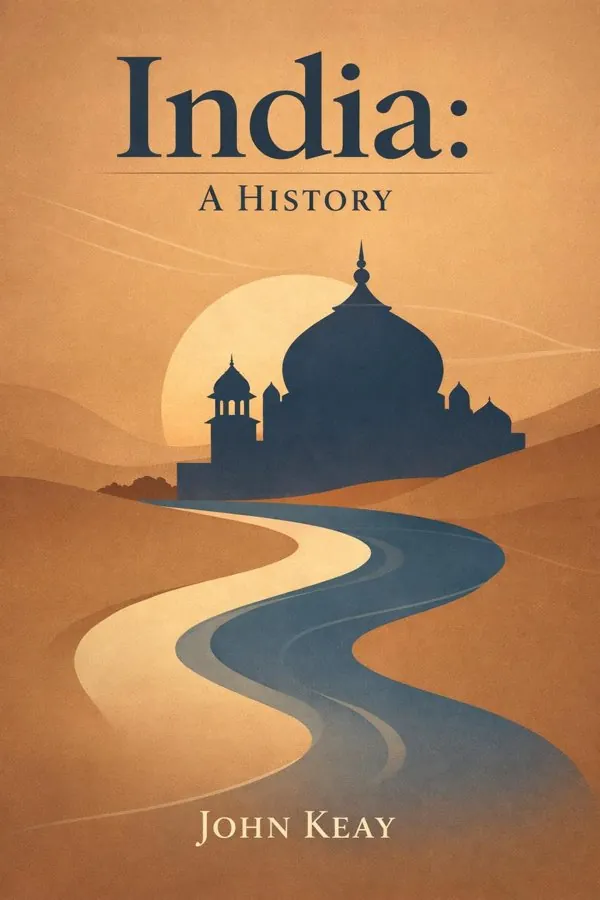
India: A History: Summary & Key Insights
by John Keay
 10 min10 chaptersAudio available
Key Takeaways from India: A History
A powerful way to begin understanding India is to abandon the expectation of a single, neat national story.
The ruins of Harappa and Mohenjo-daro suggest a startling truth: some of South Asia’s oldest known societies were also among its most sophisticated.
Civilizations do not vanish cleanly; they are reworked by those who come after.
Political power in India rarely developed apart from ideas about morality, kingship, and cosmic order.
India’s history did not move only through all-India empires.
What Is India: A History About?
India: A History by John Keay is a world_history book spanning 12 pages. John Keay’s India: A History is an ambitious, wide-ranging account of one of the world’s oldest and most complex civilizations. Spanning roughly five thousand years, the book follows the Indian subcontinent from the urban sophistication of the Indus Valley Civilization to the Vedic age, imperial formations, regional kingdoms, Islamic polities, Mughal grandeur, British domination, anti-colonial struggle, Partition, and the making of modern India. What makes the book especially valuable is that Keay refuses to flatten India into a single story. Instead, he presents it as a dynamic civilizational space shaped by migration, trade, conquest, religion, language, and continuous cultural reinvention. This history matters because India’s past is central not only to South Asia but to world history: it illuminates how religions emerge, empires function, identities form, and societies absorb change without losing continuity. Keay writes with the authority of a seasoned historian and journalist who has spent decades interpreting Asian history for broad audiences. The result is a work that is both scholarly and readable—ideal for anyone seeking an accessible yet intellectually serious guide to India’s long and layered past.
This FizzRead summary covers all 10 key chapters of India: A History in approximately 10 minutes, distilling the most important ideas, arguments, and takeaways from John Keay's work. Also available as an audio summary and Key Quotes Podcast.
India: A History
John Keay’s India: A History is an ambitious, wide-ranging account of one of the world’s oldest and most complex civilizations. Spanning roughly five thousand years, the book follows the Indian subcontinent from the urban sophistication of the Indus Valley Civilization to the Vedic age, imperial formations, regional kingdoms, Islamic polities, Mughal grandeur, British domination, anti-colonial struggle, Partition, and the making of modern India. What makes the book especially valuable is that Keay refuses to flatten India into a single story. Instead, he presents it as a dynamic civilizational space shaped by migration, trade, conquest, religion, language, and continuous cultural reinvention.
This history matters because India’s past is central not only to South Asia but to world history: it illuminates how religions emerge, empires function, identities form, and societies absorb change without losing continuity. Keay writes with the authority of a seasoned historian and journalist who has spent decades interpreting Asian history for broad audiences. The result is a work that is both scholarly and readable—ideal for anyone seeking an accessible yet intellectually serious guide to India’s long and layered past.
Who Should Read India: A History?
This book is perfect for anyone interested in world_history and looking to gain actionable insights in a short read. Whether you're a student, professional, or lifelong learner, the key ideas from India: A History by John Keay will help you think differently.
- ✓Readers who enjoy world_history and want practical takeaways
- ✓Professionals looking to apply new ideas to their work and life
- ✓Anyone who wants the core insights of India: A History in just 10 minutes
Want the full summary?
Get instant access to this book summary and 100K+ more with Fizz Moment.
Get Free SummaryAvailable on App Store • Free to download
Key Chapters
A powerful way to begin understanding India is to abandon the expectation of a single, neat national story. Keay’s central insight is that India has always been plural: geographically expansive, linguistically diverse, politically fragmented, and culturally layered. Rather than emerging in a straight line from one unified civilization, the subcontinent developed through overlapping regions, kingdoms, peoples, and faiths that often coexisted as much as they competed. This makes Indian history less like a march and more like a vast conversation.
Keay shows that the idea of India was never solely political. Long before modern nationalism, there were civilizational linkages through pilgrimage, trade, epics, Sanskritic learning, sacred geography, and shared cosmological concepts. At the same time, local identities remained strong. Tamil, Bengali, Rajput, Deccan, Kashmiri, and Punjabi worlds all contributed distinctive traditions. Even major empires such as the Mauryas, Guptas, Mughals, and British Raj could not erase this diversity; they had to govern through it.
This perspective is useful far beyond historical study. It helps readers make sense of why modern India contains deep internal variety while still sustaining a coherent national framework. It also offers a broader lesson: large civilizations are rarely built by uniformity. They endure by accommodating multiplicity.
A practical application is to approach Indian history regionally as well as nationally. When studying any period, ask not only what happened at the imperial center, but also how different regions experienced it. Actionable takeaway: replace the question “What is the story of India?” with “How did many Indian stories become interconnected over time?”
The ruins of Harappa and Mohenjo-daro suggest a startling truth: some of South Asia’s oldest known societies were also among its most sophisticated. Keay presents the Indus Valley Civilization as the earliest recognizable urban culture in the region, flourishing over four thousand years ago across parts of present-day Pakistan and northwest India. Its planned cities, drainage systems, granaries, craft specialization, and long-distance trade challenge simplistic assumptions that civilization in India began with later religious texts or imperial states.
What makes the Indus world especially fascinating is its combination of complexity and mystery. Its script remains undeciphered, and unlike Egypt or Mesopotamia, it has left no easily readable royal inscriptions or monumental narratives of conquest. As a result, historians reconstruct this civilization from archaeology rather than from written chronicles. Keay emphasizes how this absence of textual certainty forces humility: much about early India must be inferred, not declared.
The Indus Civilization also matters because it established patterns that would echo throughout Indian history: urban-rural interdependence, regional trade, technological adaptation, and a capacity for cultural continuity despite political change. Even its decline appears less like sudden collapse and more like transformation under environmental and economic pressures.
A useful lesson for modern readers is that civilization is not measured only by kings, wars, or famous texts. Infrastructure, trade networks, sanitation, and local organization are equally revealing. In practical terms, when studying ancient societies, pay attention to how ordinary life was structured. Actionable takeaway: use archaeology—not just literature—to understand the foundations of any civilization.
Civilizations do not vanish cleanly; they are reworked by those who come after. In Keay’s account, the centuries following the decline of the Indus world saw the growing importance of Indo-Aryan-speaking groups whose hymns and ritual poetry would be preserved in the Vedas. This Vedic age did not simply replace what came before. Rather, it added a new linguistic, religious, and social layer to the subcontinent’s evolving identity.
The Vedas are important not just because they are ancient texts, but because they shaped social imagination. They preserved cosmologies, sacrificial rituals, lineages, and ideas of social order that later informed Brahmanical traditions. During and after this period, more settled agriculture expanded, chiefdoms evolved into larger polities, and social distinctions hardened into structures that would eventually be described through varna and caste frameworks.
Keay is careful not to treat the Vedic age as a mythic golden beginning. Instead, he situates it within migration, adaptation, and contestation. New rituals, languages, and elites entered landscapes already inhabited by older populations and traditions. This process of synthesis—rather than pure replacement—is crucial to understanding Indian civilization.
This has a practical use for readers today. Many contemporary debates about identity, religion, and social hierarchy in South Asia trace back to interpretations of the Vedic past. To read the period well is to resist both romanticization and oversimplification. Actionable takeaway: whenever ancient texts are invoked in modern arguments, ask how they emerged historically, who preserved them, and how later generations reinterpreted them.
Political power in India rarely developed apart from ideas about morality, kingship, and cosmic order. Keay traces how the rise of kingdoms and empires transformed the subcontinent from a mosaic of clans and regional polities into larger, more organized states. This process is especially visible in the age of the mahajanapadas, the emergence of Magadha, and later the Mauryan Empire, which marked one of the first large-scale attempts to govern much of the subcontinent under a centralized authority.
The Mauryan achievement, especially under Ashoka, reveals how political expansion and ethical universalism could reinforce one another. Ashoka’s inscriptions stand out in Indian history because they speak directly in the voice of a ruler concerned with governance, order, and moral responsibility. Keay shows how Buddhism, Jainism, and broader shramana traditions emerged partly in response to the social and political transformations of the time, offering alternatives to ritual orthodoxy.
Later, the Gupta era is often remembered for cultural flowering in literature, mathematics, art, and religion. Keay presents it less as an untouched golden age and more as a period in which political prestige and cultural patronage created enduring classical forms.
For modern readers, this chapter of history demonstrates that states are never purely administrative machines. They depend on narratives, values, and symbols that legitimize authority. In any society, ask what moral language power uses to justify itself. Actionable takeaway: when examining a historical empire, study its ideals alongside its institutions; both are necessary to understand how it ruled.
India’s history did not move only through all-India empires. One of Keay’s most important correctives is his attention to regional dynasties that shaped the subcontinent more deeply than many centralized states. After imperial phases waned, powers such as the Cholas in the south, the Rajputs in the north and west, the Palas in the east, and Deccan kingdoms built durable political cultures rooted in language, temple networks, agrarian systems, and maritime trade.
This regionalization was not a sign of decline. It was often a period of remarkable creativity. Temple architecture expanded dramatically, vernacular literatures flourished, devotional movements transformed religious practice, and commercial exchange linked India to Southeast Asia, the Indian Ocean, and beyond. The Cholas, for example, were not merely local rulers; they projected military and mercantile power across maritime Asia. Regional courts sponsored art and scholarship that still define classical Indian culture.
Keay’s treatment helps readers see that India’s cohesion often survived through distributed civilizational networks rather than uniform state control. Pilgrimage routes, sacred texts, trade circuits, and ritual institutions connected regions even when politics was fragmented.
This idea applies broadly to how we think about large societies today. National unity does not always require centralized sameness; it can emerge from strong local traditions that remain in dialogue with one another. A practical reading strategy is to study regional histories as engines of national history, not as side notes. Actionable takeaway: if you want to understand India, spend as much time on its regions, languages, and local cultures as on its empires.
One of the most misunderstood parts of Indian history is the arrival and expansion of Islamic power. Keay treats this period with nuance, showing that invasions, conquests, and state formation under Turkic and Afghan dynasties certainly reshaped the subcontinent, but they did not create a civilizational rupture so total that earlier India disappeared. Instead, the Delhi Sultanate and related polities became part of an ongoing process of adaptation, conflict, accommodation, and synthesis.
Military conquest mattered: new ruling elites, administrative methods, cavalry warfare, and political networks tied northern India more tightly to Central and West Asia. Yet the social and cultural story is more complex. Persian became a language of courtly prestige. Sufi traditions spread through local settings. Architectural forms evolved through encounters between Islamic and Indic styles. Revenue systems were negotiated with existing landed elites. Hindu-majority societies did not vanish; they interacted with new rulers in multiple ways, from resistance to collaboration.
Keay helps readers avoid two distortions: glorifying conquest as seamless progress or portraying it as pure civilizational destruction. Indian history in this period is better understood as reciprocal transformation under unequal conditions.
This is practically important because modern politics often weaponizes medieval history. A careful reading encourages evidence over ideology. When evaluating controversial periods, separate state action from entire communities and distinguish military conquest from long-term social coexistence. Actionable takeaway: approach the Delhi Sultanate and related eras as histories of interaction, not as simplistic stories of either harmony or catastrophe.
The Mughal Empire stands at the center of early modern Indian history because it combined military strength, administrative sophistication, artistic brilliance, and political imagination on an extraordinary scale. Keay presents the Mughals not just as conquerors but as empire builders who created one of the subcontinent’s most influential governing systems. From Babur’s precarious beginnings to Akbar’s expansive statecraft and later imperial splendor under Jahangir, Shah Jahan, and Aurangzeb, the Mughal story reveals both the possibilities and limits of centralized power in India.
Akbar is especially significant in Keay’s account. His reign showed how empire in India required more than battlefield victory; it demanded alliances with regional elites, experiments in religious accommodation, and a revenue structure that could bind a huge agrarian world to the imperial center. Mughal culture flourished through Persianate court life, Indo-Islamic architecture, miniature painting, and patronage of learning. At the same time, the empire depended on constant negotiation with diverse local powers.
Its later strains also matter. Overextension, succession struggles, fiscal pressure, and regional assertion gradually weakened imperial cohesion. This decline did not mean instant collapse, but it opened space for successor states and European intervention.
The broader lesson is that successful governance in a diverse society requires inclusion, administrative flexibility, and symbolic legitimacy. These are timeless principles. When assessing any large political system, ask how it balances center and periphery. Actionable takeaway: study the Mughal Empire as a masterclass in ruling diversity—and a warning about the fragility of power that cannot continually renew its coalitions.
European expansion in India was not merely a story of trade becoming empire; it was also a story of information becoming control. Keay shows how the Portuguese, Dutch, French, and especially British entered Indian politics through commerce, diplomacy, and military opportunism. The East India Company did not conquer a vacuum. It inserted itself into a changing landscape of regional powers after Mughal weakening and gradually converted mercantile influence into territorial rule.
What made British colonialism distinctive was not only military superiority but institutional penetration. The British surveyed land, codified laws, categorized populations, reorganized revenue systems, mapped territory, controlled education, and reshaped the economy around imperial interests. Railways, telegraphs, and bureaucratic structures modernized certain aspects of governance while also deepening extraction and dependence. Keay highlights this duality: colonial rule brought infrastructural and administrative integration, yet these served an unequal regime built on domination.
The British also influenced how India understood itself. Census categories, legal definitions of caste and community, and orientalist scholarship hardened identities that had once been more fluid. In this sense, colonialism was not just external rule; it was also a system of classification that changed social reality.
This insight has modern relevance wherever states gather data and define populations. Categories are never neutral; they shape behavior, rights, and conflict. When examining modern institutions, ask who benefits from classification and standardization. Actionable takeaway: to understand colonialism, look beyond conquest to the quieter tools of rule—maps, records, schools, courts, and statistics.
Anti-colonial nationalism gave India one of the most compelling political movements of the modern age, but Keay reminds readers that liberation came with profound tensions. The freedom struggle was not a single campaign led by a single ideology. It included constitutional reformers, militant revolutionaries, social reformers, religious revivalists, peasants, workers, and mass movements under leaders such as Gandhi and Nehru. Nationalism drew strength from its breadth, yet it also struggled to reconcile competing visions of what India was and who it belonged to.
Gandhi’s importance lies not just in his leadership but in his method. He transformed politics by linking moral discipline, nonviolent resistance, and popular mobilization. Nehru offered a modernist and secular vision of nationhood. Jinnah and the Muslim League increasingly argued that Muslim political interests required separate safeguards, and eventually a separate state. These differences were not sudden; they were shaped by colonial institutions, representative politics, communal tensions, and fears of majoritarian rule.
Partition in 1947 became both culmination and catastrophe: independence arrived, but with mass migration, violence, trauma, and the creation of India and Pakistan. Keay treats this as a foundational rupture whose consequences continue to shape the region.
The practical lesson is sobering. Movements for justice can still produce exclusion if they fail to accommodate plural identities. In any coalition, unity must be built deliberately, not assumed. Actionable takeaway: when studying nationalist movements, examine not only how they oppose power, but also how they handle internal difference.
The most remarkable fact about independent India may be that such a vast, poor, diverse, and recently partitioned country chose—and sustained—democracy. Keay’s account of post-independence India emphasizes both achievement and strain. The new republic inherited trauma, princely states, linguistic complexity, social inequality, communal tension, and developmental urgency. Yet through a constitution, elections, institutions, and repeated political adaptation, India constructed a durable democratic framework.
This did not mean smooth progress. The Nehruvian state pursued planning, secularism, and nonalignment, but it also confronted wars, food shortages, and bureaucratic overreach. Linguistic reorganization acknowledged regional identities while preserving national unity. Later decades brought the Emergency, the rise of caste-based politics, economic liberalization, Hindu nationalism, coalition governments, and new forms of social mobility and conflict. Keay’s larger point is that modern India cannot be understood as the end of history. It remains an unfinished experiment in managing civilizational scale within a democratic order.
What makes this especially relevant today is that India’s modern dilemmas—development versus equality, secularism versus religious majoritarianism, central power versus federal diversity, growth versus justice—are global dilemmas in concentrated form.
Readers can apply this by treating democracy not as a settled achievement but as an ongoing practice of negotiation. Institutions matter, but so do habits of coexistence. Actionable takeaway: see modern India as proof that diversity is governable, but only when political systems keep renewing their commitment to inclusion, representation, and constitutional balance.
All Chapters in India: A History
About the Author
John Keay is a British historian, journalist, and author widely known for his engaging works on Asian history, empire, and exploration. Educated at Magdalen College, Oxford, he first developed a strong interest in South Asia through travel and reporting, and he later built a distinguished career writing for both general and specialist audiences. Keay is especially admired for turning large, complex historical subjects into clear and compelling narratives without sacrificing nuance. His books cover India, China, the East India Company, the Himalayas, and the wider history of Asia’s encounters with Europe. In India: A History, his strengths are fully evident: wide learning, balanced judgment, and an ability to connect political events with cultural and civilizational change. He remains one of the most respected popular historians of Asia writing in English.
Get This Summary in Your Preferred Format
Read or listen to the India: A History summary by John Keay anytime, anywhere. FizzRead offers multiple formats so you can learn on your terms — all free.
Available formats: App · Audio · PDF · EPUB — All included free with FizzRead
Download India: A History PDF and EPUB Summary
Key Quotes from India: A History
“A powerful way to begin understanding India is to abandon the expectation of a single, neat national story.”
“The ruins of Harappa and Mohenjo-daro suggest a startling truth: some of South Asia’s oldest known societies were also among its most sophisticated.”
“Civilizations do not vanish cleanly; they are reworked by those who come after.”
“Political power in India rarely developed apart from ideas about morality, kingship, and cosmic order.”
“India’s history did not move only through all-India empires.”
Frequently Asked Questions about India: A History
India: A History by John Keay is a world_history book that explores key ideas across 10 chapters. John Keay’s India: A History is an ambitious, wide-ranging account of one of the world’s oldest and most complex civilizations. Spanning roughly five thousand years, the book follows the Indian subcontinent from the urban sophistication of the Indus Valley Civilization to the Vedic age, imperial formations, regional kingdoms, Islamic polities, Mughal grandeur, British domination, anti-colonial struggle, Partition, and the making of modern India. What makes the book especially valuable is that Keay refuses to flatten India into a single story. Instead, he presents it as a dynamic civilizational space shaped by migration, trade, conquest, religion, language, and continuous cultural reinvention. This history matters because India’s past is central not only to South Asia but to world history: it illuminates how religions emerge, empires function, identities form, and societies absorb change without losing continuity. Keay writes with the authority of a seasoned historian and journalist who has spent decades interpreting Asian history for broad audiences. The result is a work that is both scholarly and readable—ideal for anyone seeking an accessible yet intellectually serious guide to India’s long and layered past.
You Might Also Like
The Age of Capital
Eric Hobsbawm
10 min
The Gulag Archipelago
Aleksandr Solzhenitsyn
10 min
Jerusalem: The Biography
Simon Sebag Montefiore
10 min
The Anglo-Saxons
James Campbell
10 min
The Boer War
Thomas Pakenham
10 min
The Industrial Revolutionaries: The Making of the Modern World 1776–1914
Gavin Weightman
10 minBrowse by Category
Ready to read India: A History?
Get the full summary and 100K+ more books with Fizz Moment.