
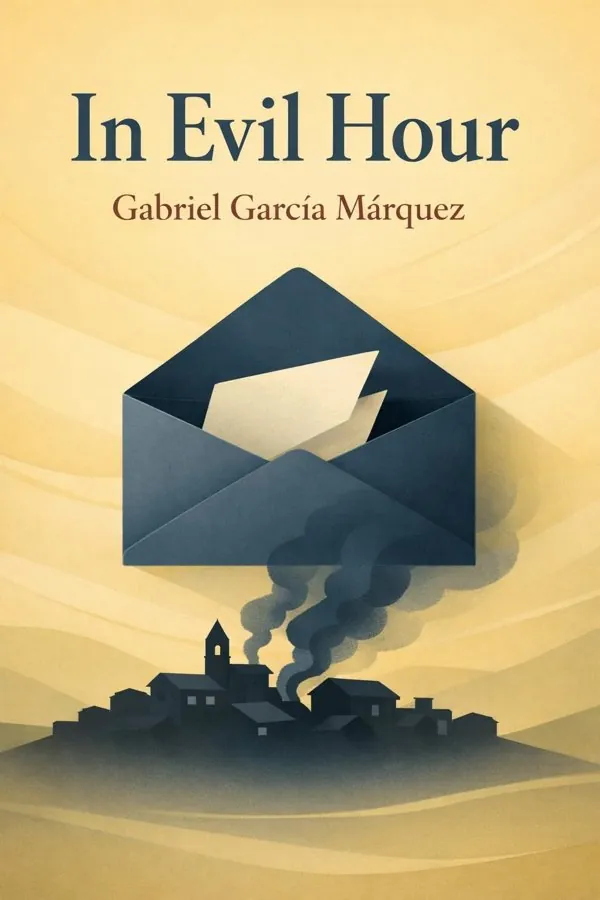
In Evil Hour: Summary & Key Insights
 10 min8 chaptersAudio available
Key Takeaways from In Evil Hour
One of the novel’s most unsettling insights is that social peace can be little more than exhausted silence.
A society begins to rot when language stops revealing reality and starts manufacturing danger.
Authoritarianism rarely announces itself with grand speeches at first; it grows through everyday moral concessions.
The novel reveals a painful truth: humiliation often seeks an audience, and once exposed, it can turn deadly.
Moral authority fails when it becomes ceremonial instead of courageous.
What Is In Evil Hour About?
In Evil Hour by Gabriel García Márquez is a classics book spanning 7 pages. In Evil Hour is Gabriel García Márquez’s piercing portrait of a town that appears to have survived war but has not escaped its consequences. Set in a small Colombian community during the uneasy aftermath of civil conflict, the novel begins with a series of anonymous pamphlets posted at night, each exposing hidden affairs, betrayals, debts, and private shames. What starts as gossip quickly becomes a civic disease. Suspicion spreads, old resentments return, and the town’s fragile peace collapses into fear, revenge, and repression. Beneath its seemingly simple plot, the novel examines how violence lingers long after battles end, shaping institutions, relationships, and even the way people speak to one another. García Márquez, drawing on Colombia’s history of political turmoil and his own gifts as both journalist and novelist, turns this local disturbance into a profound study of power, moral decay, and collective guilt. Though less fantastical than some of his later works, In Evil Hour is a vital classic because it shows, with remarkable clarity, how communities unravel when truth becomes weaponized and authority loses its conscience.
This FizzRead summary covers all 8 key chapters of In Evil Hour in approximately 10 minutes, distilling the most important ideas, arguments, and takeaways from Gabriel García Márquez's work. Also available as an audio summary and Key Quotes Podcast.
In Evil Hour
In Evil Hour is Gabriel García Márquez’s piercing portrait of a town that appears to have survived war but has not escaped its consequences. Set in a small Colombian community during the uneasy aftermath of civil conflict, the novel begins with a series of anonymous pamphlets posted at night, each exposing hidden affairs, betrayals, debts, and private shames. What starts as gossip quickly becomes a civic disease. Suspicion spreads, old resentments return, and the town’s fragile peace collapses into fear, revenge, and repression. Beneath its seemingly simple plot, the novel examines how violence lingers long after battles end, shaping institutions, relationships, and even the way people speak to one another. García Márquez, drawing on Colombia’s history of political turmoil and his own gifts as both journalist and novelist, turns this local disturbance into a profound study of power, moral decay, and collective guilt. Though less fantastical than some of his later works, In Evil Hour is a vital classic because it shows, with remarkable clarity, how communities unravel when truth becomes weaponized and authority loses its conscience.
Who Should Read In Evil Hour?
This book is perfect for anyone interested in classics and looking to gain actionable insights in a short read. Whether you're a student, professional, or lifelong learner, the key ideas from In Evil Hour by Gabriel García Márquez will help you think differently.
- ✓Readers who enjoy classics and want practical takeaways
- ✓Professionals looking to apply new ideas to their work and life
- ✓Anyone who wants the core insights of In Evil Hour in just 10 minutes
Want the full summary?
Get instant access to this book summary and 100K+ more with Fizz Moment.
Get Free SummaryAvailable on App Store • Free to download
Key Chapters
A society begins to rot when language stops revealing reality and starts manufacturing danger. The anonymous pamphlets in In Evil Hour are powerful not because they invent evil from nothing, but because they weaponize what people half-know, suspect, or wish to believe. They expose adulteries, humiliations, and hidden scandals, circulating private truths in public form. Once that boundary collapses, no one feels safe.
García Márquez shows that rumor is not trivial. It is social force. A whispered accusation can alter reputations, marriages, political alliances, and the willingness of neighbors to trust one another. The pamphlets spread because they feed on a community already primed for suspicion. People read them not only to learn but to confirm their anxieties and enjoy the fall of others. That is why the novel’s atmosphere changes so quickly. Words are no longer part of conversation; they become instruments of injury.
This idea feels especially modern. Anonymous messages, leaked screenshots, online pile-ons, and unverified claims can destabilize communities just as effectively now as pamphlets did in the novel. The mechanism is the same: partial truth mixed with secrecy, amplified by collective appetite. The damage is also similar: fear, polarization, humiliation, and retaliation.
The deeper lesson is that information is never neutral when trust is weak. In a healthy community, truth can lead to accountability. In a broken one, exposure often becomes spectacle. That is why the town does not move toward honesty after the pamphlets appear; it moves toward paranoia.
The actionable takeaway is to treat circulating accusations with discipline. Before repeating, sharing, or reacting, ask who benefits, what is verified, and whether the impulse is justice or merely revenge. Protecting the integrity of language is one way of protecting the integrity of communal life.
Authoritarianism rarely announces itself with grand speeches at first; it grows through everyday moral concessions. The mayor in In Evil Hour is not simply a villain imposed from outside the town. He represents a style of rule that becomes possible when fear is allowed to justify increasingly harsh decisions. Faced with instability, he does not restore trust through transparency or fairness. Instead, he responds with force, surveillance, and convenient legal fictions.
García Márquez is especially insightful in showing how power presents itself as necessity. The mayor frames his actions as practical measures to preserve order. Yet each step reveals a deeper corruption: institutions no longer serve justice, only control. The law becomes selective. Rights become conditional. Public authority shifts from guardian to threat. This is one of the novel’s central political arguments: when leaders treat citizens as problems to be managed rather than persons to be protected, disorder intensifies rather than subsides.
The novel also suggests that moral compromise happens in layers. Officials who excuse one abuse for the sake of efficiency soon excuse another for the sake of stability. Citizens, tired of uncertainty, may even welcome these measures temporarily. That is how repression gains legitimacy.
In practical terms, this applies well beyond governments. In any organization, a leader who begins by bending rules to “handle a crisis” may create a culture where intimidation replaces accountability. Teams become quieter, but not healthier.
The actionable takeaway is to judge power not by its promises but by its methods. Whenever authority asks for blind trust, secrecy, or exceptions in the name of order, examine what is being normalized. The defense against corruption begins with refusing the idea that injustice is acceptable if it seems efficient.
The novel reveals a painful truth: humiliation often seeks an audience, and once exposed, it can turn deadly. The pamphlets do not merely embarrass people; they strip them of social shelter. In a small town, identity is communal. To have one’s secrets made public is not just to feel ashamed but to lose standing, certainty, and belonging. García Márquez understands that this kind of exposure can provoke irrational, explosive responses.
The murder that follows the circulation of the pamphlets is therefore not an isolated incident. It is the natural consequence of a social environment in which honor, masculinity, resentment, and gossip are tightly fused. A public revelation does not stay in the realm of words. It enters the body, the home, and the street. Violence erupts because the town has no healthy mechanism for absorbing truth, apologizing, forgiving, or seeking justice. It only knows accusation and retaliation.
This dynamic extends far beyond the novel’s setting. Public shaming in schools, workplaces, neighborhoods, and online spaces can produce despair, rage, and reckless action. When people feel cornered, they do not always seek resolution; they often seek someone to punish. García Márquez’s point is not to excuse violence but to show the chain reaction between exposure and eruption in a culture already saturated with tension.
A practical lesson emerges here: if communities want honesty, they must build forms of accountability that do not depend on spectacle. Criticism without dignity often generates denial or revenge rather than change.
The actionable takeaway is to take public humiliation seriously as a social risk. When conflict arises, favor direct conversation, due process, and restorative paths over exposure for its own sake. Truth matters, but the way it is delivered can determine whether it heals or destroys.
Moral authority fails when it becomes ceremonial instead of courageous. In In Evil Hour, the priest stands within a tradition meant to offer ethical guidance, consolation, and communal coherence. Yet as tensions rise, religion proves unable to restore trust or confront corruption effectively. The church remains present, but its influence is weakened by caution, habit, and its own compromised relationship to power.
García Márquez does not merely criticize an individual priest. He exposes a broader institutional weakness: when spiritual leadership is more concerned with preserving decorum than naming injustice, it loses its power to guide. Ritual continues, but moral clarity fades. The people still attend mass, still inhabit a world shaped by religious symbols, yet those forms cannot stop the town’s descent. The sacred language of forgiveness, sin, and truth has become disconnected from the community’s actual conduct.
This is one of the novel’s sharpest insights. Institutions that claim moral legitimacy must prove it under pressure. It is easy to preach virtue during ordinary times. The real test comes when fear, political intimidation, and public cruelty demand a response. Silence then becomes its own message.
The idea applies to any institution that positions itself as a guardian of values: schools, media organizations, corporations, universities, and families. A code of ethics means little if it disappears when it becomes inconvenient.
The actionable takeaway is to measure moral leadership by action during crisis. Ask not who speaks most about values, but who is willing to risk comfort in defense of them. If you hold a position of influence, do not rely on role or reputation alone. Translate principle into visible conduct before your authority becomes merely symbolic.
The anonymous writer matters less than the society that makes anonymity so powerful. A central tension in In Evil Hour is the search for whoever is posting the pamphlets, but García Márquez subtly shifts the focus away from a simple culprit. The town longs to identify one guilty person, as if punishing that individual would restore innocence. But the novel suggests that the deeper guilt is collective. The pamphlets thrive because they express what many already know, suspect, or secretly enjoy.
Anonymity in the book is not just concealment; it is a mirror. It reflects the town’s appetite for scandal and its refusal to acknowledge shared responsibility. People condemn the pamphlets while consuming them. They denounce exposure while participating in the culture of surveillance that gives exposure its force. In that sense, the unseen writer is almost an instrument of the community’s own hidden impulses.
This insight remains highly relevant. In digital culture, anonymous posts, comments, and leaks often draw outrage toward the speaker while obscuring the broader ecosystem that rewards outrage, gossip, and cruelty. Blaming one user or one source may be emotionally satisfying, but it does not address the social incentives that make such behavior spread.
The novel invites us to ask harder questions: What kind of environment turns secrets into public entertainment? What habits of attention sustain collective harm? When does a community become complicit not by acting directly, but by reading, forwarding, laughing, or remaining silent?
The actionable takeaway is to resist the comfort of scapegoats. In any culture of rumor or humiliation, examine not only who initiated the harm but who enabled it, amplified it, or benefited from it. Real repair begins when responsibility is shared honestly rather than outsourced to one convenient offender.
Communities do not usually fall apart because of one shocking event; they decay through accumulating failures of trust. By the later stages of In Evil Hour, the town’s descent into chaos feels both sudden and inevitable. The pamphlets have triggered conflict, but the real collapse comes from institutions proving unable or unwilling to contain the damage. Fear reshapes ordinary life. People watch one another more closely, speak more cautiously, and retreat into self-protection.
García Márquez traces this breakdown with remarkable precision. Public and private life begin to contaminate each other. Domestic tensions become political. Official actions intensify personal grievances. The atmosphere thickens with unpredictability. In such conditions, every new event is interpreted through suspicion. That is how chaos functions: not as noise alone, but as the erosion of reliable meaning.
The novel is powerful because it shows that disorder is cumulative. A lie left unchallenged, an abuse excused, a humiliation enjoyed, a fear ignored—each contributes to a wider collapse. This makes the book useful as a lens for understanding failing organizations, polarized societies, or fractured neighborhoods. The question is not simply what went wrong, but what warning signs were normalized early on.
One practical application is to recognize that healthy communities require maintenance, not just management. Trust must be replenished through fairness, communication, and shared norms. Once people assume bad faith as the default, even well-intentioned actions are misread.
The actionable takeaway is to treat small breakdowns seriously. Repair misunderstandings early, confront unfairness quickly, and strengthen channels of honest dialogue before suspicion becomes the organizing principle of collective life. By the time chaos is visible, the deeper damage has often been underway for a long time.
One of the novel’s most enduring messages is that war does not end when gunfire stops; it lingers in habits, institutions, and imaginations. In Evil Hour is set after overt civil conflict, yet nearly every page bears the mark of violence’s afterlife. The town is full of people attempting normality, but they do so in a climate shaped by intimidation, unresolved grievance, and the memory of arbitrary power.
García Márquez understands violence as cultural, not merely military. It persists in how authority behaves, how people interpret threat, and how quickly fear can reactivate old divisions. The town has inherited a nervous system trained by conflict. That is why a series of pamphlets can destabilize it so completely. The social body is already primed for injury.
This insight helps explain many real-world situations in which formal peace agreements or political transitions fail to produce genuine reconciliation. Trauma does not vanish because policy changes. Communities carry forward learned mistrust. Leaders continue to use emergency logic. Citizens continue to expect betrayal.
At a personal level, the same pattern can appear after any sustained period of conflict. A family may leave a turbulent era behind yet still react defensively to minor tensions. A workplace may recover from a hostile leadership period yet retain habits of silence and caution.
The actionable takeaway is to take aftermath seriously. If conflict has shaped a group or relationship, do not assume time alone will heal it. Create deliberate processes for truth-telling, accountability, and rebuilding trust. Peace must be practiced, not merely declared, or the logic of violence will keep governing life long after the war is said to be over.
All Chapters in In Evil Hour
About the Author
Gabriel García Márquez (1927–2014) was a Colombian novelist, journalist, screenwriter, and one of the defining literary voices of the twentieth century. Born in Aracataca, Colombia, he drew deeply on Latin American history, oral storytelling, politics, and memory to create fiction of extraordinary richness and influence. He is best known for masterpieces such as One Hundred Years of Solitude, Love in the Time of Cholera, and Chronicle of a Death Foretold. Although often linked to magical realism, García Márquez also wrote sharply realistic works that examined violence, power, and social decay, as In Evil Hour does. In 1982, he received the Nobel Prize in Literature for a body of work that transformed world literature and helped bring Latin American fiction to a vast international readership.
Get This Summary in Your Preferred Format
Read or listen to the In Evil Hour summary by Gabriel García Márquez anytime, anywhere. FizzRead offers multiple formats so you can learn on your terms — all free.
Available formats: App · Audio · PDF · EPUB — All included free with FizzRead
Download In Evil Hour PDF and EPUB Summary
Key Quotes from In Evil Hour
“One of the novel’s most unsettling insights is that social peace can be little more than exhausted silence.”
“A society begins to rot when language stops revealing reality and starts manufacturing danger.”
“Authoritarianism rarely announces itself with grand speeches at first; it grows through everyday moral concessions.”
“The novel reveals a painful truth: humiliation often seeks an audience, and once exposed, it can turn deadly.”
“Moral authority fails when it becomes ceremonial instead of courageous.”
Frequently Asked Questions about In Evil Hour
In Evil Hour by Gabriel García Márquez is a classics book that explores key ideas across 8 chapters. In Evil Hour is Gabriel García Márquez’s piercing portrait of a town that appears to have survived war but has not escaped its consequences. Set in a small Colombian community during the uneasy aftermath of civil conflict, the novel begins with a series of anonymous pamphlets posted at night, each exposing hidden affairs, betrayals, debts, and private shames. What starts as gossip quickly becomes a civic disease. Suspicion spreads, old resentments return, and the town’s fragile peace collapses into fear, revenge, and repression. Beneath its seemingly simple plot, the novel examines how violence lingers long after battles end, shaping institutions, relationships, and even the way people speak to one another. García Márquez, drawing on Colombia’s history of political turmoil and his own gifts as both journalist and novelist, turns this local disturbance into a profound study of power, moral decay, and collective guilt. Though less fantastical than some of his later works, In Evil Hour is a vital classic because it shows, with remarkable clarity, how communities unravel when truth becomes weaponized and authority loses its conscience.
More by Gabriel García Márquez


You Might Also Like



Browse by Category
Ready to read In Evil Hour?
Get the full summary and 100K+ more books with Fizz Moment.