
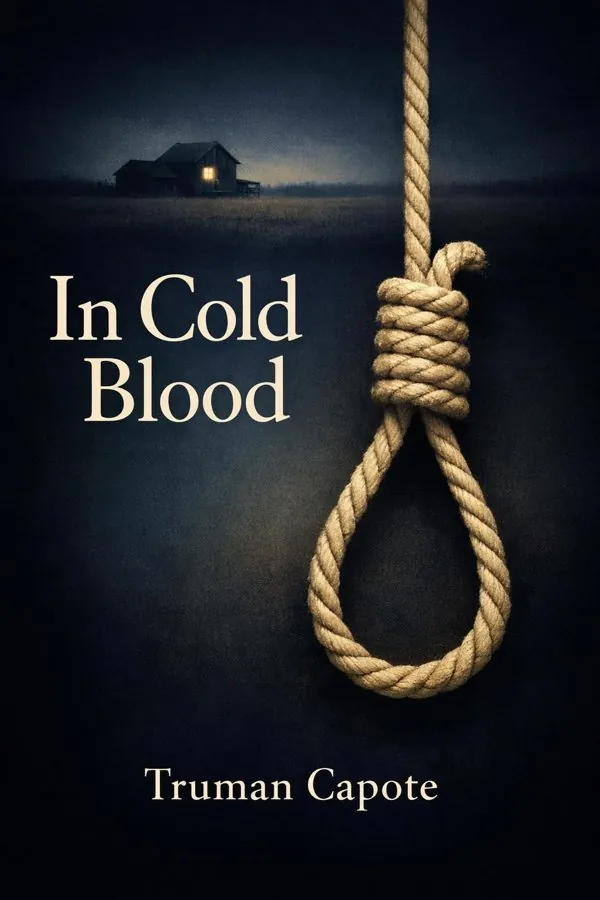
In Cold Blood: Summary & Key Insights
 10 min10 chaptersAudio available
Key Takeaways from In Cold Blood
Peace often feels permanent until a single event exposes how fragile it really is.
The emotional force of a crime story depends on whether the victims are treated as human beings rather than plot devices.
The most disturbing criminals are often not monsters from another world, but damaged and flawed human beings from our own.
Some of the worst crimes begin not with necessity, but with illusion.
An unsolved crime can spread damage far beyond its original victims.
What Is In Cold Blood About?
In Cold Blood by Truman Capote is a law_crime book spanning 9 pages. In Cold Blood is Truman Capote’s groundbreaking nonfiction narrative about the 1959 murder of the Clutter family in Holcomb, Kansas, and the long aftermath that followed. At one level, it is a true-crime account: a prosperous farm family is brutally killed, a stunned town searches for answers, and two drifters become the focus of one of the most famous criminal cases in American history. But Capote’s book reaches far beyond the facts of the crime. It explores fear in a small community, the psychology of violence, the workings of the justice system, and the uneasy line between sympathy and condemnation. What makes the book matter is not only its shocking story, but the way Capote tells it. Through years of reporting, interviews, and meticulous reconstruction, he created a new kind of literary journalism that brought the depth of the novel to real events. Capote’s authority comes from that immersive reporting and from his unmatched ability to render people in all their contradictions. The result is a haunting, influential work that changed both true crime and modern narrative nonfiction.
This FizzRead summary covers all 10 key chapters of In Cold Blood in approximately 10 minutes, distilling the most important ideas, arguments, and takeaways from Truman Capote's work. Also available as an audio summary and Key Quotes Podcast.
In Cold Blood
In Cold Blood is Truman Capote’s groundbreaking nonfiction narrative about the 1959 murder of the Clutter family in Holcomb, Kansas, and the long aftermath that followed. At one level, it is a true-crime account: a prosperous farm family is brutally killed, a stunned town searches for answers, and two drifters become the focus of one of the most famous criminal cases in American history. But Capote’s book reaches far beyond the facts of the crime. It explores fear in a small community, the psychology of violence, the workings of the justice system, and the uneasy line between sympathy and condemnation. What makes the book matter is not only its shocking story, but the way Capote tells it. Through years of reporting, interviews, and meticulous reconstruction, he created a new kind of literary journalism that brought the depth of the novel to real events. Capote’s authority comes from that immersive reporting and from his unmatched ability to render people in all their contradictions. The result is a haunting, influential work that changed both true crime and modern narrative nonfiction.
Who Should Read In Cold Blood?
This book is perfect for anyone interested in law_crime and looking to gain actionable insights in a short read. Whether you're a student, professional, or lifelong learner, the key ideas from In Cold Blood by Truman Capote will help you think differently.
- ✓Readers who enjoy law_crime and want practical takeaways
- ✓Professionals looking to apply new ideas to their work and life
- ✓Anyone who wants the core insights of In Cold Blood in just 10 minutes
Want the full summary?
Get instant access to this book summary and 100K+ more with Fizz Moment.
Get Free SummaryAvailable on App Store • Free to download
Key Chapters
Peace often feels permanent until a single event exposes how fragile it really is. Capote begins In Cold Blood by carefully establishing Holcomb, Kansas, as a place of routine, modest prosperity, and social trust. The town is not glamorous or dramatic; that is precisely the point. Its rhythms are familiar: school activities, church attendance, farm work, polite neighborliness, and the quiet confidence of a community that believes it knows itself. At the center of this order stands the Clutter family, especially Herbert Clutter, who is respected as disciplined, generous, and morally upright. Nancy Clutter is admired by nearly everyone, and the family becomes a symbol of decency and structure.
By building this portrait before the crime occurs, Capote makes the murders feel like a violation not just of four lives, but of an entire worldview. Holcomb is forced to confront an unbearable idea: terrible violence can arrive without warning, without a clear local cause, and without any moral logic that makes it easier to accept. In modern life, this remains deeply relevant. Families, workplaces, and communities often assume safety because routines appear stable. Yet crises, whether violent, financial, or emotional, frequently emerge from outside the patterns we trust.
One practical lesson is the importance of community resilience. Holcomb’s fear spreads because people realize familiarity is not the same as security. Today, neighborhoods, schools, and organizations benefit from discussing emergency preparedness, mental health support, and communication systems before disaster strikes. Stability matters, but resilience matters more. The takeaway: never confuse normalcy with immunity; strong communities prepare for disruption while preserving compassion.
The emotional force of a crime story depends on whether the victims are treated as human beings rather than plot devices. Capote gives the Clutter family individual presence, showing their habits, values, ambitions, and vulnerabilities. Herbert Clutter is organized and principled, almost austere in his self-discipline. Bonnie Clutter struggles privately with depression and physical distress. Nancy is lively, talented, and socially beloved. Kenyon is gentle, mechanically gifted, and reserved. These details matter because they resist abstraction. The family is not merely “murdered people”; they are a web of personalities, relationships, and unfinished futures.
Capote’s method reminds readers that violence destroys far more than bodies. It interrupts plans, roles, identities, and the invisible emotional architecture of everyday life. This insight is crucial in how we consume crime stories today. True crime can easily become sensational when it focuses only on the perpetrators, the clues, or the shocking details. Capote does spend enormous time on the killers, but he first asks the reader to understand what was lost.
In practical terms, this is a lesson in moral attention. Whether reading the news, discussing a public tragedy, or supporting someone affected by loss, we should begin with the dignity of the people harmed. In workplaces and communities, this means avoiding language that reduces people to cases, incidents, or headlines. It also means remembering that every loss echoes through families and institutions in lasting ways.
An actionable takeaway is simple: when confronted with stories of harm, pause to ask who the victims were as full people. That question restores empathy and guards against the numbness that often follows repeated exposure to violence.
The most disturbing criminals are often not monsters from another world, but damaged and flawed human beings from our own. Capote introduces Perry Smith and Richard Hickock not as caricatures of evil, but as men shaped by deprivation, fantasy, resentment, impulse, and moral collapse. Dick appears more outwardly practical and socially manipulative, driven by greed, entitlement, and sexual predation. Perry is more introspective, wounded, and volatile, carrying childhood trauma, physical pain, and a restless fantasy life. Together, they form a destructive partnership in which grievance and opportunity become lethal.
Capote’s great achievement here is his refusal to simplify. He neither excuses their actions nor strips them of humanity. Instead, he shows how violence can emerge from a tangle of personal history, bad choices, social failure, and immediate circumstance. This complexity unsettles readers because it resists the comforting idea that evil is always obvious and easily separated from ordinary human experience.
There is a practical application in how we think about risk, rehabilitation, and personal influence. Harmful behavior rarely appears fully formed. It develops through patterns: resentment left unchecked, substance abuse, repeated dishonesty, thrill-seeking, coercion, and association with people who amplify one’s worst instincts. In schools, families, and correctional systems, early intervention matters. So does careful attention to the company people keep.
The takeaway: learn to recognize destructive patterns before they harden into catastrophe. Compassion for damaged people is important, but compassion must never replace accountability. The goal is to understand causes without confusing understanding with absolution.
Some of the worst crimes begin not with necessity, but with illusion. The murder of the Clutter family is driven by a false belief: that Herb Clutter keeps a large amount of cash in a safe at his home. This rumor, passed through prison talk and criminal imagination, gives Dick and Perry a motive built on fantasy. They travel to Holcomb expecting a profitable robbery and encounter a reality far more ordinary than the one they had pictured. Yet instead of retreating when the premise collapses, they continue into violence.
This is one of the book’s most chilling insights. Catastrophic harm can result when fantasy combines with entitlement and poor impulse control. Dick and Perry are not starving men pushed to the edge by immediate necessity. They are men acting on imagined reward, then escalating when reality frustrates them. In this sense, the murders reveal how dangerous it is when people treat other human beings as obstacles inside their own private story.
Modern parallels are everywhere. Fraud schemes, violent outbursts, reckless business decisions, and abusive relationships often begin with an imagined payoff: easy money, restored status, revenge, or control. When reality does not cooperate, some individuals double down rather than reassess. The inability to abandon a false narrative can be devastating.
A practical lesson is to challenge assumptions early, especially those driven by greed, resentment, or hearsay. In decision-making, whether personal or professional, verify your premises before acting. If a plan requires dehumanizing others or ignoring obvious warning signs, stop. The actionable takeaway: when reality contradicts your fantasy, revise the fantasy, not your conscience.
An unsolved crime can spread damage far beyond its original victims. After the Clutter murders, Holcomb and the surrounding community enter a state of fear and suspicion. Doors are locked where they were once left open. Neighbors reconsider one another. The absence of an immediate suspect creates not only anxiety, but a crisis of trust. Capote shows that violent crime attacks social confidence as much as physical security. People no longer know what kind of world they are living in.
The investigation reflects both the strengths and limits of law enforcement. Investigators must work through rumor, pressure, incomplete evidence, and the public demand for answers. The eventual progress of the case depends not on dramatic genius alone, but on patient reconstruction, coordination across state lines, and the accumulation of small details. This procedural dimension is one reason the book remains important in the law-and-crime category: it reveals how justice is often slow, uncertain, and vulnerable to error or delay.
For modern readers, this section offers lessons about crisis response. In any emergency, whether criminal, organizational, or personal, fear creates a hunger for immediate certainty. But premature conclusions can distort the truth. Good investigation requires patience, documentation, and disciplined skepticism. Communities need transparent communication without reckless speculation.
A useful application is in everyday problem-solving. When something goes seriously wrong at work, at home, or in public life, resist the urge to invent a satisfying explanation too quickly. Gather facts, separate evidence from rumor, and communicate responsibly. The takeaway: fear pushes people toward hasty stories, but justice depends on patient truth-seeking.
Running from consequences does not produce freedom; it produces a thinner and more desperate version of life. As Perry and Dick flee after the murders, Capote follows them through highways, cheap rooms, petty schemes, and strained conversations. On the surface, they remain mobile and uncaught. Underneath, their world narrows. Their movements become repetitive, their confidence unstable, and their partnership increasingly fragile. The fantasy of escape slowly reveals itself as exhaustion, paranoia, and moral emptiness.
This section matters because it dismantles a common illusion in crime narratives: that evasion is glamorous. Capote shows the opposite. The fugitives are not liberated men; they are trapped in a moving prison of fear, dependence, and self-deception. The contrast between the vast American landscape and their inner confinement is especially powerful. They can cross state lines, but they cannot outrun what they have done.
There is a wider lesson here about avoidance behavior. People often imagine that if they postpone a reckoning, change cities, switch jobs, hide debt, or deny wrongdoing, the problem will become manageable. More often, avoidance compounds the damage and shrinks one’s options. Emotional, legal, and financial evasions follow a similar pattern: temporary relief followed by deeper instability.
A practical application is to address serious mistakes early. Seek counsel, admit facts, repair what can be repaired, and stop escalating the original harm. Delay may feel strategic, but it usually increases the eventual cost. The takeaway: escape is not the same as resolution. The sooner we face consequences honestly, the more human choices remain available.
A confession does not simply reveal the truth; it also shapes the story that truth will take. When Perry and Dick are finally captured and questioned, their admissions become central to the legal and moral meaning of the case. Yet Capote makes clear that confessions are not pure, transparent windows into reality. They are filtered through memory, self-justification, rivalry, fear, and the desire to control how one will be seen. Perry and Dick each assign blame differently, minimize certain aspects, and expose others strategically.
This matters because readers often treat confession as the endpoint of uncertainty. In fact, confession is another kind of narrative, one that must be tested against evidence. Capote is deeply attentive to the gap between fact and self-presentation. Both men tell the truth in partial, self-serving ways. Their words reveal the crime, but also their personalities: Dick’s opportunism, Perry’s sensitivity and volatility, each man’s need to preserve a version of himself.
This has practical relevance far beyond criminal law. In personal conflict, workplace disputes, and public scandal, admissions rarely come free of spin. People tell the truth while also protecting ego, status, or leverage. Listening well means hearing both what is said and what is being managed.
An actionable lesson is to pair testimony with verification. Whether evaluating an apology, an explanation, or a confession, ask what the speaker may gain by framing events in a particular way. Respect narrative, but do not surrender judgment to it. The takeaway: truth often arrives in human language, and human language is never neutral.
The legal system can deliver a verdict without resolving the deeper moral unease of a case. The trial of Perry Smith and Dick Hickock leads toward conviction and death sentences, but Capote does not present this as a neat restoration of balance. The Clutters are gone, the town is changed, and the process of punishment raises questions that remain unsettled: What does justice mean when the crime is irreversible? Can legal order answer moral devastation? Does execution demonstrate justice, revenge, deterrence, or institutional power?
Capote’s treatment of the trial is especially strong because he understands that courtroom outcomes are both necessary and incomplete. The law must classify, sentence, and close the case procedurally. But human beings continue to wrestle with pity, anger, disgust, and doubt. Perry, in particular, complicates easy judgment because his damaged history invites sympathy even as his actions demand condemnation. Capote does not resolve that tension; he makes readers live inside it.
This is useful for anyone thinking seriously about law and crime. Justice systems need rules, but citizens need moral maturity. In public debates, people often seek certainty so complete that complexity feels inconvenient. Yet responsible judgment requires holding two truths at once: a person may be deeply shaped by suffering and fully accountable for terrible harm.
A practical takeaway is to resist simplistic moral binaries in difficult cases. Support due process, demand accountability, and still allow yourself to recognize complexity. Doing so does not weaken justice; it strengthens it by making it more honest.
Punishment is not only a sentence; it is also a lived experience of time. In the death row sections of In Cold Blood, Capote turns from the dramatic momentum of crime and capture to the slower psychological terrain of confinement. Waiting becomes its own form of reality. The condemned men inhabit routines, calculations, legal hopes, and emotional fluctuations that stretch punishment into something prolonged and unsettling. The reader is made to confront not only the idea of execution, but the drawn-out human process that precedes it.
This shift is one of the book’s boldest structural choices. Instead of ending with conviction, Capote lingers in suspended time. He shows how institutions process human lives, how appeals delay finality, and how even the guilty remain thinking, feeling beings while the machinery of punishment advances. The effect is not sentimental, but sobering. Death row becomes a space where society’s power is visible in its most intimate form.
There is a broader lesson here about systems and delay. In law, medicine, immigration, employment disputes, and other institutional settings, waiting can become a major part of suffering. Uncertainty changes people. It erodes clarity, intensifies fear, and alters identity. Efficient systems are not merely convenient; they are humane.
A practical application is to notice where unnecessary delay adds hidden harm in your own sphere, whether in management, caregiving, or public service. Clear timelines, honest updates, and procedural fairness matter. The takeaway: institutions shape human dignity not only by what they decide, but by how long and how transparently they make people wait.
How a story is told can be almost as important as what happened. In Cold Blood is famous not only for its subject, but for its form. Capote helped define the nonfiction novel by using scene construction, dialogue, shifting perspective, and novelistic pacing to tell a true story with unusual depth and drama. This stylistic innovation changed journalism, true crime, and literary nonfiction. Readers felt they were not merely receiving information, but entering a fully realized world.
Yet the same achievement raises ethical questions. When a writer shapes reality with the tools of fiction, where is the line between reconstruction and embellishment? How much interpretive power should an author wield over real suffering? Capote’s closeness to the case, especially to Perry Smith, has long prompted debate about empathy, influence, and artistic ambition. These tensions do not diminish the book’s greatness; they are part of what makes it enduringly important.
For readers and creators today, the lesson is clear: compelling storytelling carries responsibility. Podcasters, journalists, documentary makers, and social media commentators all face the same challenge. It is possible to humanize subjects without exploiting them, and to create tension without distorting fact. But doing so requires humility, sourcing, transparency, and ethical self-awareness.
The actionable takeaway is to consume and create true stories critically. Ask not only whether a story is moving, but how it was built, whose perspective it privileges, and what moral cost its dramatic power may conceal.
All Chapters in In Cold Blood
About the Author
Truman Capote was an American writer born in New Orleans in 1924 and raised partly in the South, an experience that shaped his ear for voice, atmosphere, and social nuance. He gained early acclaim for his fiction, including Other Voices, Other Rooms and Breakfast at Tiffany’s, and became known for his elegant prose and sharp public persona. His most influential work, In Cold Blood, emerged from years of research into the 1959 Clutter family murders in Kansas and helped establish the nonfiction novel as a major literary form. Capote combined journalistic inquiry with the narrative sophistication of fiction, influencing generations of writers, reporters, and true-crime authors. He died in 1984, but his work remains central to American literary and cultural history.
Get This Summary in Your Preferred Format
Read or listen to the In Cold Blood summary by Truman Capote anytime, anywhere. FizzRead offers multiple formats so you can learn on your terms — all free.
Available formats: App · Audio · PDF · EPUB — All included free with FizzRead
Download In Cold Blood PDF and EPUB Summary
Key Quotes from In Cold Blood
“Peace often feels permanent until a single event exposes how fragile it really is.”
“The emotional force of a crime story depends on whether the victims are treated as human beings rather than plot devices.”
“The most disturbing criminals are often not monsters from another world, but damaged and flawed human beings from our own.”
“Some of the worst crimes begin not with necessity, but with illusion.”
“An unsolved crime can spread damage far beyond its original victims.”
Frequently Asked Questions about In Cold Blood
In Cold Blood by Truman Capote is a law_crime book that explores key ideas across 10 chapters. In Cold Blood is Truman Capote’s groundbreaking nonfiction narrative about the 1959 murder of the Clutter family in Holcomb, Kansas, and the long aftermath that followed. At one level, it is a true-crime account: a prosperous farm family is brutally killed, a stunned town searches for answers, and two drifters become the focus of one of the most famous criminal cases in American history. But Capote’s book reaches far beyond the facts of the crime. It explores fear in a small community, the psychology of violence, the workings of the justice system, and the uneasy line between sympathy and condemnation. What makes the book matter is not only its shocking story, but the way Capote tells it. Through years of reporting, interviews, and meticulous reconstruction, he created a new kind of literary journalism that brought the depth of the novel to real events. Capote’s authority comes from that immersive reporting and from his unmatched ability to render people in all their contradictions. The result is a haunting, influential work that changed both true crime and modern narrative nonfiction.
You Might Also Like
Abortion and the Law in America: Roe v. Wade to the Present
Mary Ziegler
10 min
Black Edge: Inside Information, Dirty Money, and the Quest to Bring Down the Most Wanted Man on Wall Street
Sheelah Kolhatkar
10 min
Blood Feud: The Man Who Blew the Whistle on One of the Deadliest Prescription Drugs Ever
Kathleen Sharp
10 min
Catch and Kill: Lies, Spies, and a Conspiracy to Protect Predators
Ronan Farrow
10 min
Chaos: Charles Manson, the CIA, and the Secret History of the Sixties
Tom O'Neill with Dan Piepenbring
10 min
Code and Other Laws of Cyberspace
Lawrence Lessig
10 minBrowse by Category
Ready to read In Cold Blood?
Get the full summary and 100K+ more books with Fizz Moment.