
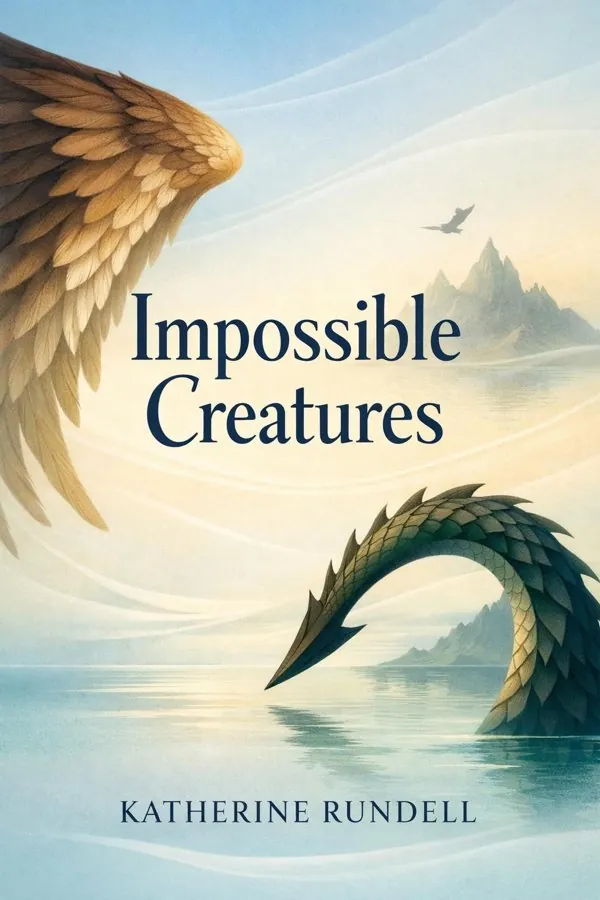
Impossible Creatures: Summary & Key Insights
 10 min8 chaptersAudio available
Key Takeaways from Impossible Creatures
The most transformative adventures begin when ordinary certainty cracks.
No meaningful journey is undertaken alone; it depends on who we decide to trust when the stakes are unclear.
A fantasy world becomes memorable when its wonders are tied to consequences.
Inheritance is not only what we receive; it is what we are asked to defend.
Some truths are hidden for protection, but secrecy always comes at a cost.
What Is Impossible Creatures About?
Impossible Creatures by Katherine Rundell is a scifi_fantasy book spanning 4 pages. What if the old stories were not stories at all, but field guides to a hidden reality? In Impossible Creatures, Katherine Rundell opens a secret door between the ordinary modern world and an archipelago where mythical beings still survive: griffins, dragons, sphinxes, unicorns, and creatures so strange they seem borrowed from dreams. At the center of the novel are Christopher, a seemingly ordinary boy, and Mal, a fierce girl carrying dangerous knowledge. Their meeting launches a high-stakes quest across islands filled with beauty, peril, and moral complexity. This is more than a fantasy adventure. Rundell uses wonder to ask serious questions about extinction, stewardship, courage, inheritance, and the cost of indifference. The creatures are not decorative fantasy elements; they embody fragility, mystery, and the parts of the world humans often exploit before they understand them. Rundell is especially qualified to tell this kind of story. Known for acclaimed novels such as Rooftoppers and The Explorer, she combines lyrical prose, deep historical and natural curiosity, and a gift for writing children as morally serious people. Impossible Creatures is both a thrilling journey and a passionate defense of imagination, responsibility, and the living world.
This FizzRead summary covers all 8 key chapters of Impossible Creatures in approximately 10 minutes, distilling the most important ideas, arguments, and takeaways from Katherine Rundell's work. Also available as an audio summary and Key Quotes Podcast.
Impossible Creatures
What if the old stories were not stories at all, but field guides to a hidden reality? In Impossible Creatures, Katherine Rundell opens a secret door between the ordinary modern world and an archipelago where mythical beings still survive: griffins, dragons, sphinxes, unicorns, and creatures so strange they seem borrowed from dreams. At the center of the novel are Christopher, a seemingly ordinary boy, and Mal, a fierce girl carrying dangerous knowledge. Their meeting launches a high-stakes quest across islands filled with beauty, peril, and moral complexity.
This is more than a fantasy adventure. Rundell uses wonder to ask serious questions about extinction, stewardship, courage, inheritance, and the cost of indifference. The creatures are not decorative fantasy elements; they embody fragility, mystery, and the parts of the world humans often exploit before they understand them. Rundell is especially qualified to tell this kind of story. Known for acclaimed novels such as Rooftoppers and The Explorer, she combines lyrical prose, deep historical and natural curiosity, and a gift for writing children as morally serious people. Impossible Creatures is both a thrilling journey and a passionate defense of imagination, responsibility, and the living world.
Who Should Read Impossible Creatures?
This book is perfect for anyone interested in scifi_fantasy and looking to gain actionable insights in a short read. Whether you're a student, professional, or lifelong learner, the key ideas from Impossible Creatures by Katherine Rundell will help you think differently.
- ✓Readers who enjoy scifi_fantasy and want practical takeaways
- ✓Professionals looking to apply new ideas to their work and life
- ✓Anyone who wants the core insights of Impossible Creatures in just 10 minutes
Want the full summary?
Get instant access to this book summary and 100K+ more with Fizz Moment.
Get Free SummaryAvailable on App Store • Free to download
Key Chapters
No meaningful journey is undertaken alone; it depends on who we decide to trust when the stakes are unclear. Christopher’s encounter with Mal propels the novel from discovery into motion. Mal is not a simple guide figure who explains the magical world to a newcomer. She is wounded, secretive, capable, and under pressure. That complexity makes the relationship compelling. Christopher must decide whether to believe someone he barely knows, while Mal must risk relying on someone who has not yet proven himself.
Their partnership reveals one of the book’s core truths: trust is not blind faith but a courageous choice made under conditions of uncertainty. Rundell avoids making friendship sentimental. Instead, she shows it being built through action. Shared danger, hard decisions, and moments of sacrifice slowly turn two wary children into allies. This feels emotionally authentic because real trust often emerges the same way. We do not grant it because someone is perfect; we grant it because they keep showing up.
This theme has practical resonance. In school, work, and family life, people often wait for total certainty before collaborating. Yet many of life’s most important relationships begin when certainty is impossible. A new teammate, a friend in crisis, or a neighbor asking for help may require us to move before we have complete information.
Mal also expands Christopher’s moral world. Through her, he sees that survival can make people abrupt, defensive, or difficult. Compassion means recognizing fear beneath sharp edges. Trust, then, becomes not naïveté but disciplined empathy.
Actionable takeaway: When you meet someone guarded or difficult, ask what burden they might be carrying. Build trust through small acts of reliability rather than demanding immediate openness from others.
A fantasy world becomes memorable when its wonders are tied to consequences. The archipelago in Impossible Creatures is not merely a parade of astonishing beasts. It operates as a living ecosystem in which every island, species, and secret is connected. Rundell gives the world texture and internal logic, making the creatures feel less like symbolic ornaments and more like beings with habitats, vulnerabilities, instincts, and histories.
This matters because the novel asks readers to see enchantment and ecology as inseparable. A griffin is breathtaking, but it is also a creature that can be hunted, displaced, misunderstood, or driven toward extinction. The magic of the world does not exempt it from scarcity; if anything, rarity makes it more precarious. That is a powerful reframing of fantasy. Instead of treating wonder as endless and self-renewing, Rundell presents it as something that can be lost.
Readers can apply this insight to the real world. Beautiful things often seem indestructible until suddenly they are gone: wetlands replaced by roads, languages no longer spoken, neighborhood species that disappear quietly over a decade. By making invented creatures feel ecologically real, the novel trains attention. It asks us to think in systems rather than isolated spectacles.
The archipelago also demonstrates that protection requires knowledge. To care for a world, one must understand how its parts fit together. That principle applies to classrooms, communities, and workplaces as much as habitats. When you understand the system, you make better decisions about what to preserve and how to intervene.
Actionable takeaway: Choose one real ecosystem, local park, or endangered species and learn how it actually functions. Wonder deepens when it is paired with knowledge, and protection begins with informed attention.
Inheritance is not only what we receive; it is what we are asked to defend. As the plot deepens, Christopher and Mal learn that the danger facing the archipelago is larger than a single chase or villainous scheme. The world of impossible creatures is under systemic threat, and the children’s lives are entangled with older histories, forgotten promises, and family legacies. Rundell uses these revelations to widen the story from personal adventure into civilizational crisis.
Legacy in this novel works on two levels. First, there is biological or familial inheritance: names, bloodlines, old loyalties, and hidden pasts shape who the characters are and why they matter. Second, there is moral inheritance: the living receive a world they did not build, complete with its injuries, protections, and unfinished responsibilities. Christopher and Mal do not choose the past, but they must decide what to do with it.
That dilemma is deeply relevant beyond fiction. Every generation inherits damaged systems, whether environmental decline, social prejudice, or broken institutions. We may not be guilty of creating them, but we are still implicated in what happens next. Rundell refuses the fantasy that children can remain untouched by history. Instead, she shows young people rising to meet it.
The novel also suggests that legacy is not destiny. Knowing where you come from matters, but it does not imprison you. The value of inherited power or knowledge depends on how you use it. Readers can take from this a liberating lesson: your background explains some of your burdens and gifts, but your choices determine your character.
Actionable takeaway: Reflect on one inheritance in your own life, whether family, culture, privilege, or pain. Ask not only what it has given you, but what responsibility it places in your hands.
Some truths are hidden for protection, but secrecy always comes at a cost. One of the novel’s sharpest tensions lies in the question of whether the hidden world should remain concealed from ordinary humans or be revealed to secure its survival. This is not a simple puzzle with one obviously righteous answer. Secrecy can preserve fragile things from exploitation, yet it can also isolate them, limit aid, and concentrate power in too few hands.
Rundell uses this conflict to elevate the story beyond chase-and-rescue plotting. The characters must weigh competing goods: safety versus openness, trust versus control, immediate survival versus long-term justice. The result is a richer moral landscape. The reader is invited to see that protecting the vulnerable sometimes involves compromise, uncertainty, and uncomfortable trade-offs.
This theme has practical uses in everyday life. Families keep secrets to protect children; institutions conceal information to avoid panic; marginalized communities guard knowledge to prevent appropriation. In each case, the question is the same: when does protection become exclusion, and when does disclosure become danger? Impossible Creatures does not offer a simplistic formula, but it does model careful ethical thinking.
Christopher’s growth is especially visible here. He begins as a newcomer dazzled by marvels, but he matures into someone capable of asking what stewardship actually requires. Mal, meanwhile, embodies the emotional burden of secrecy. Keeping the truth can preserve life, but it can also create loneliness and mistrust.
Actionable takeaway: When deciding whether to share or withhold important information, ask three questions: who is being protected, who is being harmed, and who gets to make the choice. Ethical secrecy demands accountability, not just good intentions.
Bravery is often misunderstood as fearlessness, but stories worth remembering know better. In Impossible Creatures, courage is not a personality trait possessed by only the boldest characters. It is a repeated decision to move toward danger, grief, or uncertainty because something more important is at stake. Christopher is not introduced as a natural hero. Mal, for all her toughness, is not untouched by fear. Their courage matters precisely because it coexists with vulnerability.
Rundell’s treatment of bravery is valuable for younger and older readers alike. It makes heroism attainable. Many people assume they are not brave because they feel anxious, unprepared, or overwhelmed. The novel argues the opposite: fear is often evidence that the stakes are real. The question is not whether fear appears, but what values govern your actions once it does.
Examples from daily life make this especially practical. Speaking up for a classmate who is being targeted, reporting wrongdoing at work, setting a boundary in a difficult relationship, or admitting a painful truth all require courage of the same structure. The battlefield changes, but the inner mechanics remain similar: fear, decision, action.
The book also shows that courage is contagious. One character’s act of resolve can create the conditions for others to act. This matters in communities and teams. People become braver when they witness integrity in motion. Christopher and Mal repeatedly give each other this kind of momentum.
Actionable takeaway: Redefine courage in your own life as “acting in service of what matters despite fear.” The next time you feel afraid, identify the value at stake and take one concrete step aligned with it.
Awe deepens when it is accompanied by understanding. One of Rundell’s greatest strengths is that she does not treat wonder as shallow spectacle. The creatures in the novel inspire amazement, but the story also asks how they live, what they need, what threatens them, and how humans relate to them. This combination gives the book unusual power. It invites readers to marvel, but it refuses to let marveling be enough.
That distinction matters because modern culture often turns beauty into consumption. We take photos of extraordinary places without learning their histories. We admire animals without considering their habitats. We praise creativity without supporting the conditions that make it possible. Impossible Creatures pushes against this pattern. To encounter something magnificent ethically, one must move from delight to understanding and from understanding to care.
This is a useful principle in learning and leadership. A teacher who awakens wonder in students should also guide them toward depth. A manager excited by innovation should understand the human systems required to sustain it. A traveler inspired by a place should ask what communities and ecologies make that beauty possible.
Christopher’s education throughout the novel models this progression. At first he is astonished by the hidden world; later he begins to comprehend its fragility and structure. That change marks his maturation. He becomes not just a witness to wonder but a participant in its preservation.
Actionable takeaway: The next time something fascinates you, resist stopping at admiration. Learn one layer deeper: its history, ecosystem, craft, or context. Wonder that grows roots becomes commitment.
One reason fantasy for younger readers endures is that it often tells the truth adults try to soften: children are already living in the moral world. Impossible Creatures treats its young protagonists with unusual seriousness. Christopher and Mal are not decorative children standing near a grand adult conflict. They are central decision-makers whose choices alter outcomes. Rundell respects young readers by assuming they can understand grief, duty, courage, betrayal, and sacrifice.
This matters because stories shape how readers imagine their own agency. If children are constantly told that adults will solve everything, they may learn passivity. If they are told that youth excuses them from responsibility, they may underestimate their influence. Rundell offers a better model. Christopher and Mal are young, and their youth matters, but it does not invalidate their moral intelligence. They are capable of misjudgment, but also of insight adults lack.
This idea extends beyond the novel. Young people often notice environmental damage, social cruelty, or institutional hypocrisy with unusual clarity. In families, schools, and communities, adults benefit when they treat children and teenagers as participants rather than bystanders. Listening to them does not mean burdening them with everything; it means honoring their capacity to matter.
The book also speaks to adult readers by reminding them not to patronize the younger generation. Guidance is necessary, but so is trust. Many forms of leadership fail because they underestimate those they lead. Rundell’s story suggests that courage and wisdom can appear in small, uncredentialed, unexpected forms.
Actionable takeaway: If you work with or parent young people, ask for their perspective on a real issue and take it seriously. If you are young yourself, do not wait for permission to act with integrity where you are.
All Chapters in Impossible Creatures
About the Author
Katherine Rundell is a British novelist, essayist, and academic widely admired for bringing lyrical language and high adventure to children’s literature. She studied at Oxford, where she later became a Fellow, and her literary work reflects both scholarly depth and a vivid imaginative range. Rundell first gained major attention with Rooftoppers, and she went on to write acclaimed books including The Wolf Wilder, The Explorer, and The Good Thieves. Her fiction often centers on brave young protagonists, wild landscapes, and the moral intensity of childhood. She has received numerous honors, including the Costa Children’s Book Award and the Waterstones Children’s Book Prize. In Impossible Creatures, she brings together her signature gifts: thrilling storytelling, emotional intelligence, and a passionate belief that wonder, language, and the natural world are worth defending.
Get This Summary in Your Preferred Format
Read or listen to the Impossible Creatures summary by Katherine Rundell anytime, anywhere. FizzRead offers multiple formats so you can learn on your terms — all free.
Available formats: App · Audio · PDF · EPUB — All included free with FizzRead
Download Impossible Creatures PDF and EPUB Summary
Key Quotes from Impossible Creatures
“The most transformative adventures begin when ordinary certainty cracks.”
“No meaningful journey is undertaken alone; it depends on who we decide to trust when the stakes are unclear.”
“A fantasy world becomes memorable when its wonders are tied to consequences.”
“Inheritance is not only what we receive; it is what we are asked to defend.”
“Some truths are hidden for protection, but secrecy always comes at a cost.”
Frequently Asked Questions about Impossible Creatures
Impossible Creatures by Katherine Rundell is a scifi_fantasy book that explores key ideas across 8 chapters. What if the old stories were not stories at all, but field guides to a hidden reality? In Impossible Creatures, Katherine Rundell opens a secret door between the ordinary modern world and an archipelago where mythical beings still survive: griffins, dragons, sphinxes, unicorns, and creatures so strange they seem borrowed from dreams. At the center of the novel are Christopher, a seemingly ordinary boy, and Mal, a fierce girl carrying dangerous knowledge. Their meeting launches a high-stakes quest across islands filled with beauty, peril, and moral complexity. This is more than a fantasy adventure. Rundell uses wonder to ask serious questions about extinction, stewardship, courage, inheritance, and the cost of indifference. The creatures are not decorative fantasy elements; they embody fragility, mystery, and the parts of the world humans often exploit before they understand them. Rundell is especially qualified to tell this kind of story. Known for acclaimed novels such as Rooftoppers and The Explorer, she combines lyrical prose, deep historical and natural curiosity, and a gift for writing children as morally serious people. Impossible Creatures is both a thrilling journey and a passionate defense of imagination, responsibility, and the living world.
You Might Also Like
Red Rising
Pierce Brown
10 min
Stranger in a Strange Land
Robert A. Heinlein
10 min
AI Valley
Chen Qiufan
10 min
Bloodchild
Octavia E. Butler
10 min
Do Androids Dream of Electric Sheep?
Philip K. Dick
10 min
Jujutsu Kaisen, Vol. 24
Gege Akutami
10 minBrowse by Category
Ready to read Impossible Creatures?
Get the full summary and 100K+ more books with Fizz Moment.