
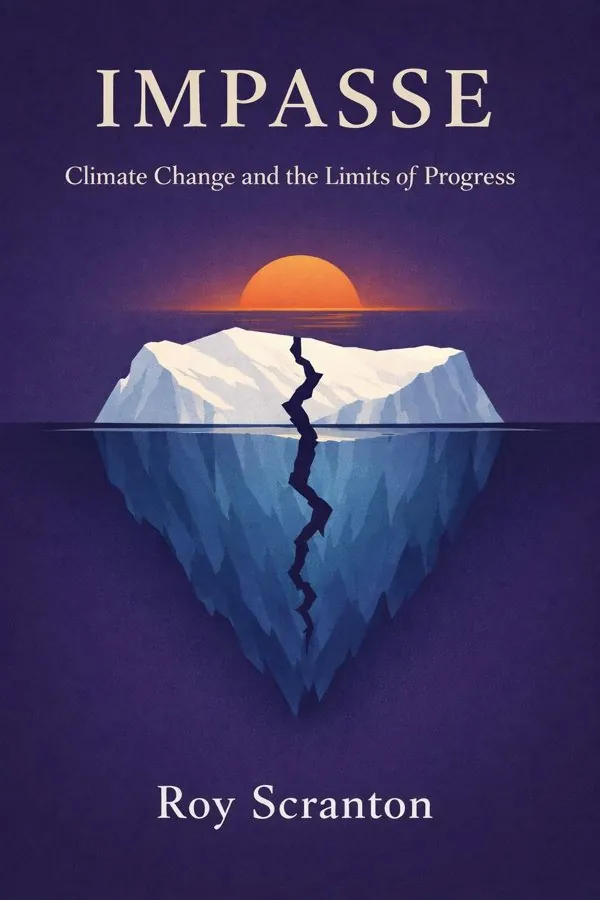
Impasse: Climate Change and the Limits of Progress: Summary & Key Insights
by Roy Scranton
 10 min9 chaptersAudio available
What Is Impasse: Climate Change and the Limits of Progress About?
Impasse: Climate Change and the Limits of Progress by Roy Scranton is a environment book spanning 9 pages. In this book, Roy Scranton explores the cultural, philosophical, and existential dimensions of the climate crisis. He argues that humanity faces not only environmental and political challenges but also a cognitive and narrative impasse that prevents us from truly grasping the scale and implications of global warming. Through literary and philosophical reflection, Scranton calls for a new realism that confronts the limits of progress and rethinks our relationship with the planet.
This FizzRead summary covers all 9 key chapters of Impasse: Climate Change and the Limits of Progress in approximately 10 minutes, distilling the most important ideas, arguments, and takeaways from Roy Scranton's work. Also available as an audio summary and Key Quotes Podcast.
Impasse: Climate Change and the Limits of Progress
In this book, Roy Scranton explores the cultural, philosophical, and existential dimensions of the climate crisis. He argues that humanity faces not only environmental and political challenges but also a cognitive and narrative impasse that prevents us from truly grasping the scale and implications of global warming. Through literary and philosophical reflection, Scranton calls for a new realism that confronts the limits of progress and rethinks our relationship with the planet.
Who Should Read Impasse: Climate Change and the Limits of Progress?
This book is perfect for anyone interested in environment and looking to gain actionable insights in a short read. Whether you're a student, professional, or lifelong learner, the key ideas from Impasse: Climate Change and the Limits of Progress by Roy Scranton will help you think differently.
- ✓Readers who enjoy environment and want practical takeaways
- ✓Professionals looking to apply new ideas to their work and life
- ✓Anyone who wants the core insights of Impasse: Climate Change and the Limits of Progress in just 10 minutes
Want the full summary?
Get instant access to this book summary and 100K+ more with Fizz Moment.
Get Free SummaryAvailable on App Store • Free to download
Key Chapters
To understand how humanity arrived at the impasse, we must revisit the Enlightenment, that dazzling moment when European thinkers began to see history as a process of rational advancement. Emerging from religious and feudal worlds, they imagined human reason as the engine of liberation. Figures like Francis Bacon and Descartes proclaimed that through knowledge and method, we could become 'masters and possessors of nature.' Empirical science promised to illuminate the unknown, while political revolutions sought to replace kings and priests with citizens and laws. From this vision flowed the modern idea of progress: linear, cumulative, unstoppable.
But woven into this optimism was a blindness. The Enlightenment’s dream of rational mastery carried with it the seeds of exploitation—the extractive drive to treat nature, and eventually humanity itself, as resource. Industrialization became the material form of that dream. Coal, steam, electricity: each innovation deepened faith in human ingenuity, even as it eroded the ecological foundations on which civilization rested. When we talk about climate change today, we are witnessing not the failure of technology but the consequences of its success within a flawed philosophical frame.
In 'Impasse,' I argue that our climate predicament is not an aberration from modernity but its logical outcome. What we call progress was never neutral; it was a mode of conquest disguised as enlightenment. The Enlightenment taught us to think of the world as something external to human consciousness, something to be surveyed, controlled, and improved. That metaphysical separation—humanity versus nature—created the condition for industrial domination. And even now, as the consequences mount, our institutions still operate according to that same logic, believing that improvement and innovation will rescue us from their own fallout.
Recognizing this history matters because it forces us to question the stories we inherited. The climate crisis did not simply arrive; we made it by living inside an idea—the idea that growth and knowledge always lead to good. The task now is to face the philosophical poverty of that idea and begin to imagine what it means to live within limits, not beyond them.
If the Enlightenment gave birth to progress, industrial modernity turned it into religion. We built nations and economies upon the promise that tomorrow would always be better than today. We measured success by GDP, by technological breakthroughs, by the speed of machines and markets. Progress became the ultimate moral good. But like every mythology, it required faith—a faith sustained by stories that obscured their costs.
In 'Impasse,' I look at how this myth functions. Progress tells us that history moves forward, that humanity evolves toward ever-greater freedom and prosperity. Yet beneath that narrative lies extraction, displacement, and destruction. The Earth’s carbon being burned for mobility and wealth is a form of time theft, a conversion of geological history into economic present. The myth legitimizes these acts because it promises that every sacrifice leads to greater good.
We see this rhetoric in the language of green capitalism and techno-utopianism, where innovation is offered as cure for ecological decay. But these futures only repeat the logic that caused the crisis. When Elon Musk imagines colonizing Mars or when Silicon Valley sells sustainability as consumer lifestyle, the myth of progress continues its hold, comforting us with the idea that we can escape limits by reinventing them.
To confront the climate emergency, we must break this mythic spell. That does not mean rejecting all tools or ingenuity, but it does mean recognizing that not every advance is progress, and not every problem admits a solution. The ecological crisis is not an obstacle to be conquered—it is the mirror in which we see ourselves. True growth now lies in wisdom, restraint, and the moral courage to say 'enough.'
+ 7 more chapters — available in the FizzRead app
All Chapters in Impasse: Climate Change and the Limits of Progress
About the Author
Roy Scranton is an American author, essayist, and professor known for his works on climate change, war, and philosophy. He teaches English at the University of Notre Dame and has written several acclaimed books including 'Learning to Die in the Anthropocene' and 'We're Doomed. Now What?'. His writing often blends literary analysis with environmental and existential inquiry.
Get This Summary in Your Preferred Format
Read or listen to the Impasse: Climate Change and the Limits of Progress summary by Roy Scranton anytime, anywhere. FizzRead offers multiple formats so you can learn on your terms — all free.
Available formats: App · Audio · PDF · EPUB — All included free with FizzRead
Download Impasse: Climate Change and the Limits of Progress PDF and EPUB Summary
Key Quotes from Impasse: Climate Change and the Limits of Progress
“To understand how humanity arrived at the impasse, we must revisit the Enlightenment, that dazzling moment when European thinkers began to see history as a process of rational advancement.”
“If the Enlightenment gave birth to progress, industrial modernity turned it into religion.”
Frequently Asked Questions about Impasse: Climate Change and the Limits of Progress
Impasse: Climate Change and the Limits of Progress by Roy Scranton is a environment book that explores key ideas across 9 chapters. In this book, Roy Scranton explores the cultural, philosophical, and existential dimensions of the climate crisis. He argues that humanity faces not only environmental and political challenges but also a cognitive and narrative impasse that prevents us from truly grasping the scale and implications of global warming. Through literary and philosophical reflection, Scranton calls for a new realism that confronts the limits of progress and rethinks our relationship with the planet.
You Might Also Like
A Life on Our Planet: My Witness Statement and a Vision for the Future
David Attenborough
10 min
A Sky Full Of Birds
Matt Merritt
10 min
Carbon Zero: Imagining Cities That Can Save the Planet
Alex Steffen
10 min
Eaarth: Making a Life on a Tough New Planet
Bill McKibben
10 min
The Social Contract and Environmental Governance
Various Editors
10 min
The Wild Places
Robert Macfarlane
10 minBrowse by Category
Ready to read Impasse: Climate Change and the Limits of Progress?
Get the full summary and 100K+ more books with Fizz Moment.