
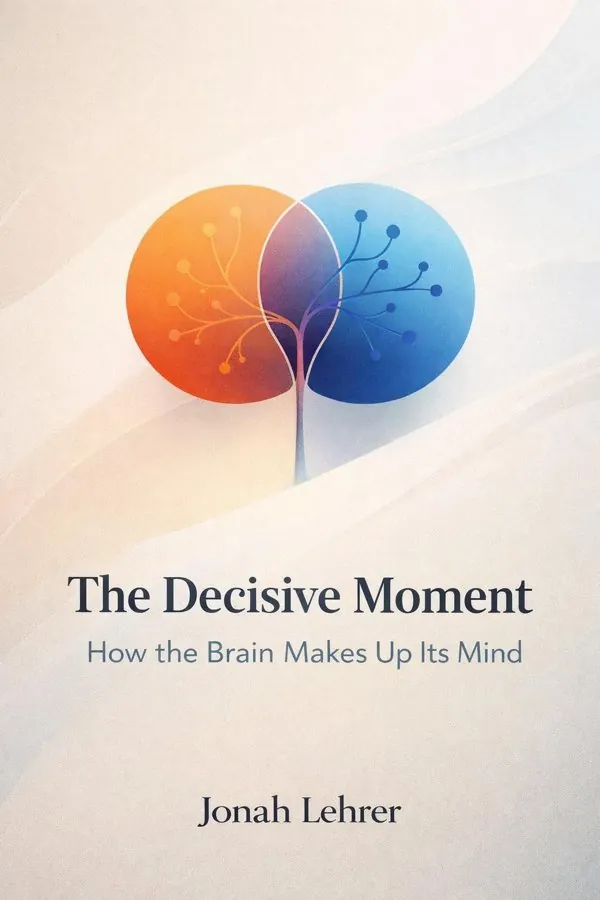
The Decisive Moment: How the Brain Makes Up Its Mind: Summary & Key Insights
by Jonah Lehrer
 10 min9 chaptersAudio available
Key Takeaways from The Decisive Moment: How the Brain Makes Up Its Mind
One of the book’s most important insights is that emotion is not the enemy of reason; it is often the basis of sound judgment.
If emotion gives decisions energy and direction, reason gives them structure.
The real secret of good decision-making is not choosing between emotion and reason, but knowing how to combine them.
Much of the brain’s decision-making happens before conscious awareness catches up.
Stress changes the architecture of decision-making.
What Is The Decisive Moment: How the Brain Makes Up Its Mind About?
The Decisive Moment: How the Brain Makes Up Its Mind by Jonah Lehrer is a neuroscience book spanning 9 pages. Why do some of our best choices feel instinctive, while others demand careful analysis? In The Decisive Moment: How the Brain Makes Up Its Mind, Jonah Lehrer explores one of the most important questions in neuroscience and daily life: how the human brain actually makes decisions. Drawing on research in psychology, neuroscience, behavioral economics, and real-world case studies, Lehrer challenges the old idea that reason and emotion are opposing forces. Instead, he shows that good judgment depends on a dynamic partnership between feeling and thought. The book matters because decision-making shapes nearly everything we do, from relationships and careers to investing, driving, and responding in moments of crisis. Lehrer explains why emotions can be surprisingly intelligent, why rational analysis sometimes misleads us, and why the brain often relies on unconscious processes long before we become aware of a choice. His gift lies in making complex science readable through memorable stories, clear explanations, and practical implications. For readers who want to understand themselves better and make wiser choices in a noisy, uncertain world, this book offers a fascinating and highly useful guide.
This FizzRead summary covers all 9 key chapters of The Decisive Moment: How the Brain Makes Up Its Mind in approximately 10 minutes, distilling the most important ideas, arguments, and takeaways from Jonah Lehrer's work. Also available as an audio summary and Key Quotes Podcast.
The Decisive Moment: How the Brain Makes Up Its Mind
Why do some of our best choices feel instinctive, while others demand careful analysis? In The Decisive Moment: How the Brain Makes Up Its Mind, Jonah Lehrer explores one of the most important questions in neuroscience and daily life: how the human brain actually makes decisions. Drawing on research in psychology, neuroscience, behavioral economics, and real-world case studies, Lehrer challenges the old idea that reason and emotion are opposing forces. Instead, he shows that good judgment depends on a dynamic partnership between feeling and thought.
The book matters because decision-making shapes nearly everything we do, from relationships and careers to investing, driving, and responding in moments of crisis. Lehrer explains why emotions can be surprisingly intelligent, why rational analysis sometimes misleads us, and why the brain often relies on unconscious processes long before we become aware of a choice. His gift lies in making complex science readable through memorable stories, clear explanations, and practical implications. For readers who want to understand themselves better and make wiser choices in a noisy, uncertain world, this book offers a fascinating and highly useful guide.
Who Should Read The Decisive Moment: How the Brain Makes Up Its Mind?
This book is perfect for anyone interested in neuroscience and looking to gain actionable insights in a short read. Whether you're a student, professional, or lifelong learner, the key ideas from The Decisive Moment: How the Brain Makes Up Its Mind by Jonah Lehrer will help you think differently.
- ✓Readers who enjoy neuroscience and want practical takeaways
- ✓Professionals looking to apply new ideas to their work and life
- ✓Anyone who wants the core insights of The Decisive Moment: How the Brain Makes Up Its Mind in just 10 minutes
Want the full summary?
Get instant access to this book summary and 100K+ more with Fizz Moment.
Get Free SummaryAvailable on App Store • Free to download
Key Chapters
One of the book’s most important insights is that emotion is not the enemy of reason; it is often the basis of sound judgment. Lehrer illustrates this through neurological cases such as Phineas Gage and patients with damage to emotional circuits in the brain. These individuals can often still reason logically, describe options, and calculate consequences. Yet they struggle to make even simple decisions. The lesson is striking: without emotion, thought becomes directionless.
Emotions help the brain assign value. They mark certain options as dangerous, rewarding, urgent, or meaningful. When you feel uneasy about a business deal, attracted to a career path, or instantly wary of someone’s behavior, those feelings may reflect the brain’s rapid integration of past experience. This emotional signaling process allows us to narrow overwhelming choices into manageable possibilities.
In everyday life, this means that gut feelings should not automatically be dismissed as irrational noise. A hiring manager may sense that a technically qualified candidate is wrong for the team. A parent may react immediately when a situation feels unsafe. A shopper may feel regret before making an expensive impulse purchase. These emotional signals are often data-rich, even if they are not yet verbalized.
At the same time, emotion is useful only when it has been shaped by real learning. Fear can be wise, but it can also be distorted. The key is not to suppress feeling, but to understand when it reflects expertise and when it reflects bias.
Actionable takeaway: When facing a decision, ask not only “What do I think?” but also “What do I feel, and what past experience might that feeling be summarizing?”
If emotion gives decisions energy and direction, reason gives them structure. Lehrer argues that the rational mind, especially the prefrontal cortex, plays a crucial role when we need to pause, compare alternatives, delay gratification, and think beyond the present moment. This part of the brain supports planning, self-control, and the ability to imagine long-term consequences.
Reason is particularly valuable in situations where immediate desires conflict with future goals. Saving money, sticking to a training plan, choosing a healthy meal, or preparing for an exam all require the mind to override short-term temptation. In these moments, rational thinking acts like an internal manager. It organizes information, weighs trade-offs, and keeps us aligned with what matters most over time.
Lehrer also shows that reason shines in novel, rule-based, and analytical problems. If you are comparing mortgage rates, reviewing a legal contract, or calculating business risk, emotions alone are not enough. These situations benefit from deliberate thought, external data, and slow evaluation. The rational brain is especially useful when options can be measured clearly and when impulsive reactions would be costly.
Still, reason has limits. Overthinking can create paralysis, especially when too many variables are considered at once. The point is not to worship logic, but to use it where it works best: controlling impulses, evaluating evidence, and protecting long-term interests.
Actionable takeaway: Use deliberate analysis for choices involving long-term consequences, numbers, or clear trade-offs, especially when immediate emotion pushes you toward a tempting but shortsighted option.
The real secret of good decision-making is not choosing between emotion and reason, but knowing how to combine them. Lehrer’s central argument is that the best decisions emerge when these two systems work together. Emotion offers speed, pattern recognition, and motivational force. Reason offers reflection, comparison, and self-control. When they cooperate, judgment becomes both intelligent and adaptable.
This balance matters because different situations demand different mental tools. A firefighter entering a burning building cannot stop to list pros and cons; trained intuition must lead. A financial planner evaluating retirement options, however, cannot rely only on instinct; careful reasoning is essential. Many of life’s important choices contain elements of both. Choosing a job, for instance, involves facts such as salary, commute, and stability, but also emotional questions about meaning, culture, and fit.
Trouble begins when one system dominates in the wrong context. Pure impulse can lead to reckless spending, angry outbursts, or poor risk assessment. Pure analysis can lead to indecision, emotional blindness, or a failure to notice subtle human realities. Lehrer suggests that wisdom lies in matching the mode of thinking to the nature of the problem.
A practical way to do this is to separate decisions into categories. Is this a fast-moving situation requiring skill-based intuition? Or is it a complex but measurable problem requiring analysis? In relationships, leadership, medicine, and negotiation, the strongest choices usually come from people who can feel deeply and think clearly at the same time.
Actionable takeaway: Before deciding, identify what the situation demands most, intuition, analysis, or a deliberate mix of both, and respond accordingly.
Much of the brain’s decision-making happens before conscious awareness catches up. Lehrer emphasizes that the unconscious mind is not a mystical force but a highly active processing system that continuously scans patterns, stores associations, and prepares responses. By the time you think you have “made up your mind,” your brain may already have been weighing evidence for seconds, hours, or even years.
This hidden processing explains why some answers seem to arrive suddenly. You step away from a difficult problem, take a walk, or sleep on it, and then clarity appears. The unconscious has been organizing information in the background. It is especially useful when decisions involve many subtle cues that are difficult to explain verbally, such as reading social dynamics, sensing market tone, or evaluating creative ideas.
Lehrer’s discussion helps readers trust incubation without romanticizing it. The unconscious works best when it has been fed high-quality input. A chess master’s intuition is powerful because it is built on thousands of hours of pattern exposure. A doctor’s quick judgment can be life-saving because it reflects deep experience. But unconscious processing can also absorb prejudice, faulty habits, and misleading signals.
In practical terms, this means that stepping away from a decision can be productive, especially after gathering relevant information. Instead of forcing an immediate answer, you can let the mind continue its work beneath the surface. This approach is useful for writing, strategy, design, and emotionally complex choices.
Actionable takeaway: Gather solid information, then create space, through rest, walking, or sleep, to let unconscious processing contribute before making an important decision.
Stress changes the architecture of decision-making. Under pressure, the brain shifts away from slow deliberation and leans more heavily on habit, emotion, and rapid pattern recognition. Lehrer shows that in high-stakes situations, this can be either a strength or a danger. Pressure does not automatically make us worse decision-makers; it amplifies the systems we have already trained.
In emergencies, fast intuitive action can save lives. Experienced pilots, athletes, surgeons, and firefighters often perform best when there is no time for conscious analysis. Their brains have encoded useful responses so deeply that action feels automatic. In these moments, thinking too much can interfere with performance. This is why experts often “just know” what to do.
But pressure can also narrow attention, increase impulsivity, and trigger panic. If a person lacks training, stress may cause them to freeze, lash out, or make simplistic decisions. In business, deadlines can lead teams to ignore warning signs. In personal conflict, strong emotion can produce words that damage trust. In investing, market volatility can trigger fear-based selling.
The key lesson is that calm decision-making under stress depends on preparation before the stressful moment arrives. Routines, checklists, simulation, and repetition give the brain reliable patterns to fall back on. This is why elite performers train under realistic conditions rather than relying on motivation alone.
Actionable takeaway: For decisions likely to happen under pressure, build habits and rehearsed responses in advance so your brain has something trustworthy to rely on when time is short.
Intuition is not magic. It is compressed experience. Lehrer explains that what we call a gut feeling is often the result of the brain learning patterns from repeated exposure. Over time, the emotional system stores the outcomes of past decisions, rewarding what worked and warning against what failed. This allows experts to make remarkably fast judgments that seem effortless from the outside.
Consider a seasoned investor who senses that market enthusiasm is detached from fundamentals, or a nurse who notices tiny changes in a patient before instruments show a crisis. These judgments may be difficult to articulate, but they are not baseless. They arise from countless encounters that have shaped the brain’s pattern-recognition systems. Experience teaches the body and mind what to notice.
However, Lehrer is careful to distinguish valid intuition from mere confidence. Experience improves judgment only when the environment provides meaningful feedback. A tennis player, emergency physician, or air-traffic controller can learn quickly because outcomes are relatively clear. By contrast, in fields with noisy or delayed feedback, people may become overconfident without actually becoming accurate.
For everyday readers, this means two things. First, intuition deserves more trust in areas where you have real, tested experience. Second, if you want better instincts, you need repetition, reflection, and feedback. Journal your choices, review outcomes, and learn from mistakes. Expertise is built, not inherited.
Actionable takeaway: Trust your intuition most in domains where you have substantial experience and clear feedback, and deliberately strengthen it by reviewing decisions and learning from results.
We often assume that more thinking leads to better choices. Lehrer challenges that assumption by showing that analysis has limits. The conscious mind can only hold a small amount of information at once, and when faced with too many variables, it becomes overloaded. In such cases, excessive deliberation may reduce satisfaction, blur priorities, and create decision paralysis.
This is especially true for choices involving personal preference, emotional nuance, or many interacting features. For example, someone choosing a house, partner, or creative direction may become less clear after producing endless spreadsheets and comparison lists. The attempt to quantify everything can strip away the very signals that matter most. Likewise, when consumers are given too many options, they often postpone choosing altogether.
Lehrer’s point is not that analysis is bad, but that conscious reasoning is a limited tool. It works best on structured problems with a manageable number of factors. Beyond that, the mind can become trapped in loops of second-guessing. Anyone who has reread the same email ten times, researched a purchase for weeks, or delayed a decision out of fear of making the wrong choice knows this experience.
A better approach is to narrow the field, define a few essential criteria, and avoid treating every minor detail as equally important. Once the obvious facts are known, continuing to analyze may not improve the outcome. It may only increase anxiety.
Actionable takeaway: When analysis starts creating confusion instead of clarity, simplify the choice to a few key factors and give yourself a deadline for deciding.
Creative decisions emerge from a brain that can both focus and let go. Lehrer explores how insight often arises when rational effort reaches its limit and the mind becomes more open, associative, and flexible. Creativity is therefore not separate from decision-making; it is a special form of it, one that requires combining information in new ways.
This matters because many important choices are not merely about selecting from fixed options. They are about inventing better options. A leader facing a failing project may need a new strategy rather than a simple yes-or-no decision. A writer stuck on structure may need to reconceive the whole piece. An entrepreneur may have to reframe the market rather than optimize an existing plan.
The brain supports this kind of thinking by shifting between modes. Focused attention helps gather facts and understand constraints. Looser, more associative states help connect distant ideas. That is why solutions often appear in the shower, during a commute, or while doing something repetitive. Relaxed attention allows hidden connections to surface.
Lehrer’s discussion suggests that creativity can be cultivated. Exposure to diverse ideas, breaks from concentrated effort, and environments that tolerate experimentation all improve the likelihood of insight. So does reducing the fear of failure, which can make the brain overly rigid.
In practical life, this means that when a decision feels stuck, the problem may not be a lack of willpower but a need for a different mental state. Sometimes the right move is to stop forcing and start exploring.
Actionable takeaway: When a choice feels trapped between bad options, step back, change environments, and ask how you might create a better alternative rather than merely select among existing ones.
The final lesson of the book is both hopeful and practical: although the brain has biases and limitations, decision-making can be improved. Lehrer argues that better choices do not come from becoming perfectly rational. They come from understanding how the mind works and designing habits, environments, and processes that make good judgment more likely.
One improvement strategy is to match the method to the problem. Use data and analysis for measurable, long-term, high-stakes decisions. Use trained intuition for fast-moving situations within your expertise. Another strategy is to reduce avoidable noise. Fatigue, distraction, hunger, stress, and information overload all degrade judgment. Many poor decisions are not moral failures but cognitive failures caused by depleted conditions.
Lehrer also points toward the value of self-awareness. Learn your recurring blind spots. Do you become impulsive under stress? Do you overanalyze personal choices? Do you trust confidence more than competence? The more precisely you know your patterns, the more effectively you can compensate for them. Checklists, decision journals, trusted advisors, and cooling-off periods can all serve as practical safeguards.
Importantly, better decisions are often social rather than solitary. Feedback from others can reveal what emotion misses and what logic overlooks. Teams perform best when they welcome both analytical evidence and intuitive concern.
The broader message is empowering: wisdom is not about removing humanity from judgment. It is about using the full intelligence of the brain more skillfully.
Actionable takeaway: Build a personal decision system, including rest, reflection, feedback, and clear criteria, so that good choices rely less on mood and more on reliable habits.
All Chapters in The Decisive Moment: How the Brain Makes Up Its Mind
About the Author
Jonah Lehrer is an American author and journalist best known for writing about neuroscience, psychology, creativity, and decision-making for a broad audience. He studied neuroscience at Columbia University, where he developed a strong interest in how the brain shapes behavior and thought. Lehrer later became a science writer and gained attention for his ability to translate complex research into clear, engaging stories filled with real-world relevance. His books and essays often explore the meeting point between science and everyday life, especially in areas such as judgment, innovation, and human performance. Known for blending scientific findings with narrative storytelling, Lehrer helped popularize many ideas from modern brain science for non-specialist readers interested in understanding how the mind works.
Get This Summary in Your Preferred Format
Read or listen to the The Decisive Moment: How the Brain Makes Up Its Mind summary by Jonah Lehrer anytime, anywhere. FizzRead offers multiple formats so you can learn on your terms — all free.
Available formats: App · Audio · PDF · EPUB — All included free with FizzRead
Download The Decisive Moment: How the Brain Makes Up Its Mind PDF and EPUB Summary
Key Quotes from The Decisive Moment: How the Brain Makes Up Its Mind
“One of the book’s most important insights is that emotion is not the enemy of reason; it is often the basis of sound judgment.”
“If emotion gives decisions energy and direction, reason gives them structure.”
“The real secret of good decision-making is not choosing between emotion and reason, but knowing how to combine them.”
“Much of the brain’s decision-making happens before conscious awareness catches up.”
“Stress changes the architecture of decision-making.”
Frequently Asked Questions about The Decisive Moment: How the Brain Makes Up Its Mind
The Decisive Moment: How the Brain Makes Up Its Mind by Jonah Lehrer is a neuroscience book that explores key ideas across 9 chapters. Why do some of our best choices feel instinctive, while others demand careful analysis? In The Decisive Moment: How the Brain Makes Up Its Mind, Jonah Lehrer explores one of the most important questions in neuroscience and daily life: how the human brain actually makes decisions. Drawing on research in psychology, neuroscience, behavioral economics, and real-world case studies, Lehrer challenges the old idea that reason and emotion are opposing forces. Instead, he shows that good judgment depends on a dynamic partnership between feeling and thought. The book matters because decision-making shapes nearly everything we do, from relationships and careers to investing, driving, and responding in moments of crisis. Lehrer explains why emotions can be surprisingly intelligent, why rational analysis sometimes misleads us, and why the brain often relies on unconscious processes long before we become aware of a choice. His gift lies in making complex science readable through memorable stories, clear explanations, and practical implications. For readers who want to understand themselves better and make wiser choices in a noisy, uncertain world, this book offers a fascinating and highly useful guide.
More by Jonah Lehrer
You Might Also Like
Anxious
Joseph LeDoux
10 min
Hallucinations
Oliver Sacks
10 min
The Biological Mind: How Brain, Body, and Environment Collaborate to Make Us Who We Are
Alan Jasanoff
10 min
The Feeling of Life Itself: Why Consciousness Is Widespread but Can't Be Computed
Christof Koch
10 min
The No-Nonsense Meditation Book
Steven Laureys
10 min
A General Theory of Love
Thomas Lewis, Fari Amini, Richard Lannon
10 minBrowse by Category
Ready to read The Decisive Moment: How the Brain Makes Up Its Mind?
Get the full summary and 100K+ more books with Fizz Moment.