
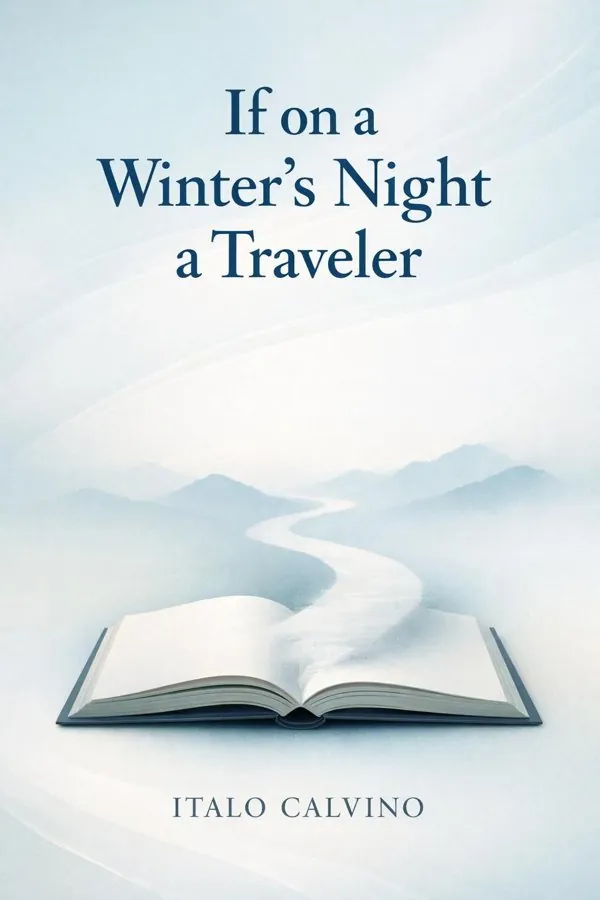
If on a Winter's Night a Traveler: Summary & Key Insights
 10 min9 chaptersAudio available
Key Takeaways from If on a Winter's Night a Traveler
Every act of reading begins with a private hope: that a book will open a world and hold us inside it.
A story is never only a story; it is also a relationship between a text and the person trying to complete it.
We often speak as if an author were a stable source of meaning, but Calvino shows how quickly that certainty dissolves.
Completion is satisfying, but interruption is often what makes us feel most intensely alive as readers.
What you choose to read is never only a preference; it is also a portrait of the self you are becoming.
What Is If on a Winter's Night a Traveler About?
If on a Winter's Night a Traveler by Italo Calvino is a classics book spanning 3 pages. Originally published in 1979, If on a Winter’s Night a Traveler is Italo Calvino’s dazzling meditation on what it means to read, to desire stories, and to search for meaning in fragments. The novel begins simply enough: you, the Reader, sit down to start a book called If on a Winter’s Night a Traveler. But a printing error interrupts the text almost immediately, sending you on a strange literary quest through bookstores, publishers, translators, forgeries, and ten different novels that all stop just when they become most gripping. What follows is part mystery, part philosophical game, and part love letter to literature itself. Calvino matters because few writers have examined the act of reading with such wit, elegance, and structural brilliance. Already celebrated for works like Invisible Cities and Cosmicomics, he brings to this novel a rare combination of imagination and precision. Rather than offering a single plot, he creates an experience that mirrors real reading: curiosity, frustration, projection, and the longing for completion. This is a classic not because it is difficult for its own sake, but because it turns reading into the subject of art—and makes that inquiry thrilling, playful, and unforgettable.
This FizzRead summary covers all 9 key chapters of If on a Winter's Night a Traveler in approximately 10 minutes, distilling the most important ideas, arguments, and takeaways from Italo Calvino's work. Also available as an audio summary and Key Quotes Podcast.
If on a Winter's Night a Traveler
Originally published in 1979, If on a Winter’s Night a Traveler is Italo Calvino’s dazzling meditation on what it means to read, to desire stories, and to search for meaning in fragments. The novel begins simply enough: you, the Reader, sit down to start a book called If on a Winter’s Night a Traveler. But a printing error interrupts the text almost immediately, sending you on a strange literary quest through bookstores, publishers, translators, forgeries, and ten different novels that all stop just when they become most gripping. What follows is part mystery, part philosophical game, and part love letter to literature itself.
Calvino matters because few writers have examined the act of reading with such wit, elegance, and structural brilliance. Already celebrated for works like Invisible Cities and Cosmicomics, he brings to this novel a rare combination of imagination and precision. Rather than offering a single plot, he creates an experience that mirrors real reading: curiosity, frustration, projection, and the longing for completion. This is a classic not because it is difficult for its own sake, but because it turns reading into the subject of art—and makes that inquiry thrilling, playful, and unforgettable.
Who Should Read If on a Winter's Night a Traveler?
This book is perfect for anyone interested in classics and looking to gain actionable insights in a short read. Whether you're a student, professional, or lifelong learner, the key ideas from If on a Winter's Night a Traveler by Italo Calvino will help you think differently.
- ✓Readers who enjoy classics and want practical takeaways
- ✓Professionals looking to apply new ideas to their work and life
- ✓Anyone who wants the core insights of If on a Winter's Night a Traveler in just 10 minutes
Want the full summary?
Get instant access to this book summary and 100K+ more with Fizz Moment.
Get Free SummaryAvailable on App Store • Free to download
Key Chapters
Every act of reading begins with a private hope: that a book will open a world and hold us inside it. Calvino turns that quiet expectation into the central drama of the novel by addressing the protagonist as “you.” This second-person voice is not a gimmick. It collapses the distance between reader and character, forcing us to notice how reading itself is an action full of rituals, moods, interruptions, and desire.
At the start, “you” buy the novel, prepare the right environment, and begin to read. But almost immediately the text breaks off because of a publishing error. That interruption matters because it reveals how fragile immersion really is. Reading depends not only on the story but on material conditions: editions, printing, translation, timing, attention, and even physical comfort. By making the Reader a character, Calvino dramatizes what usually remains invisible—the reader’s expectations, habits, and vulnerability.
This idea has practical resonance beyond fiction. We often imagine that understanding comes only from content, but Calvino reminds us that our encounter with any idea is shaped by context. A distracted mind, a flawed medium, or an abrupt break can alter meaning as much as the words themselves. In everyday life, this applies to how we consume news, learn skills, or even listen to others. The frame affects the message.
Calvino also suggests that readers are not passive recipients. The Reader becomes an investigator, a seeker, and eventually a participant in the machinery of literature. To read is to choose, infer, compare, and pursue. We do not merely receive stories; we co-create them through attention.
Actionable takeaway: Pay attention to your reading conditions and habits. Create intentional space for focused reading, and notice how your expectations shape what a text becomes for you.
A story is never only a story; it is also a relationship between a text and the person trying to complete it. Between the interrupted novels in If on a Winter’s Night a Traveler, the Reader’s own plot unfolds as he searches for the missing continuation of the book. Along the way, he meets Ludmilla, another reader, and enters a world where authors, publishers, translators, impostors, and manuscripts are constantly shifting identities.
What begins as irritation over a printing mistake becomes a larger puzzle about who controls a text and how books travel through systems of production. Titles change. Translations distort. Editions are mixed up. The “same” book turns out not to be the same at all. Calvino uses this dance of confusion to show that literature does not arrive pure and untouched from author to reader. It passes through institutions, economies, languages, and interpretations.
This is especially relevant in a world flooded with versions, excerpts, adaptations, and algorithmic recommendations. We may think we are encountering an original work, but often we meet it through filters—reviews, social media discourse, editorial packaging, or translation choices. Calvino anticipated this instability. He asks us to recognize that reading is not simply entering a sealed world; it is navigating a network.
The relationship between the Reader and Ludmilla deepens this point. They are connected not by certainty but by shared appetite for books. Their attraction grows through mutual reading, contrasting with characters who want to dominate, classify, or exploit literature. Calvino suggests that the healthiest relation to books is neither ownership nor mastery, but responsiveness.
Actionable takeaway: When reading any important work, look beyond the text itself. Ask who translated it, who published it, what versions exist, and how those factors influence your experience.
Completion is satisfying, but interruption is often what makes us feel most intensely alive as readers. One of Calvino’s boldest insights is that narrative desire grows strongest when a story is cut off. Each of the ten embedded novels begins with momentum, atmosphere, and intrigue—then stops at a crucial moment. The result is frustration, but also fascination. We discover how much reading depends on the pull of what has not yet been revealed.
Calvino is exploring a basic human mechanism: uncertainty generates attention. Cliffhangers, unanswered questions, and missing links keep us mentally involved. But the book goes further by making interruption itself the theme. The Reader’s search for continuations mirrors our own daily experience of unfinished business—projects abandoned, conversations left unresolved, ambitions suspended by circumstance.
This insight applies broadly. In productivity, marketers exploit open loops to keep people engaged. In relationships, ambiguity can intensify attachment. In learning, a good teacher often leaves a conceptual gap that students feel compelled to fill. Yet Calvino also warns that endless interruption can become exhausting. Desire needs closure at some point, or it turns into alienation.
By repeatedly denying the reader a finished plot, the novel asks an uncomfortable question: do we love stories for their endings, or for the state of wanting they produce? Many readers realize that pursuit itself can become addictive. We chase the next chapter, the next explanation, the next resolution, only to discover that desire renews itself.
Calvino’s genius lies in making us observe this mechanism while we are trapped inside it. He turns impatience into self-knowledge.
Actionable takeaway: Notice where unfinished narratives are controlling your attention. Choose consciously which open loops deserve completion and which ones you can let remain unresolved.
What you choose to read is never only a preference; it is also a portrait of the self you are becoming. In Calvino’s novel, readers are distinguished not just by taste but by their mode of attention. The Reader, Ludmilla, and other figures embody different relationships to literature: immersion, interpretation, collection, control, performance, and appetite. Through them, Calvino shows that reading is a way of living.
Ludmilla, in particular, represents a generous and sensuous relation to books. She reads for the pleasure of entering another world, not to dominate it intellectually. Others around her turn literature into ideology, scholarship, vanity, or conspiracy. The contrast suggests that books reveal our character. One person reads to encounter complexity; another reads to confirm prior beliefs; a third reads to display sophistication.
This idea extends far beyond novels. Today, our reading identities are often public. We signal ourselves through what we post, quote, annotate, and recommend. We build personal brands around our cultural consumption. Calvino’s novel asks whether this performance obscures the intimate encounter that gives reading its value. Are we still reading to be changed, or only to be seen reading?
At a practical level, the book invites self-examination. Do you rush through books for completion? Do you abandon them too quickly? Do you read broadly or defensively? Do you seek challenge, comfort, prestige, escape? None of these motives is inherently wrong, but becoming aware of them deepens the experience.
Calvino’s point is subtle: readers are not simply consumers of identity; they are shaped by the forms of attention they practice. Reading patiently, curiously, and receptively can cultivate a more spacious mind.
Actionable takeaway: Reflect on your reading habits for a week. Note not just what you read, but why you chose it and how you approached it.
We usually treat errors as obstacles to meaning, but Calvino reveals that errors can expose how meaning is made in the first place. In If on a Winter’s Night a Traveler, mistranslations, misprints, false attributions, and editorial confusions are not incidental mishaps. They are engines of the plot. The Reader’s quest exists because texts fail to remain stable as they move across languages and institutions.
This makes translation especially important. Translation in the novel is not merely technical transfer; it is transformation. A text changes as it enters another linguistic and cultural system. Nuances shift, tones mutate, references break or regenerate. Calvino treats this instability not as a tragedy alone, but as a fact of literary life. Purity is a myth. Every act of transmission alters what it carries.
The book therefore encourages humility. We rarely encounter reality directly; we encounter versions of it. Whether reading literature, following world events, or interpreting data, we depend on mediators. Information is translated not only between languages but between expert and public, event and report, experience and memory. Errors do not just distort truth; they reveal the channels through which truth travels.
There is also creativity in this instability. New meanings emerge from slippage. A mistranslation may generate unexpected beauty; a fragmented text may inspire stronger imaginative participation than a complete one. Calvino does not celebrate confusion for its own sake, but he shows that uncertainty can produce richer engagement than false certainty.
For modern readers navigating edited clips, summarized articles, and machine-translated ideas, this lesson is urgent. To read well is to remain alert to mediation.
Actionable takeaway: When encountering an important text or claim, compare versions if possible. Look for translation notes, source context, and signs of editorial framing before assuming you have the full picture.
Readers often imagine they want one kind of book, yet Calvino suggests what we really crave is the renewing shock of narrative possibility. The ten interrupted novels span a remarkable range of styles and genres: thriller, espionage tale, political intrigue, erotic tension, existential unease, adventure, and more. Each opening feels distinct, as if it belongs to a different literary universe. Together, they create a catalog of narrative appetites.
Why does this matter? Because the novel argues that reading is not loyalty to a single form but responsiveness to many forms of desire. One day we want suspense. Another day we seek atmosphere, philosophy, romance, danger, or the uncanny. Calvino honors these impulses without reducing them to high or low culture. He treats genre as a set of promises made to the reader—and interrupted before fulfillment.
This creates a fascinating effect. Instead of settling into one story, we become conscious of what each story offers. We learn to identify our own hooks: a voice, a setting, a secret, a pursuit, a threat. Calvino turns readers into critics of their own craving. Which beginnings seduce us most strongly? What kinds of worlds do we most regret losing?
In practical terms, this broadens how we think about literary value. A reader need not choose between intellectual seriousness and plot-driven pleasure. Calvino’s novel demonstrates that experimentation can coexist with suspense, and play can coexist with philosophical depth. It invites us to diversify our reading lives rather than confining ourselves to one shelf of experience.
The book also reminds writers and creators that form matters. Different structures generate different emotions, and beginnings are powerful acts of invitation.
Actionable takeaway: Use this novel as a map of your own tastes. After reading it, list which embedded story interested you most and seek another book in that mode.
Human beings are pattern-seeking creatures, and Calvino understands how quickly we turn fragments into systems. As the Reader follows clues through bookstores, archives, and conversations, the novel begins to resemble a detective story. Yet unlike classic detective fiction, the search does not lead to one neat revelation. Instead, every apparent solution generates more complexity. The desire for order remains, but the world resists simplification.
This tension lies at the heart of modern life. We constantly assemble narratives from incomplete information: about politics, careers, relationships, and ourselves. We want coherent explanations. We look for hidden masterminds, clean causal chains, and final truths. Calvino sympathizes with that impulse while exposing its limits. Some systems are real; others are projections imposed by anxious minds.
The novel’s publishing conspiracies and textual mysteries can therefore be read as satire on overinterpretation. Not every discrepancy conceals a grand design. Sometimes bureaucracy, error, ambition, and accident produce confusion without deeper harmony. Yet Calvino does not advise surrender. He portrays interpretation as necessary even when certainty is impossible. The challenge is to search intelligently without demanding total control.
This insight is practical for anyone living amid information overload. When facing conflicting reports or ambiguous events, we should investigate, compare, and reason—but also accept that some questions remain open. Intellectual maturity lies between credulity and paranoia.
The Reader’s journey becomes meaningful not because he masters the labyrinth, but because he learns how to move within it. That is one of the book’s deepest lessons: order may be partial, provisional, and local, yet still worth pursuing.
Actionable takeaway: When confronted with confusing information, separate what is known, what is inferred, and what is imagined. This simple habit reduces both gullibility and overinterpretation.
In a culture obsessed with messages and conclusions, Calvino insists on something more basic: the act of reading itself has value. If on a Winter’s Night a Traveler is not just about what books say. It is about what happens when a person gives sustained attention to language, possibility, and uncertainty. The novel celebrates reading as a mode of presence.
This is why the ending matters. Without reducing the book to a tidy moral, Calvino moves toward a recognition that reading is woven into ordinary human life—into intimacy, time, routine, and companionship. The Reader’s quest, however labyrinthine, returns us to a simple truth: books matter because they organize our longing, focus our attention, and create forms of relation to others and to ourselves.
This message feels especially urgent today. Much of contemporary reading is fragmented into headlines, notifications, clips, and commentary. We skim, react, and move on. Calvino offers a counterexperience. He reminds us that serious reading includes frustration, delay, and ambiguity—and that these are not defects but part of its power. To read deeply is to practice patience in an impatient world.
The novel also rejects the notion that literature must justify itself through utility alone. Reading may sharpen analysis and empathy, but it also nourishes pleasure, wonder, and interior freedom. Those are not secondary benefits. They are central human goods.
Ultimately, Calvino turns the reader’s ordinary act into a subject worthy of art. By doing so, he dignifies the quiet, solitary, often overlooked labor of paying attention.
Actionable takeaway: Set aside regular time for uninterrupted reading with no multitasking. Treat it not as a luxury, but as a practice that strengthens attention, imagination, and inner life.
All Chapters in If on a Winter's Night a Traveler
About the Author
Italo Calvino (1923–1985) was one of the most inventive and influential writers of the twentieth century. Born in Santiago de las Vegas, Cuba, to Italian parents and raised in Sanremo, Italy, he came of age during the turmoil of fascism and World War II, experiences that shaped his early work. He first gained attention with neorealist fiction, including The Path to the Nest of Spiders, but later became known for a distinctive literary style that fused imagination, philosophy, irony, and formal experimentation. His best-known works include Invisible Cities, Cosmicomics, The Baron in the Trees, and If on a Winter’s Night a Traveler. Calvino’s writing explores storytelling, perception, language, and human curiosity with unusual elegance and precision. He remains a central figure in world literature and modern narrative innovation.
Get This Summary in Your Preferred Format
Read or listen to the If on a Winter's Night a Traveler summary by Italo Calvino anytime, anywhere. FizzRead offers multiple formats so you can learn on your terms — all free.
Available formats: App · Audio · PDF · EPUB — All included free with FizzRead
Download If on a Winter's Night a Traveler PDF and EPUB Summary
Key Quotes from If on a Winter's Night a Traveler
“Every act of reading begins with a private hope: that a book will open a world and hold us inside it.”
“A story is never only a story; it is also a relationship between a text and the person trying to complete it.”
“We often speak as if an author were a stable source of meaning, but Calvino shows how quickly that certainty dissolves.”
“Completion is satisfying, but interruption is often what makes us feel most intensely alive as readers.”
“What you choose to read is never only a preference; it is also a portrait of the self you are becoming.”
Frequently Asked Questions about If on a Winter's Night a Traveler
If on a Winter's Night a Traveler by Italo Calvino is a classics book that explores key ideas across 9 chapters. Originally published in 1979, If on a Winter’s Night a Traveler is Italo Calvino’s dazzling meditation on what it means to read, to desire stories, and to search for meaning in fragments. The novel begins simply enough: you, the Reader, sit down to start a book called If on a Winter’s Night a Traveler. But a printing error interrupts the text almost immediately, sending you on a strange literary quest through bookstores, publishers, translators, forgeries, and ten different novels that all stop just when they become most gripping. What follows is part mystery, part philosophical game, and part love letter to literature itself. Calvino matters because few writers have examined the act of reading with such wit, elegance, and structural brilliance. Already celebrated for works like Invisible Cities and Cosmicomics, he brings to this novel a rare combination of imagination and precision. Rather than offering a single plot, he creates an experience that mirrors real reading: curiosity, frustration, projection, and the longing for completion. This is a classic not because it is difficult for its own sake, but because it turns reading into the subject of art—and makes that inquiry thrilling, playful, and unforgettable.
More by Italo Calvino

You Might Also Like


Browse by Category
Ready to read If on a Winter's Night a Traveler?
Get the full summary and 100K+ more books with Fizz Moment.