
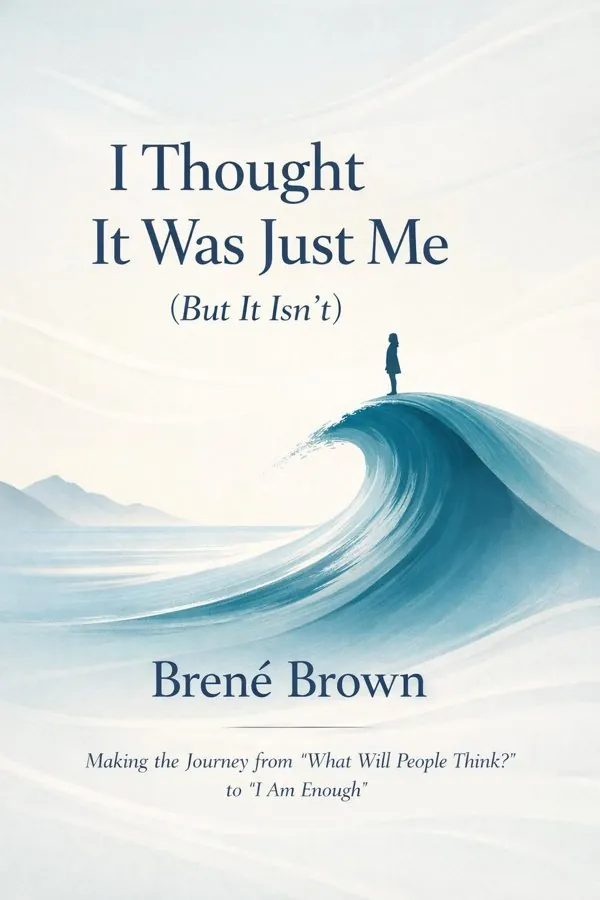
I Thought It Was Just Me (But It Isn't): Making the Journey from 'What Will People Think?' to 'I Am Enough': Summary & Key Insights
by Brené Brown
 10 min5 chaptersAudio available
What Is I Thought It Was Just Me (But It Isn't): Making the Journey from 'What Will People Think?' to 'I Am Enough' About?
I Thought It Was Just Me (But It Isn't): Making the Journey from 'What Will People Think?' to 'I Am Enough' by Brené Brown is a psychology book spanning 5 pages. In this groundbreaking work, Brené Brown explores the concept of shame and its pervasive impact on women’s lives. Drawing on extensive research and personal stories, she reveals how shame thrives on secrecy, silence, and judgment, and offers a path toward empathy, courage, and connection. The book provides practical strategies for developing shame resilience and embracing authenticity.
This FizzRead summary covers all 5 key chapters of I Thought It Was Just Me (But It Isn't): Making the Journey from 'What Will People Think?' to 'I Am Enough' in approximately 10 minutes, distilling the most important ideas, arguments, and takeaways from Brené Brown's work. Also available as an audio summary and Key Quotes Podcast.
I Thought It Was Just Me (But It Isn't): Making the Journey from 'What Will People Think?' to 'I Am Enough'
In this groundbreaking work, Brené Brown explores the concept of shame and its pervasive impact on women’s lives. Drawing on extensive research and personal stories, she reveals how shame thrives on secrecy, silence, and judgment, and offers a path toward empathy, courage, and connection. The book provides practical strategies for developing shame resilience and embracing authenticity.
Who Should Read I Thought It Was Just Me (But It Isn't): Making the Journey from 'What Will People Think?' to 'I Am Enough'?
This book is perfect for anyone interested in psychology and looking to gain actionable insights in a short read. Whether you're a student, professional, or lifelong learner, the key ideas from I Thought It Was Just Me (But It Isn't): Making the Journey from 'What Will People Think?' to 'I Am Enough' by Brené Brown will help you think differently.
- ✓Readers who enjoy psychology and want practical takeaways
- ✓Professionals looking to apply new ideas to their work and life
- ✓Anyone who wants the core insights of I Thought It Was Just Me (But It Isn't): Making the Journey from 'What Will People Think?' to 'I Am Enough' in just 10 minutes
Want the full summary?
Get instant access to this book summary and 100K+ more with Fizz Moment.
Get Free SummaryAvailable on App Store • Free to download
Key Chapters
Every culture has unwritten rules about what makes a woman worthy. They vary by context—appearance, motherhood, professional success—but they all share one feature: they are rooted in unattainable ideals. Through my research, women described hundreds of scenarios where they felt judged or inadequate, from failing to embody the 'perfect mom' to not fitting beauty standards.
Beauty culture tells us we must look forever young and effortlessly stylish. Professional norms insist we perform flawlessly while suppressing vulnerability. Motherhood messages demand constant availability without complaint. All of these standards generate shame because they set criteria we cannot meet—yet make us believe we should. Shame grows from this conflict between who we are and who we think we’re supposed to be.
I found that perfectionism is shame’s loyal ally. Perfectionism often masquerades as self-improvement, but it is actually a defensive strategy to avoid shame. We think, “If I look perfect, work perfect, parent perfect, then I can escape judgment.” But the moment we fall short—as we inevitably do—the shame intensifies. The secret here is not to become more perfect, but to step out of the toxic cycle altogether by acknowledging our humanity.
Recognizing cultural expectations isn’t about rejecting society altogether; it’s about seeing clearly how those expectations shape our self-image. When we identify the sources of shame, we become better equipped to challenge them. Awareness doesn’t erase shame overnight, but it opens the first door to freedom—understanding that these rules were constructed, not created by truth.
+ 3 more chapters — available in the FizzRead app
All Chapters in I Thought It Was Just Me (But It Isn't): Making the Journey from 'What Will People Think?' to 'I Am Enough'
About the Author
Brené Brown is a research professor at the University of Houston, known for her pioneering work on vulnerability, courage, shame, and empathy. She is the author of several bestselling books and a renowned public speaker whose TED Talk on vulnerability has reached millions worldwide.
Get This Summary in Your Preferred Format
Read or listen to the I Thought It Was Just Me (But It Isn't): Making the Journey from 'What Will People Think?' to 'I Am Enough' summary by Brené Brown anytime, anywhere. FizzRead offers multiple formats so you can learn on your terms — all free.
Available formats: App · Audio · PDF · EPUB — All included free with FizzRead
Download I Thought It Was Just Me (But It Isn't): Making the Journey from 'What Will People Think?' to 'I Am Enough' PDF and EPUB Summary
Key Quotes from I Thought It Was Just Me (But It Isn't): Making the Journey from 'What Will People Think?' to 'I Am Enough'
“In my work, I make an essential distinction between shame and guilt—because confusing them can keep us stuck.”
“Every culture has unwritten rules about what makes a woman worthy.”
Frequently Asked Questions about I Thought It Was Just Me (But It Isn't): Making the Journey from 'What Will People Think?' to 'I Am Enough'
I Thought It Was Just Me (But It Isn't): Making the Journey from 'What Will People Think?' to 'I Am Enough' by Brené Brown is a psychology book that explores key ideas across 5 chapters. In this groundbreaking work, Brené Brown explores the concept of shame and its pervasive impact on women’s lives. Drawing on extensive research and personal stories, she reveals how shame thrives on secrecy, silence, and judgment, and offers a path toward empathy, courage, and connection. The book provides practical strategies for developing shame resilience and embracing authenticity.
More by Brené Brown



You Might Also Like
The Body Keeps the Score
Bessel van der Kolk
10 min
Surrounded by Idiots
Thomas Erikson
10 min
Emotional Intelligence
Daniel Goleman
10 min
Attached
Amir Levine
10 min
Why Does He Do That
Lundy Bancroft
10 min
Women Who Run with the Wolves
Clarissa Pinkola Estés
10 minBrowse by Category
Ready to read I Thought It Was Just Me (But It Isn't): Making the Journey from 'What Will People Think?' to 'I Am Enough'?
Get the full summary and 100K+ more books with Fizz Moment.