
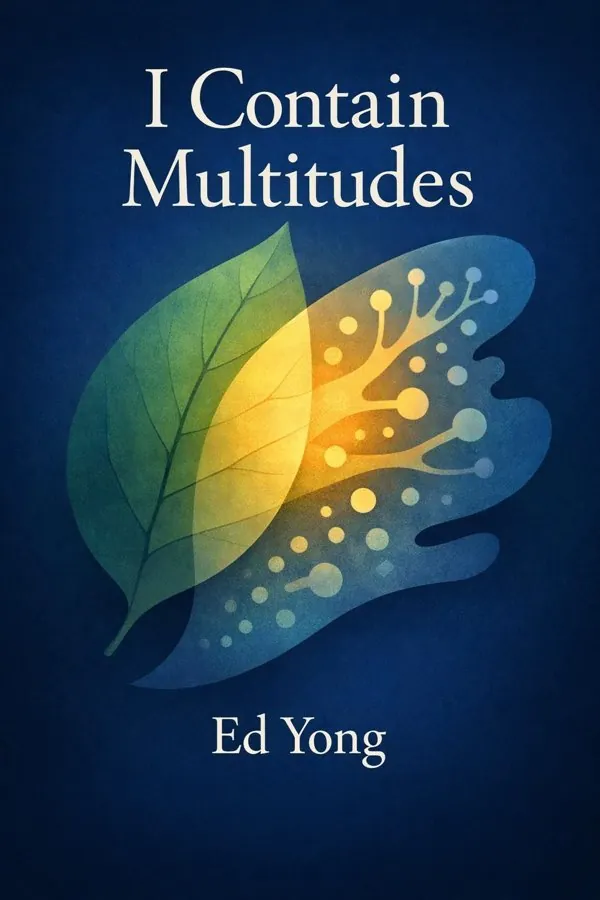
I Contain Multitudes: The Microbes Within Us and a Grander View of Life: Summary & Key Insights
by Ed Yong
 10 min9 chaptersAudio available
Key Takeaways from I Contain Multitudes: The Microbes Within Us and a Grander View of Life
The most important creatures on Earth are usually the ones we never see.
What if an animal is not a single being, but a crowded community?
To understand your body, you must also understand the multitudes living on and within it.
Some of the strangest influences in biology come from organisms too small to notice.
We often imagine evolution as a story of competition between isolated organisms, but Yong shows that cooperation belongs at the center of the narrative as well.
What Is I Contain Multitudes: The Microbes Within Us and a Grander View of Life About?
I Contain Multitudes: The Microbes Within Us and a Grander View of Life by Ed Yong is a life_science book spanning 9 pages. Ed Yong’s I Contain Multitudes invites us to look beyond the visible world and recognize that life on Earth is built through partnerships with microbes. Bacteria, fungi, archaea, and viruses are not just background organisms or occasional causes of disease. They are constant companions that shape animal bodies, influence ecosystems, drive evolution, and help make life possible. In this vivid and deeply reported book, Yong shows that every plant and animal is less an individual than an ecosystem: a community of species living together in intimate cooperation, conflict, and exchange. What makes the book so important is the shift in perspective it demands. Instead of seeing microbes mainly as enemies to be eliminated, Yong reveals them as collaborators that digest food, train immune systems, defend hosts from harm, and alter the behavior of entire organisms. Drawing on cutting-edge microbiology, evolutionary biology, and ecology, he translates complex science into memorable stories, from squid that glow with bacterial help to humans whose health depends on unseen internal communities. As an award-winning science journalist, Yong brings clarity, nuance, and wonder to a subject that changes how we understand bodies, health, and life itself.
This FizzRead summary covers all 9 key chapters of I Contain Multitudes: The Microbes Within Us and a Grander View of Life in approximately 10 minutes, distilling the most important ideas, arguments, and takeaways from Ed Yong's work. Also available as an audio summary and Key Quotes Podcast.
I Contain Multitudes: The Microbes Within Us and a Grander View of Life
Ed Yong’s I Contain Multitudes invites us to look beyond the visible world and recognize that life on Earth is built through partnerships with microbes. Bacteria, fungi, archaea, and viruses are not just background organisms or occasional causes of disease. They are constant companions that shape animal bodies, influence ecosystems, drive evolution, and help make life possible. In this vivid and deeply reported book, Yong shows that every plant and animal is less an individual than an ecosystem: a community of species living together in intimate cooperation, conflict, and exchange.
What makes the book so important is the shift in perspective it demands. Instead of seeing microbes mainly as enemies to be eliminated, Yong reveals them as collaborators that digest food, train immune systems, defend hosts from harm, and alter the behavior of entire organisms. Drawing on cutting-edge microbiology, evolutionary biology, and ecology, he translates complex science into memorable stories, from squid that glow with bacterial help to humans whose health depends on unseen internal communities. As an award-winning science journalist, Yong brings clarity, nuance, and wonder to a subject that changes how we understand bodies, health, and life itself.
Who Should Read I Contain Multitudes: The Microbes Within Us and a Grander View of Life?
This book is perfect for anyone interested in life_science and looking to gain actionable insights in a short read. Whether you're a student, professional, or lifelong learner, the key ideas from I Contain Multitudes: The Microbes Within Us and a Grander View of Life by Ed Yong will help you think differently.
- ✓Readers who enjoy life_science and want practical takeaways
- ✓Professionals looking to apply new ideas to their work and life
- ✓Anyone who wants the core insights of I Contain Multitudes: The Microbes Within Us and a Grander View of Life in just 10 minutes
Want the full summary?
Get instant access to this book summary and 100K+ more with Fizz Moment.
Get Free SummaryAvailable on App Store • Free to download
Key Chapters
The most important creatures on Earth are usually the ones we never see. That is the unsettling and exhilarating starting point of Ed Yong’s book. Microbes existed billions of years before animals or plants, and they still underpin nearly every biological process that keeps the planet habitable. They cycle carbon and nitrogen, produce oxygen, decompose waste, and inhabit environments as ordinary as garden soil and as extreme as hot springs and ocean vents. In sheer number, diversity, and evolutionary influence, they dwarf the visible organisms that humans tend to focus on.
Yong argues that our everyday perspective is biased by scale. Because we notice large organisms, we tell stories about forests, whales, and people, while ignoring the microbial communities that make these lives possible. Yet a teaspoon of soil can contain an astonishing number of microbial species, each participating in invisible chemical exchanges. Oceans, too, are alive with microscopic partnerships that influence climate and food webs. Microbes are not a side note to life; they are its infrastructure.
This matters because it changes how we define nature. If the world is fundamentally microbial, then health, agriculture, climate, and conservation must be understood at that level. For example, restoring damaged land is not only about replanting trees but also about rebuilding microbial communities in the soil. Personal health is not only about organs and genes but also about the organisms that live with us.
A practical way to apply this idea is to become more curious about the hidden systems behind visible outcomes. Whether you are thinking about your digestion, a garden, or environmental change, ask what microbial processes are involved. The takeaway: stop treating microbes as marginal and start seeing them as the living foundation beneath almost everything.
What if an animal is not a single being, but a crowded community? Yong uses this idea to overturn the traditional image of organisms as self-contained units. Every animal is a host to legions of microbes that help shape its body, chemistry, and chances of survival. One of the book’s most memorable examples is the Hawaiian bobtail squid, which houses the bacterium Vibrio fischeri in a special light organ. At night, the squid uses the bacteria’s glow to erase its silhouette and avoid predators. The organ itself develops properly only in response to the microbial partner, showing that the host body is built through collaboration.
This pattern appears everywhere in nature. Some animals rely on microbes to digest food they otherwise could not process. Others use microbes for defense, camouflage, or development. Termites depend on gut microbes to break down wood. Certain insects carry bacterial partners that manufacture nutrients missing from their diets. These relationships are not accidents. Over evolutionary time, animals and microbes have shaped each other’s biology.
Yong’s broader point is that individuality is more porous than we assume. If crucial functions are outsourced to microbial partners, then the “self” is partly collective. This has practical implications for biology and medicine. Studying an organism in isolation may miss the microbial allies that explain its behavior, nutrition, or disease resistance.
In everyday life, this idea encourages humility. Your body is not just yours; it is home to many interacting lives. That does not diminish you. It expands the meaning of what a living being is. The takeaway: when thinking about animals, including humans, view them as ecosystems whose abilities emerge from partnership rather than solitude.
To understand your body, you must also understand the multitudes living on and within it. Yong explores the human microbiome as a bustling assembly of microbes occupying the gut, skin, mouth, airways, and other niches. These organisms do far more than hitch a ride. They help digest food, produce useful compounds, educate the immune system, and block harmful invaders by competing for space and resources. In many cases, they act less like passengers and more like essential contributors to normal bodily function.
Yong is careful to avoid simplistic claims. The microbiome is not a magical master key that explains every illness, but neither is it trivial. Research suggests that early exposure to microbes influences immune development, and disruptions to microbial communities may be linked to conditions such as allergies, inflammatory disorders, and some metabolic diseases. Even birth matters: babies born vaginally and babies born by cesarean encounter different microbial communities in their earliest moments, potentially shaping later development.
One reason the human microbiome is so fascinating is that it is dynamic. Diet, medication, age, environment, and social contact can all shift microbial populations. A fiber-rich diet, for instance, tends to support microbes that produce beneficial short-chain fatty acids in the gut. Excessive or unnecessary antibiotic use can wipe out helpful species along with harmful ones.
For readers, the practical lesson is balance rather than obsession. You do not need to sterilize your world or chase every microbiome trend. Instead, support microbial resilience through habits that are broadly healthful: diverse plant-rich foods, prudent use of antibiotics when medically necessary, and respect for normal environmental exposure. The takeaway: your body works in partnership with microbes, so protecting health means caring for the community as well as the individual.
Some of the strangest influences in biology come from organisms too small to notice. Yong explores the provocative idea that microbes can affect behavior, not just in simple organisms but across a wide range of species. Insects infected with certain microbes may change mating patterns, social interactions, or reproduction. Gut microbes can alter how animals respond to food, stress, and threats. Even when the mechanisms are still being untangled, the central insight is powerful: behavior may emerge partly from chemical conversations between hosts and their microscopic residents.
This does not mean microbes control us like puppeteers. Yong resists sensationalism. Instead, he shows that the boundaries between physiology, mood, appetite, and microbial ecology are more intertwined than we once thought. The gut and brain are linked through nerves, hormones, immune signals, and microbial byproducts. In animal studies, changes to microbial communities have sometimes been associated with altered anxiety-like behavior, learning, or social responses. In humans, scientists are still sorting strong evidence from hype, but the field points toward a richer understanding of what shapes thought and feeling.
The practical value of this idea is caution against overly individualistic explanations of behavior. Not every craving, mood shift, or disorder has a microbial cause, but the body’s internal ecology may contribute in meaningful ways. This can influence research on mental health, nutrition, and personalized medicine.
For everyday application, think of lifestyle choices as inputs to a wider biological network. Sleep, stress, diet, and medications may affect not only your cells but also the microbes interacting with them. The takeaway: behavior is not produced by the brain alone; it may also reflect signals from the living community inside the body.
We often imagine evolution as a story of competition between isolated organisms, but Yong shows that cooperation belongs at the center of the narrative as well. Microbes have not merely adapted to hosts; they have helped hosts become what they are. Across evolutionary time, animals and plants have formed alliances with microbial partners that expand their capabilities, opening new diets, habitats, and survival strategies. Evolution, in this view, is not only about genes within one lineage but also about relationships between lineages.
This perspective helps explain why certain species can thrive in environments that would otherwise be impossible. Ruminants digest grass through microbial fermentation. Deep-sea animals survive near vents through symbiotic bacteria. Coral reefs depend on partnerships between corals and microscopic algae, alongside broader microbial communities. These examples reveal that adaptation can be distributed across a consortium of organisms rather than housed in one genome.
Yong also highlights a key scientific challenge: microbial communities are complex, variable, and sensitive to context. Unlike inherited genes, microbes can be acquired from parents, peers, food, and the environment. That makes evolution messier, but also more creative. Hosts may gain new capacities by recruiting useful partners rather than evolving every solution from scratch.
For readers, this idea broadens how we think about innovation in nature. Success is not always the result of independence. Often, it comes from building the right alliances. This principle applies beyond biology: organizations, technologies, and societies also thrive through networks rather than isolation.
The takeaway: evolution is not just a contest of lone organisms. It is also a history of collaboration, where life advances by forming durable and transformative partnerships.
Modern medicine has been enormously successful by identifying dangerous microbes and finding ways to kill them. Yong does not dispute that achievement; antibiotics, sanitation, and vaccines have saved countless lives. But he argues that the old model of total microbial war is incomplete. When we treat all microbes as enemies, we risk damaging the communities that protect and regulate us. A healthier framework is ecological: instead of asking only how to eliminate pathogens, we should also ask how to support beneficial microbes and restore disturbed ecosystems.
This shift has major implications. Broad-spectrum antibiotics can be lifesaving, but they may also devastate gut communities, sometimes enabling opportunists such as Clostridioides difficile to take over. In such cases, the problem is not merely the presence of a bad microbe but the collapse of a balanced ecosystem. Treatments like fecal microbiota transplantation, though still carefully regulated and not appropriate for every condition, demonstrate the power of restoring community structure rather than targeting a single organism.
Yong also points to the limits of over-cleanliness and indiscriminate antimicrobial products. Sterility is crucial in surgery and infection control, but trying to sterilize daily life can be misguided. Human health depends on selective protection, not universal eradication.
For readers, the practical lesson is to appreciate precision. Use antibiotics responsibly and only when medically appropriate. Be skeptical of products that promise total germ destruction in ordinary settings. Support preventive health through sleep, nutrition, hygiene, vaccination, and informed medical care rather than microbial fear.
The takeaway: the future of medicine lies not only in killing harmful microbes, but in managing the body as an ecosystem and preserving the allies that help keep disease at bay.
A forest, coral reef, or farm field is never just made of visible organisms. Beneath every landscape lies a microbial engine that determines fertility, resilience, and collapse. Yong expands the microbiome concept beyond the human body to show that environments themselves are shaped by dense microbial communities. Soil microbes help plants acquire nutrients, marine microbes drive chemical cycles in the oceans, and microbial imbalances can contribute to ecological failure. If we ignore these hidden populations, we misunderstand how ecosystems function.
Consider agriculture. Healthy soil is not simply dirt with minerals in it; it is a living matrix filled with bacteria, fungi, and other organisms that recycle matter and support plant growth. Intensive farming practices that degrade soil biology can reduce long-term productivity even if short-term yields remain high. Similarly, coral reefs depend on delicate alliances among corals, algae, and microbes. Changes in temperature or pollution can disrupt these relationships and leave reefs vulnerable.
Yong’s larger contribution is conceptual. Conservation should not focus only on protecting charismatic species. It should also preserve microbial diversity and the conditions that sustain it. Rewilding a habitat, restoring wetlands, or improving farming practices all involve rebuilding microbial communities, whether or not we notice them.
This idea has practical relevance for gardeners, farmers, policymakers, and anyone concerned with climate and biodiversity. Composting, reducing unnecessary chemical overuse, protecting wetlands, and supporting regenerative practices can all help maintain microbial health at larger scales.
The takeaway: ecosystems are held together by unseen microbial labor. To protect nature effectively, we must care for the microscopic communities that quietly maintain the living world.
One of the most exciting turns in the book is the realization that microbes are not only subjects of study; they are also tools for solving human problems. Yong describes how scientists are learning to harness microbial abilities in medicine, industry, and environmental management. Because microbes excel at chemistry, adaptation, and reproduction, they can be used to make drugs, process waste, produce food, monitor ecosystems, and perhaps one day personalize therapies with greater precision.
This potential emerges from understanding microbial talents instead of fearing them by default. Humans have long relied on microbes in fermentation to make bread, yogurt, cheese, beer, and countless traditional foods. Modern biotechnology extends that partnership. Engineered microbes can help produce insulin or other medically important molecules. Researchers are investigating whether microbial communities can be guided to improve crop resilience or reduce pollution through biodegradation.
Yong is also attentive to complexity. Manipulating microbial ecosystems is difficult because they are context-dependent and interactive. Adding one beneficial species does not guarantee a predictable outcome if the surrounding community resists or the environment changes. That means microbial technology requires humility, testing, and ecological thinking rather than quick fixes.
For readers, this key idea encourages openness to biologically informed innovation. Microbes may help address challenges in health, food systems, and sustainability, but only if we work with their complexity instead of forcing simplistic solutions.
A practical takeaway is to notice where microbial technologies already support modern life, from fermented foods to pharmaceuticals, and to approach new microbiome products with both interest and skepticism. The takeaway: microbes are not merely hazards to control; they are powerful partners whose abilities can be directed toward human and environmental benefit.
The deepest argument in I Contain Multitudes is philosophical as much as scientific. Yong asks us to reconsider what it means to be an individual, a species, or even a self. If bodies are composed through relationships with microbes, then life is less about separateness than about coexistence. The familiar boundaries between organism and environment, self and other, become more fluid. We remain individuals, but not in the isolated, autonomous sense that traditional biology often implied.
This reframing has emotional and ethical power. It invites humility by reminding us that human life depends on ancient, invisible companions. It also encourages a more relational view of health and ecology. A person cannot be fully understood apart from their microbial partners, just as a forest cannot be understood apart from the microbial networks in its soil. The world is built from interdependence all the way down.
Yong does not romanticize microbes. Some harm us; many are indifferent to us. The point is not that nature is harmonious, but that life is entangled. Cooperation and conflict happen simultaneously within every body and ecosystem. Recognizing that complexity helps us think more clearly about medicine, evolution, and environmental stewardship.
For everyday readers, the practical application is a shift in mindset. Treat living systems as relationships rather than machines. Be wary of narratives that promise simple control over bodies or ecosystems. Look for balance, resilience, and context instead.
The takeaway: the book’s grandest lesson is that no creature lives alone. To understand life well, we must replace the myth of independence with a richer vision of interconnected existence.
All Chapters in I Contain Multitudes: The Microbes Within Us and a Grander View of Life
About the Author
Ed Yong is a British science journalist and author celebrated for his ability to translate complex scientific research into vivid, accessible prose. He has written extensively about microbiology, evolution, animal behavior, health, and the broader relationship between science and society. Yong is especially known for combining deep reporting with narrative clarity, helping general readers grasp difficult ideas without losing their nuance. His work for major publications, including The Atlantic, has earned widespread acclaim and multiple journalism awards. In I Contain Multitudes, he brings those strengths to the emerging science of the microbiome, showing how invisible organisms shape bodies, ecosystems, and evolution. Yong is widely regarded as one of the most insightful and trustworthy science communicators of his generation.
Get This Summary in Your Preferred Format
Read or listen to the I Contain Multitudes: The Microbes Within Us and a Grander View of Life summary by Ed Yong anytime, anywhere. FizzRead offers multiple formats so you can learn on your terms — all free.
Available formats: App · Audio · PDF · EPUB — All included free with FizzRead
Download I Contain Multitudes: The Microbes Within Us and a Grander View of Life PDF and EPUB Summary
Key Quotes from I Contain Multitudes: The Microbes Within Us and a Grander View of Life
“The most important creatures on Earth are usually the ones we never see.”
“What if an animal is not a single being, but a crowded community?”
“To understand your body, you must also understand the multitudes living on and within it.”
“Some of the strangest influences in biology come from organisms too small to notice.”
“We often imagine evolution as a story of competition between isolated organisms, but Yong shows that cooperation belongs at the center of the narrative as well.”
Frequently Asked Questions about I Contain Multitudes: The Microbes Within Us and a Grander View of Life
I Contain Multitudes: The Microbes Within Us and a Grander View of Life by Ed Yong is a life_science book that explores key ideas across 9 chapters. Ed Yong’s I Contain Multitudes invites us to look beyond the visible world and recognize that life on Earth is built through partnerships with microbes. Bacteria, fungi, archaea, and viruses are not just background organisms or occasional causes of disease. They are constant companions that shape animal bodies, influence ecosystems, drive evolution, and help make life possible. In this vivid and deeply reported book, Yong shows that every plant and animal is less an individual than an ecosystem: a community of species living together in intimate cooperation, conflict, and exchange. What makes the book so important is the shift in perspective it demands. Instead of seeing microbes mainly as enemies to be eliminated, Yong reveals them as collaborators that digest food, train immune systems, defend hosts from harm, and alter the behavior of entire organisms. Drawing on cutting-edge microbiology, evolutionary biology, and ecology, he translates complex science into memorable stories, from squid that glow with bacterial help to humans whose health depends on unseen internal communities. As an award-winning science journalist, Yong brings clarity, nuance, and wonder to a subject that changes how we understand bodies, health, and life itself.
More by Ed Yong
You Might Also Like
The Selfish Gene
Richard Dawkins
10 min
Awakenings
Oliver Sacks
10 min
Parasite Rex: Inside the Bizarre World of Nature's Most Dangerous Creatures
Carl Zimmer
10 min
The Atlas of Life on Earth
Various
10 min
The Book of Humans: The Story of How We Became Us
Adam Rutherford
10 min
The Horse
Wendy Williams
10 minBrowse by Category
Ready to read I Contain Multitudes: The Microbes Within Us and a Grander View of Life?
Get the full summary and 100K+ more books with Fizz Moment.