
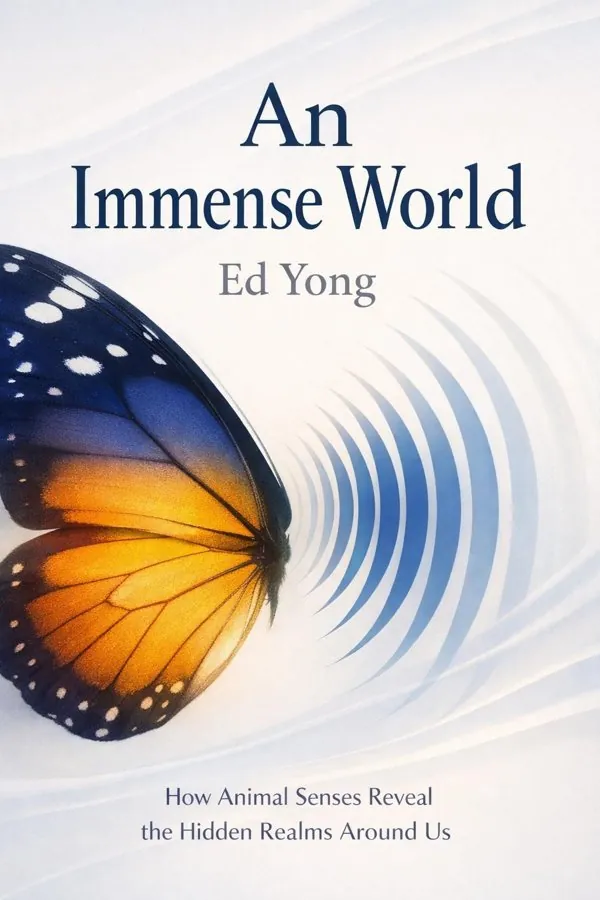
An Immense World: How Animal Senses Reveal the Hidden Realms Around Us: Summary & Key Insights
by Ed Yong
 10 min10 chaptersAudio available
What Is An Immense World: How Animal Senses Reveal the Hidden Realms Around Us About?
An Immense World: How Animal Senses Reveal the Hidden Realms Around Us by Ed Yong is a popular_sci book spanning 10 pages. A captivating exploration of the extraordinary sensory worlds of animals, revealing how they perceive the world in ways profoundly different from humans. Ed Yong takes readers on a journey through the diverse sensory experiences of creatures—from the ultraviolet vision of birds to the echolocation of bats—showing how each species lives in its own unique perceptual universe, or Umwelt.
This FizzRead summary covers all 10 key chapters of An Immense World: How Animal Senses Reveal the Hidden Realms Around Us in approximately 10 minutes, distilling the most important ideas, arguments, and takeaways from Ed Yong's work. Also available as an audio summary and Key Quotes Podcast.
An Immense World: How Animal Senses Reveal the Hidden Realms Around Us
A captivating exploration of the extraordinary sensory worlds of animals, revealing how they perceive the world in ways profoundly different from humans. Ed Yong takes readers on a journey through the diverse sensory experiences of creatures—from the ultraviolet vision of birds to the echolocation of bats—showing how each species lives in its own unique perceptual universe, or Umwelt.
Who Should Read An Immense World: How Animal Senses Reveal the Hidden Realms Around Us?
This book is perfect for anyone interested in popular_sci and looking to gain actionable insights in a short read. Whether you're a student, professional, or lifelong learner, the key ideas from An Immense World: How Animal Senses Reveal the Hidden Realms Around Us by Ed Yong will help you think differently.
- ✓Readers who enjoy popular_sci and want practical takeaways
- ✓Professionals looking to apply new ideas to their work and life
- ✓Anyone who wants the core insights of An Immense World: How Animal Senses Reveal the Hidden Realms Around Us in just 10 minutes
Want the full summary?
Get instant access to this book summary and 100K+ more with Fizz Moment.
Get Free SummaryAvailable on App Store • Free to download
Key Chapters
When von Uexküll coined the term *Umwelt*, he was trying to articulate a radical idea: that each living creature inhabits its own perceptual world, framed by what its senses can detect. To a tick, the entire universe may be reduced to three cues—the odor of butyric acid from mammalian skin, the warmth of blood beneath, and the sensation of hair to signal a safe landing. To us, such simplicity feels like deprivation, but within the tick’s Umwelt, it is perfectly adequate. This realization reveals that there is no privileged sensory world—only different ones, each tuned to ecological necessity.
In embracing this concept, I hoped to free readers from the tyranny of human perspective. Our species privileges sight and sound; we build technologies around these senses. Yet even our sight—often taken for granted as superior—is constrained. We see only a narrow sliver of the electromagnetic spectrum, ignoring the ultraviolet brilliance visible to butterflies or the infrared glow apprehended by snakes. To think deeply about Umwelt is to realize that we are surrounded by layers of reality we can neither see nor feel but that others navigate effortlessly. Recognizing this diversity leads us not to despair over human limitation, but to marvel at the creative potential of evolution—to see life, as I like to phrase it, in super-resolution.
Every chapter of this journey begins with humility: the human sensorium is not standard but provincial. Many animals live in worlds shaped by senses that we barely comprehend. Mantis shrimps, for instance, perceive colors through a dozen receptor types, yet likely organize those colors differently from us. Bees use patterns of polarized light to find their way through the sky. Fish sense the flow and movement of water through mechanoreceptors called lateral lines, a sixth sense that fuses touch and pressure. Dogs taste the air in olfactory panoramas thousands of times richer than ours.
One question runs through all of this: what is it like to be those animals? Science can never fully answer that; yet by understanding their sensory equipment, scientists can infer how perception sculpts behavior. A bat’s echolocation clicks are not merely biological sonar—they are a way of building reality. A shrimp’s sensitivity to ultraviolet helps it identify mates and predators in a light environment totally foreign to us. Even familiar pets inhabit alien worlds. The more we learn about these realities, the thinner the illusion of human sensory dominance becomes. In uncovering them, I want readers to rediscover wonder—the simple, transformative awareness that reality is plural.
+ 8 more chapters — available in the FizzRead app
All Chapters in An Immense World: How Animal Senses Reveal the Hidden Realms Around Us
About the Author
Get This Summary in Your Preferred Format
Read or listen to the An Immense World: How Animal Senses Reveal the Hidden Realms Around Us summary by Ed Yong anytime, anywhere. FizzRead offers multiple formats so you can learn on your terms — all free.
Available formats: App · Audio · PDF · EPUB — All included free with FizzRead
Download An Immense World: How Animal Senses Reveal the Hidden Realms Around Us PDF and EPUB Summary
Key Quotes from An Immense World: How Animal Senses Reveal the Hidden Realms Around Us
“When von Uexküll coined the term *Umwelt*, he was trying to articulate a radical idea: that each living creature inhabits its own perceptual world, framed by what its senses can detect.”
“Every chapter of this journey begins with humility: the human sensorium is not standard but provincial.”
Frequently Asked Questions about An Immense World: How Animal Senses Reveal the Hidden Realms Around Us
An Immense World: How Animal Senses Reveal the Hidden Realms Around Us by Ed Yong is a popular_sci book that explores key ideas across 10 chapters. A captivating exploration of the extraordinary sensory worlds of animals, revealing how they perceive the world in ways profoundly different from humans. Ed Yong takes readers on a journey through the diverse sensory experiences of creatures—from the ultraviolet vision of birds to the echolocation of bats—showing how each species lives in its own unique perceptual universe, or Umwelt.
More by Ed Yong
You Might Also Like

Structures: Or Why Things Don"t Fall Down
J.E. Gordon
10 min
The Road to Wigan Pier
George Orwell
10 min
Bonk: The Curious Coupling of Science and Sex
Mary Roach
10 min
First Bite: How We Learn to Eat
Bee Wilson
10 min
In Pursuit Of The Unknown: 17 Equations That Changed The World
Ian Stewart
10 min
Napoleon's Buttons: 17 Molecules That Changed History
Penny Le Couteur and Jay Burreson
10 minBrowse by Category
Ready to read An Immense World: How Animal Senses Reveal the Hidden Realms Around Us?
Get the full summary and 100K+ more books with Fizz Moment.