
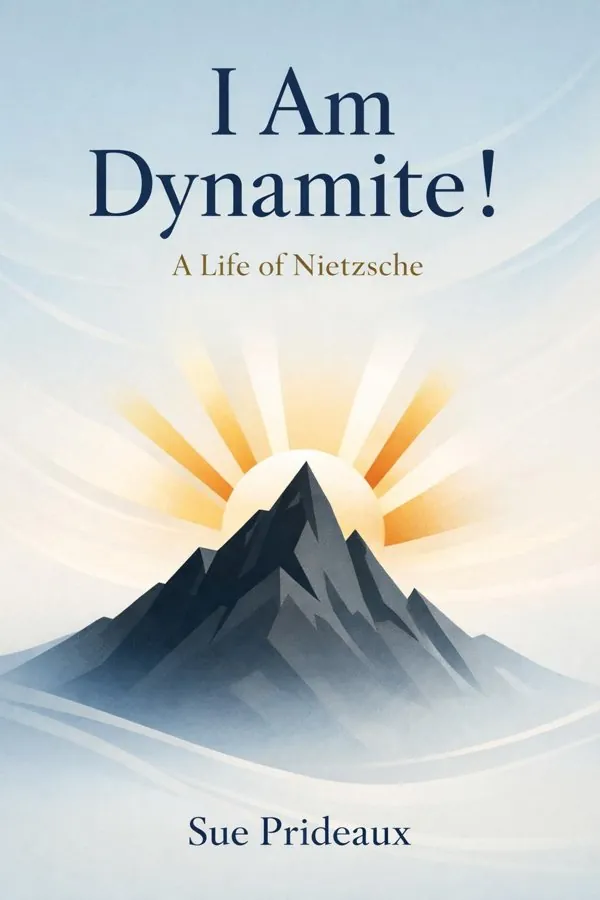
I Am Dynamite!: A Life of Nietzsche: Summary & Key Insights
by Sue Prideaux
 10 min9 chaptersAudio available
Key Takeaways from I Am Dynamite!: A Life of Nietzsche
Great thinkers rarely appear fully formed; they are usually shaped by tensions they never entirely escape.
Brilliance often needs structure before it can become originality.
Influence can elevate us before it traps us.
The hardest kind of independence is not public rebellion but private disillusionment.
Suffering can narrow a life, but it can also change what a mind notices.
What Is I Am Dynamite!: A Life of Nietzsche About?
I Am Dynamite!: A Life of Nietzsche by Sue Prideaux is a biographies book spanning 7 pages. Sue Prideaux’s I Am Dynamite!: A Life of Nietzsche is far more than a standard intellectual biography. It is a vivid, dramatic, and deeply human portrait of Friedrich Nietzsche, one of the most disruptive and misunderstood thinkers in modern history. Prideaux traces Nietzsche’s journey from a pastor’s son in provincial Prussia to a lonely, radical philosopher whose ideas would shake religion, morality, art, politics, and psychology. Along the way, she clears away many of the myths that have long distorted his life and work, especially the false association of his thought with nationalism and fascism. What emerges is not a cold academic or a crazed prophet, but an intensely sensitive, often ill, fiercely honest man who fought to think beyond the assumptions of his age. The book matters because Nietzsche’s questions remain our questions: How should we live after the collapse of certainty? What do we owe tradition, and what must we overcome? Prideaux writes with narrative energy, archival depth, and a biographer’s instinct for character, making this an authoritative and accessible guide to both the man and his explosive legacy.
This FizzRead summary covers all 9 key chapters of I Am Dynamite!: A Life of Nietzsche in approximately 10 minutes, distilling the most important ideas, arguments, and takeaways from Sue Prideaux's work. Also available as an audio summary and Key Quotes Podcast.
I Am Dynamite!: A Life of Nietzsche
Sue Prideaux’s I Am Dynamite!: A Life of Nietzsche is far more than a standard intellectual biography. It is a vivid, dramatic, and deeply human portrait of Friedrich Nietzsche, one of the most disruptive and misunderstood thinkers in modern history. Prideaux traces Nietzsche’s journey from a pastor’s son in provincial Prussia to a lonely, radical philosopher whose ideas would shake religion, morality, art, politics, and psychology. Along the way, she clears away many of the myths that have long distorted his life and work, especially the false association of his thought with nationalism and fascism. What emerges is not a cold academic or a crazed prophet, but an intensely sensitive, often ill, fiercely honest man who fought to think beyond the assumptions of his age. The book matters because Nietzsche’s questions remain our questions: How should we live after the collapse of certainty? What do we owe tradition, and what must we overcome? Prideaux writes with narrative energy, archival depth, and a biographer’s instinct for character, making this an authoritative and accessible guide to both the man and his explosive legacy.
Who Should Read I Am Dynamite!: A Life of Nietzsche?
This book is perfect for anyone interested in biographies and looking to gain actionable insights in a short read. Whether you're a student, professional, or lifelong learner, the key ideas from I Am Dynamite!: A Life of Nietzsche by Sue Prideaux will help you think differently.
- ✓Readers who enjoy biographies and want practical takeaways
- ✓Professionals looking to apply new ideas to their work and life
- ✓Anyone who wants the core insights of I Am Dynamite!: A Life of Nietzsche in just 10 minutes
Want the full summary?
Get instant access to this book summary and 100K+ more with Fizz Moment.
Get Free SummaryAvailable on App Store • Free to download
Key Chapters
Great thinkers rarely appear fully formed; they are usually shaped by tensions they never entirely escape. Prideaux begins Nietzsche’s story in Röcken, where he was born in 1844 into a devout Lutheran family headed by his father, a pastor. The early death of his father, followed by the close, female-dominated household in which he was raised, gave Nietzsche both emotional sensitivity and a profound awareness of fragility, grief, and performance. He grew up surrounded by religious seriousness, moral discipline, and social expectations that seemed orderly on the surface yet were haunted by loss underneath. This tension mattered. Nietzsche would later become one of Christianity’s fiercest critics, but Prideaux shows that his rebellion came not from shallow rejection but from intimate knowledge. He knew the language, rituals, and emotional power of faith from the inside.
Prideaux also highlights how early experiences of isolation sharpened his inwardness. Nietzsche learned to observe others while concealing much of himself. That habit would later nourish both his philosophical independence and his loneliness. His life reminds us that opposition often begins as sensitivity rather than aggression. People who question inherited beliefs are often those who have felt their contradictions most deeply.
A practical lesson follows from this opening chapter of Nietzsche’s life: our deepest convictions often arise from the environments we later resist. To understand a thinker, a leader, or even ourselves, we should ask not only what we believe now but what emotional world formed those beliefs. Actionable takeaway: identify one inherited idea from your family, culture, or education that still shapes you, and examine whether you truly endorse it or merely carry it forward.
Brilliance often needs structure before it can become originality. At Schulpforta, the elite boarding school where Nietzsche spent his adolescence, Prideaux shows a gifted boy undergoing rigorous intellectual formation. The school demanded extraordinary discipline in languages, literature, classical antiquity, and self-control. There Nietzsche absorbed Greek and Roman texts with almost monastic devotion, developing the philological precision that would define his early academic work. He learned to read slowly, compare manuscripts, trace meanings historically, and respect the weight of language. This training mattered because even when Nietzsche later broke with academic convention, he did so from a position of mastery rather than ignorance.
Prideaux makes clear that philology was not merely technical scholarship for Nietzsche. It was a way of entering distant worlds and uncovering the hidden assumptions buried in words. This habit later evolved into genealogy, his method of asking where values come from and whose interests they serve. In that sense, the rebellious philosopher grew directly out of the disciplined schoolboy.
There is a practical insight here for modern readers. Creativity is often romanticized as spontaneous genius, but Nietzsche’s life suggests that originality is strengthened by deep apprenticeship. Whether in writing, design, science, or business, those who learn the tools thoroughly are often best placed to transform them. The student who trains carefully may later become the innovator who changes the field.
Actionable takeaway: choose one skill central to your work and spend a week practicing its fundamentals with unusual rigor. Improvement in basics often unlocks higher-level originality.
Influence can elevate us before it traps us. Nietzsche’s meteoric academic rise was astonishing: still in his twenties, he became a professor of classical philology at Basel, a rare appointment that confirmed his exceptional talent. Yet Prideaux shows that his career was shaped not only by scholarship but by emotional and intellectual attachments, above all his encounter with Richard Wagner. Wagner appeared to Nietzsche as the embodiment of artistic genius, cultural renewal, and heroic seriousness. The composer and his circle offered belonging, excitement, and the intoxicating sense of participating in a grand cultural mission.
In Wagner, Nietzsche briefly found a father figure, artistic ideal, and national hope all at once. Their friendship energized his early work, especially The Birth of Tragedy, where Greek tragedy became a model for cultural rebirth through the union of form and ecstatic vitality. But Prideaux is careful not to reduce Nietzsche to a disciple. Even in admiration, his independence was stirring. He noticed vanity, theatricality, and ideological manipulation in Wagner long before he could fully break away.
This episode illustrates a timeless pattern: ambitious people often accelerate through alliances with charismatic mentors, movements, or institutions, but those same alliances can blur judgment. In careers today, this may look like joining a visionary founder, a fashionable intellectual camp, or a powerful organization whose prestige masks deeper compromises.
Actionable takeaway: audit your most important influence. Ask what this person or institution has helped you become, what it has discouraged you from seeing, and whether admiration is starting to replace independent judgment.
The hardest kind of independence is not public rebellion but private disillusionment. Prideaux presents Nietzsche’s break with Wagner and with the cultural nationalism surrounding him as one of the decisive turning points of his life. What had once seemed like artistic renewal increasingly looked to him like theatrical self-mythologizing, chauvinism, and sentimental decadence. Nietzsche’s alienation deepened as he recognized that many celebrated ideals rested on bad faith. The man who had sought cultural redemption through Wagner now had to face the more unsettling task of thinking without idols.
This rupture was painful in every sense. Nietzsche’s health deteriorated, his academic path became unstable, and his social world narrowed. Yet disillusionment became productive. Freed from the need to belong, he moved toward a more radical honesty. Prideaux shows how this phase prepared the emergence of Nietzsche’s mature voice: sharper, more skeptical, less willing to flatter audiences, and more determined to examine morality, religion, and culture at their roots. He did not merely change opinions; he changed method. Rather than asking what noble words mean, he asked what drives lie behind them.
For modern readers, this is one of the book’s most useful lessons. Many people outgrow a career path, belief system, or relationship but delay the necessary break because identity has become entangled with loyalty. Nietzsche’s life suggests that intellectual and personal growth often requires surviving the collapse of an admired image.
Actionable takeaway: identify one ideal you still defend out of habit or loyalty. Write down the evidence for and against it, and decide whether your attachment is based on truth, comfort, or fear of starting over.
Suffering can narrow a life, but it can also change what a mind notices. Nietzsche’s chronic illness is one of the most important threads in Prideaux’s biography. He endured severe headaches, digestive troubles, eyesight problems, exhaustion, and periods of near incapacity. These were not minor inconveniences attached to an otherwise stable career; they shaped his routines, relationships, travel, output, and sense of time. Because he was often unable to sustain ordinary academic life, he became a wandering, solitary writer, composing in boarding houses and mountain retreats, timing work around windows of bearable health.
Prideaux resists the simplistic idea that illness made Nietzsche a genius, but she shows that it altered his perspective. Physical vulnerability sharpened his concern with strength, resilience, self-overcoming, and the body’s role in thought. He became acutely aware that philosophy is not produced by detached minds floating above life but by embodied beings with needs, limits, moods, and pain thresholds. His writing style itself—aphoristic, intense, mobile—reflects a thinker working under pressure, capturing insight in bursts.
This has practical relevance today in a culture that often prizes relentless productivity. Nietzsche’s life reminds us that constraint can force selectivity, and selectivity can deepen thought. He could not live expansively in the conventional sense, so he learned to think with unusual intensity.
Actionable takeaway: rather than treating every limitation as a defect, ask how one recurring constraint in your life might be directing you toward a more honest way of working, resting, or creating.
When old certainties collapse, the real question is not what we lost but what kind of life becomes possible next. Prideaux situates Nietzsche’s mature philosophy within a Europe experiencing erosion of traditional religious authority, moral confidence, and cultural unity. Nietzsche did not simply announce that God was dead as a slogan of atheism; he explored the psychological and civilizational consequences of a world in which inherited values no longer command unquestioned belief. The problem, as he saw it, was not disbelief alone but the vacuum left behind. If transcendent guarantees disappear, how are values created, justified, and lived?
From this crisis emerged some of Nietzsche’s best-known ideas: self-overcoming, the revaluation of values, the critique of herd morality, and the aspiration toward higher forms of human flourishing. Prideaux explains these ideas through the texture of Nietzsche’s life rather than abstract system-building. He wanted people to become creators rather than mere inheritors of meaning. That does not mean selfishness or domination in the crude sense often attributed to him. It means refusing second-hand values and taking responsibility for shaping a life.
In practical terms, this speaks directly to modern readers navigating institutional distrust, ideological fatigue, and identity confusion. Many people live among borrowed beliefs long after they have ceased to believe them deeply. Nietzsche asks for a more difficult honesty: if your framework is gone, what can you affirm in its place?
Actionable takeaway: list three values you claim to hold, then note whether each came from conviction, convenience, or conformity. Keep only the ones you are willing to actively live.
A person can hunger for intimacy and still be driven toward solitude by temperament and truthfulness. Prideaux gives careful attention to Nietzsche’s relationships, especially his friendships and the emotionally charged, ultimately painful episode involving Lou Andreas-Salomé. These connections reveal a side of Nietzsche often obscured by his later reputation: he was capable of warmth, admiration, wit, and deep longing for companionship. Yet he was also difficult to live with intellectually. His standards were severe, his sensitivity acute, and his philosophical path increasingly isolating.
The failed triangle involving Lou, Paul Rée, and Nietzsche was more than a romantic disappointment. It dramatized the mismatch between Nietzsche’s craving for shared intellectual life and his inability to inhabit ordinary social arrangements. Prideaux does not sentimentalize him, but she shows how repeated disappointments reinforced his solitude. That solitude then became both wound and working condition. Some of his greatest books emerged from isolation, yet isolation also intensified instability and misunderstanding.
This part of the biography matters because it cautions against separating intellectual life from emotional life. Our ideas about freedom, dependence, selfhood, and honesty are tested in friendship and love, not only in books. Many talented people justify relational failures by calling them necessary for greatness, but Nietzsche’s life shows the cost of that story.
Actionable takeaway: if your independence has become a shield, reach out to one person capable of honest exchange. Protecting your inner life is valuable, but total self-containment can quietly harden into loneliness.
A thinker’s fate after death can be as dramatic as the life itself. Prideaux recounts Nietzsche’s final collapse in Turin in 1889, when his mind gave way after years of strain and illness. The remaining years of his life were spent in silence and incapacity, first under his mother’s care and then under the control of his sister, Elisabeth Förster-Nietzsche. This part of the story is crucial because it explains how Nietzsche’s work became distorted. Elisabeth, nationalist and anti-Semitic, curated his image and manipulated his unpublished writings to align him with political views he did not hold. Prideaux is especially strong in dismantling the false connection between Nietzsche and Nazism.
This is one of the book’s major contributions. Nietzsche despised German nationalism, anti-Semitism, and herd politics, yet selective quotation and ideological editing turned him into a usable symbol for later extremists. Prideaux restores the record by returning to letters, manuscripts, friendships, and context. She shows how fragile an intellectual legacy can be once a writer can no longer defend himself.
There is an important modern application here. In an age of decontextualized clips, selective citation, and online mythmaking, reputations are easily manufactured. The story of Nietzsche’s afterlife is a warning about how power shapes interpretation.
Actionable takeaway: whenever you encounter a famous thinker used as a slogan, go one layer deeper. Check the original context before repeating a claim, especially when it conveniently confirms a political or cultural narrative.
Some biographies matter because they recover the past; this one matters because it clarifies the present. Prideaux shows that Nietzsche remains startlingly relevant not because he offers comforting answers but because he diagnosed conditions that have intensified in modern life: the collapse of shared certainties, suspicion toward inherited morality, the performance of identity, resentment masquerading as virtue, and the struggle to create meaning in a fragmented world. His questions now echo across psychology, literature, political theory, religious debate, and cultural criticism.
What makes Prideaux especially persuasive is that she links these themes to the man’s lived experience. Nietzsche’s relevance does not arise from a detached theoretical system but from a life spent wrestling with isolation, dependence, artistic longing, failed belonging, bodily suffering, and moral seriousness in an age losing faith in its foundations. He feels contemporary because he lived early what many now live diffusely: a crisis of values without a stable replacement.
For readers today, Nietzsche’s enduring power lies in his challenge to comfort. He asks whether we are merely reacting, imitating, and moralizing, or whether we are capable of genuine affirmation. That challenge applies in work, politics, art, and personal life. Are we choosing, or simply inheriting and resenting?
Actionable takeaway: use Nietzsche not as a guru but as a test. Pick one area of your life—career, belief, relationship, or creative practice—and ask whether it expresses your deepest commitments or merely your adaptation to expectations.
All Chapters in I Am Dynamite!: A Life of Nietzsche
About the Author
Sue Prideaux is a British biographer and novelist celebrated for bringing major cultural figures to life through elegant prose and meticulous research. She is best known for her biographies of Edvard Munch and Friedrich Nietzsche, works that combine archival depth with a strong narrative voice. Prideaux has a particular gift for recovering the human complexity behind iconic names, showing how personality, history, illness, relationships, and artistic ambition shape intellectual and creative achievement. Her biography I Am Dynamite!: A Life of Nietzsche was widely praised for its freshness, readability, and success in correcting long-standing myths about Nietzsche’s politics and legacy. With a style that is both literary and accessible, Prideaux has earned a reputation as a writer who makes demanding subjects vivid for general readers without sacrificing seriousness.
Get This Summary in Your Preferred Format
Read or listen to the I Am Dynamite!: A Life of Nietzsche summary by Sue Prideaux anytime, anywhere. FizzRead offers multiple formats so you can learn on your terms — all free.
Available formats: App · Audio · PDF · EPUB — All included free with FizzRead
Download I Am Dynamite!: A Life of Nietzsche PDF and EPUB Summary
Key Quotes from I Am Dynamite!: A Life of Nietzsche
“Great thinkers rarely appear fully formed; they are usually shaped by tensions they never entirely escape.”
“Brilliance often needs structure before it can become originality.”
“Influence can elevate us before it traps us.”
“The hardest kind of independence is not public rebellion but private disillusionment.”
“Suffering can narrow a life, but it can also change what a mind notices.”
Frequently Asked Questions about I Am Dynamite!: A Life of Nietzsche
I Am Dynamite!: A Life of Nietzsche by Sue Prideaux is a biographies book that explores key ideas across 9 chapters. Sue Prideaux’s I Am Dynamite!: A Life of Nietzsche is far more than a standard intellectual biography. It is a vivid, dramatic, and deeply human portrait of Friedrich Nietzsche, one of the most disruptive and misunderstood thinkers in modern history. Prideaux traces Nietzsche’s journey from a pastor’s son in provincial Prussia to a lonely, radical philosopher whose ideas would shake religion, morality, art, politics, and psychology. Along the way, she clears away many of the myths that have long distorted his life and work, especially the false association of his thought with nationalism and fascism. What emerges is not a cold academic or a crazed prophet, but an intensely sensitive, often ill, fiercely honest man who fought to think beyond the assumptions of his age. The book matters because Nietzsche’s questions remain our questions: How should we live after the collapse of certainty? What do we owe tradition, and what must we overcome? Prideaux writes with narrative energy, archival depth, and a biographer’s instinct for character, making this an authoritative and accessible guide to both the man and his explosive legacy.
You Might Also Like

An American Marriage
Tayari Jones
10 min
Benjamin Franklin: An American Life
Walter Isaacson
10 min
I Know Why The Caged Bird Sings
Maya Angelou
10 min
Long Walk to Freedom
Nelson Mandela
10 min
Persepolis
Marjane Satrapi
10 min
Surely You're Joking, Mr. Feynman!
Richard P. Feynman
10 minBrowse by Category
Ready to read I Am Dynamite!: A Life of Nietzsche?
Get the full summary and 100K+ more books with Fizz Moment.