
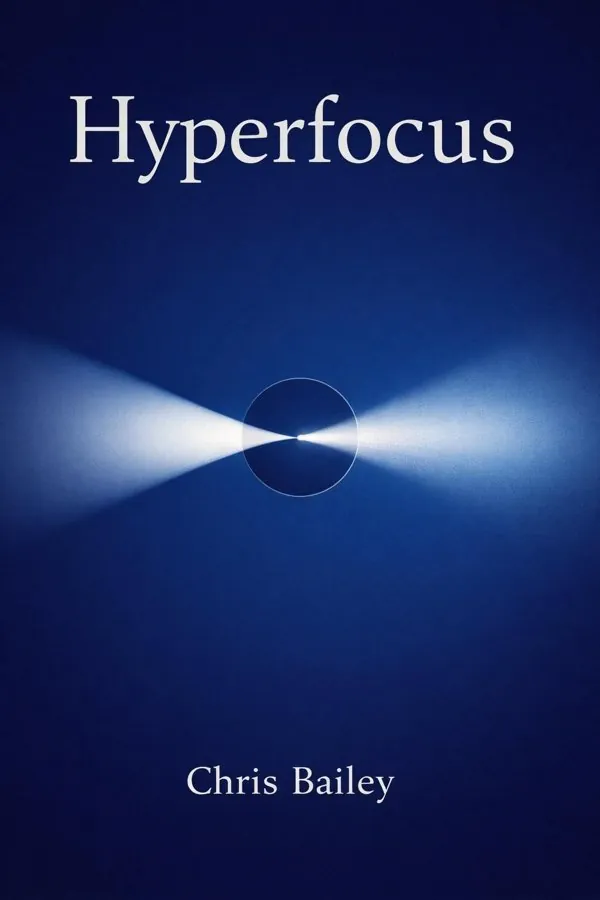
Hyperfocus: How to Work Less to Achieve More: Summary & Key Insights
by Chris Bailey
 10 min9 chaptersAudio available
Key Takeaways from Hyperfocus: How to Work Less to Achieve More
Most people think their problem is a lack of time, when the deeper issue is often a lack of usable attention.
Deep productivity begins when attention stops bouncing and locks onto one meaningful target.
The most damaging distractions are often the ones we have normalized.
Focus is easier to enter when the path into it is prepared.
Getting into a focused state is valuable, but staying there is where extraordinary results are made.
What Is Hyperfocus: How to Work Less to Achieve More About?
Hyperfocus: How to Work Less to Achieve More by Chris Bailey is a productivity book spanning 8 pages. Hyperfocus: How to Work Less to Achieve More is a practical guide to mastering one of the most valuable resources in modern life: attention. In a world designed to fragment concentration through notifications, multitasking, and constant stimulation, Chris Bailey argues that productivity is not mainly about managing time. It is about managing where and how the mind is directed. The book introduces two complementary mental modes: hyperfocus, a state of deep concentration on one meaningful task, and scatterfocus, a more open mode of attention that supports creativity, planning, and problem-solving. Together, these modes help us work with greater intention while avoiding burnout and mental overload. Bailey writes with unusual authority because his ideas are grounded in extensive research, personal experimentation, and years spent studying productivity in real-life settings. Rather than offering abstract theory alone, he turns cognitive science into practical habits readers can use immediately. The result is a thoughtful, actionable book for anyone who feels busy yet unfocused and wants to achieve more by using attention more deliberately.
This FizzRead summary covers all 9 key chapters of Hyperfocus: How to Work Less to Achieve More in approximately 10 minutes, distilling the most important ideas, arguments, and takeaways from Chris Bailey's work. Also available as an audio summary and Key Quotes Podcast.
Hyperfocus: How to Work Less to Achieve More
Hyperfocus: How to Work Less to Achieve More is a practical guide to mastering one of the most valuable resources in modern life: attention. In a world designed to fragment concentration through notifications, multitasking, and constant stimulation, Chris Bailey argues that productivity is not mainly about managing time. It is about managing where and how the mind is directed. The book introduces two complementary mental modes: hyperfocus, a state of deep concentration on one meaningful task, and scatterfocus, a more open mode of attention that supports creativity, planning, and problem-solving. Together, these modes help us work with greater intention while avoiding burnout and mental overload. Bailey writes with unusual authority because his ideas are grounded in extensive research, personal experimentation, and years spent studying productivity in real-life settings. Rather than offering abstract theory alone, he turns cognitive science into practical habits readers can use immediately. The result is a thoughtful, actionable book for anyone who feels busy yet unfocused and wants to achieve more by using attention more deliberately.
Who Should Read Hyperfocus: How to Work Less to Achieve More?
This book is perfect for anyone interested in productivity and looking to gain actionable insights in a short read. Whether you're a student, professional, or lifelong learner, the key ideas from Hyperfocus: How to Work Less to Achieve More by Chris Bailey will help you think differently.
- ✓Readers who enjoy productivity and want practical takeaways
- ✓Professionals looking to apply new ideas to their work and life
- ✓Anyone who wants the core insights of Hyperfocus: How to Work Less to Achieve More in just 10 minutes
Want the full summary?
Get instant access to this book summary and 100K+ more with Fizz Moment.
Get Free SummaryAvailable on App Store • Free to download
Key Chapters
Most people think their problem is a lack of time, when the deeper issue is often a lack of usable attention. Bailey begins by explaining that attention is a limited mental resource. At any moment, we can hold only a small amount of information in what he calls our attentional space. Whatever enters that space shapes our experience, our performance, and ultimately the quality of our work. This is why interruptions feel so costly: they do not merely pause progress, they displace what we were mentally holding and force us to rebuild context from scratch.
The book shows that attention is selective, fragile, and deeply influenced by both internal and external triggers. A buzzing phone, a cluttered browser, anxiety about another task, or even hunger can compete for entry into attentional space. Once that space becomes crowded, clear thinking deteriorates. We become reactive instead of intentional. This helps explain why multitasking feels productive in the moment but often leads to shallow results, mistakes, and fatigue.
Bailey’s framework is useful because it makes productivity concrete. Instead of vaguely trying to “focus better,” we can ask a sharper question: what deserves space in my mind right now? For example, during writing, having email open in the background consumes mental bandwidth even if you do not actively respond. Likewise, trying to plan dinner while finishing a report splits attention before either task is complete.
The actionable takeaway is to treat attention like a budget. Before starting important work, remove as many competing claims on your attentional space as possible so your mind can fully engage with what matters most.
Deep productivity begins when attention stops bouncing and locks onto one meaningful target. Bailey defines hyperfocus as a deliberate state in which you concentrate intensely on a single task, filtering out distractions and immersing yourself so fully that work becomes more efficient and often more satisfying. This is not mindless overwork or obsessive busyness. Hyperfocus is intentional concentration directed toward something important.
What makes this idea powerful is that hyperfocus is less about willpower than design. People often assume deep focus happens only when inspiration strikes, but Bailey shows that it can be cultivated. The mind enters hyperfocus more easily when a task is clear, challenging but manageable, and free from unnecessary interruptions. In that state, we process information more effectively, make better decisions, and produce higher-quality output in less time.
Consider the difference between spending three hours “working” while checking messages every few minutes versus spending ninety uninterrupted minutes on a proposal, analysis, or lesson plan. The second approach often produces more meaningful progress because the mind remains fully engaged. Hyperfocus also makes work feel less draining, since constant task-switching is one of the biggest sources of cognitive exhaustion.
Bailey’s point is not that every task requires deep immersion. Routine administrative work may not. But our most valuable tasks usually do: writing, designing, strategic planning, studying, coding, or solving complex problems. These are the activities that reward sustained attention.
The actionable takeaway is to identify one high-value task each day that deserves full concentration, then commit to working on it in single-tasking mode for a defined block of time without splitting your attention.
Focus is easier to enter when the path into it is prepared. Bailey shows that hyperfocus rarely appears by accident in environments built for interruption. Instead, it emerges when we create conditions that invite sustained attention. The first condition is choosing one task worth focusing on. If priorities are vague, attention scatters. The second is defining a clear endpoint, because the brain resists open-ended demands. The third is reducing friction, so beginning the task feels simple rather than mentally expensive.
This can be done in practical ways. Before a work session, decide exactly what success looks like: draft the introduction, analyze three client accounts, review one chapter, or prepare five slides. Close unrelated tabs, silence alerts, put the phone in another room, and gather needed materials in advance. Even a brief ritual such as making tea, putting on headphones, or clearing the desk can signal to the brain that concentration is about to begin.
Bailey also notes that attention follows interest and challenge. Tasks that are too easy invite boredom, while tasks that are too difficult trigger avoidance. If a project feels overwhelming, reduce it to a smaller starting point. Instead of “write the report,” begin with “outline the first three sections.” If motivation is low, create a timer-based commitment such as focusing for twenty-five or forty-five minutes before reevaluating.
Entering hyperfocus is not about waiting to feel ready. It is about lowering barriers until deep work becomes the most natural next action. Momentum often follows initiation, not the other way around.
The actionable takeaway is to create a repeatable focus ritual: choose one priority, define the next concrete step, remove obvious distractions, and begin with a timed session.
Getting into a focused state is valuable, but staying there is where extraordinary results are made. Bailey explains that hyperfocus is vulnerable because attention is constantly being pulled by novelty, uncertainty, and competing demands. Maintaining concentration therefore requires active protection. The goal is not rigid perfection but reducing the number of moments when the mind is invited to wander.
One of the most practical strategies is to work in structured intervals that respect mental energy. Many people can sustain strong concentration for a limited period before quality declines. Rather than forcing endless endurance, Bailey suggests using deliberate blocks of focus followed by brief breaks. Breaks are not failures of discipline; they help restore attention and prevent the cognitive fatigue that leads to mindless switching.
Another important method is managing open loops. The brain clings to unfinished tasks, reminders, and loose obligations. If you suddenly remember a bill to pay or a call to return, writing it down externally prevents it from continuing to occupy attentional space. Similarly, batching small tasks together at separate times keeps them from intruding into deep work sessions.
Bailey also stresses the importance of energy basics. Sleep, nutrition, movement, and stress management are not side issues. They directly shape how stable our attention is. A tired mind is more distractible and more likely to seek quick stimulation. A well-rested mind is more capable of sustained effort.
The actionable takeaway is to treat focus as something to defend: work in intentional blocks, capture stray thoughts on paper, and support concentration with sleep, movement, and regular breaks.
Some of our best ideas arrive when we stop trying so hard to think. This is the insight behind scatterfocus, Bailey’s term for a looser mode of attention in which the mind wanders freely and makes unexpected connections. While hyperfocus is ideal for execution, scatterfocus is essential for creativity, reflection, memory consolidation, and problem-solving. Productivity is not just about narrowing attention. It is also about knowing when to let the mind open up.
Scatterfocus often emerges during low-stimulation activities such as walking, showering, commuting, or doing household chores. In these moments, the brain shifts away from immediate external demands and begins exploring internal material. Ideas combine, unresolved questions resurface, and patterns become visible. This is why a solution to a work problem may appear during a run rather than at the desk.
Bailey helps readers understand that constant stimulation kills this process. If every spare moment is filled with scrolling, podcasts, or messages, the mind has little room to drift productively. We may stay entertained, but we lose access to the mental space where insight often forms. Scatterfocus is not laziness; it is a cognitive mode with distinct value.
In practical terms, scatterfocus can be cultivated intentionally. Leave some walks device-free. Sit for a few quiet minutes after finishing a major task. Step away from a problem before forcing a solution. Keep a notebook nearby, because wandering thoughts often produce useful ideas when captured quickly.
The actionable takeaway is to build small pockets of deliberate mental openness into your day, especially after periods of intense work, so your mind has space to generate new connections and solutions.
Peak performance does not come from focusing all the time. It comes from alternating wisely between concentration and openness. Bailey’s most distinctive contribution is showing that hyperfocus and scatterfocus are not competing states but complementary ones. Hyperfocus helps us execute with precision. Scatterfocus helps us think broadly, recharge, and incubate ideas. If we overuse one mode and neglect the other, our work becomes either rigid or unfocused.
Many productivity systems glorify nonstop intensity, but Bailey argues this is unsustainable and often counterproductive. Long stretches of forced concentration can reduce creativity and increase fatigue. On the other hand, too much mental drift leads to vague intentions and unfinished work. The real skill is knowing which mode a task requires. Writing a final draft may call for hyperfocus. Generating concepts, rethinking strategy, or solving a stubborn problem may benefit more from scatterfocus.
A balanced attention system might look like this: spend the morning in deep work on a high-value project, take a walk afterward without checking your phone, then use the afternoon for meetings or lighter tasks. Or study intensely for fifty minutes, then let your mind rest briefly before returning. Teams can apply the same principle by separating brainstorming sessions from execution sessions rather than trying to do both at once.
This balance also supports well-being. People feel less drained when they stop expecting one mental mode to do everything. Attention is dynamic, and productivity improves when we work with that reality rather than against it.
The actionable takeaway is to plan your days around both modes of attention, pairing focused work blocks with quiet periods that allow ideas to breathe and develop.
Willpower is unreliable, but environments quietly shape behavior all day long. Bailey repeatedly shows that the easiest way to improve focus is often not trying harder but making distraction less available and meaningful work more obvious. Our surroundings cue habits. A phone within reach invites checking. An open-plan office invites interruption. Twenty browser tabs invite cognitive overload. A clear desk and a visible priority list invite engagement with what matters.
Attention-friendly design can happen at several levels. Physical space matters: lighting, noise, clutter, posture, and comfort all affect mental stability. Digital space matters just as much: inboxes, app badges, desktop clutter, and social feeds can fracture concentration before work even begins. Social expectations also matter. If colleagues assume instant replies, uninterrupted work becomes difficult unless boundaries are communicated.
Bailey’s ideas are practical because they ask readers to redesign defaults. Put distracting apps off the home screen. Keep only one relevant document open during deep work. Use full-screen mode. Schedule communication windows rather than constantly monitoring messages. If you work in a busy setting, use signals such as headphones or calendar blocks to indicate focus time. At home, even changing rooms or facing away from visual distractions can improve concentration.
This approach reduces the need for constant self-control. Instead of fighting temptation hundreds of times a day, you simply encounter it less often. The result is not only better productivity but also lower mental friction.
The actionable takeaway is to redesign one physical and one digital environment this week so that the next obvious action is focused work, not distraction.
Where attention goes, life follows. Bailey makes it clear that attention management is bigger than workplace efficiency. It shapes relationships, leisure, decision-making, and how meaningful our days feel. If attention is constantly fragmented, even enjoyable activities can feel thin and unsatisfying. We skim conversations, half-watch entertainment, and rush through meals while mentally elsewhere. Productivity then becomes only one symptom of a broader issue: living without full presence.
This is why the lessons of Hyperfocus extend beyond getting more done. Deliberate attention helps us listen better, think more carefully, and derive more value from fewer activities. A focused hour with a loved one can matter more than an evening spent together while everyone checks devices. Reading one chapter with full attention can be richer than “covering” many pages while distracted. Even rest improves when we are actually resting rather than toggling between entertainment and unfinished work.
Bailey’s philosophy also challenges the assumption that being busy is the same as being effective. Attention reveals the truth. If the day was consumed by reactive tasks, shallow browsing, and fragmented effort, busyness may have masked low-value activity. By contrast, a shorter day centered on a few meaningful priorities can produce better results and leave more room for life.
The book ultimately invites readers to become intentional about what they allow into consciousness. That is both a productivity strategy and a way of living more deliberately.
The actionable takeaway is to choose one daily activity outside work, such as a meal, conversation, or walk, and practice giving it your complete, undivided attention.
All Chapters in Hyperfocus: How to Work Less to Achieve More
About the Author
Chris Bailey is a Canadian author and productivity expert known for translating behavioral science and cognitive research into practical strategies for everyday work and life. He first gained wide attention through ambitious self-directed productivity experiments, in which he tested methods for improving focus, energy, and effectiveness. Bailey is the author of The Productivity Project and Hyperfocus, two influential books that explore how people can work smarter in a world filled with distraction. His writing is respected for being both research-based and highly actionable, blending neuroscience, psychology, and personal experimentation. Through his books, articles, and speaking, Bailey has become a trusted voice on attention management, deep work, and sustainable productivity, helping readers achieve more without relying on busyness or burnout.
Get This Summary in Your Preferred Format
Read or listen to the Hyperfocus: How to Work Less to Achieve More summary by Chris Bailey anytime, anywhere. FizzRead offers multiple formats so you can learn on your terms — all free.
Available formats: App · Audio · PDF · EPUB — All included free with FizzRead
Download Hyperfocus: How to Work Less to Achieve More PDF and EPUB Summary
Key Quotes from Hyperfocus: How to Work Less to Achieve More
“Most people think their problem is a lack of time, when the deeper issue is often a lack of usable attention.”
“Deep productivity begins when attention stops bouncing and locks onto one meaningful target.”
“The most damaging distractions are often the ones we have normalized.”
“Focus is easier to enter when the path into it is prepared.”
“Getting into a focused state is valuable, but staying there is where extraordinary results are made.”
Frequently Asked Questions about Hyperfocus: How to Work Less to Achieve More
Hyperfocus: How to Work Less to Achieve More by Chris Bailey is a productivity book that explores key ideas across 9 chapters. Hyperfocus: How to Work Less to Achieve More is a practical guide to mastering one of the most valuable resources in modern life: attention. In a world designed to fragment concentration through notifications, multitasking, and constant stimulation, Chris Bailey argues that productivity is not mainly about managing time. It is about managing where and how the mind is directed. The book introduces two complementary mental modes: hyperfocus, a state of deep concentration on one meaningful task, and scatterfocus, a more open mode of attention that supports creativity, planning, and problem-solving. Together, these modes help us work with greater intention while avoiding burnout and mental overload. Bailey writes with unusual authority because his ideas are grounded in extensive research, personal experimentation, and years spent studying productivity in real-life settings. Rather than offering abstract theory alone, he turns cognitive science into practical habits readers can use immediately. The result is a thoughtful, actionable book for anyone who feels busy yet unfocused and wants to achieve more by using attention more deliberately.
More by Chris Bailey
You Might Also Like

Browse by Category
Ready to read Hyperfocus: How to Work Less to Achieve More?
Get the full summary and 100K+ more books with Fizz Moment.