
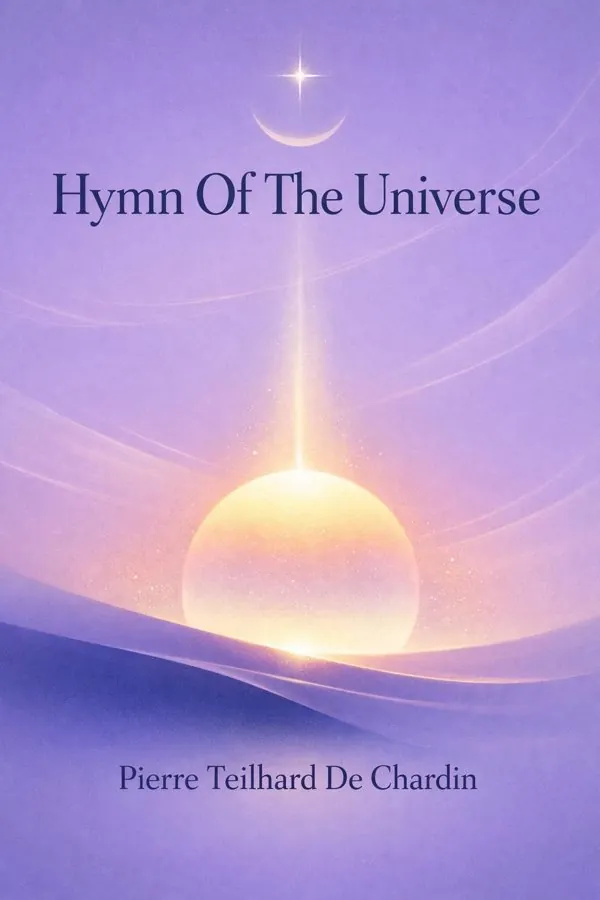
Hymn Of The Universe: Summary & Key Insights
 10 min10 chaptersAudio available
Key Takeaways from Hymn Of The Universe
A great spiritual shift begins when we stop treating the world as spiritually empty.
The story of evolution can feel cold when reduced to mechanism, but Teilhard sees in it a majestic spiritual drama.
Deprived of bread, wine, altar, and church, he offers instead the whole earth as the material of worship.
Many spiritual traditions struggle with the temptation to divide reality into higher spirit and lower matter.
Teilhard’s most distinctive theological claim is that evolution is ultimately gathered, centered, and fulfilled in Christ.
What Is Hymn Of The Universe About?
Hymn Of The Universe by Pierre Teilhard De Chardin is a western_phil book spanning 10 pages. Hymn Of The Universe is one of Pierre Teilhard de Chardin’s most luminous and daring spiritual works, blending prayer, theology, science, and poetic meditation into a single vision of reality. Rather than treating the material world as something separate from the divine, Teilhard presents the universe itself as a sacred process unfolding toward spiritual fulfillment. Across essays such as The Mass on the World, he argues that matter, life, consciousness, suffering, love, and human history all participate in a vast movement toward union in what he calls the Cosmic Christ. This is not a rejection of science but an attempt to see evolution as spiritually meaningful. The book matters because it offers a way of thinking that can speak both to religious readers seeking a larger faith and to modern readers searching for meaning in a scientific age. Teilhard’s authority is unusual and powerful: he was a Jesuit priest, a trained philosopher, and a distinguished paleontologist who worked directly with the story of life’s development over deep time. Hymn Of The Universe remains a profound invitation to see the world not as fragmented and empty, but as alive with divine purpose.
This FizzRead summary covers all 10 key chapters of Hymn Of The Universe in approximately 10 minutes, distilling the most important ideas, arguments, and takeaways from Pierre Teilhard De Chardin's work. Also available as an audio summary and Key Quotes Podcast.
Hymn Of The Universe
Hymn Of The Universe is one of Pierre Teilhard de Chardin’s most luminous and daring spiritual works, blending prayer, theology, science, and poetic meditation into a single vision of reality. Rather than treating the material world as something separate from the divine, Teilhard presents the universe itself as a sacred process unfolding toward spiritual fulfillment. Across essays such as The Mass on the World, he argues that matter, life, consciousness, suffering, love, and human history all participate in a vast movement toward union in what he calls the Cosmic Christ. This is not a rejection of science but an attempt to see evolution as spiritually meaningful. The book matters because it offers a way of thinking that can speak both to religious readers seeking a larger faith and to modern readers searching for meaning in a scientific age. Teilhard’s authority is unusual and powerful: he was a Jesuit priest, a trained philosopher, and a distinguished paleontologist who worked directly with the story of life’s development over deep time. Hymn Of The Universe remains a profound invitation to see the world not as fragmented and empty, but as alive with divine purpose.
Who Should Read Hymn Of The Universe?
This book is perfect for anyone interested in western_phil and looking to gain actionable insights in a short read. Whether you're a student, professional, or lifelong learner, the key ideas from Hymn Of The Universe by Pierre Teilhard De Chardin will help you think differently.
- ✓Readers who enjoy western_phil and want practical takeaways
- ✓Professionals looking to apply new ideas to their work and life
- ✓Anyone who wants the core insights of Hymn Of The Universe in just 10 minutes
Want the full summary?
Get instant access to this book summary and 100K+ more with Fizz Moment.
Get Free SummaryAvailable on App Store • Free to download
Key Chapters
A great spiritual shift begins when we stop treating the world as spiritually empty. One of Teilhard’s central insights is that the earth is not merely raw material for human use, nor a fallen stage to escape from, but a living field of divine presence. Mountains, oceans, labor, history, and even the unfinished processes of life belong within a sacred whole. In Hymn Of The Universe, he asks us to recover a sacramental vision: matter is not opposed to God but can become a medium through which God is encountered.
This idea changes the tone of spiritual life. Instead of confining prayer to churches or private contemplation, Teilhard opens the possibility that ordinary existence itself can become worship. Scientific work, parenting, building institutions, growing food, healing the sick, and caring for the environment all take on spiritual dignity. If creation is already oriented toward divine fulfillment, then our attention to it matters. Reverence becomes a mode of seeing before it becomes a doctrine.
Practically, this means we can train ourselves to notice the sacred in daily experience. A researcher studying ecosystems, a teacher guiding students, or a nurse caring for a patient can approach work not as secular interruption but as participation in a larger creative process. Even acts of maintenance and patience can become forms of devotion when seen in this light.
Actionable takeaway: Choose one ordinary part of your day—work, walking, cooking, or conversation—and practice viewing it as a place where the sacred is already present rather than absent.
The story of evolution can feel cold when reduced to mechanism, but Teilhard sees in it a majestic spiritual drama. As a paleontologist, he spent his life tracing the deep history of matter becoming life and life becoming thought. For him, evolution is not a random curiosity on the margins of faith; it is the very process through which the universe discloses its inner direction. Complexity increases, life emerges, consciousness awakens, and humanity becomes capable of reflection. These developments suggest to Teilhard that the cosmos is not static but moving.
What makes this significant is his refusal to separate scientific understanding from spiritual meaning. He does not deny struggle, death, contingency, or immense time. Instead, he argues that these belong to a creative unfolding in which the universe slowly becomes capable of greater unity and awareness. Evolution is not merely biological succession; it is the gradual interiorization of reality. Matter develops an inwardness that culminates, at least for now, in human self-consciousness.
This view offers a different response to modern disillusionment. Rather than seeing science as a force that strips meaning from existence, Teilhard proposes that science reveals the grandeur of a universe still in the making. A person studying history, biology, or cosmology can interpret these fields not as threats to spiritual life but as invitations to wonder.
Actionable takeaway: When you encounter scientific accounts of nature or human origins, ask not only how things developed, but what kind of increasing depth, consciousness, or connectedness that development might be pointing toward.
One of the most memorable sections of Hymn Of The Universe is The Mass on the World, written when Teilhard found himself in a place where he could not celebrate the Eucharist in the usual way. Deprived of bread, wine, altar, and church, he offers instead the whole earth as the material of worship. Human labor, suffering, aspiration, and the energies of the planet become the elements lifted toward God. This is not a replacement of liturgy but an expansion of sacramental imagination.
The insight is radical: all genuine work and all honest suffering can be gathered into an offering. The world itself becomes altar-like when viewed in relation to divine love. Teilhard does not flatten the distinction between God and creation, but he insists that creation can be consciously presented back to God through human awareness and praise. The Eucharistic pattern of offering, transformation, and communion becomes cosmic in scope.
This can be applied in daily life by reframing activity as intentional offering. A person beginning a demanding day can inwardly place their tasks, frustrations, efforts, and relationships on the altar of intention. A social worker dealing with exhaustion, a parent carrying invisible burdens, or a scientist pursuing difficult truth can convert labor into participation in a larger act of praise.
Actionable takeaway: At the start of the day, name one effort and one difficulty you will consciously offer as part of something larger than yourself, turning work and strain into a spiritual act.
Many spiritual traditions struggle with the temptation to divide reality into higher spirit and lower matter. Teilhard resists this split with unusual force. In his vision, matter is not the enemy of spirit, nor is spirit an escape from the physical world. Instead, matter is the womb of spirit’s emergence. The universe moves from elemental structure to life, from life to thought, and from thought toward fuller spiritual union. Spirit does not arrive by rejecting matter but by passing through it and transforming it from within.
This idea helps resolve a common modern tension. People often feel pressured to choose between scientific materialism, which reduces everything to physical processes, and religious dualism, which diminishes the importance of embodiment and history. Teilhard offers a third way. He sees matter as charged with potentiality, capable of organization, interiority, and eventually consciousness. Spirit is not foreign to the world; it is the deepening of the world.
In practice, this can reshape how we think about the body, technology, art, and ecology. Caring for physical health, building just institutions, and respecting ecosystems are not merely practical concerns detached from spiritual life. They are ways of honoring the very medium through which higher forms of life and awareness emerge. Spiritual maturity should deepen engagement with the world, not weaken it.
Actionable takeaway: Identify one area where you have treated the physical as spiritually unimportant—your body, environment, work tools, or home—and bring to it more reverence, care, and intentionality.
Teilhard’s most distinctive theological claim is that evolution is ultimately gathered, centered, and fulfilled in Christ. He does not present Christ merely as a figure in ancient history or only as a private savior of souls. Instead, he speaks of the Cosmic Christ: the divine presence through whom the universe coheres and toward whom all creation moves. In this view, Christianity is not a narrow religious system added onto the world; it is a revelation of the deepest meaning already at work within the world’s unfolding.
This expands the significance of incarnation. If Christ is truly united with creation, then redemption does not concern only human guilt in isolation. It concerns the transfiguration of the whole cosmos. The evolutionary process, with all its striving toward greater unity and consciousness, is not self-sufficient, but neither is it spiritually abandoned. Christ is both the source of its coherence and the final point of its convergence.
For readers, this can renew faith by making it larger and more intellectually hospitable. It allows Christian belief to meet modern cosmology without retreating into defensiveness. It also challenges believers to think beyond purely individual salvation. If Christ’s work is cosmic, then justice, solidarity, scientific inquiry, and ecological responsibility all gain theological depth.
Actionable takeaway: Reflect on one area where your spiritual life has become too private or narrow, and ask how it might look if you understood it as participation in a reality that embraces all creation.
The emergence of human consciousness is, for Teilhard, one of evolution’s decisive thresholds. Matter becomes life, life becomes reflective thought, and in human beings the universe gains the ability to know itself. This does not make humanity the owner of creation, but it does assign us a profound responsibility. Consciousness is not simply an accidental byproduct; it is a sign that the cosmos is developing inward depth as well as outward complexity.
Teilhard often emphasizes reflection: the uniquely human capacity not only to know, but to know that we know. This self-awareness makes moral choice, culture, science, art, and religion possible. It also creates danger. Humans can use consciousness to fragment, dominate, and destroy, or to cooperate, unify, and deepen the world’s spiritual future. Evolution at the human level becomes partially entrusted to freedom.
A practical implication is that interior development matters. Learning, contemplation, ethical discipline, dialogue, and creative work are not luxuries. They contribute to the growth of a more conscious humanity. Communities that foster critical thinking, compassion, and shared purpose become sites where evolution advances in personal and collective form.
In everyday terms, a person who cultivates attention instead of distraction, understanding instead of reaction, and service instead of egoism is participating in this movement toward higher consciousness.
Actionable takeaway: Commit to one practice that strengthens reflective awareness—journaling, meditation, deep reading, or thoughtful dialogue—and treat it as part of your responsibility to grow, not merely as self-improvement.
Not all forces in the universe can be measured by physics alone. Teilhard gives love a central place because he sees it as the power that unites without erasing difference. In biological and social evolution, mere aggregation is not enough; what matters is the formation of richer unities. Love, in the broadest and deepest sense, is the energy by which persons move beyond isolation and enter communion. It is the spiritual law of convergence.
This does not mean sentimentality. For Teilhard, love includes attraction, loyalty, solidarity, sacrifice, and the patient building of bonds across separation. It is the force that allows consciousness to rise to a more integrated level. In families, friendships, intellectual communities, and social movements, genuine love creates new wholes that are greater than their parts. It honors individuality while drawing persons into meaningful relation.
This matters especially in a fragmented age. Modern life often produces connection without communion and information without mutual belonging. Teilhard suggests that the future of humanity depends not simply on technological coordination but on spiritualized relationship. Without love, complexity becomes chaos; with love, complexity becomes unity.
Examples are easy to find: a team that trusts one another creates better work than a group held together only by rules; communities that practice forgiveness endure; societies built on solidarity are more humane than those driven by competition alone.
Actionable takeaway: Strengthen one relationship this week through a concrete act of attentive love—listening fully, reconciling honestly, encouraging generously, or serving without seeking recognition.
A vision as expansive as Teilhard’s must account for pain, loss, and failure. He does not romanticize suffering or pretend that all wounds are easily meaningful. Yet he insists that suffering need not be spiritually sterile. In a universe still unfinished, resistance, limitation, and even breakdown can become part of a deeper transformation. What cannot be avoided can still be offered, integrated, and transfigured.
This is one of the book’s more demanding claims. Teilhard distinguishes between passive diminishment—illness, aging, disappointment, powerlessness—and active effort. Both can be spiritually fruitful when united to a larger movement toward God. The person who cannot change their condition may still change the meaning of their condition by consenting to let it become an offering rather than mere defeat. This does not remove grief, but it prevents despair from having the final word.
In ordinary life, this insight can sustain people through setbacks that otherwise feel absurd. A caregiver facing exhaustion, a patient living with chronic illness, or a worker enduring failure may discover that endurance, honesty, and trust can deepen character and compassion. The value of suffering lies not in pain itself, but in what love can make of it.
Actionable takeaway: When facing a difficulty you cannot quickly solve, ask how you might respond in a way that preserves dignity, deepens compassion, and joins your pain to a purpose larger than immediate relief.
Teilhard’s grand vision culminates in the idea of the Omega Point, the final center toward which evolution tends. Omega is not merely the end of time in a chronological sense. It is the supreme point of personal and spiritual convergence, where the many are united without being annihilated. For Teilhard, this ultimate fulfillment is inseparable from God and fully expressed in the Cosmic Christ. The universe does not dissolve into impersonal nothingness; it reaches consummation in a higher order of conscious union.
The importance of Omega is that it gives direction to the entire book. Without some real goal, evolution would be motion without meaning. With Omega, the struggles and incompletions of history can be interpreted as stages in an unfinished but purposive process. This hope is not naive progressivism. Teilhard knows that history includes catastrophe and regression. His claim is deeper: beneath surface disorder, creation is being drawn toward a unifying fulfillment.
For readers, Omega can function as a spiritual orientation. We become what we love and what we move toward. If our lives are directed only by short-term success or fear, we remain fragmented. If they are ordered toward truth, communion, and divine fullness, our decisions begin to align around a deeper center.
Actionable takeaway: Clarify your own highest orientation by asking what ultimate end your habits are training you toward, and choose one change that better aligns your daily life with unity, truth, and love.
All Chapters in Hymn Of The Universe
About the Author
Pierre Teilhard de Chardin (1881–1955) was a French Jesuit priest, scientist, and philosopher whose work sought to bring Christian theology into conversation with modern evolutionary science. Trained in theology as well as paleontology, he participated in major scientific research and spent years studying fossils, human origins, and the development of life across geological time. These experiences deeply shaped his thought, leading him to propose that evolution is not only a biological process but also a spiritual one moving toward greater consciousness and unity. During his lifetime, some of his theological ideas were viewed with suspicion by Church authorities, and several of his major works were published only after his death. Today, he is widely recognized as a pioneering thinker in religion and science, admired for his visionary concept of the Cosmic Christ and the spiritual destiny of the universe.
Get This Summary in Your Preferred Format
Read or listen to the Hymn Of The Universe summary by Pierre Teilhard De Chardin anytime, anywhere. FizzRead offers multiple formats so you can learn on your terms — all free.
Available formats: App · Audio · PDF · EPUB — All included free with FizzRead
Download Hymn Of The Universe PDF and EPUB Summary
Key Quotes from Hymn Of The Universe
“A great spiritual shift begins when we stop treating the world as spiritually empty.”
“The story of evolution can feel cold when reduced to mechanism, but Teilhard sees in it a majestic spiritual drama.”
“One of the most memorable sections of Hymn Of The Universe is The Mass on the World, written when Teilhard found himself in a place where he could not celebrate the Eucharist in the usual way.”
“Many spiritual traditions struggle with the temptation to divide reality into higher spirit and lower matter.”
“Teilhard’s most distinctive theological claim is that evolution is ultimately gathered, centered, and fulfilled in Christ.”
Frequently Asked Questions about Hymn Of The Universe
Hymn Of The Universe by Pierre Teilhard De Chardin is a western_phil book that explores key ideas across 10 chapters. Hymn Of The Universe is one of Pierre Teilhard de Chardin’s most luminous and daring spiritual works, blending prayer, theology, science, and poetic meditation into a single vision of reality. Rather than treating the material world as something separate from the divine, Teilhard presents the universe itself as a sacred process unfolding toward spiritual fulfillment. Across essays such as The Mass on the World, he argues that matter, life, consciousness, suffering, love, and human history all participate in a vast movement toward union in what he calls the Cosmic Christ. This is not a rejection of science but an attempt to see evolution as spiritually meaningful. The book matters because it offers a way of thinking that can speak both to religious readers seeking a larger faith and to modern readers searching for meaning in a scientific age. Teilhard’s authority is unusual and powerful: he was a Jesuit priest, a trained philosopher, and a distinguished paleontologist who worked directly with the story of life’s development over deep time. Hymn Of The Universe remains a profound invitation to see the world not as fragmented and empty, but as alive with divine purpose.
More by Pierre Teilhard De Chardin
You Might Also Like
A Little History of Philosophy
Nigel Warburton
10 min
Areopagitica
John Milton
10 min
How To Think Like A Philosopher: Essential Principles For Clear Thinking
Peter Cave
10 min
Language, Truth and Logic
A. J. Ayer
10 min
The Age of Reason
Thomas Paine
10 min
The Essays
Michel De Montaigne
10 minBrowse by Category
Ready to read Hymn Of The Universe?
Get the full summary and 100K+ more books with Fizz Moment.