
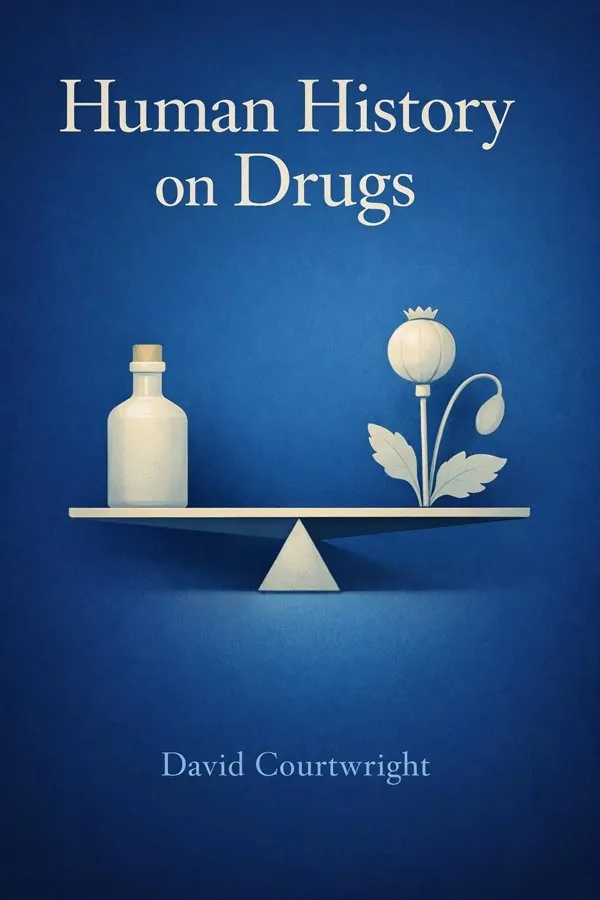
Human History on Drugs: Summary & Key Insights
 10 min9 chaptersAudio available
Key Takeaways from Human History on Drugs
One of the oldest facts about human life is that people rarely settled for ordinary consciousness alone.
A substance becomes historically powerful when it travels.
Few historical forces expanded drug use more aggressively than empire.
A drug becomes a social force on a new scale when technology makes it cheaper, stronger, and more widely available.
The line between medicine and vice has always been unstable.
What Is Human History on Drugs About?
Human History on Drugs by David Courtwright is a world_history book spanning 9 pages. Human beings have always searched for ways to change consciousness. Long before laboratories, pharmacies, and drug laws existed, people fermented fruit, chewed stimulating leaves, inhaled smoke, brewed intoxicating drinks, and used plants in rituals, medicine, and trade. In Human History on Drugs, historian David T. Courtwright shows that psychoactive substances are not a side story in civilization; they are woven into the rise of empires, the expansion of global commerce, the shaping of social habits, and the making of modern states. Rather than treating drugs only as a moral problem or a criminal issue, Courtwright places them in a broad historical framework that explains why some substances became accepted, taxed, celebrated, medicalized, or banned. The book matters because it helps readers see today’s debates about addiction, regulation, and public health as the latest chapter in a very long human story. Courtwright, a leading historian of drugs and policy, writes with clarity, scholarship, and balance, making this an essential guide for anyone who wants to understand how intoxicants helped build the modern world.
This FizzRead summary covers all 9 key chapters of Human History on Drugs in approximately 10 minutes, distilling the most important ideas, arguments, and takeaways from David Courtwright's work. Also available as an audio summary and Key Quotes Podcast.
Human History on Drugs
Human beings have always searched for ways to change consciousness. Long before laboratories, pharmacies, and drug laws existed, people fermented fruit, chewed stimulating leaves, inhaled smoke, brewed intoxicating drinks, and used plants in rituals, medicine, and trade. In Human History on Drugs, historian David T. Courtwright shows that psychoactive substances are not a side story in civilization; they are woven into the rise of empires, the expansion of global commerce, the shaping of social habits, and the making of modern states. Rather than treating drugs only as a moral problem or a criminal issue, Courtwright places them in a broad historical framework that explains why some substances became accepted, taxed, celebrated, medicalized, or banned. The book matters because it helps readers see today’s debates about addiction, regulation, and public health as the latest chapter in a very long human story. Courtwright, a leading historian of drugs and policy, writes with clarity, scholarship, and balance, making this an essential guide for anyone who wants to understand how intoxicants helped build the modern world.
Who Should Read Human History on Drugs?
This book is perfect for anyone interested in world_history and looking to gain actionable insights in a short read. Whether you're a student, professional, or lifelong learner, the key ideas from Human History on Drugs by David Courtwright will help you think differently.
- ✓Readers who enjoy world_history and want practical takeaways
- ✓Professionals looking to apply new ideas to their work and life
- ✓Anyone who wants the core insights of Human History on Drugs in just 10 minutes
Want the full summary?
Get instant access to this book summary and 100K+ more with Fizz Moment.
Get Free SummaryAvailable on App Store • Free to download
Key Chapters
One of the oldest facts about human life is that people rarely settled for ordinary consciousness alone. Courtwright begins with the deep past, showing that psychoactive drug use long predates written history. Early humans discovered through trial, ritual, and observation that certain plants, fermented fruits, and smoke-producing materials could dull pain, induce trance, enhance sociability, or create feelings of energy and pleasure. These discoveries were not random curiosities. They became embedded in hunting cultures, healing practices, spiritual ceremonies, and social bonding. In many societies, intoxicants were linked to sacred power, status, or specialized knowledge, giving shamans, healers, and elders influence over when and how such substances were used.
What makes this idea important is that it challenges the modern assumption that drug use is a recent social breakdown. Courtwright instead suggests that the desire for intoxication is a recurring feature of human behavior. Alcohol, hallucinogenic plants, and stimulants were often woven into daily or ceremonial life long before formal markets existed. A practical way to apply this insight is to reconsider present-day debates. If the appetite for mind-altering substances is historically persistent, then policies built on the fantasy of total eradication may be unrealistic. More effective approaches acknowledge enduring demand and focus on safety, context, and harm reduction.
Actionable takeaway: when thinking about modern drug issues, start from the premise that drug use is a longstanding human constant, not an abnormal interruption of history.
A substance becomes historically powerful when it travels. Courtwright shows that as trade routes expanded across Asia, Africa, Europe, and later the Atlantic world, drugs moved from local customs into global commodities. The Silk Road, Indian Ocean trade, and regional caravan networks carried not just silk, spices, and metals but also psychoactive goods and the habits surrounding them. Coffee spread from the Islamic world outward. Tobacco, after the Columbian Exchange, rapidly transformed smoking cultures across continents. Opium, betel, cannabis, tea, and distilled spirits all crossed borders, changing who used them and what they meant.
This globalization mattered because drugs often traveled faster than the institutions needed to regulate them. A leaf, resin, bean, or powder could take on entirely new social roles when introduced into another culture. Coffeehouses became centers of debate and commerce. Tobacco became a taxable mass habit. Tea reshaped patterns of labor, hospitality, and empire. Drug diffusion also reveals a wider historical truth: commerce does not simply move products; it transfers rituals, identities, and economic dependencies.
Readers can apply this idea by looking at any modern consumer craze, from vaping to energy drinks, as part of a longer pattern in which psychoactive preferences scale through trade, branding, and imitation. New markets often appear before societies have fully considered the health, legal, and cultural consequences.
Actionable takeaway: whenever a drug becomes globally popular, ask not just where it came from, but what systems of trade, prestige, and profit made its spread possible.
Few historical forces expanded drug use more aggressively than empire. Courtwright explains that colonial powers did not merely encounter psychoactive substances; they reorganized entire economies around them. Sugar, tobacco, rum, opium, and later cocaine-related products became embedded in imperial systems of plantation labor, taxation, shipping, and military power. Colonizers frequently encouraged production and consumption when profits were high, even while moralizing about the users. The clearest example is the opium trade, especially Britain’s role in expanding opium sales into China, where commercial interests overrode ethical concerns and contributed to war, political humiliation, and social disruption.
Colonial drug economies reveal how states can simultaneously denounce and depend on intoxicants. Tobacco taxes funded governments. Rum supported Atlantic trade networks tied to slavery. Colonial administrations often regulated substances not to eliminate them, but to control revenue and populations. Some drugs were racialized and class-coded, tolerated among powerful groups and condemned among marginalized ones. This pattern still echoes in modern policy, where legality often reflects history and politics as much as pharmacology.
A practical application is to examine present-day industries with the same historical skepticism. When governments benefit from alcohol taxes, pharmaceutical lobbying, or cannabis revenues, moral language may conceal deeper fiscal and political motives. Courtwright helps readers see that drug policy is rarely neutral.
Actionable takeaway: look behind official narratives about drugs and ask who profits, who governs, and whose consumption is being tolerated or punished.
A drug becomes a social force on a new scale when technology makes it cheaper, stronger, and more widely available. Courtwright shows that industrialization transformed psychoactive substances from regionally limited goods into mass-market products. Mechanized cigarette production, improved distillation, refined sugar, branded patent medicines, and global shipping networks allowed intoxicants to reach millions at lower cost and with more standardized potency. Advertising then did the rest, turning habits into identities and routine use into a modern norm.
This shift matters because industrial production changed both the experience and the risks of drug use. Cigarettes, for instance, made nicotine consumption faster, more frequent, and more addictive than older forms of tobacco. Distilled alcohol differed from fermented beverages in strength and social impact. Pharmaceutical processing isolated alkaloids like morphine and cocaine, increasing medical usefulness but also abuse potential. Consumers no longer dealt only with natural plants in traditional settings; they confronted concentrated, commercial products backed by industrial scale.
The lesson extends beyond history. Today’s ultra-processed nicotine products, high-caffeine beverages, designer drugs, and algorithmically marketed health supplements follow similar patterns. Technology amplifies access, repetition, and dependence. The issue is not only chemistry but delivery systems, packaging, convenience, and mass persuasion.
Actionable takeaway: when evaluating any psychoactive product, pay attention not just to the substance itself but to the industrial systems that increase potency, normalize use, and shape behavior at scale.
The line between medicine and vice has always been unstable. Courtwright traces how many drugs moved through medical systems before becoming restricted, stigmatized, or reclassified. Opiates relieved pain. Cocaine was used as a local anesthetic. Cannabis tinctures circulated in nineteenth-century medicine. Alcohol served therapeutic as well as recreational roles. Physicians, pharmacists, and commercial medicine sellers helped normalize many substances, often before science fully understood dependence, toxicity, or long-term effects.
As medical knowledge advanced, the same institutions that legitimized drugs also helped narrow their acceptable uses. This process of medicalization and regulation created a new framework: drugs could be legal if prescribed, illegal if sold informally, respectable in clinics, and shameful on the street. Courtwright shows that modern drug control emerged partly from this shift in professional authority. Governments relied on medical expertise to classify substances, define addiction, and separate treatment from punishment, though never perfectly.
This history is useful today because similar struggles continue over painkillers, psychiatric medications, psychedelics, and medical cannabis. Scientific evidence matters, but so do professional incentives, cultural fears, and commercial pressures. A drug can move from miracle to menace and back again depending on context and institutions.
Actionable takeaway: approach medical claims about psychoactive substances with both respect for evidence and awareness that medicine, like politics, is shaped by changing knowledge, interests, and social values.
Banning a substance does not erase demand; it often reorganizes supply. Courtwright argues that the modern illegal drug trade grew not simply because drugs are addictive, but because prohibition created profitable black markets. Once governments restricted opiates, cocaine, cannabis, and other substances, criminal entrepreneurs stepped in to meet continuing demand. Smuggling networks, gangs, cartels, clandestine laboratories, and corruption followed. The more intense the crackdown, the more valuable high-potency, easily transportable drugs often became.
This is one of the book’s most important historical insights. Drug control can reduce access in some settings, but it can also generate violent underground economies. Illegal markets reward secrecy, territorial competition, adulteration, and political bribery. Users become vulnerable not only to the substance but to unregulated purity, predatory sellers, and criminalized survival. Courtwright does not suggest that all regulation is futile. Instead, he shows that policy choices shape the character of drug problems. A legal market with taxation and oversight produces different harms than a prohibited one dominated by organized crime.
Readers can use this framework to analyze current debates over fentanyl, cannabis legalization, prescription monitoring, and decriminalization. The key question is not whether societies should respond, but what kind of response shifts incentives in safer directions.
Actionable takeaway: judge drug policy by the full system of consequences it creates, including violence, corruption, adulteration, and public health outcomes, not by moral intention alone.
Drugs are often discussed as private choices, yet Courtwright shows they have repeatedly been tools and casualties of state power. Wars disrupted supply chains, altered patterns of use, and gave governments reasons to control strategic commodities. Soldiers were issued stimulants, painkillers, alcohol, and tobacco. Wartime mobilization normalized some drugs while demonizing others associated with enemies, minorities, or unruly populations. Political leaders used drug campaigns to project order, discipline labor, and signal moral authority.
The relationship works both ways. Drug revenues have funded armies, insurgencies, and intelligence operations. Opium, coca, and cannabis economies have flourished in conflict zones where state control is weak and armed groups need income. International treaties, antinarcotics campaigns, and policing partnerships often emerged from geopolitical concerns as much as from medical evidence. Courtwright’s historical perspective helps explain why drug policy can become symbolic: it communicates power, sovereignty, and national values even when practical results are mixed.
A contemporary application is to read headlines about drug crackdowns, border controls, or emergency scheduling with a political lens. Such actions may respond to real harms, but they also serve electoral, diplomatic, or security goals. Public fear can accelerate punitive policies that outlast the crisis that produced them.
Actionable takeaway: whenever governments frame drugs as a war, ask what political interests, national anxieties, or strategic goals are being advanced alongside public health concerns.
The difference between a tolerated stimulant and a condemned narcotic is not merely chemical; it is cultural. Courtwright emphasizes that societies assign meanings to drugs based on religion, class, race, gender, work habits, and historical memory. Coffee may symbolize productivity and civilization. Wine may suggest sophistication or ritual. Tobacco once carried glamour and adulthood before becoming a public health villain. Cannabis has moved from criminal stigma to wellness branding in some places. The substance matters, but the social story around it matters just as much.
This insight explains why similar pharmacological effects can be judged differently depending on who uses the drug and in what setting. Elite drinking may be normalized while poor people’s drug use is criminalized. A medicine in one decade becomes an abuse crisis in the next. Courtwright invites readers to see perception itself as historical evidence. Public attitudes shift when science changes, when industries market new identities, when media create moral panics, or when marginalized users become politically visible.
This idea has practical value in everyday life. It encourages more critical thinking about social habits we barely question. Energy drinks, anti-anxiety prescriptions, after-work alcohol, and microdosing trends all sit within cultural narratives that shape whether we notice risk or call it normal.
Actionable takeaway: before judging any drug, examine the cultural assumptions surrounding it and ask whether your reaction comes from evidence, habit, status cues, or inherited stigma.
The modern world did not solve the drug question; it accelerated it. Courtwright concludes by showing how globalization, deregulated finance, rapid transport, digital communication, and pharmaceutical innovation have made drug markets more fluid and harder to govern. Today, legal and illegal psychoactive substances circulate through container shipping, online forums, encrypted payments, telemedicine, global advertising, and transnational supply chains. New synthetic drugs can be developed and distributed faster than laws can classify them. Meanwhile, old substances are constantly repackaged for new audiences.
What makes this final perspective powerful is that it ties ancient human desires to distinctly modern systems of scale. The same drives that once led people to ferment fruit now interact with multinational corporations, criminal networks, and public health institutions. The result is a world in which addiction, overdose, pharmaceutical dependence, wellness culture, and recreational experimentation overlap. Courtwright’s historical approach helps readers avoid simplistic solutions. Drug issues are not isolated pathologies; they are connected to inequality, technology, labor stress, consumer culture, and global commerce.
In practical terms, this means effective responses must be adaptive and interdisciplinary. Public health, education, economic policy, treatment access, and international cooperation all matter. Moral panic alone cannot keep pace with a constantly innovating market.
Actionable takeaway: treat contemporary drug issues as global systems problems, and support responses that combine history, public health, regulation, and realistic understanding of human demand.
All Chapters in Human History on Drugs
About the Author
David T. Courtwright is an American historian and Professor Emeritus at the University of North Florida, where he specialized in the history of drugs, addiction, medicine, crime, and violence. He is widely recognized for helping readers understand psychoactive substances as part of broader social, political, and economic history rather than as isolated moral problems. Courtwright has written several influential books on drug policy and the history of addiction, earning a reputation for combining rigorous scholarship with accessible writing. His work often examines how commerce, state power, medical knowledge, and cultural attitudes shape human behavior over time. Because of this interdisciplinary approach, he has become one of the most respected voices in the historical study of drugs and their place in modern society.
Get This Summary in Your Preferred Format
Read or listen to the Human History on Drugs summary by David Courtwright anytime, anywhere. FizzRead offers multiple formats so you can learn on your terms — all free.
Available formats: App · Audio · PDF · EPUB — All included free with FizzRead
Download Human History on Drugs PDF and EPUB Summary
Key Quotes from Human History on Drugs
“One of the oldest facts about human life is that people rarely settled for ordinary consciousness alone.”
“A substance becomes historically powerful when it travels.”
“Few historical forces expanded drug use more aggressively than empire.”
“A drug becomes a social force on a new scale when technology makes it cheaper, stronger, and more widely available.”
“The line between medicine and vice has always been unstable.”
Frequently Asked Questions about Human History on Drugs
Human History on Drugs by David Courtwright is a world_history book that explores key ideas across 9 chapters. Human beings have always searched for ways to change consciousness. Long before laboratories, pharmacies, and drug laws existed, people fermented fruit, chewed stimulating leaves, inhaled smoke, brewed intoxicating drinks, and used plants in rituals, medicine, and trade. In Human History on Drugs, historian David T. Courtwright shows that psychoactive substances are not a side story in civilization; they are woven into the rise of empires, the expansion of global commerce, the shaping of social habits, and the making of modern states. Rather than treating drugs only as a moral problem or a criminal issue, Courtwright places them in a broad historical framework that explains why some substances became accepted, taxed, celebrated, medicalized, or banned. The book matters because it helps readers see today’s debates about addiction, regulation, and public health as the latest chapter in a very long human story. Courtwright, a leading historian of drugs and policy, writes with clarity, scholarship, and balance, making this an essential guide for anyone who wants to understand how intoxicants helped build the modern world.
You Might Also Like
The Age of Capital
Eric Hobsbawm
10 min
The Gulag Archipelago
Aleksandr Solzhenitsyn
10 min
Jerusalem: The Biography
Simon Sebag Montefiore
10 min
The Anglo-Saxons
James Campbell
10 min
The Boer War
Thomas Pakenham
10 min
The Industrial Revolutionaries: The Making of the Modern World 1776–1914
Gavin Weightman
10 minBrowse by Category
Ready to read Human History on Drugs?
Get the full summary and 100K+ more books with Fizz Moment.