
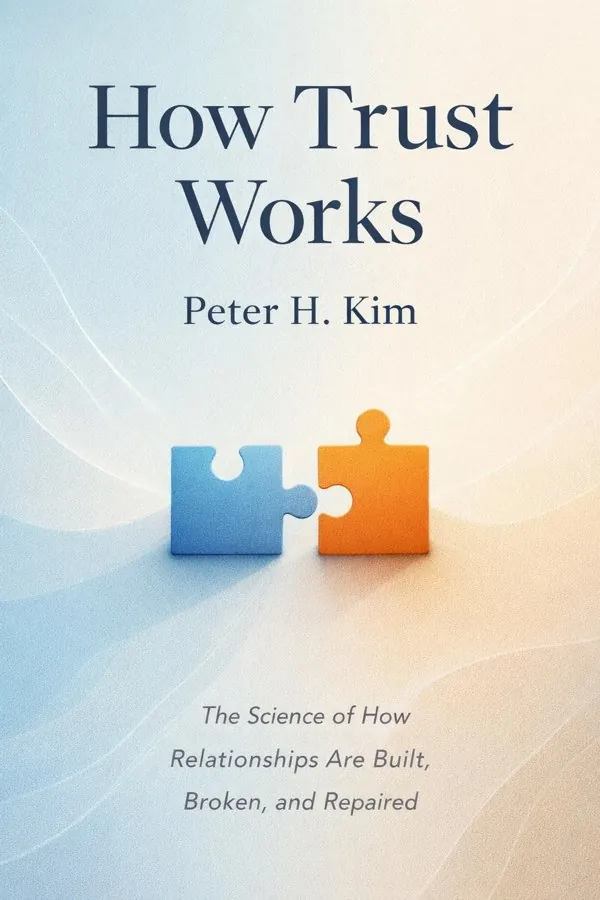
How Trust Works: The Science of How Relationships Are Built, Broken, and Repaired: Summary & Key Insights
by Peter H. Kim
 10 min5 chaptersAudio available
What Is How Trust Works: The Science of How Relationships Are Built, Broken, and Repaired About?
How Trust Works: The Science of How Relationships Are Built, Broken, and Repaired by Peter H. Kim is a psychology book spanning 5 pages. In this book, social psychologist Peter H. Kim explores the science behind trust—how it is formed, lost, and regained in personal and professional relationships. Drawing on decades of research, Kim explains the psychological mechanisms that govern trust decisions, the role of communication and perception, and how individuals and organizations can rebuild trust after betrayal. The book combines empirical insights with real-world examples to illuminate the dynamics of human cooperation and conflict.
This FizzRead summary covers all 5 key chapters of How Trust Works: The Science of How Relationships Are Built, Broken, and Repaired in approximately 10 minutes, distilling the most important ideas, arguments, and takeaways from Peter H. Kim's work. Also available as an audio summary and Key Quotes Podcast.
How Trust Works: The Science of How Relationships Are Built, Broken, and Repaired
In this book, social psychologist Peter H. Kim explores the science behind trust—how it is formed, lost, and regained in personal and professional relationships. Drawing on decades of research, Kim explains the psychological mechanisms that govern trust decisions, the role of communication and perception, and how individuals and organizations can rebuild trust after betrayal. The book combines empirical insights with real-world examples to illuminate the dynamics of human cooperation and conflict.
Who Should Read How Trust Works: The Science of How Relationships Are Built, Broken, and Repaired?
This book is perfect for anyone interested in psychology and looking to gain actionable insights in a short read. Whether you're a student, professional, or lifelong learner, the key ideas from How Trust Works: The Science of How Relationships Are Built, Broken, and Repaired by Peter H. Kim will help you think differently.
- ✓Readers who enjoy psychology and want practical takeaways
- ✓Professionals looking to apply new ideas to their work and life
- ✓Anyone who wants the core insights of How Trust Works: The Science of How Relationships Are Built, Broken, and Repaired in just 10 minutes
Want the full summary?
Get instant access to this book summary and 100K+ more with Fizz Moment.
Get Free SummaryAvailable on App Store • Free to download
Key Chapters
Trust begins with perception. When we meet someone new or evaluate a partner’s promise, our minds are constantly reading cues—tone of voice, facial expressions, consistency of behavior. These signals form our first impressions, which quickly set the stage for trust or suspicion. Decades of experiments have shown that people use both rational and emotional lenses to judge others. Even when we believe we’re using logic, our expectations and biases color what we see.
In the lab, trust often appears as a gamble. Participants are asked to share resources or delegate decisions, uncertain whether others will reciprocate. Interestingly, trust doesn’t stem from certainty; it arises precisely because uncertainty exists. Our brains must calculate: What are the potential rewards of trusting versus the costs if I’m betrayed? This risk–benefit analysis is embedded in our evolutionary history. Cooperation allowed early humans to thrive, but misplaced trust could mean death or loss. Thus, our minds evolved complex mechanisms to assess credibility.
Social reputation plays a crucial role. When we lack direct experience, we rely on network cues—others’ endorsements, shared affiliations, or institutional signals like job titles or brands. But perception is never stable. Once expectations are set, confirmation bias kicks in. We notice behaviors that fit our assumptions and downplay those that contradict them. This is why a single act of loyalty can anchor years of trust, while a single act of betrayal can undo it overnight.
In professional contexts, understanding this psychology is essential. A leader who assumes trust is earned solely through competence misses the emotional dimension; followers trust those who demonstrate benevolence and integrity. Similarly, data transparency may signal credibility, but if it comes without warmth or acknowledgment of others’ concerns, it fails to create confidence. In my research, I’ve found that trust flourishes where both logic and empathy intersect. You must be seen not only as able but as caring.
Trust formation is an act of construction. We build it piece by piece from patterns we observe. Consistency in behavior, clarity in communication, and alignment between words and deeds are the materials. In its early stages, trust is fragile and easily shaken. The mind keeps a mental ledger—every fulfilled promise strengthens the bridge; every inconsistency creates a crack.
But when that bridge collapses, people react not just cognitively but emotionally. Betrayal is experienced as a violation of expectation and identity. In my research, I found that people interpret trust violations through the lens of intention. A mistake feels different from a deceit. Was the harm accidental, or was it planned? That judgment determines whether forgiveness is even possible.
When we perceive deliberate betrayal, anger and withdrawal follow. Our brains activate threat responses, pushing us to protect ourselves. Yet paradoxically, the same psychological systems that amplify pain also allow us to seek repair. Humans possess a deep need to restore coherence in their relationships. When someone sincerely acknowledges wrongdoing—without excuses, with visible remorse—the betrayed party’s defensive walls can lower. Empathy, too, can bridge the divide: seeing the offender’s humanity is often the first step to rebuilding.
Organizations face a similar pattern. Corporate scandals reveal how quickly trust can unravel when stakeholders feel deceived. Transparency without acknowledgment fails; only actions coupled with accountability restore credibility. Leaders must understand that rebuilding trust involves a moral dimension: demonstrating integrity through consistent follow-through over time. Quick fixes never work because trust is relational, not transactional.
+ 3 more chapters — available in the FizzRead app
All Chapters in How Trust Works: The Science of How Relationships Are Built, Broken, and Repaired
About the Author
Peter H. Kim is a professor of management and organization at the University of Southern California’s Marshall School of Business. His research focuses on trust, negotiation, and conflict management, and his work has been published in leading academic journals in psychology and organizational behavior.
Get This Summary in Your Preferred Format
Read or listen to the How Trust Works: The Science of How Relationships Are Built, Broken, and Repaired summary by Peter H. Kim anytime, anywhere. FizzRead offers multiple formats so you can learn on your terms — all free.
Available formats: App · Audio · PDF · EPUB — All included free with FizzRead
Download How Trust Works: The Science of How Relationships Are Built, Broken, and Repaired PDF and EPUB Summary
Key Quotes from How Trust Works: The Science of How Relationships Are Built, Broken, and Repaired
“When we meet someone new or evaluate a partner’s promise, our minds are constantly reading cues—tone of voice, facial expressions, consistency of behavior.”
“Trust formation is an act of construction.”
Frequently Asked Questions about How Trust Works: The Science of How Relationships Are Built, Broken, and Repaired
How Trust Works: The Science of How Relationships Are Built, Broken, and Repaired by Peter H. Kim is a psychology book that explores key ideas across 5 chapters. In this book, social psychologist Peter H. Kim explores the science behind trust—how it is formed, lost, and regained in personal and professional relationships. Drawing on decades of research, Kim explains the psychological mechanisms that govern trust decisions, the role of communication and perception, and how individuals and organizations can rebuild trust after betrayal. The book combines empirical insights with real-world examples to illuminate the dynamics of human cooperation and conflict.
You Might Also Like
The Body Keeps the Score
Bessel van der Kolk
10 min
Surrounded by Idiots
Thomas Erikson
10 min
Emotional Intelligence
Daniel Goleman
10 min
Attached
Amir Levine
10 min
Why Does He Do That
Lundy Bancroft
10 min
Women Who Run with the Wolves
Clarissa Pinkola Estés
10 minBrowse by Category
Ready to read How Trust Works: The Science of How Relationships Are Built, Broken, and Repaired?
Get the full summary and 100K+ more books with Fizz Moment.