
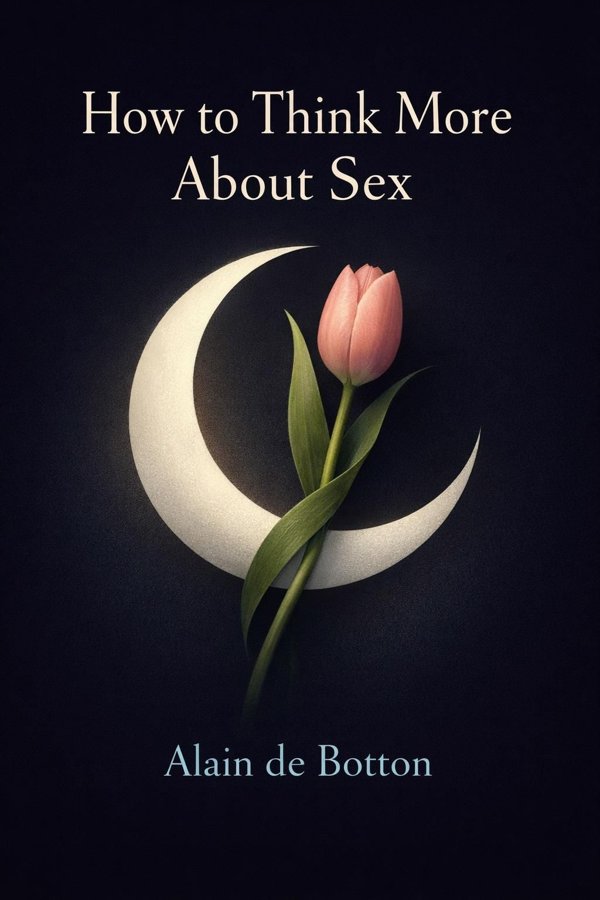
How to Think More About Sex: Summary & Key Insights
 10 min9 chaptersAudio available
Key Takeaways from How to Think More About Sex
Desire rarely arrives with a clear explanation.
No one develops a sexual identity in isolation.
Fantasy is often treated as embarrassing, dangerous, or morally suspicious, yet de Botton suggests it deserves interpretation rather than panic.
We like to imagine that romantic love and sexual desire naturally reinforce each other, but lived experience is more complicated.
Monogamy is often treated as morally obvious and psychologically simple, yet de Botton argues that it is one of the most ambitious demands we make of ourselves.
What Is How to Think More About Sex About?
How to Think More About Sex by Alain De Botton is a romantic_relationships book spanning 9 pages. Sex is often treated in one of two unhelpful ways: either as a source of embarrassment and silence, or as a subject of endless stimulation stripped of emotional depth. In How to Think More About Sex, Alain de Botton argues that both approaches miss the point. Sex is not merely a physical act or private appetite; it is a psychological, cultural, and moral phenomenon that reveals some of our deepest hopes, fears, insecurities, and longings. What we desire, what we fantasize about, what shames us, and what we seek from intimacy all say something essential about who we are. Drawing on philosophy, psychoanalysis, literature, and everyday observation, de Botton invites readers to examine sexuality with greater honesty and compassion. Rather than offering rules or techniques, he offers a framework for thinking: why desire can feel irrational, why monogamy is difficult, why fantasy often differs from character, and why shame distorts our erotic lives. His authority lies in making complex emotional truths accessible and humane. This book matters because it helps readers replace confusion and self-judgment with self-knowledge, and approach sex as an important part of a thoughtful life.
This FizzRead summary covers all 9 key chapters of How to Think More About Sex in approximately 10 minutes, distilling the most important ideas, arguments, and takeaways from Alain De Botton's work. Also available as an audio summary and Key Quotes Podcast.
How to Think More About Sex
Sex is often treated in one of two unhelpful ways: either as a source of embarrassment and silence, or as a subject of endless stimulation stripped of emotional depth. In How to Think More About Sex, Alain de Botton argues that both approaches miss the point. Sex is not merely a physical act or private appetite; it is a psychological, cultural, and moral phenomenon that reveals some of our deepest hopes, fears, insecurities, and longings. What we desire, what we fantasize about, what shames us, and what we seek from intimacy all say something essential about who we are.
Drawing on philosophy, psychoanalysis, literature, and everyday observation, de Botton invites readers to examine sexuality with greater honesty and compassion. Rather than offering rules or techniques, he offers a framework for thinking: why desire can feel irrational, why monogamy is difficult, why fantasy often differs from character, and why shame distorts our erotic lives. His authority lies in making complex emotional truths accessible and humane. This book matters because it helps readers replace confusion and self-judgment with self-knowledge, and approach sex as an important part of a thoughtful life.
Who Should Read How to Think More About Sex?
This book is perfect for anyone interested in romantic_relationships and looking to gain actionable insights in a short read. Whether you're a student, professional, or lifelong learner, the key ideas from How to Think More About Sex by Alain De Botton will help you think differently.
- ✓Readers who enjoy romantic_relationships and want practical takeaways
- ✓Professionals looking to apply new ideas to their work and life
- ✓Anyone who wants the core insights of How to Think More About Sex in just 10 minutes
Want the full summary?
Get instant access to this book summary and 100K+ more with Fizz Moment.
Get Free SummaryAvailable on App Store • Free to download
Key Chapters
Desire rarely arrives with a clear explanation. We may be able to justify our choices in work, friendship, or politics, but sexual attraction often feels arbitrary, sudden, and beyond reason. One person leaves us unmoved, while another captivates us through a gesture, a voice, a look, or a quality we can barely name. De Botton’s point is that sexuality does not obey logic, and trying to force it into neat rational categories often creates frustration rather than understanding.
Part of the mystery lies in the fact that desire is shaped by hidden associations. We are drawn not only to beauty in a general sense, but to meanings accumulated through memory, upbringing, fantasy, and emotional history. Someone’s confidence may attract us because it answers a private insecurity. Someone’s aloofness may echo a familiar childhood pattern. Even features that seem trivial can carry deep symbolic weight. This does not mean desire is random; it means its causes are often buried.
This insight can be liberating. Instead of shaming ourselves for our attractions or assuming they must represent a moral verdict, we can approach them with curiosity. A person who repeatedly desires emotionally unavailable partners, for example, might stop asking, “What is wrong with me?” and begin asking, “What emotional script am I replaying?” Likewise, attraction that seems surprising need not be treated as dangerous simply because it does not fit a tidy self-image.
In relationships, acknowledging the irrationality of desire can also reduce false expectations. We should not assume that attraction can be commanded by virtue or erased through good sense alone. Erotic life is more unruly than that.
Actionable takeaway: When you feel strong attraction, pause before judging it. Write down what specifically draws you in, and ask what emotional meanings or past experiences those qualities might represent.
No one develops a sexual identity in isolation. Long before we begin making conscious choices, we absorb messages about what sex means, what bodies should look like, who is desirable, what counts as normal, and what should provoke guilt. De Botton emphasizes that sexuality is never purely natural; it is always filtered through culture. Religion, advertising, cinema, fashion, pornography, and family attitudes all leave their mark on our erotic imagination.
This matters because many people mistake culturally inherited preferences and anxieties for personal truth. A person may believe they are inadequate because they do not resemble media ideals of attractiveness. Another may feel shame over desire because they inherited moral teachings that cast sexuality as suspicious or dirty. Even our expectations about romance and passion are often shaped by stories rather than reality: we are taught to expect ease, spontaneity, and constant intensity, then feel defective when sex becomes awkward, uneven, or emotionally complicated.
Cultural scripts also influence what we hide. For instance, men may feel pressure to appear perpetually confident and eager, while women may feel compelled to seem effortlessly attractive yet morally controlled. These contradictions generate anxiety. The result is that many people perform sexuality according to external expectations rather than inhabit it honestly.
Seeing culture’s influence does not mean rejecting all norms. It means understanding that some of our sexual beliefs are inherited rather than chosen. This awareness allows us to decide which values genuinely serve intimacy and which merely create pressure. Couples can benefit greatly from discussing where their assumptions came from: family, religion, peers, media, or past relationships.
Actionable takeaway: List three beliefs you hold about sex, attractiveness, or relationships, and ask where each belief came from. Keep the ones that deepen honesty and discard those rooted only in fear or imitation.
We like to imagine that romantic love and sexual desire naturally reinforce each other, but lived experience is more complicated. De Botton shows that love seeks security, tenderness, familiarity, and trust, while desire often thrives on distance, mystery, novelty, or tension. The same person may long to be deeply known and yet also miss the electricity that comes from uncertainty. This is not necessarily a sign of failure; it is built into the different psychological functions of love and lust.
In the early stages of a relationship, these forces may align more easily because the beloved is both intimate and unknown. Over time, however, domestic life can make partners more familiar than mysterious. Shared routines, logistical pressures, fatigue, parenting, and emotional dependence can slowly dilute erotic charge. Many couples interpret this as proof that something has gone wrong, when in fact they are confronting a common human dilemma.
The challenge is not to force love and sex into seamless harmony, but to understand their tensions intelligently. Emotional safety remains essential, yet a relationship also benefits from room for individuality, surprise, playfulness, and psychological space. Erotic energy may revive when partners stop treating one another only as co-managers of life and begin seeing each other again as separate, interesting beings.
Practical applications include protecting time from routine, nurturing personal interests outside the relationship, and speaking candidly about sexual drift without blame. Couples who normalize these fluctuations are often better able to respond creatively than those who interpret every change as rejection.
Actionable takeaway: If desire has faded in a loving relationship, do not begin with panic. Ask what conditions once made attraction vivid, and how you might reintroduce novelty, independence, or attentiveness into the partnership.
Monogamy is often treated as morally obvious and psychologically simple, yet de Botton argues that it is one of the most ambitious demands we make of ourselves. To expect one person to satisfy our needs for affection, sexual variety, companionship, admiration, stability, and excitement over many years is an extraordinary hope. The difficulty of monogamy does not prove that commitment is impossible; it simply means that fidelity requires more realism and compassion than moral slogans usually allow.
Human beings are restless. We are drawn to novelty, tempted by alternatives, and capable of erotic response outside our chosen relationship. Many people assume that commitment should cancel these reactions, and then feel guilt when it does not. De Botton encourages a more mature understanding: the presence of temptation is not identical to betrayal, nor does occasional desire for others necessarily mean love has ended.
This perspective can reduce hypocrisy. Instead of pretending that committed people never notice anyone else, couples can acknowledge the ordinary complexity of long-term desire. Doing so makes honest dialogue more possible. Some relationships may reaffirm strict exclusivity, others may negotiate different boundaries, but in every case clarity matters more than denial.
Monogamy works best when it is seen not as the absence of all competing feelings, but as a deliberate commitment sustained through self-knowledge, communication, and mutual care. It also helps to recognize that many affairs begin not only with lust, but with loneliness, resentment, boredom, or a hunger for reassurance.
Actionable takeaway: Treat fidelity as an active practice rather than a passive state. Talk with your partner about what threatens closeness, what boundaries matter most, and how to address boredom or distance before secrecy fills the gap.
Few parts of life are so saturated with shame as sexuality. People feel ashamed of wanting too much, too little, the wrong person, the wrong frequency, the wrong fantasy, the wrong body, the wrong past. De Botton argues that much of this shame comes from the mistaken belief that a sexually acceptable person should be simple, consistent, and effortlessly normal. In reality, erotic life is messy for nearly everyone.
Shame thrives in secrecy and comparison. When people imagine that others are sexually confident and untroubled, their own doubts feel uniquely damning. But most individuals carry anxieties: about performance, desirability, rejection, aging, boredom, inexperience, inadequacy, or exposure. The tragedy is that shame prevents the very conversations that could make these feelings bearable.
Sexual shame also narrows our sense of self. Someone who has unusual fantasies may conclude they are fundamentally corrupt. Someone with a low libido may feel broken. Someone whose desire fluctuates with stress or grief may think they are failing their partner. De Botton urges a kinder interpretation. Sexuality is influenced by mood, history, trauma, confidence, health, and relationship dynamics. Variability is part of being human.
Reducing shame does not mean abandoning ethics or boundaries. It means replacing crude judgment with honest inquiry. A compassionate sexual culture would allow people to speak more openly about uncertainty, and to seek help without humiliation. In intimate relationships, small disclosures can make a major difference: admitting fear, awkwardness, insecurity, or confusion often creates closeness rather than contempt.
Actionable takeaway: Identify one sexual insecurity you usually hide and describe it in nonjudgmental language, either in a journal or with a trusted partner. Naming shame gently is often the first step to weakening it.
Modern discussions of sexual morality often focus, rightly, on consent. But de Botton suggests that ethical sex involves more than mutual agreement. People can consent while still being careless, manipulative, vain, emotionally evasive, or indifferent to the other person’s vulnerability. Sex is ethical not only when it is permitted, but when it is conducted with kindness, honesty, tact, and a realistic awareness of emotional consequences.
This broader view matters because sex is rarely just physical. It touches self-esteem, attachment, fantasy, and hope. A casual encounter may be genuinely casual for one person and emotionally charged for another. A flirtation may seem harmless while quietly exploiting someone’s loneliness. A person may technically tell the truth while still obscuring intentions in ways that invite hurt. Ethics asks us to consider not only what we want, but what our behavior may awaken in someone else.
De Botton is not calling for prudishness; he is calling for maturity. Ethical sexuality requires emotional intelligence. That includes reading context, communicating clearly, avoiding false promises, respecting fragility, and being attentive to asymmetries of power or expectation. In committed relationships, ethics also involves fairness, empathy, and responsibility for how secrecy or neglect may injure trust.
A practical application is to move beyond the minimal question, “Am I allowed to do this?” and ask richer ones: “Am I being clear? Am I using this person to regulate my ego? Am I taking their emotional reality seriously?” Such reflection does not kill desire. It can deepen it by aligning pleasure with respect.
Actionable takeaway: Before a sexual decision, ask yourself three questions: Is it consensual? Is it honest? Is it considerate of the likely emotional impact on the other person? If any answer is unclear, slow down.
In few areas of life do we feel so acutely exposed as in sex. Sexuality confronts us with our hunger to be wanted, our fear of rejection, our dependence on another’s response, and our uncertainty about our own value. De Botton argues that sex matters so intensely because it is tied to the self. To be desired can feel like confirmation that we are alive, lovable, and significant. To be refused can feel disproportionately devastating because it touches old insecurities beneath the immediate moment.
This helps explain why sexual disappointment often triggers reactions that seem larger than the event itself. A partner declining sex may be interpreted not as fatigue or distraction, but as proof of unattractiveness. Performance anxiety may become a referendum on masculinity, femininity, competence, or worth. Jealousy may arise not only from fear of losing a person, but from fear of being replaceable.
Seeing these dynamics clearly can make both self-awareness and compassion possible. Rather than turning every sexual difficulty into an accusation, we can ask what vulnerability has been activated. Someone who becomes defensive after criticism may not be arrogant, but ashamed. Someone who seeks constant reassurance may not be demanding, but frightened of invisibility.
This idea also reframes sex as a form of communication. It is not only about gratification, but about recognition. The gestures, timing, tone, and emotional atmosphere surrounding sex all speak to whether a person feels welcomed, safe, and seen.
Actionable takeaway: The next time a sexual interaction stirs strong emotion, ask yourself what deeper self-concern is involved: fear of being unwanted, inadequate, ordinary, replaceable, or misunderstood. Address that wound directly instead of arguing only about the surface event.
Many people assume that sex should be instinctive. If it requires discussion, reflection, or effort, they worry that something unnatural has happened. De Botton rejects this myth. A good sexual life, like a good emotional life, is not simply found; it is learned. It requires language, patience, experimentation, self-knowledge, and the willingness to revise immature ideas inherited from culture.
Thinking more about sex does not make it colder. It can make it kinder and more enjoyable by reducing confusion. People who reflect on their patterns are better equipped to understand why they choose certain partners, why specific fantasies recur, why intimacy falters under stress, or why desire and affection do not always move together. Reflection also helps individuals distinguish between what they truly want and what they think they ought to want.
In practice, a thoughtful sexual life includes honest communication, tolerance for awkwardness, and freedom from perfectionism. It means accepting that partners cannot read minds, that preferences evolve, that misunderstandings are inevitable, and that repair is part of intimacy. It also means seeing sexuality as connected to the rest of life: stress, self-esteem, resentment, tenderness, fatigue, and trust all enter the bedroom.
The larger invitation of the book is humane rather than technical. We should become students of our erotic lives without becoming tyrants toward ourselves. Curiosity is more useful than judgment; compassion is more helpful than performance.
Actionable takeaway: Set aside time, alone or with a partner, to talk explicitly about what supports desire, what blocks it, and what emotional conditions make intimacy feel meaningful. Treat the conversation as an ongoing practice, not a one-time fix.
All Chapters in How to Think More About Sex
About the Author
Alain de Botton is a Swiss-born British writer and philosopher best known for bringing philosophical reflection into everyday life. Born in Zurich in 1969 and educated at Cambridge, he has written widely on subjects such as love, status, travel, architecture, work, and emotional health. His books combine philosophy, literature, psychology, and cultural criticism in a style that is accessible, elegant, and practical. De Botton is also the founder of The School of Life, an organization devoted to emotional intelligence and self-understanding through culture and education. Across his work, he aims to help readers think more clearly about ordinary but emotionally significant experiences. In How to Think More About Sex, he applies that same humane, reflective approach to one of the most misunderstood areas of human life.
Get This Summary in Your Preferred Format
Read or listen to the How to Think More About Sex summary by Alain De Botton anytime, anywhere. FizzRead offers multiple formats so you can learn on your terms — all free.
Available formats: App · Audio · PDF · EPUB — All included free with FizzRead
Download How to Think More About Sex PDF and EPUB Summary
Key Quotes from How to Think More About Sex
“Desire rarely arrives with a clear explanation.”
“No one develops a sexual identity in isolation.”
“Fantasy is often treated as embarrassing, dangerous, or morally suspicious, yet de Botton suggests it deserves interpretation rather than panic.”
“We like to imagine that romantic love and sexual desire naturally reinforce each other, but lived experience is more complicated.”
“Monogamy is often treated as morally obvious and psychologically simple, yet de Botton argues that it is one of the most ambitious demands we make of ourselves.”
Frequently Asked Questions about How to Think More About Sex
How to Think More About Sex by Alain De Botton is a romantic_relationships book that explores key ideas across 9 chapters. Sex is often treated in one of two unhelpful ways: either as a source of embarrassment and silence, or as a subject of endless stimulation stripped of emotional depth. In How to Think More About Sex, Alain de Botton argues that both approaches miss the point. Sex is not merely a physical act or private appetite; it is a psychological, cultural, and moral phenomenon that reveals some of our deepest hopes, fears, insecurities, and longings. What we desire, what we fantasize about, what shames us, and what we seek from intimacy all say something essential about who we are. Drawing on philosophy, psychoanalysis, literature, and everyday observation, de Botton invites readers to examine sexuality with greater honesty and compassion. Rather than offering rules or techniques, he offers a framework for thinking: why desire can feel irrational, why monogamy is difficult, why fantasy often differs from character, and why shame distorts our erotic lives. His authority lies in making complex emotional truths accessible and humane. This book matters because it helps readers replace confusion and self-judgment with self-knowledge, and approach sex as an important part of a thoughtful life.
More by Alain De Botton


You Might Also Like

Rebel
Beverly Jenkins
10 min
The Last Letter
Rebecca Yarros
10 min
A Thousand Boy Kisses
Tillie Cole
10 min
Aflame
Penelope Douglas
10 min
After The Bite
Lynsay Sands
10 min
Alchemised
SenLinYu
10 minBrowse by Category
Ready to read How to Think More About Sex?
Get the full summary and 100K+ more books with Fizz Moment.