
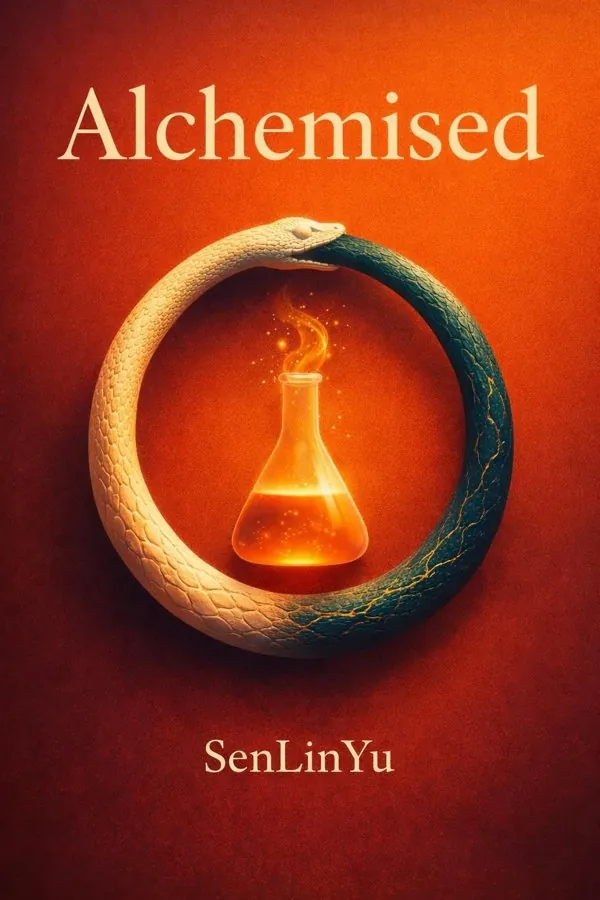
Alchemised: Summary & Key Insights
by SenLinYu
 10 min9 chaptersAudio available
Key Takeaways from Alchemised
Real transformation rarely starts with inspiration; it starts with fracture.
Love is most compelling in fiction when it does more than comfort; it reveals.
The brilliance of Alchemised lies in how it uses fantasy not as decoration, but as structure.
One of the novel’s most mature ideas is that redemption is not the same as innocence.
The novel understands a truth many romances only touch lightly: power is never abstract when it enters intimacy.
What Is Alchemised About?
Alchemised by SenLinYu is a romantic_relationships book spanning 5 pages. Alchemised by SenLinYu is a fantasy romance that turns the language of magic into a meditation on identity, grief, and the terrifying intimacy of being truly seen. Written in English and widely discussed among readers of emotionally intense speculative fiction, the novel reimagines familiar archetypes from the Harry Potter universe in an alternate setting where alchemy is not merely a craft but a philosophy of change. At its heart, the book asks a difficult question: if pain, guilt, and love all transform us, what kind of person emerges on the other side? SenLinYu approaches that question with lyrical prose, psychological precision, and a remarkable ability to make emotional conflict feel as urgent as external danger. The result is a story that works on two levels at once: as a sweeping, romantic fantasy and as a character-driven exploration of redemption, power, and vulnerability. Alchemised matters because it treats romance not as escape, but as a crucible. It shows how love can expose what is broken, refine what is hidden, and demand a more honest self.
This FizzRead summary covers all 9 key chapters of Alchemised in approximately 10 minutes, distilling the most important ideas, arguments, and takeaways from SenLinYu's work. Also available as an audio summary and Key Quotes Podcast.
Alchemised
Alchemised by SenLinYu is a fantasy romance that turns the language of magic into a meditation on identity, grief, and the terrifying intimacy of being truly seen. Written in English and widely discussed among readers of emotionally intense speculative fiction, the novel reimagines familiar archetypes from the Harry Potter universe in an alternate setting where alchemy is not merely a craft but a philosophy of change. At its heart, the book asks a difficult question: if pain, guilt, and love all transform us, what kind of person emerges on the other side? SenLinYu approaches that question with lyrical prose, psychological precision, and a remarkable ability to make emotional conflict feel as urgent as external danger. The result is a story that works on two levels at once: as a sweeping, romantic fantasy and as a character-driven exploration of redemption, power, and vulnerability. Alchemised matters because it treats romance not as escape, but as a crucible. It shows how love can expose what is broken, refine what is hidden, and demand a more honest self.
Who Should Read Alchemised?
This book is perfect for anyone interested in romantic_relationships and looking to gain actionable insights in a short read. Whether you're a student, professional, or lifelong learner, the key ideas from Alchemised by SenLinYu will help you think differently.
- ✓Readers who enjoy romantic_relationships and want practical takeaways
- ✓Professionals looking to apply new ideas to their work and life
- ✓Anyone who wants the core insights of Alchemised in just 10 minutes
Want the full summary?
Get instant access to this book summary and 100K+ more with Fizz Moment.
Get Free SummaryAvailable on App Store • Free to download
Key Chapters
Real transformation rarely starts with inspiration; it starts with fracture. One of the central insights of Alchemised is that change becomes possible only when a person can no longer keep living inside old illusions. The novel uses alchemy as both magical system and emotional metaphor, suggesting that nothing can be remade without first being broken down. Characters are pushed into states of instability where certainty collapses, identities blur, and long-protected defenses fail. In that instability, they are forced to confront what they fear, what they desire, and what parts of themselves they have buried to survive.
This is what gives the book its emotional force. Instead of presenting growth as a smooth, noble arc, SenLinYu shows it as painful, messy, and often involuntary. A relationship deepens not because two people are ideal for each other from the start, but because they are changed by conflict, memory, guilt, and need. The alchemical framework makes this idea especially powerful: transmutation requires heat, pressure, and surrender. In emotional terms, that means vulnerability. A guarded character may need to admit dependence. A proud character may need to accept remorse. A wounded character may need to risk trust despite every reason not to.
Readers can apply this insight beyond fiction. In real life, major personal shifts often follow disruption: a breakup, a failure, a loss, or a truth we can no longer avoid. Rather than asking how to stay unchanged under pressure, Alchemised invites us to ask what pressure is revealing. Are we defending an identity that no longer serves us? Are we resisting a necessary reckoning because it feels like loss?
The practical takeaway is simple: when life becomes unstable, do not rush only to restore the old form. First ask what new form might be trying to emerge.
Love is most compelling in fiction when it does more than comfort; it reveals. In Alchemised, romance is not treated as a decorative subplot or a reward waiting at the end of hardship. Instead, it is the medium through which the characters become legible to themselves. Attraction exposes buried motives. Intimacy unsettles self-deception. Desire becomes a force that tests moral boundaries and emotional endurance. The relationship at the center of the novel matters because it changes what each character can hide, justify, or deny.
SenLinYu excels at building a romantic dynamic charged by tension, restraint, and psychological complexity. The emotional stakes are heightened not simply by longing, but by danger, memory, and unequal knowledge. The characters do not merely fall in love; they negotiate fear, distrust, power, and shame while being drawn together. This creates a richer understanding of romance: true closeness is not passive chemistry but an active confrontation with another person’s interior world. To love someone, the novel suggests, is to risk having your own carefully constructed narrative dismantled.
That idea has practical relevance. Many people think of relationships primarily in terms of compatibility, shared interests, or surface communication. Alchemised points toward a deeper standard. The most meaningful connections often ask whether another person calls us into greater honesty. Do they make us more aware of our patterns? Do they challenge our defenses without humiliating us? Do they create a space where truth is difficult, but possible?
A useful application is to reflect on whether a relationship helps you perform a version of yourself or understand your real self. The actionable takeaway: measure intimacy not only by closeness, but by how much truth it can hold.
The brilliance of Alchemised lies in how it uses fantasy not as decoration, but as structure. Alchemy in the novel is more than a magical discipline; it is a language for discussing emotional and moral transformation. The process of combining, breaking apart, refining, and reconstituting matter becomes a way of thinking about identity itself. What happens when pain alters a person? Can guilt be purified, or only endured? Can love transform, or does it simply expose what was already there?
By embedding these questions into the worldbuilding, SenLinYu gives symbolic depth to the story’s emotional movements. Material change reflects interior change. The magical system does not distract from the characters; it illuminates them. This is why the fantasy elements feel meaningful even to readers who usually prioritize character over plot. The world is built to echo the psychological stakes. The laboratory becomes a metaphorical chamber of self-examination. A transmutation becomes an image of grief, obsession, devotion, or repair.
This layered design offers a useful lesson for readers and creators alike. Symbols become powerful when they are integrated into action rather than added afterward. In daily life, people also rely on symbolic systems to understand themselves. We speak of burning out, carrying baggage, healing wounds, building boundaries, or feeling unmoored. These are metaphorical frameworks that help us process experience. Alchemised reminds us that the metaphors we live by shape the way we endure difficulty.
A practical application is to notice the language you use for your own change. Do you speak as if you are broken beyond repair, or unfinished and in process? The actionable takeaway: choose metaphors that allow growth, because the stories you tell about transformation influence whether you believe transformation is possible.
One of the novel’s most mature ideas is that redemption is not the same as innocence. Alchemised does not offer a simplistic vision in which suffering automatically makes someone good or love automatically wipes away past harm. Instead, it treats redemption as a demanding process rooted in recognition, accountability, and altered behavior. A character may be broken, traumatized, or remorseful, but none of those states alone absolve what has been done. The emotional credibility of the story comes from its refusal to confuse explanation with excuse.
This is especially important in dark or psychologically intense romance, where readers often encounter morally compromised characters. SenLinYu navigates that space by keeping the consequences of action present. The question is not whether a flawed person deserves love in the abstract, but whether they can become capable of loving in a way that is honest, responsible, and humane. That distinction gives the romance moral weight. Redemption becomes something enacted through difficult choices, restraint, confession, sacrifice, and a willingness to face judgment.
This insight applies powerfully in real life. People often seek relief from guilt before they undertake repair. They want to feel forgiven before they fully acknowledge the damage they caused. Alchemised proposes a harder, truer path: redemption begins when someone stops centering their own pain and starts reckoning with impact. That may mean apologizing without defensiveness, changing repeated behaviors, or accepting that trust takes time to rebuild.
A practical example is conflict in close relationships. If you hurt someone, explaining your motives may matter, but only after you clearly name the harm and demonstrate change. The actionable takeaway: if you seek redemption, focus less on being understood immediately and more on becoming trustworthy over time.
The novel understands a truth many romances only touch lightly: power is never abstract when it enters intimacy. In Alchemised, emotional closeness is inseparable from questions of control, vulnerability, knowledge, and dependency. Who knows what? Who can withhold? Who can protect? Who can destroy? These tensions make the central relationship compelling because attraction unfolds alongside asymmetry. The reader feels not only desire, but risk.
SenLinYu’s handling of power is nuanced because she avoids reducing it to a single trait such as status or magical ability. Power moves dynamically through scenes. A physically vulnerable character may possess moral clarity. A socially dominant character may be emotionally exposed. Someone who appears in control may be governed by obsession, guilt, or fear. This shifting balance creates depth and makes the relationship feel alive rather than formulaic. The fantasy setting heightens these dynamics, but the emotional reality is widely recognizable.
In life, intimate power often appears in subtler forms: one person speaks better under pressure, one has more social influence, one controls access to affection, one knows the other’s secrets, one can leave more easily. Healthy relationships do not eliminate power differences entirely, but they require awareness of them. Unexamined asymmetry can become manipulation even when no one intends it.
Readers can use this idea by reflecting on how power functions in their own connections. Do both people have room to say no? Is vulnerability met with care or leverage? Does one person repeatedly define reality for the other? The actionable takeaway: in any close relationship, pay attention not only to affection but to power, because tenderness without ethical awareness can still become harm.
Some books are memorable for plot, others for voice. Alchemised stands out because its prose does active emotional work. SenLinYu’s lyrical style is not ornamental excess; it shapes how readers experience longing, dread, tenderness, and psychological fracture. The language often creates a heightened atmosphere where feeling seems almost material. Desire lingers. Silence sharpens. Memory stains the present. This stylistic intensity deepens the novel’s romantic and alchemical themes by making emotion feel transformative in itself.
What makes the prose especially effective is its control. The writing is often lush, but it remains tethered to character. Beauty never matters for its own sake alone. Instead, imagery and cadence reveal interior states the characters cannot always articulate directly. A scene can feel charged because the diction itself carries tension between what is yearned for and what is feared. The result is a reading experience in which atmosphere becomes part of meaning.
This has practical relevance for anyone interested in communication. The words we choose do not merely report emotion; they shape it. Compare saying, “I’m upset,” with saying, “I feel dismissed.” Compare “We have problems” with “We no longer know how to speak without armor.” Precision changes understanding. The novel reminds us that language can either flatten experience or clarify it.
A useful exercise is to replace vague emotional labels with more exact descriptions. Instead of saying you feel bad, ask whether you feel ashamed, lonely, angry, threatened, or grief-stricken. Better language produces better self-knowledge. The actionable takeaway: when emotion feels overwhelming, try to name it with precision, because clarity in language is often the first step toward clarity in action.
A powerful undercurrent in Alchemised is the question of what truly defines a person. Is identity determined by origin, reputation, trauma, talent, desire, or history? The novel repeatedly suggests that while the past shapes us, it does not fully settle who we are. Characters carry inherited narratives about themselves and each other, but those narratives are tested by what they choose under pressure. In this sense, identity is not static essence; it is an evolving pattern of actions.
This matters because the story is populated by people who might easily be reduced to archetypes: the damaged one, the dangerous one, the brilliant one, the loyal one, the fallen one. SenLinYu complicates those categories. The characters become real through contradiction. Someone can be cruel and grieving, devoted and secretive, powerful and ashamed. The novel resists clean moral labels without collapsing into moral chaos. Instead, it asks readers to evaluate character through choices made when comfort is impossible and stakes are high.
This perspective is deeply useful in ordinary life. Many people overidentify with a past version of themselves or with labels imposed by family, relationships, or failure. “I’m just a jealous person.” “I always ruin things.” “I’m the responsible one.” Such statements can become cages. Alchemised proposes a more dynamic view: who you have been matters, but what you repeatedly choose matters more.
A practical application is to examine one identity statement you tell yourself often, then test it against recent behavior. Are you living it, hiding behind it, or ready to outgrow it? The actionable takeaway: define yourself less by fixed labels and more by the values your actions consistently express.
Not all healing returns us to what we were before. One of Alchemised’s most affecting ideas is that repair may produce something altered rather than restored. Characters do not simply overcome damage and resume an untouched self. They endure, adapt, confess, grieve, and connect in ways that leave visible marks. The novel suggests that beauty can emerge not from purity, but from integration: the ability to live honestly with what has happened and still choose tenderness, purpose, or love.
This makes the story feel emotionally adult. Many narratives promise wholeness as a return to innocence. SenLinYu offers something more believable and, in many ways, more hopeful. To be healed is not to erase scars; it is to no longer be ruled by them. The alchemical lens sharpens this point. A transformed substance is not a restored original. It is the result of reaction. Likewise, a person shaped by suffering may become more complex, more self-aware, and more capable of meaningful attachment precisely because they have been forced to reckon with fragility.
This has obvious practical resonance. In grief, betrayal, burnout, or recovery, people often compare themselves to a prior version and feel diminished. Alchemised offers another framework: you may not return to who you were, but that does not mean you are ruined. You may be becoming someone who carries pain differently, with more discernment and compassion.
A useful practice is to stop asking only, “How do I get back to normal?” and start asking, “What would honest repair look like now?” The actionable takeaway: seek healing that integrates your history instead of denying it, because durable growth comes from repair, not pretense.
All Chapters in Alchemised
About the Author
SenLinYu is an English-language author best known for psychologically layered, emotionally intense fiction associated with the Harry Potter fanfiction sphere. She rose to prominence through widely read works such as Manacled and Alchemised, earning a devoted readership for her ability to combine dark themes, lyrical prose, and deeply complex character dynamics. Her writing often explores trauma, devotion, moral ambiguity, redemption, and the ways love can both wound and transform. What distinguishes her voice is the balance between sweeping emotional intensity and careful interior characterization; even in fantastical settings, her stories remain grounded in human conflict. SenLinYu has become a notable figure among readers of transformative fiction, especially those drawn to literary-style fantasy romance with depth, tension, and unforgettable emotional stakes.
Get This Summary in Your Preferred Format
Read or listen to the Alchemised summary by SenLinYu anytime, anywhere. FizzRead offers multiple formats so you can learn on your terms — all free.
Available formats: App · Audio · PDF · EPUB — All included free with FizzRead
Download Alchemised PDF and EPUB Summary
Key Quotes from Alchemised
“Real transformation rarely starts with inspiration; it starts with fracture.”
“Love is most compelling in fiction when it does more than comfort; it reveals.”
“The brilliance of Alchemised lies in how it uses fantasy not as decoration, but as structure.”
“One of the novel’s most mature ideas is that redemption is not the same as innocence.”
“The novel understands a truth many romances only touch lightly: power is never abstract when it enters intimacy.”
Frequently Asked Questions about Alchemised
Alchemised by SenLinYu is a romantic_relationships book that explores key ideas across 9 chapters. Alchemised by SenLinYu is a fantasy romance that turns the language of magic into a meditation on identity, grief, and the terrifying intimacy of being truly seen. Written in English and widely discussed among readers of emotionally intense speculative fiction, the novel reimagines familiar archetypes from the Harry Potter universe in an alternate setting where alchemy is not merely a craft but a philosophy of change. At its heart, the book asks a difficult question: if pain, guilt, and love all transform us, what kind of person emerges on the other side? SenLinYu approaches that question with lyrical prose, psychological precision, and a remarkable ability to make emotional conflict feel as urgent as external danger. The result is a story that works on two levels at once: as a sweeping, romantic fantasy and as a character-driven exploration of redemption, power, and vulnerability. Alchemised matters because it treats romance not as escape, but as a crucible. It shows how love can expose what is broken, refine what is hidden, and demand a more honest self.
You Might Also Like

Rebel
Beverly Jenkins
10 min
The Last Letter
Rebecca Yarros
10 min
A Thousand Boy Kisses
Tillie Cole
10 min
Aflame
Penelope Douglas
10 min
After The Bite
Lynsay Sands
10 min
All Your Perfects
Colleen Hoover
10 minBrowse by Category
Ready to read Alchemised?
Get the full summary and 100K+ more books with Fizz Moment.