
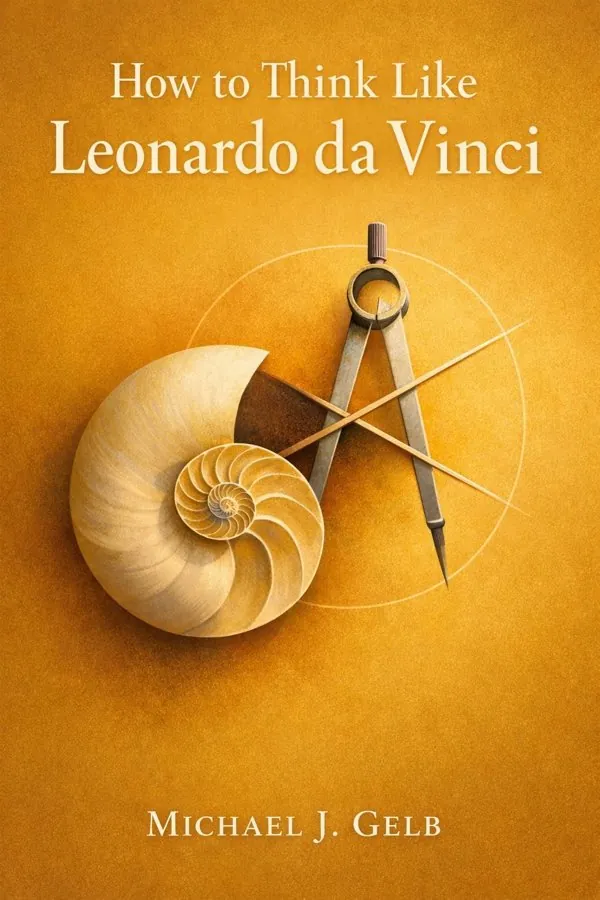
How to Think Like Leonardo da Vinci: Seven Steps to Genius Every Day: Summary & Key Insights
 10 min9 chaptersAudio available
Key Takeaways from How to Think Like Leonardo da Vinci: Seven Steps to Genius Every Day
The quality that most separates vibrant minds from stagnant ones is not intelligence alone, but the refusal to stop asking questions.
A belief becomes wisdom only after it survives contact with reality.
Most people look without seeing, listen without hearing, and move through life half awake to the richness of their surroundings.
Many people crave clear answers so strongly that they cling to simplistic ones.
Breakthrough thinking often happens when logic and imagination stop competing and start collaborating.
What Is How to Think Like Leonardo da Vinci: Seven Steps to Genius Every Day About?
How to Think Like Leonardo da Vinci: Seven Steps to Genius Every Day by Michael J. Gelb is a creativity book spanning 8 pages. What if genius were not a rare gift reserved for a few extraordinary people, but a capacity you could strengthen through daily practice? In How to Think Like Leonardo da Vinci, Michael J. Gelb argues exactly that. Using Leonardo not as an untouchable icon but as a model for human potential, Gelb distills the Renaissance master’s habits of mind into seven practical principles: curiosità, dimostrazione, sensazione, sfumato, arte/scienza, corporalità, and connessione. Together, they form a framework for thinking more creatively, observing more carefully, learning more deeply, and living more fully. The book matters because it speaks to a modern problem: many people are overloaded with information yet undernourished in attention, imagination, and self-directed learning. Gelb offers an antidote by showing how Leonardo combined wonder, rigorous testing, sensory awareness, bodily vitality, and systems thinking. Rather than presenting creativity as a mystery, he turns it into a discipline. As an author, educator, and consultant known for translating the practices of exceptional thinkers into usable methods, Gelb brings both enthusiasm and practical authority. This book is a guide for anyone who wants to awaken sharper perception, better judgment, and more original thought in everyday life.
This FizzRead summary covers all 9 key chapters of How to Think Like Leonardo da Vinci: Seven Steps to Genius Every Day in approximately 10 minutes, distilling the most important ideas, arguments, and takeaways from Michael J. Gelb's work. Also available as an audio summary and Key Quotes Podcast.
How to Think Like Leonardo da Vinci: Seven Steps to Genius Every Day
What if genius were not a rare gift reserved for a few extraordinary people, but a capacity you could strengthen through daily practice? In How to Think Like Leonardo da Vinci, Michael J. Gelb argues exactly that. Using Leonardo not as an untouchable icon but as a model for human potential, Gelb distills the Renaissance master’s habits of mind into seven practical principles: curiosità, dimostrazione, sensazione, sfumato, arte/scienza, corporalità, and connessione. Together, they form a framework for thinking more creatively, observing more carefully, learning more deeply, and living more fully.
The book matters because it speaks to a modern problem: many people are overloaded with information yet undernourished in attention, imagination, and self-directed learning. Gelb offers an antidote by showing how Leonardo combined wonder, rigorous testing, sensory awareness, bodily vitality, and systems thinking. Rather than presenting creativity as a mystery, he turns it into a discipline. As an author, educator, and consultant known for translating the practices of exceptional thinkers into usable methods, Gelb brings both enthusiasm and practical authority. This book is a guide for anyone who wants to awaken sharper perception, better judgment, and more original thought in everyday life.
Who Should Read How to Think Like Leonardo da Vinci: Seven Steps to Genius Every Day?
This book is perfect for anyone interested in creativity and looking to gain actionable insights in a short read. Whether you're a student, professional, or lifelong learner, the key ideas from How to Think Like Leonardo da Vinci: Seven Steps to Genius Every Day by Michael J. Gelb will help you think differently.
- ✓Readers who enjoy creativity and want practical takeaways
- ✓Professionals looking to apply new ideas to their work and life
- ✓Anyone who wants the core insights of How to Think Like Leonardo da Vinci: Seven Steps to Genius Every Day in just 10 minutes
Want the full summary?
Get instant access to this book summary and 100K+ more with Fizz Moment.
Get Free SummaryAvailable on App Store • Free to download
Key Chapters
The quality that most separates vibrant minds from stagnant ones is not intelligence alone, but the refusal to stop asking questions. Gelb begins with curiosità because Leonardo da Vinci’s genius was powered by an endless appetite for inquiry. He wanted to understand everything: why birds fly, how muscles move, how water swirls, how light changes a face, how emotion appears in posture. His notebooks reveal a mind that treated every ordinary moment as an invitation to investigate.
In the book, curiosità is not presented as vague fascination. It is a practice of deliberately cultivating questions, especially the kind that have no immediate utilitarian purpose. Leonardo did not divide knowledge into “useful” and “useless.” He understood that breakthroughs often come from connections made between distant fields and from observations others dismiss as trivial. Gelb encourages readers to revive this childlike yet disciplined wonder by keeping a notebook, listing unanswered questions, and developing tolerance for open-ended exploration.
In practical terms, this principle can transform work and life. A manager might ask not only how to improve sales, but what hidden assumptions shape the team’s strategy. An artist might study engineering. A scientist might read poetry. A parent might ask better questions of their children instead of rushing to give advice. Curiosity widens perception before it produces answers.
Gelb also suggests regular self-reflection questions: What am I most curious about right now? What have I accepted without examining? What topic have I always wanted to explore? These prompts train the mind to remain alive rather than merely efficient.
Actionable takeaway: Start a “100 Questions” list about your life, work, and the world, and review it daily to reignite the habit of wondering before concluding.
A belief becomes wisdom only after it survives contact with reality. That is the spirit of dimostrazione, Leonardo’s commitment to learning through direct experience, experimentation, and the willingness to correct errors. Gelb emphasizes that Leonardo did not simply inherit accepted truths. He tested them. He dissected bodies to understand anatomy, observed nature firsthand, and revised his ideas continuously in light of evidence.
This principle challenges one of the most common obstacles to growth: passive acceptance. People often rely on authority, habit, or secondhand opinions instead of personal verification. Gelb argues that creative and intelligent living requires a more active stance. We must be willing to ask, “How do I know this is true?” and “What evidence would change my mind?” Dimostrazione is therefore both practical and ethical. It demands humility, because genuine learning means admitting that our first conclusions may be flawed.
Applied today, this principle can improve decision-making in every field. An entrepreneur can test assumptions about customers instead of building from guesswork. A student can compare different study methods rather than using what feels familiar. A leader can gather feedback on whether a strategy works in practice rather than defending it because it was carefully planned. Even in personal life, dimostrazione matters: people can examine whether their routines actually support health, focus, or happiness instead of assuming they do.
Gelb also links this principle to self-knowledge. Our identities are often built on untested stories: “I’m not creative,” “I’m bad at public speaking,” or “I don’t learn languages well.” Leonardo’s example suggests that many limits are hypotheses, not facts.
Actionable takeaway: Choose one assumption you hold about your work, habits, or abilities, and design a simple real-world experiment this week to test whether it is actually true.
Most people look without seeing, listen without hearing, and move through life half awake to the richness of their surroundings. Gelb’s principle of sensazione argues that refined perception is one of the foundations of intelligence. Leonardo’s art and scientific insight were inseparable from his extraordinary observational power. He trained his eye to notice subtle gradations of shadow, his hand to capture form, and his attention to register patterns in motion, anatomy, and expression.
Gelb shows that sensory refinement is not just for artists. Better perception leads to better thought because the quality of our ideas depends on the quality of what we notice. If we miss details, flatten complexity, or dull our senses through distraction, our thinking becomes shallow. Sensazione invites us to become more alert to color, texture, sound, rhythm, taste, and spatial relationships. It also encourages aesthetic appreciation, because beauty can be a form of intelligence that teaches us proportion, harmony, and contrast.
In practice, this can be cultivated through drawing, active listening, mindful eating, music, time in nature, and attention exercises. A designer may become more skilled by studying how light falls on surfaces. A teacher may improve by listening for emotional tone rather than only words. A doctor may notice posture, breath, and facial micro-expressions. A writer may sharpen language by paying closer attention to sensory specifics.
Gelb’s larger point is that sensory life is trainable. You do not need to be born unusually gifted to become more observant; you need to practice noticing. In a distracted age, this is a radical discipline.
Actionable takeaway: Spend 10 minutes each day observing one ordinary object or scene in detail, then write down at least 15 things you noticed that you would normally overlook.
Many people crave clear answers so strongly that they cling to simplistic ones. Leonardo’s genius, by contrast, flourished in ambiguity. Gelb uses the term sfumato, borrowed from the soft, smoky transitions in Leonardo’s paintings, to describe the capacity to hold paradox, uncertainty, and unresolved tension without panic. This is not indecision. It is mature thinking that recognizes reality is often more nuanced than rigid categories allow.
Leonardo worked across art, engineering, anatomy, philosophy, and natural science, fields filled with incomplete evidence and difficult questions. Rather than forcing premature closure, he stayed in dialogue with mystery. Gelb argues that this tolerance for ambiguity is essential for creativity because original ideas rarely arrive fully formed. They emerge through exploration, revision, and the ability to keep multiple possibilities alive long enough for insight to develop.
In modern life, sfumato has practical value everywhere. Leaders face incomplete information. Researchers work with uncertain findings. Relationships involve mixed motives and contradictory feelings. Career choices often require acting before certainty is possible. People who cannot tolerate ambiguity tend to either delay endlessly or adopt oversimplified narratives. Those who can remain curious within uncertainty make wiser decisions over time.
Gelb recommends developing this capacity by engaging with open-ended questions, reflecting on paradoxes, studying subjects that resist easy answers, and examining emotional reactions to uncertainty. Practices like journaling, meditation, and reading literature can help people become less reactive when life feels unclear.
The deeper lesson is psychological: confusion is not always failure. Sometimes it is the necessary atmosphere of growth. A mind that can breathe in uncertainty becomes more resilient, subtle, and inventive.
Actionable takeaway: This week, identify one unresolved issue in your life and resist the urge for an immediate answer; instead, write down three competing interpretations and what each might teach you.
Breakthrough thinking often happens when logic and imagination stop competing and start collaborating. Gelb’s principle of arte/scienza captures Leonardo’s most famous strength: the union of art and science, intuition and analysis, imagination and discipline. Leonardo did not see drawing and mathematics, beauty and engineering, as separate domains. For him, they illuminated each other.
Gelb uses this principle to challenge a deeply limiting modern habit: over-identifying with one mode of thought. Some people pride themselves on being rational and dismiss emotion, aesthetics, or intuition. Others celebrate creativity but neglect structure, measurement, and critical evaluation. Leonardo shows that the highest form of intelligence is integrative. You need analysis to test ideas and imagination to generate them. You need structure to execute and play to discover.
In practice, arte/scienza can reshape how people solve problems. A business strategist can use visual mapping to think through data. A scientist can draw models to understand complexity. An artist can study anatomy or geometry to deepen craft. A product team can evaluate user metrics while also paying attention to emotional experience and design elegance. Even personal decisions benefit when intuition is checked against facts rather than replaced by them.
Gelb often connects this principle to whole-brain thinking: using verbal, numerical, visual, kinesthetic, and metaphorical modes together. The goal is not simply to become balanced in an abstract sense, but to become more powerful by recruiting more of your mental resources. Great innovation tends to be both imaginative and exacting.
Actionable takeaway: On your next important project, force yourself to use both analytical and creative tools—for example, combine a spreadsheet or checklist with sketching, brainstorming, or mind mapping before making decisions.
Clear thinking depends more on physical vitality than many intellectuals like to admit. Gelb’s principle of corporalità highlights Leonardo’s appreciation for grace, ambidexterity, fitness, posture, movement, and embodied presence. Leonardo studied anatomy not only to paint better, but because he understood the body as a source of knowledge. Mind and body were not separate systems; they were expressions of one integrated life.
Gelb argues that many people undermine their creativity by neglecting physical well-being. Fatigue, poor breathing, tension, and sedentary habits narrow attention and lower resilience. By contrast, an energized body supports alertness, emotional steadiness, and expressive confidence. Corporalità therefore includes exercise, flexibility, coordination, balance, and poise, but it also includes how one carries oneself in conversation, work, and art.
This principle has immediate everyday applications. A professional preparing for a presentation can improve impact through breathing, posture, and movement rather than focusing only on words. A student can learn better by alternating concentrated study with walks or physical activity. A creator can renew stalled thinking by changing environments, stretching, or using the hands. Gelb also notes that fine motor skill, handwriting, drawing, and manual engagement can stimulate forms of cognition that purely digital work may suppress.
Corporalità is also about self-respect. Caring for the body is not vanity; it is stewardship of the instrument through which all thought, perception, and action occur. If you want to think like Leonardo, you must also live in your body with greater awareness and dignity.
Actionable takeaway: Build one non-negotiable daily physical ritual—such as walking, stretching, breathwork, or coordination practice—to support sharper focus and more creative energy.
The world makes more sense when you stop looking at isolated parts and start noticing relationships. Gelb’s principle of connessione reflects Leonardo’s systems thinking: his ability to see analogies between flowing water, curling hair, weather patterns, anatomical structures, architecture, and mechanical design. He grasped that nature works through interconnected processes, and this allowed him to move fluidly across disciplines.
Gelb presents connessione as a master principle because creativity often arises from linking things that seem unrelated. When people stay trapped inside narrow categories, they miss the deeper patterns that unify experience. Systems thinking reveals that causes are rarely linear, problems rarely stand alone, and solutions often have ripple effects. This perspective is especially valuable in a complex world where social, technological, environmental, and personal issues interact constantly.
In practical terms, connessione can improve strategic thinking and innovation. A leader can examine how culture, incentives, communication, and structure reinforce one another instead of blaming one symptom. A health-minded person can see how sleep, stress, food, exercise, and relationships shape well-being as a system. A writer or inventor can borrow structures from biology, music, or architecture to solve problems in a new field.
Gelb often encourages visual tools like mind maps because they help people represent connections instead of just sequences. This mirrors Leonardo’s notebook style, in which sketches, questions, diagrams, and observations interact dynamically rather than sitting in rigid compartments.
The larger lesson is philosophical: reality is relational. The more deeply you perceive patterns and interdependence, the less fragmented your thinking becomes.
Actionable takeaway: Take one persistent problem you face and map at least ten factors connected to it, including indirect influences, to reveal leverage points you had not previously seen.
One of Leonardo’s most powerful habits was deceptively simple: he wrote things down. His notebooks were not polished journals for public display, but living laboratories of thought filled with questions, sketches, observations, lists, designs, and reflections. Gelb treats notebook keeping as one of the most practical ways to develop Da Vincian thinking because it externalizes the mind, making curiosity visible and insight cumulative.
The notebook matters for several reasons. First, it preserves fleeting observations that would otherwise disappear. Second, it creates a space where ideas can remain unfinished without being discarded. Third, it reveals patterns over time: recurring interests, blind spots, and emerging intuitions. Gelb suggests that writing and sketching by hand can be especially powerful because they slow thinking just enough to deepen attention and memory.
In a practical sense, a notebook can become a tool for all seven principles. You can record questions for curiosità, experiments for dimostrazione, sensory details for sensazione, paradoxes for sfumato, diagrams for arte/scienza, physical goals for corporalità, and mind maps for connessione. Instead of treating personal growth as vague aspiration, the notebook turns it into a daily practice.
This habit is useful for professionals, students, creators, and reflective readers alike. A founder can capture customer observations. A teacher can document what engages students. A designer can sketch concepts quickly. A curious individual can simply build a richer relationship with everyday life.
Actionable takeaway: Begin a dedicated Leonardo-style notebook today, and fill at least one page each day with questions, observations, sketches, or connections rather than polished conclusions.
The book’s ultimate claim is both inspiring and demanding: genius is less a fixed trait than a way of living. Gelb does not ask readers to admire Leonardo from a distance. He asks them to practice habits that make daily life more inventive, observant, and integrated. The seven principles are not isolated concepts; they reinforce one another. Curiosity leads to experimentation. Better perception sharpens judgment. Comfort with ambiguity sustains creativity. Integrating art and science broadens problem-solving. Physical vitality supports mental agility. Systems thinking reveals hidden opportunities.
What makes the book useful is its insistence on application. Readers are encouraged to ask better questions, challenge assumptions, engage the senses, cultivate uncertainty tolerance, think across disciplines, care for the body, and trace connections between domains. This can change the way a person leads meetings, learns skills, makes decisions, creates art, studies nature, or reflects on personal goals.
The practical power of Gelb’s approach lies in scale. You do not need to become a Renaissance master to benefit from Da Vincian habits. A few minutes of observation, a notebook page of questions, a more experimental attitude toward work, or a daily walk to stimulate thought can all begin to shift how you think. Over time, these small practices create a more awake and capable mind.
The book also serves as a reminder that personal development should not become mechanical optimization. Leonardo’s example points toward a richer ideal: a life animated by beauty, inquiry, rigor, and wonder.
Actionable takeaway: Choose one exercise from each principle and build a simple weekly routine so that Da Vincian thinking becomes a lived practice rather than an admired philosophy.
All Chapters in How to Think Like Leonardo da Vinci: Seven Steps to Genius Every Day
About the Author
Michael J. Gelb is an American author, executive coach, and speaker known for his work on creativity, innovation, leadership, and accelerated learning. He has written extensively about how the habits of great thinkers can be adapted for modern personal and professional development. His best-known book, How to Think Like Leonardo da Vinci, helped popularize the idea that genius is not a fixed trait but a set of learnable practices. Gelb’s work often blends psychology, history, philosophy, and practical exercises, making complex ideas accessible and applicable. In addition to writing, he has advised organizations and leaders around the world on improving creative thinking, decision-making, and performance. His approach is distinctive for combining intellectual breadth with hands-on methods readers can use immediately.
Get This Summary in Your Preferred Format
Read or listen to the How to Think Like Leonardo da Vinci: Seven Steps to Genius Every Day summary by Michael J. Gelb anytime, anywhere. FizzRead offers multiple formats so you can learn on your terms — all free.
Available formats: App · Audio · PDF · EPUB — All included free with FizzRead
Download How to Think Like Leonardo da Vinci: Seven Steps to Genius Every Day PDF and EPUB Summary
Key Quotes from How to Think Like Leonardo da Vinci: Seven Steps to Genius Every Day
“The quality that most separates vibrant minds from stagnant ones is not intelligence alone, but the refusal to stop asking questions.”
“A belief becomes wisdom only after it survives contact with reality.”
“Most people look without seeing, listen without hearing, and move through life half awake to the richness of their surroundings.”
“Many people crave clear answers so strongly that they cling to simplistic ones.”
“Breakthrough thinking often happens when logic and imagination stop competing and start collaborating.”
Frequently Asked Questions about How to Think Like Leonardo da Vinci: Seven Steps to Genius Every Day
How to Think Like Leonardo da Vinci: Seven Steps to Genius Every Day by Michael J. Gelb is a creativity book that explores key ideas across 9 chapters. What if genius were not a rare gift reserved for a few extraordinary people, but a capacity you could strengthen through daily practice? In How to Think Like Leonardo da Vinci, Michael J. Gelb argues exactly that. Using Leonardo not as an untouchable icon but as a model for human potential, Gelb distills the Renaissance master’s habits of mind into seven practical principles: curiosità, dimostrazione, sensazione, sfumato, arte/scienza, corporalità, and connessione. Together, they form a framework for thinking more creatively, observing more carefully, learning more deeply, and living more fully. The book matters because it speaks to a modern problem: many people are overloaded with information yet undernourished in attention, imagination, and self-directed learning. Gelb offers an antidote by showing how Leonardo combined wonder, rigorous testing, sensory awareness, bodily vitality, and systems thinking. Rather than presenting creativity as a mystery, he turns it into a discipline. As an author, educator, and consultant known for translating the practices of exceptional thinkers into usable methods, Gelb brings both enthusiasm and practical authority. This book is a guide for anyone who wants to awaken sharper perception, better judgment, and more original thought in everyday life.
You Might Also Like
Dimensions Of Creativity
Margaret A. Boden
10 min
How to Fly a Horse: The Secret History of Creation, Invention, and Discovery
Kevin Ashton
10 min
Imagine: How Creativity Works
Jonah Lehrer
10 min
The Accidental Creative: How to Be Brilliant at a Moment's Notice
Todd Henry
10 min
The Origins of Creativity
Edward O. Wilson
10 min
Wired to Create: Unraveling the Mysteries of the Creative Mind
Scott Barry Kaufman, Carolyn Gregoire
10 minBrowse by Category
Ready to read How to Think Like Leonardo da Vinci: Seven Steps to Genius Every Day?
Get the full summary and 100K+ more books with Fizz Moment.