
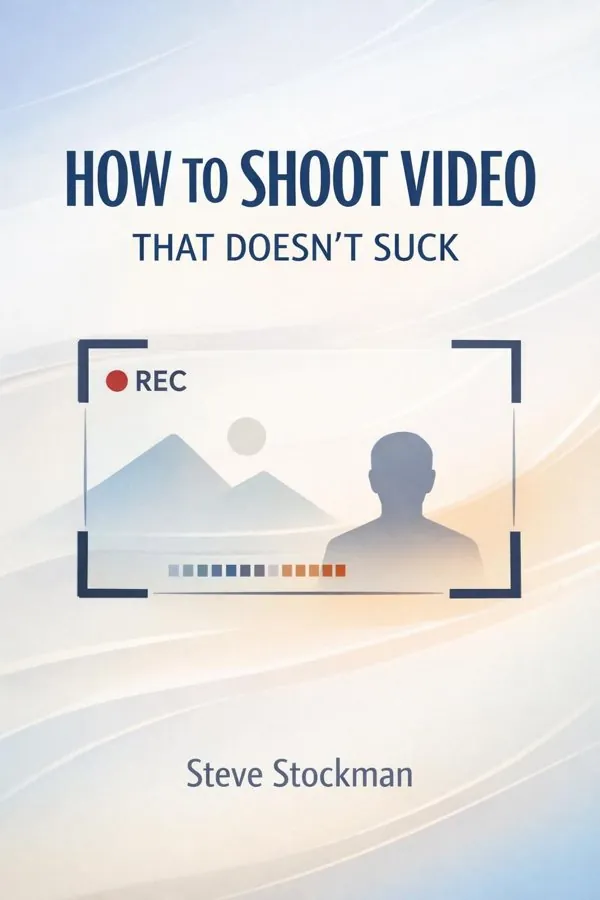
How to Shoot Video That Doesn't Suck: Advice to Make Any Amateur Look Like a Pro: Summary & Key Insights
 10 min11 chaptersAudio available
What Is How to Shoot Video That Doesn't Suck: Advice to Make Any Amateur Look Like a Pro About?
How to Shoot Video That Doesn't Suck: Advice to Make Any Amateur Look Like a Pro by Steve Stockman is a creativity book spanning 11 pages. A practical guide for beginners and aspiring filmmakers, this book teaches the fundamentals of shooting engaging video content. Steve Stockman explains how to think like a director, plan shots, tell stories visually, and avoid common mistakes that make amateur videos dull. The book covers topics such as framing, lighting, editing, and storytelling, offering clear, humorous, and actionable advice for anyone using a camera—from smartphones to professional gear.
This FizzRead summary covers all 11 key chapters of How to Shoot Video That Doesn't Suck: Advice to Make Any Amateur Look Like a Pro in approximately 10 minutes, distilling the most important ideas, arguments, and takeaways from Steve Stockman's work. Also available as an audio summary and Key Quotes Podcast.
How to Shoot Video That Doesn't Suck: Advice to Make Any Amateur Look Like a Pro
A practical guide for beginners and aspiring filmmakers, this book teaches the fundamentals of shooting engaging video content. Steve Stockman explains how to think like a director, plan shots, tell stories visually, and avoid common mistakes that make amateur videos dull. The book covers topics such as framing, lighting, editing, and storytelling, offering clear, humorous, and actionable advice for anyone using a camera—from smartphones to professional gear.
Who Should Read How to Shoot Video That Doesn't Suck: Advice to Make Any Amateur Look Like a Pro?
This book is perfect for anyone interested in creativity and looking to gain actionable insights in a short read. Whether you're a student, professional, or lifelong learner, the key ideas from How to Shoot Video That Doesn't Suck: Advice to Make Any Amateur Look Like a Pro by Steve Stockman will help you think differently.
- ✓Readers who enjoy creativity and want practical takeaways
- ✓Professionals looking to apply new ideas to their work and life
- ✓Anyone who wants the core insights of How to Shoot Video That Doesn't Suck: Advice to Make Any Amateur Look Like a Pro in just 10 minutes
Want the full summary?
Get instant access to this book summary and 100K+ more with Fizz Moment.
Get Free SummaryAvailable on App Store • Free to download
Key Chapters
If there’s one mental shift that changes everything, it’s learning to think like a director. Most amateurs think like operators—they point the camera at something and hope something interesting happens. Directors, however, think in stories. They understand that each shot must serve a purpose, and that purpose is rooted in emotion and meaning.
When I direct, I’m not just looking at what’s in front of the lens. I’m considering who’s watching and what I want them to feel. Thinking like a director means constantly asking yourself: Why is this shot here? What do I want my audience to understand, or experience, or wonder about? If you start asking those questions, your videos will instantly rise above the ordinary.
Thinking this way doesn’t require Hollywood experience—it requires awareness. Let’s say you’re filming a friend playing guitar. You could simply record the whole thing from a single angle, centered and flat. Or, you could imagine how a professional might shoot it: a close-up on the fingers striking the strings, the sweat glistening under the light, the rhythm of changing camera angles to reflect the pace of the music. You frame moments rather than just events. That’s the difference between random footage and storytelling.
The director’s mindset reminds you to take control. You decide what viewers see and when they see it. You curate reality through choices: composition, timing, sound, and editing. Once you start thinking this way, everything about the way you shoot transforms from accidental to intentional.
Every memorable video, regardless of subject, has a story—and every bad video lacks one. Story isn’t limited to fiction or documentary; it’s the architecture of meaning that guides the viewer from beginning to end. In this book, I emphasize that a story is simply change over time. Something starts somewhere, something happens, and we end up somewhere new.
That’s why even a short clip can—and should—have a story. Suppose you’re recording a basketball game. The story isn’t the game itself; it’s a player’s struggle to make a shot, the tension building as the clock runs down, the cathartic release when the ball hits the net. Your job is to help the viewer feel that progression.
A crucial lesson is that story gives viewers a reason to keep watching. Without it, they disengage. The camera must follow emotional arcs, not just physical ones. Beginners often film what’s happening, but professionals film what’s changing. If you understand that distinction, you’ll automatically start constructing videos that hold attention.
Story also shapes editing and rhythm. You can feel when a video lacks story because it feels scattered or random. When it has story, every shot, cut, and sound cue builds toward something. That’s how narrative flow works—and it’s how you make video that doesn’t suck.
+ 9 more chapters — available in the FizzRead app
All Chapters in How to Shoot Video That Doesn't Suck: Advice to Make Any Amateur Look Like a Pro
About the Author
Steve Stockman is a writer, director, and producer known for his work in film, television, and commercials. He directed the feature film 'Two Weeks' and has produced numerous television projects. Stockman is also an educator and speaker on video production and storytelling.
Get This Summary in Your Preferred Format
Read or listen to the How to Shoot Video That Doesn't Suck: Advice to Make Any Amateur Look Like a Pro summary by Steve Stockman anytime, anywhere. FizzRead offers multiple formats so you can learn on your terms — all free.
Available formats: App · Audio · PDF · EPUB — All included free with FizzRead
Download How to Shoot Video That Doesn't Suck: Advice to Make Any Amateur Look Like a Pro PDF and EPUB Summary
Key Quotes from How to Shoot Video That Doesn't Suck: Advice to Make Any Amateur Look Like a Pro
“If there’s one mental shift that changes everything, it’s learning to think like a director.”
“Every memorable video, regardless of subject, has a story—and every bad video lacks one.”
Frequently Asked Questions about How to Shoot Video That Doesn't Suck: Advice to Make Any Amateur Look Like a Pro
How to Shoot Video That Doesn't Suck: Advice to Make Any Amateur Look Like a Pro by Steve Stockman is a creativity book that explores key ideas across 11 chapters. A practical guide for beginners and aspiring filmmakers, this book teaches the fundamentals of shooting engaging video content. Steve Stockman explains how to think like a director, plan shots, tell stories visually, and avoid common mistakes that make amateur videos dull. The book covers topics such as framing, lighting, editing, and storytelling, offering clear, humorous, and actionable advice for anyone using a camera—from smartphones to professional gear.
You Might Also Like
Dimensions Of Creativity
Margaret A. Boden
10 min
How to Fly a Horse: The Secret History of Creation, Invention, and Discovery
Kevin Ashton
10 min
Imagine: How Creativity Works
Jonah Lehrer
10 min
The Accidental Creative: How to Be Brilliant at a Moment's Notice
Todd Henry
10 min
The Origins of Creativity
Edward O. Wilson
10 min
Wired to Create: Unraveling the Mysteries of the Creative Mind
Scott Barry Kaufman, Carolyn Gregoire
10 minBrowse by Category
Ready to read How to Shoot Video That Doesn't Suck: Advice to Make Any Amateur Look Like a Pro?
Get the full summary and 100K+ more books with Fizz Moment.