
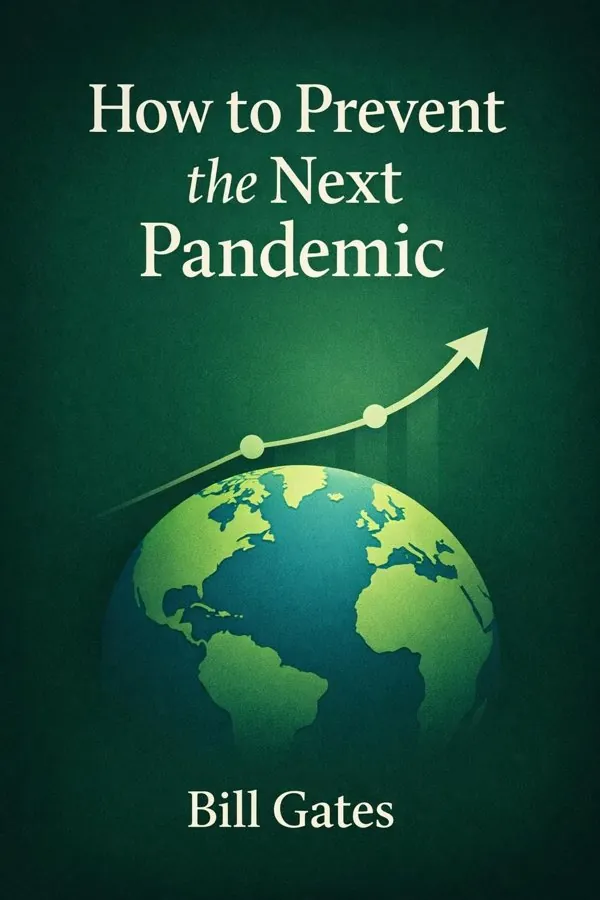
How to Prevent the Next Pandemic: Summary & Key Insights
by Bill Gates
 10 min12 chaptersAudio available
What Is How to Prevent the Next Pandemic About?
How to Prevent the Next Pandemic by Bill Gates is a health_med book spanning 12 pages. In this book, Bill Gates outlines a comprehensive plan to prevent future pandemics by improving global health systems, investing in disease surveillance, and fostering international cooperation. Drawing on lessons from COVID-19, Gates proposes actionable strategies for governments and organizations to detect outbreaks early and respond effectively, emphasizing innovation, preparedness, and equity.
This FizzRead summary covers all 12 key chapters of How to Prevent the Next Pandemic in approximately 10 minutes, distilling the most important ideas, arguments, and takeaways from Bill Gates's work. Also available as an audio summary and Key Quotes Podcast.
How to Prevent the Next Pandemic
In this book, Bill Gates outlines a comprehensive plan to prevent future pandemics by improving global health systems, investing in disease surveillance, and fostering international cooperation. Drawing on lessons from COVID-19, Gates proposes actionable strategies for governments and organizations to detect outbreaks early and respond effectively, emphasizing innovation, preparedness, and equity.
Who Should Read How to Prevent the Next Pandemic?
This book is perfect for anyone interested in health_med and looking to gain actionable insights in a short read. Whether you're a student, professional, or lifelong learner, the key ideas from How to Prevent the Next Pandemic by Bill Gates will help you think differently.
- ✓Readers who enjoy health_med and want practical takeaways
- ✓Professionals looking to apply new ideas to their work and life
- ✓Anyone who wants the core insights of How to Prevent the Next Pandemic in just 10 minutes
Want the full summary?
Get instant access to this book summary and 100K+ more with Fizz Moment.
Get Free SummaryAvailable on App Store • Free to download
Key Chapters
COVID-19 changed everything—for individuals, for nations, and for the way we perceive health security. In the early months of 2020, it became clear that the world lacked mechanisms to detect and respond effectively. Science advanced quickly—mRNA vaccines were developed at record speed—but the social and political systems lagged behind. Testing was sporadic, supply chains fractured, and coordination between governments faltered.
What can we learn from this? First, data saves lives. Nations that combined transparent data collection with coordinated response—like South Korea or New Zealand—fared better. Second, preparation matters more than prediction. We didn’t need to foresee exactly what SARS-CoV-2 would look like; we just needed systems capable of reacting to any novel pathogen. Third, inequity kills. The virus did not discriminate biologically, but poverty, weak infrastructure, and unequal vaccine distribution ensured it struck the vulnerable hardest.
As I examined these patterns, I realized COVID-19 should not merely be seen as a calamity but as a case study. It revealed what a global failure to organize looks like. Our challenge now is to convert those lessons into lasting reform.
Preparedness is not glamorous—it’s a discipline of foresight. Most of the systems that keep societies safe are invisible when they work well: we rarely see the quiet success of an air traffic control system until it fails. Health preparedness should be no different. Fighting pandemics shouldn’t be a scramble every few decades; it should be a steady commitment integrated into routine governance.
Many countries already maintain defenses for military or cyber threats, investing billions annually to anticipate risks that may never materialize. Why, then, do we hesitate to do the same for pandemics? The cost of preparedness—a few billion dollars annually—is trivial compared to the global economic losses of COVID-19, which exceeded ten trillion.
In this book, I emphasize that pandemic defense is a moral and financial responsibility. Governments must embed preparedness into budgets and education systems. Just as fire departments train for disasters that rarely occur, the global health architecture must maintain permanent readiness. The world can’t afford to treat pandemics as anomalies—they are recurring geopolitical events shaped by biology, behavior, and environment.
+ 10 more chapters — available in the FizzRead app
All Chapters in How to Prevent the Next Pandemic
About the Author
Bill Gates is an American business magnate, software developer, and philanthropist. He co-founded Microsoft Corporation and later established the Bill & Melinda Gates Foundation, focusing on global health, education, and poverty alleviation. Gates is known for his advocacy of scientific solutions to global challenges, including infectious disease prevention and climate change.
Get This Summary in Your Preferred Format
Read or listen to the How to Prevent the Next Pandemic summary by Bill Gates anytime, anywhere. FizzRead offers multiple formats so you can learn on your terms — all free.
Available formats: App · Audio · PDF · EPUB — All included free with FizzRead
Download How to Prevent the Next Pandemic PDF and EPUB Summary
Key Quotes from How to Prevent the Next Pandemic
“COVID-19 changed everything—for individuals, for nations, and for the way we perceive health security.”
“Preparedness is not glamorous—it’s a discipline of foresight.”
Frequently Asked Questions about How to Prevent the Next Pandemic
How to Prevent the Next Pandemic by Bill Gates is a health_med book that explores key ideas across 12 chapters. In this book, Bill Gates outlines a comprehensive plan to prevent future pandemics by improving global health systems, investing in disease surveillance, and fostering international cooperation. Drawing on lessons from COVID-19, Gates proposes actionable strategies for governments and organizations to detect outbreaks early and respond effectively, emphasizing innovation, preparedness, and equity.
More by Bill Gates

You Might Also Like

On Immunity
Eula Biss
10 min
The Three-Body Problem
Liu Cixin
10 min
Community Health Volunteer Toolkit: Training and Practical Activities
World Health Organization
10 min
Healing Back Pain: The Mind-Body Connection
John E. Sarno
10 min
Health Literacy for All: Practical Guides to Communicate Health Information (Compilations)
World Health Organization
10 min
The Complete Guide to Sports Supplements: An Evidence-Based Review
Anita Bean
10 minBrowse by Category
Ready to read How to Prevent the Next Pandemic?
Get the full summary and 100K+ more books with Fizz Moment.