
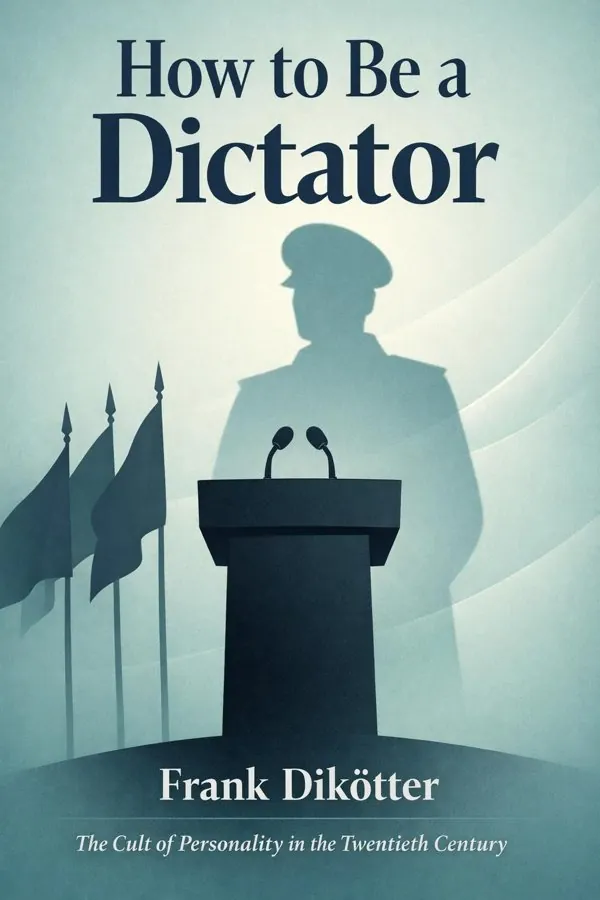
How to Be a Dictator: The Cult of Personality in the Twentieth Century: Summary & Key Insights
 10 min9 chaptersAudio available
What Is How to Be a Dictator: The Cult of Personality in the Twentieth Century About?
How to Be a Dictator: The Cult of Personality in the Twentieth Century by Frank Dikötter is a world_history book spanning 9 pages. In this incisive historical study, Frank Dikötter examines the rise and rule of eight twentieth-century dictators, including Mussolini, Hitler, Stalin, Mao, and others. He explores how they built and maintained their cults of personality, manipulated propaganda, and used fear and charisma to consolidate power. Drawing on extensive archival research, Dikötter reveals the mechanisms of totalitarian control and the fragility of such regimes.
This FizzRead summary covers all 9 key chapters of How to Be a Dictator: The Cult of Personality in the Twentieth Century in approximately 10 minutes, distilling the most important ideas, arguments, and takeaways from Frank Dikötter's work. Also available as an audio summary and Key Quotes Podcast.
How to Be a Dictator: The Cult of Personality in the Twentieth Century
In this incisive historical study, Frank Dikötter examines the rise and rule of eight twentieth-century dictators, including Mussolini, Hitler, Stalin, Mao, and others. He explores how they built and maintained their cults of personality, manipulated propaganda, and used fear and charisma to consolidate power. Drawing on extensive archival research, Dikötter reveals the mechanisms of totalitarian control and the fragility of such regimes.
Who Should Read How to Be a Dictator: The Cult of Personality in the Twentieth Century?
This book is perfect for anyone interested in world_history and looking to gain actionable insights in a short read. Whether you're a student, professional, or lifelong learner, the key ideas from How to Be a Dictator: The Cult of Personality in the Twentieth Century by Frank Dikötter will help you think differently.
- ✓Readers who enjoy world_history and want practical takeaways
- ✓Professionals looking to apply new ideas to their work and life
- ✓Anyone who wants the core insights of How to Be a Dictator: The Cult of Personality in the Twentieth Century in just 10 minutes
Want the full summary?
Get instant access to this book summary and 100K+ more with Fizz Moment.
Get Free SummaryAvailable on App Store • Free to download
Key Chapters
Benito Mussolini was the twentieth century’s first great self-marketer in politics. When he rose to power in Italy, he didn’t simply present himself as a leader—he reinvented what leadership looked like. His image as *Il Duce* was everywhere: on murals, in newspapers, echoed through architecture that embodied strength and endurance. He understood the potency of drama. Italy became a stage, and Mussolini its protagonist.
Through mass rallies, cinematic newsreels, and grand public works, he made himself synonymous with national rejuvenation. Buildings were not just constructed—they were consecrated to his vision. He dictated the tone of the press and demanded pageantry that blurred politics and religion. His raised chin and crossed arms became symbols of defiance against weakness and liberalism. Yet under this façade, Italy’s reality remained chaotic and compromised. Propaganda compensated for failure; spectacle replaced substance.
I illustrate how Mussolini’s cult transformed a faltering regime into an emotional movement. People weren’t drawn only to policy, but to the image of virility, to the idea that Il Duce alone could embody Italian strength. But this devotion was brittle—it depended on continuous performance. When the curtain finally fell in 1943, it revealed what all cults of personality hide: a man, not a messiah.
Adolf Hitler perfected the techniques Mussolini pioneered. In Germany, propaganda became not merely a tool but a total environment. Under Joseph Goebbels, image and ideology fused: no distinction remained between the man and the myth. Hitler’s rise hinged on emotional resonance—he was portrayed as the savior of a humiliated nation. His speeches were crafted as liturgies, his rallies as pilgrimages. He offered belonging through fanaticism.
Hitler’s cult was quasi-religious. The Führer was omniscient, omnipresent, beyond reproach. Children learned songs of devotion; portraits hung in every classroom. Loyalty became moral law, and the Nazi Party’s theater of unity masked systemic instability. Even those who suspected the falsehoods often found comfort in the aesthetic order he imposed. It is here we see that dictatorship thrives not because of universal belief, but because disbelief becomes unutterable.
In the book, I dissect how Hitler’s charisma functioned less as personal magnetism than as meticulous manipulation. He was the axis around which myth spun, enabled by a bureaucratic culture that sanctified obedience. Yet his persona had to be continuously fed by victory and spectacle; its collapse began when failure intruded. By the bunker’s end, the “Führer’s genius” had shrunk to a tragic farce. What remained was the residue of an illusion—a nation that had worshiped a phantom of its own making.
+ 7 more chapters — available in the FizzRead app
All Chapters in How to Be a Dictator: The Cult of Personality in the Twentieth Century
About the Author
Frank Dikötter is a Dutch historian and the Chair Professor of Humanities at the University of Hong Kong. He is best known for his works on modern Chinese history, including the award-winning 'Mao’s Great Famine' and 'The Tragedy of Liberation'. His research focuses on authoritarianism, propaganda, and the social history of modern dictatorships.
Get This Summary in Your Preferred Format
Read or listen to the How to Be a Dictator: The Cult of Personality in the Twentieth Century summary by Frank Dikötter anytime, anywhere. FizzRead offers multiple formats so you can learn on your terms — all free.
Available formats: App · Audio · PDF · EPUB — All included free with FizzRead
Download How to Be a Dictator: The Cult of Personality in the Twentieth Century PDF and EPUB Summary
Key Quotes from How to Be a Dictator: The Cult of Personality in the Twentieth Century
“Benito Mussolini was the twentieth century’s first great self-marketer in politics.”
“Adolf Hitler perfected the techniques Mussolini pioneered.”
Frequently Asked Questions about How to Be a Dictator: The Cult of Personality in the Twentieth Century
How to Be a Dictator: The Cult of Personality in the Twentieth Century by Frank Dikötter is a world_history book that explores key ideas across 9 chapters. In this incisive historical study, Frank Dikötter examines the rise and rule of eight twentieth-century dictators, including Mussolini, Hitler, Stalin, Mao, and others. He explores how they built and maintained their cults of personality, manipulated propaganda, and used fear and charisma to consolidate power. Drawing on extensive archival research, Dikötter reveals the mechanisms of totalitarian control and the fragility of such regimes.
You Might Also Like
The Age of Capital
Eric Hobsbawm
10 min
The Gulag Archipelago
Aleksandr Solzhenitsyn
10 min
Jerusalem: The Biography
Simon Sebag Montefiore
10 min
The Anglo-Saxons
James Campbell
10 min
The Boer War
Thomas Pakenham
10 min
The Industrial Revolutionaries: The Making of the Modern World 1776–1914
Gavin Weightman
10 minBrowse by Category
Ready to read How to Be a Dictator: The Cult of Personality in the Twentieth Century?
Get the full summary and 100K+ more books with Fizz Moment.