
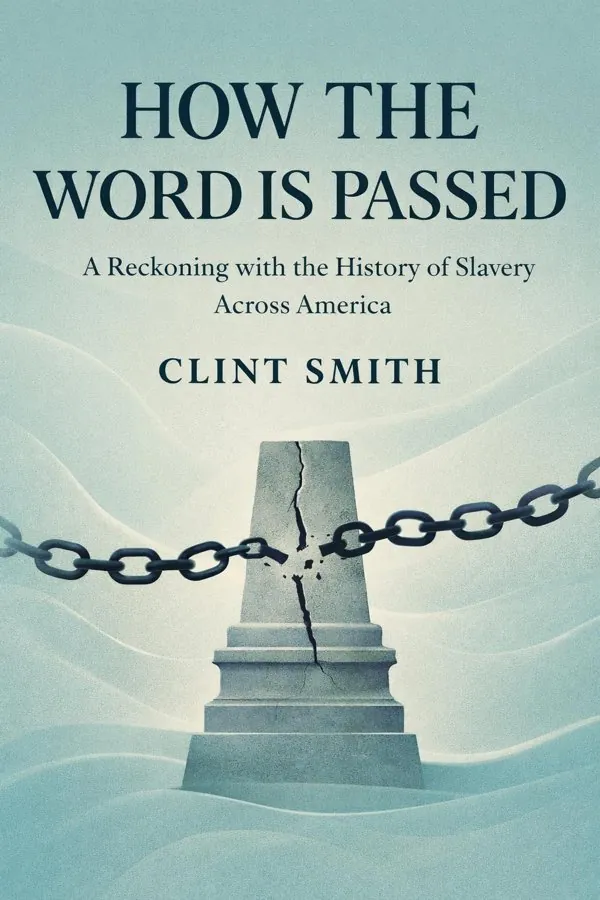
How the Word Is Passed: A Reckoning with the History of Slavery Across America: Summary & Key Insights
by Clint Smith
 10 min8 chaptersAudio available
What Is How the Word Is Passed: A Reckoning with the History of Slavery Across America About?
How the Word Is Passed: A Reckoning with the History of Slavery Across America by Clint Smith is a world_history book spanning 8 pages. In this powerful work of narrative nonfiction, Clint Smith takes readers on a journey across the United States to examine how the legacy of slavery is remembered and misremembered. Through visits to monuments, plantations, prisons, and historical landmarks, Smith explores the ways in which history is told, who tells it, and how that shapes our understanding of the present. Blending reportage, history, and personal reflection, the book offers a profound meditation on memory, identity, and justice.
This FizzRead summary covers all 8 key chapters of How the Word Is Passed: A Reckoning with the History of Slavery Across America in approximately 10 minutes, distilling the most important ideas, arguments, and takeaways from Clint Smith's work. Also available as an audio summary and Key Quotes Podcast.
How the Word Is Passed: A Reckoning with the History of Slavery Across America
In this powerful work of narrative nonfiction, Clint Smith takes readers on a journey across the United States to examine how the legacy of slavery is remembered and misremembered. Through visits to monuments, plantations, prisons, and historical landmarks, Smith explores the ways in which history is told, who tells it, and how that shapes our understanding of the present. Blending reportage, history, and personal reflection, the book offers a profound meditation on memory, identity, and justice.
Who Should Read How the Word Is Passed: A Reckoning with the History of Slavery Across America?
This book is perfect for anyone interested in world_history and looking to gain actionable insights in a short read. Whether you're a student, professional, or lifelong learner, the key ideas from How the Word Is Passed: A Reckoning with the History of Slavery Across America by Clint Smith will help you think differently.
- ✓Readers who enjoy world_history and want practical takeaways
- ✓Professionals looking to apply new ideas to their work and life
- ✓Anyone who wants the core insights of How the Word Is Passed: A Reckoning with the History of Slavery Across America in just 10 minutes
Want the full summary?
Get instant access to this book summary and 100K+ more with Fizz Moment.
Get Free SummaryAvailable on App Store • Free to download
Key Chapters
The gates of Monticello open onto one of America’s most mythologized landscapes, and one of its most haunted. Thomas Jefferson envisioned this hilltop estate as a living testament to enlightenment ideals—reason, self-governance, human progress. Yet behind every polished narrative of genius and liberty stand the hundreds of enslaved people whose labor sustained Jefferson’s dream. As I walked its grounds, guided by a historian who refused to look away from these contradictions, I realized that Monticello was in many ways a mirror of our country—noble in aspiration, but steeped in hypocrisy. Jefferson was both the author of the Declaration of Independence and the owner of more than six hundred enslaved people in his lifetime. This duality is not an anomaly; it is foundational. How should we hold both truths at once? One of the most striking things about Monticello today is how the curatorial language has shifted in recent years. Where tours once glossed over the lives of the enslaved, new exhibits now name them—John Hemmings, Ursula Granger, and of course, Sally Hemings, whose relationship with Jefferson epitomizes the coercive power dynamics of slavery. I watched visitors wrestle with discomfort as they were asked to imagine Monticello not as a monument to freedom, but as a plantation. Some resisted, others wept. In their faces, I saw the tension of a nation trying to reconcile reverence with responsibility. For me, Monticello became a symbol of the work we must all do—to hold history in its fullness, refusing the comfort of selective memory. Jefferson’s words about equality still echo, but so do the whispers of those who made possible his life of learning. Both voices belong to America. Both must be heard.
If Monticello represents a shift toward acknowledgment, the Whitney Plantation signifies a revolution in remembrance. Located along the banks of the Mississippi River in Louisiana, it was the first of its kind in the United States—a plantation museum dedicated entirely to the experience of the enslaved. From the moment I stepped onto the grounds, I felt the difference. There were no glossy portraits of owners, no grand tours of the big house as spectacle. Instead, the air was filled with the quiet insistence of remembrance. Names etched in granite. Sculptures of children cast in bronze. The rows of sugarcane outside the gates seemed to breathe with the memory of those who had toiled under the southern sun. The Whitney does not ask visitors to observe history from a comfortable distance. It asks them to dwell within it. The statues of enslaved children, created by artist Woodrow Nash, stare into you with an innocence that indicts. Each one represents a child recorded in the archives—real people stripped of agency, now restored as witnesses. It was here I understood that memorialization can itself be a form of justice, a way to reclaim humanity that history has denied. The Whitney’s founder, John Cummings, a white lawyer from New Orleans, spent more than fifteen years and millions of dollars to bring this site into existence. His work reminds us that confronting slavery’s legacy requires courage and humility from all of us. As I walked away that day, I realized that remembering is not passive nostalgia—it is restorative labor. The Whitney offers a model of how to tell the story of slavery not as a distant atrocity, but as the living root of our present inequalities.
+ 6 more chapters — available in the FizzRead app
All Chapters in How the Word Is Passed: A Reckoning with the History of Slavery Across America
About the Author
Clint Smith is an American writer, poet, and scholar. He is a staff writer at The Atlantic and the author of several acclaimed works including 'Counting Descent' and 'How the Word Is Passed'. Smith holds a Ph.D. in Education from Harvard University and is known for his insightful explorations of race, history, and social justice.
Get This Summary in Your Preferred Format
Read or listen to the How the Word Is Passed: A Reckoning with the History of Slavery Across America summary by Clint Smith anytime, anywhere. FizzRead offers multiple formats so you can learn on your terms — all free.
Available formats: App · Audio · PDF · EPUB — All included free with FizzRead
Download How the Word Is Passed: A Reckoning with the History of Slavery Across America PDF and EPUB Summary
Key Quotes from How the Word Is Passed: A Reckoning with the History of Slavery Across America
“The gates of Monticello open onto one of America’s most mythologized landscapes, and one of its most haunted.”
“If Monticello represents a shift toward acknowledgment, the Whitney Plantation signifies a revolution in remembrance.”
Frequently Asked Questions about How the Word Is Passed: A Reckoning with the History of Slavery Across America
How the Word Is Passed: A Reckoning with the History of Slavery Across America by Clint Smith is a world_history book that explores key ideas across 8 chapters. In this powerful work of narrative nonfiction, Clint Smith takes readers on a journey across the United States to examine how the legacy of slavery is remembered and misremembered. Through visits to monuments, plantations, prisons, and historical landmarks, Smith explores the ways in which history is told, who tells it, and how that shapes our understanding of the present. Blending reportage, history, and personal reflection, the book offers a profound meditation on memory, identity, and justice.
You Might Also Like
The Age of Capital
Eric Hobsbawm
10 min
The Gulag Archipelago
Aleksandr Solzhenitsyn
10 min
Jerusalem: The Biography
Simon Sebag Montefiore
10 min
The Anglo-Saxons
James Campbell
10 min
The Boer War
Thomas Pakenham
10 min
The Industrial Revolutionaries: The Making of the Modern World 1776–1914
Gavin Weightman
10 minBrowse by Category
Ready to read How the Word Is Passed: A Reckoning with the History of Slavery Across America?
Get the full summary and 100K+ more books with Fizz Moment.