
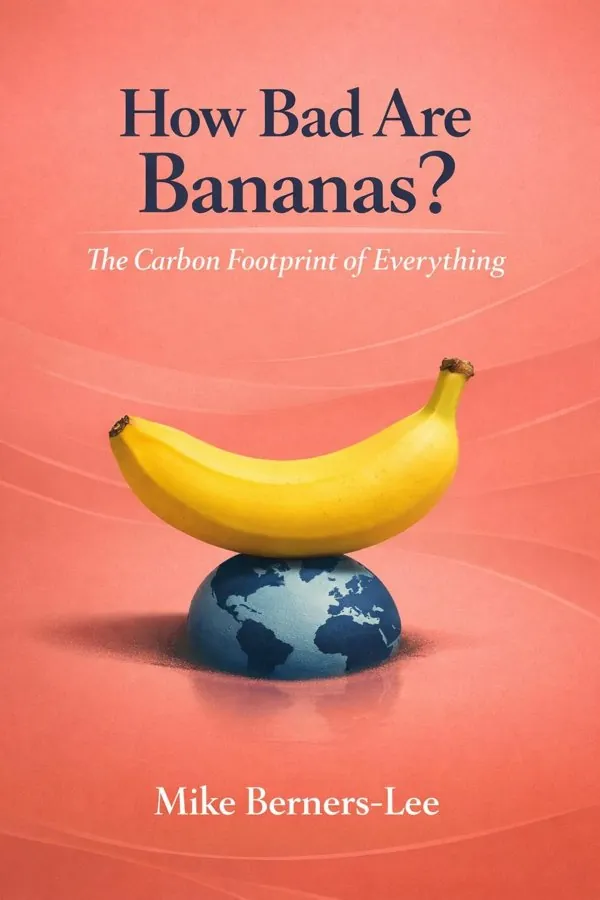
How Bad Are Bananas?: The Carbon Footprint of Everything: Summary & Key Insights
 10 min8 chaptersAudio available
What Is How Bad Are Bananas?: The Carbon Footprint of Everything About?
How Bad Are Bananas?: The Carbon Footprint of Everything by Mike Berners-Lee is a environment book spanning 8 pages. This book provides an accessible and engaging guide to understanding the carbon footprint of everyday items and activities. Mike Berners-Lee breaks down the environmental impact of everything from sending an email to eating a banana, helping readers make more informed choices about their consumption and lifestyle. The book combines scientific rigor with humor and practical advice, making complex sustainability issues understandable for a general audience.
This FizzRead summary covers all 8 key chapters of How Bad Are Bananas?: The Carbon Footprint of Everything in approximately 10 minutes, distilling the most important ideas, arguments, and takeaways from Mike Berners-Lee's work. Also available as an audio summary and Key Quotes Podcast.
How Bad Are Bananas?: The Carbon Footprint of Everything
This book provides an accessible and engaging guide to understanding the carbon footprint of everyday items and activities. Mike Berners-Lee breaks down the environmental impact of everything from sending an email to eating a banana, helping readers make more informed choices about their consumption and lifestyle. The book combines scientific rigor with humor and practical advice, making complex sustainability issues understandable for a general audience.
Who Should Read How Bad Are Bananas?: The Carbon Footprint of Everything?
This book is perfect for anyone interested in environment and looking to gain actionable insights in a short read. Whether you're a student, professional, or lifelong learner, the key ideas from How Bad Are Bananas?: The Carbon Footprint of Everything by Mike Berners-Lee will help you think differently.
- ✓Readers who enjoy environment and want practical takeaways
- ✓Professionals looking to apply new ideas to their work and life
- ✓Anyone who wants the core insights of How Bad Are Bananas?: The Carbon Footprint of Everything in just 10 minutes
Want the full summary?
Get instant access to this book summary and 100K+ more with Fizz Moment.
Get Free SummaryAvailable on App Store • Free to download
Key Chapters
To understand what a carbon footprint really means, we begin with the basic building blocks of measurement. A carbon footprint represents the total greenhouse gases emitted because of an activity, product, or process, converted into carbon dioxide equivalents (CO₂e). This standardization allows us to compare different sources of emissions—methane from cows, nitrous oxide from fertilizers, CO₂ from combustion—on a common scale.
Life-cycle analysis (LCA) is the backbone of footprint estimation. It’s an accounting method that considers a product’s full journey: extraction of raw materials, production, transportation, use, and disposal. For example, a plastic bottle’s footprint doesn’t just come from the oil used to make it—it also includes the refining process, manufacturing energy, and the fate of the bottle after we’re done with it. Similarly, the carbon cost of an email isn’t limited to the power your computer uses; it extends to data centers, transmission networks, and even the embodied energy in the devices themselves.
This sort of analysis often surprises people because it’s counterintuitive. We tend to equate visible pollution—like a car’s exhaust—with environmental impact. But a car parked in the driveway, with all the emissions tied up in its manufacture, might already have a far larger footprint than years of driving it carefully. Hence why I emphasize the invisible side of carbon.
In making these calculations, we deal with uncertainties. No figure is exact; each is a careful estimate based on best available data and assumptions. But even with imperfections, these numbers provide remarkable insights. They teach proportion and help prioritize action. You don’t need to agonize over every gram of carbon—you need to understand where the major contributors lie.
The journey into everyday activities often reveals the most startling lessons. Take boiling water or sending emails—mundane actions that turn out to carry measurable footprints. Boiling a kettle to make a cup of tea uses energy, of course, but most of the time we boil more water than we need. The excess becomes wasted heat and unnecessary carbon. It’s a small detail, yet multiplied across millions of homes, it represents a real environmental impact.
Sending an email feels intangible. But every digital message travels through servers and data centers that consume electricity round the clock. While a single message may represent only a fraction of a gram of CO₂, the total—given the billions of emails sent daily—is immense. The point isn’t to stop emailing; it’s to recognize how our digital presence intersects with the physical world.
Light bulbs provide another example. The shift from incandescent to LED lighting dramatically decreases emissions by reducing electricity demand. Here small acts amplify globally: one efficient bulb becomes millions, and the difference accumulates over time.
What I hope to convey through these examples is that awareness breeds proportionality. Once you grasp the scale, you can adjust habits without losing quality of life. Filling the kettle, turning off the lights, deleting unnecessary emails—none of these feel heroic, yet collectively they represent a culture moving toward mindfulness.
+ 6 more chapters — available in the FizzRead app
All Chapters in How Bad Are Bananas?: The Carbon Footprint of Everything
About the Author
Mike Berners-Lee is a British researcher and writer specializing in sustainability and carbon footprint analysis. He is a professor at Lancaster University and the author of several books on climate change and environmental impact, known for his clear and practical approach to complex ecological issues.
Get This Summary in Your Preferred Format
Read or listen to the How Bad Are Bananas?: The Carbon Footprint of Everything summary by Mike Berners-Lee anytime, anywhere. FizzRead offers multiple formats so you can learn on your terms — all free.
Available formats: App · Audio · PDF · EPUB — All included free with FizzRead
Download How Bad Are Bananas?: The Carbon Footprint of Everything PDF and EPUB Summary
Key Quotes from How Bad Are Bananas?: The Carbon Footprint of Everything
“To understand what a carbon footprint really means, we begin with the basic building blocks of measurement.”
“The journey into everyday activities often reveals the most startling lessons.”
Frequently Asked Questions about How Bad Are Bananas?: The Carbon Footprint of Everything
How Bad Are Bananas?: The Carbon Footprint of Everything by Mike Berners-Lee is a environment book that explores key ideas across 8 chapters. This book provides an accessible and engaging guide to understanding the carbon footprint of everyday items and activities. Mike Berners-Lee breaks down the environmental impact of everything from sending an email to eating a banana, helping readers make more informed choices about their consumption and lifestyle. The book combines scientific rigor with humor and practical advice, making complex sustainability issues understandable for a general audience.
You Might Also Like
A Life on Our Planet: My Witness Statement and a Vision for the Future
David Attenborough
10 min
A Sky Full Of Birds
Matt Merritt
10 min
Carbon Zero: Imagining Cities That Can Save the Planet
Alex Steffen
10 min
Eaarth: Making a Life on a Tough New Planet
Bill McKibben
10 min
The Social Contract and Environmental Governance
Various Editors
10 min
The Wild Places
Robert Macfarlane
10 minBrowse by Category
Ready to read How Bad Are Bananas?: The Carbon Footprint of Everything?
Get the full summary and 100K+ more books with Fizz Moment.