
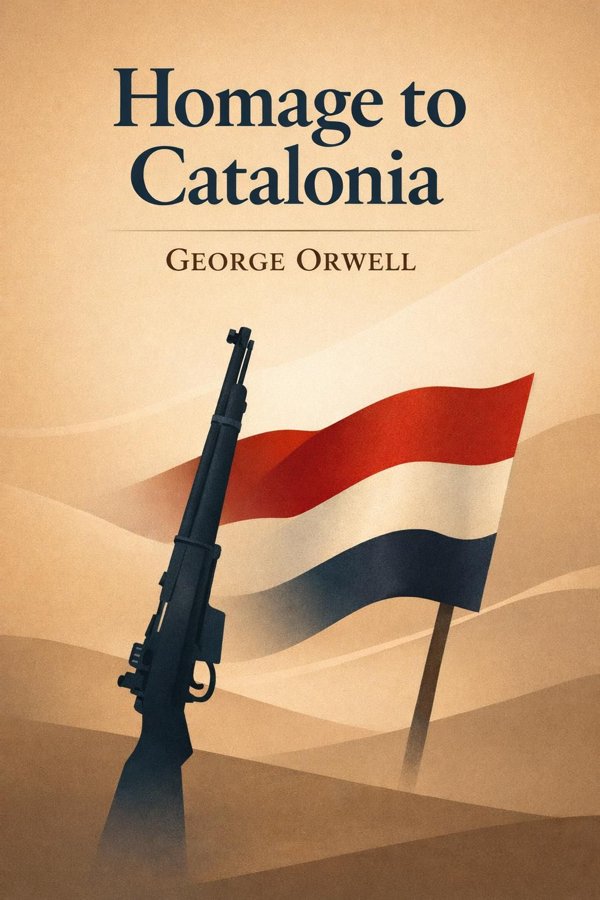
Homage to Catalonia: Summary & Key Insights
 10 min9 chaptersAudio available
Key Takeaways from Homage to Catalonia
A revolution is most persuasive not when it is argued for, but when it is briefly made visible in everyday life.
War is often imagined as constant heroism, but Orwell shows that much of it is discomfort, confusion, and waiting.
The reality of battle is not glorious clarity but fragmented experience shaped by fear, uncertainty, and chance.
Political movements often begin in unity and end in rivalry, especially once power becomes scarce.
A movement can be destroyed not only by its enemies, but by the inability of allies to agree on what they are fighting for.
What Is Homage to Catalonia About?
Homage to Catalonia by George Orwell is a war_military book spanning 9 pages. Homage to Catalonia is George Orwell’s gripping firsthand account of fighting in the Spanish Civil War, but it is far more than a war memoir. It is a book about ideals colliding with reality, about how revolutions inspire ordinary people, and about how political movements can betray their own stated principles. Orwell arrived in Spain in late 1936 intending to report on the conflict, yet he soon enlisted in the militia of the anti-Stalinist POUM and experienced the war from the trenches, hospitals, and tense streets of Barcelona. His account captures both the boredom and terror of combat, the camaraderie of soldiers living in hardship, and the bitter internal struggle among supposedly allied factions on the Republican side. What makes the book endure is Orwell’s moral seriousness. He writes not as a detached historian but as a witness determined to tell the truth even when it complicates his own sympathies. For readers interested in war, propaganda, ideology, and the human cost of political conflict, Homage to Catalonia remains one of the clearest and most honest books ever written.
This FizzRead summary covers all 9 key chapters of Homage to Catalonia in approximately 10 minutes, distilling the most important ideas, arguments, and takeaways from George Orwell's work. Also available as an audio summary and Key Quotes Podcast.
Homage to Catalonia
Homage to Catalonia is George Orwell’s gripping firsthand account of fighting in the Spanish Civil War, but it is far more than a war memoir. It is a book about ideals colliding with reality, about how revolutions inspire ordinary people, and about how political movements can betray their own stated principles. Orwell arrived in Spain in late 1936 intending to report on the conflict, yet he soon enlisted in the militia of the anti-Stalinist POUM and experienced the war from the trenches, hospitals, and tense streets of Barcelona. His account captures both the boredom and terror of combat, the camaraderie of soldiers living in hardship, and the bitter internal struggle among supposedly allied factions on the Republican side. What makes the book endure is Orwell’s moral seriousness. He writes not as a detached historian but as a witness determined to tell the truth even when it complicates his own sympathies. For readers interested in war, propaganda, ideology, and the human cost of political conflict, Homage to Catalonia remains one of the clearest and most honest books ever written.
Who Should Read Homage to Catalonia?
This book is perfect for anyone interested in war_military and looking to gain actionable insights in a short read. Whether you're a student, professional, or lifelong learner, the key ideas from Homage to Catalonia by George Orwell will help you think differently.
- ✓Readers who enjoy war_military and want practical takeaways
- ✓Professionals looking to apply new ideas to their work and life
- ✓Anyone who wants the core insights of Homage to Catalonia in just 10 minutes
Want the full summary?
Get instant access to this book summary and 100K+ more with Fizz Moment.
Get Free SummaryAvailable on App Store • Free to download
Key Chapters
A revolution is most persuasive not when it is argued for, but when it is briefly made visible in everyday life. That is the impression Orwell conveys upon arriving in Barcelona in late 1936. He finds a city transformed by revolutionary energy: class distinctions appear blurred, workers run services, bourgeois habits seem temporarily suspended, and public life carries a rough but genuine sense of equality. To Orwell, this atmosphere is not merely theatrical politics. It feels like a social experiment in which ordinary people are attempting to live differently.
What makes this opening so powerful is Orwell’s sensitivity to the moral texture of the city. He notices small things: forms of address, the absence of servility, the changed relationship between labor and authority. These details matter because they suggest that political change is real only when it alters daily conduct. The revolution in Barcelona is imperfect, improvised, and chaotic, yet it gives Orwell a glimpse of a society not entirely organized around deference and privilege.
This idea remains relevant far beyond Spain. We often judge political systems by speeches, platforms, or leaders, but Orwell suggests we should ask simpler questions: How do people treat one another? Who gets heard? Who performs invisible labor? Whether in a workplace, community group, or institution, the spirit of equality is revealed in customs, not slogans.
The practical lesson is to evaluate any movement by its lived culture. If an organization claims justice, look for it in meetings, responsibilities, language, and behavior. Actionable takeaway: judge ideals by how they transform ordinary human relationships, not by how passionately they are proclaimed.
War is often imagined as constant heroism, but Orwell shows that much of it is discomfort, confusion, and waiting. When he reaches the Aragón front with the POUM militia, he encounters not a disciplined modern army but a poorly equipped force held together by courage, improvisation, and a shared cause. Weapons are outdated, clothing is insufficient, food is basic, and military organization is often laughably weak. Yet amid all this disorder, Orwell discovers a powerful sense of fellowship.
The trenches reveal one of the book’s deepest truths: people can endure extraordinary deprivation when they believe they are part of something larger than themselves. The men around Orwell are not romanticized. They are often untrained, undisciplined, careless, and deeply human. But they are also resilient, generous, and bound by mutual dependence. Shared hardship strips away many pretenses. What remains is a rough solidarity that Orwell clearly admires.
This section also corrects glamorous myths about war. There are long stretches of monotony, bad weather, lice, freezing nights, and the constant frustration of inadequate supplies. Orwell’s honesty helps readers understand that institutional weakness can be as dangerous as enemy fire. In modern terms, it is a reminder that noble intentions cannot substitute for competent systems.
The broader application is clear: teams under pressure need both purpose and practical support. Whether in activism, business, or public service, morale collapses when infrastructure fails. Actionable takeaway: if you want commitment from people, do not rely on inspiration alone; build the material conditions that allow courage and cooperation to last.
The reality of battle is not glorious clarity but fragmented experience shaped by fear, uncertainty, and chance. Orwell’s time at the front teaches him that war rarely resembles the narratives created by newspapers or patriotic rhetoric. Even when shots are fired and danger is real, combat can feel disjointed, anticlimactic, and morally bewildering. You may not know where the enemy is, what your commanders intend, or whether an operation has any strategic value at all.
This matters because Orwell replaces abstraction with direct observation. He does not deny bravery, but he refuses to sentimentalize it. Soldiers are often cold, hungry, exhausted, and unsure. Small accidents can determine survival. Incompetence and miscommunication may matter more than ideology in the immediate moment. This realism is central to the book’s authority: Orwell records not the war people wanted to imagine, but the war he actually lived.
The lesson extends beyond military conflict. In any crisis, outsiders tend to invent tidy stories of heroes, villains, and decisive turning points. Insiders know reality is messier. Projects fail for mundane reasons, institutions drift through confusion, and people act under constraints invisible to distant observers. Orwell’s example teaches intellectual humility. We should be suspicious of any account that makes struggle look too coherent.
A practical application is to prefer firsthand evidence over dramatic simplification. In public debates, workplace crises, or political controversies, ask what conditions actually look like on the ground. Seek details, not just narratives. Actionable takeaway: whenever a complex conflict is presented as simple and heroic, slow down and look for the lived reality beneath the story.
Political movements often begin in unity and end in rivalry, especially once power becomes scarce. When Orwell returns to Barcelona after service at the front, he finds the city transformed. The earlier atmosphere of revolutionary equality has dimmed, replaced by a more conventional social order and a growing climate of mistrust. The struggle is no longer only against Franco’s forces; it is increasingly about control within the Republican camp itself.
Orwell notices that propaganda, factional hostility, and bureaucratic maneuvering are reshaping public life. The language of shared struggle remains, but the emotional reality has shifted. This contrast between the Barcelona he first encountered and the one he later reenters is one of the book’s most striking developments. It shows how revolutions can lose their original energy not just through external defeat but through internal consolidation and fear.
What Orwell captures here is a timeless political pattern. Coalitions often hold together while facing a common enemy, but once strategic priorities diverge, ideological differences harden. Groups that once tolerated disagreement begin policing it. Former comrades become liabilities. In organizations today, similar shifts happen when mission gives way to status competition, or when emergency cooperation yields to institutional self-protection.
The practical insight is that changes in atmosphere are often early warnings of deeper structural change. When openness gives way to whispering, labels, and loyalty tests, something important is being lost. Leaders and participants alike should pay attention to culture before breakdown becomes formalized. Actionable takeaway: when a cause starts rewarding conformity more than honesty, treat that as a danger signal, not a minor inconvenience.
A movement can be destroyed not only by its enemies, but by the inability of allies to agree on what they are fighting for. Orwell’s account of the May 1937 street fighting in Barcelona is the dramatic center of Homage to Catalonia. During these days, conflict erupts between different Republican factions, especially involving communists, anarchists, and the anti-Stalinist POUM. Barricades go up, confusion reigns, and the anti-fascist side effectively enters civil war within civil war.
What makes this episode so devastating is its absurdity. The Republican side is already under existential threat from Franco, yet political mistrust and competing ideological agendas become so intense that former partners turn weapons on one another. Orwell’s description is not just a chronicle of urban unrest; it is a study in how strategic incoherence and factional bitterness can sabotage a larger struggle.
This episode also reveals how language is used to justify power. Rival groups are recast as traitors, fascist collaborators, or subversives. Once that process begins, evidence matters less than utility. Labels become tools for elimination. Orwell sees that political conflict becomes especially dangerous when disagreement is redefined as treason.
Modern readers can apply this insight in any polarized environment. Teams, movements, and institutions often collapse when internal disputes become moral absolutism. It is possible to defend principles without turning every conflict into an existential purge. Actionable takeaway: in high-stakes coalitions, protect mechanisms for disagreement; once opponents inside the camp are treated as enemies beyond negotiation, collective purpose starts to die.
Nothing exposes the fragility of human plans more quickly than a bullet arriving without warning. Orwell is shot through the throat while serving at the front, an injury that nearly kills him and permanently marks his experience of the war. The event is not narrated as a grand heroic climax. Instead, it underscores one of the book’s key themes: survival in war is often arbitrary, and the line between participant and casualty is terrifyingly thin.
After the injury, Orwell’s perspective changes. Physical vulnerability becomes undeniable. The body, often ignored in political rhetoric, reasserts itself with force. Pain, medical uncertainty, and convalescence interrupt ideological commitment with hard biological fact. This is one reason the book remains so credible: Orwell never lets principle erase the material suffering that conflict imposes.
His wounding also complicates simplistic ideas of sacrifice. Courage matters, but courage does not control outcomes. A person may be brave and still be disabled, displaced, or forgotten. In modern professional or political culture, we sometimes romanticize endurance as if commitment automatically protects people from harm. Orwell reminds us that institutions owe more to individuals than praise for their bravery.
The practical application is to resist cultures that glorify sacrifice while neglecting care. In military, activist, or workplace settings, support systems matter: medical assistance, recovery time, clear communication, and humane policies. Admiration is not enough. Actionable takeaway: whenever people are asked to take risks for a cause, ask what structures exist to protect them before, during, and after the moment of danger.
One of the most unsettling discoveries in Homage to Catalonia is that political falsehood does not merely distort events; it can replace them in public memory. After the May Days, Orwell watches as newspapers and official narratives misrepresent what happened in Barcelona and smear groups like the POUM as traitorous or fascist-aligned. Since he was present, he knows these claims are false. The experience leaves him with a lifelong suspicion of propaganda and manufactured consensus.
This is a crucial turning point in Orwell’s intellectual development. He realizes that control over narrative can be almost as powerful as control over territory. If institutions can define who counts as loyal, what counts as truth, and which facts are permitted, then reality itself becomes politically vulnerable. The issue is not mere bias; it is the organized production of unreality.
The contemporary relevance is obvious. In the age of mass media, social platforms, and algorithmic amplification, people are still encouraged to outsource judgment to confident narratives. Orwell’s example suggests that the antidote is disciplined attention to evidence, testimony, and contradiction. Truth is rarely convenient, and that is why it requires defense.
A practical habit is to compare official claims with direct accounts, especially from those who were actually involved. Look for inconsistencies, incentives, and omissions. Beware of emotionally satisfying stories that arrive fully formed and require no scrutiny. Actionable takeaway: build the habit of checking narratives against firsthand reality, because once falsehood becomes politically useful, it spreads faster than truth.
Repression becomes most shocking when it comes from those who claim to be defending freedom. As the crackdown on the POUM intensifies, Orwell and his wife must navigate surveillance, fear of arrest, and a narrowing space for dissent. Their departure from Spain is not the ending of a noble campaign alone; it is an escape from a political machine that has begun devouring its own side. For Orwell, this is the bitter proof that revolutions can be betrayed from within.
What he records is not simple disillusionment with ideals. He does not conclude that justice, equality, or anti-fascism were meaningless. Rather, he concludes that institutions and parties can weaponize those ideals while abandoning their substance. This distinction is vital. Orwell’s criticism is sharp because he still cares about the principles being corrupted.
The broader lesson is that loyalty to a cause should never require loyalty to every organization that claims to represent it. People often confuse movement identity with moral truth. Orwell separates them. He learns that defending freedom may require criticizing supposed allies when they suppress independent thought, falsify events, or criminalize dissent.
This insight has obvious relevance in politics, workplaces, nonprofits, and social movements. Ethical commitment requires a willingness to disappoint your own side when it acts unjustly. Actionable takeaway: stay loyal to principles rather than factions, and if an institution demands silence in the face of wrongdoing, treat that demand as evidence of corruption.
History books often focus on generals, ministers, and ideologues, but Orwell keeps returning to the ordinary people who made the struggle meaningful. The militiamen beside him, the civilians navigating shortages, the workers who briefly built a different social order, and the wounded who disappear from grand narratives all form the moral core of Homage to Catalonia. Their names may be forgotten, but their courage gives the conflict its human significance.
This attention to ordinary people is not sentimental. Orwell knows they can be mistaken, inconsistent, or politically naive. Yet he insists that their decency and endurance matter more than official posturing. In a world of propaganda, they are often the least visible and most truthful participants. Their motives are rarely as theatrical as those of party leaders. They fight, labor, improvise, and survive.
This idea has broad application. Institutions are sustained by people whose contributions are easy to overlook: frontline workers, support staff, volunteers, junior team members, and those without public recognition. Orwell’s writing encourages readers to shift moral attention downward, toward the people who bear the burdens created by decisions made above them.
A practical way to apply this lesson is to ask in any system: who is carrying the real cost, and whose voice is missing from the official account? Whether analyzing politics, business, or social change, begin with lived experience at the ground level. Actionable takeaway: measure the value of a cause not by the prominence of its leaders, but by how it treats and remembers the ordinary people who sustain it.
All Chapters in Homage to Catalonia
About the Author
George Orwell, born Eric Arthur Blair in 1903, was an English novelist, essayist, journalist, and critic whose work remains central to modern political literature. After serving in the Indian Imperial Police in Burma, he turned to writing and developed a reputation for lucid prose, moral seriousness, and a fierce commitment to truth. His experiences among the poor, his reporting on industrial England, and especially his service in the Spanish Civil War shaped his lifelong opposition to imperialism, injustice, and totalitarianism. Orwell is best known for Animal Farm and Nineteen Eighty-Four, both of which examine propaganda, power, and political corruption. He died in 1950, but his writing continues to influence readers, journalists, and thinkers seeking clarity about politics, language, and freedom.
Get This Summary in Your Preferred Format
Read or listen to the Homage to Catalonia summary by George Orwell anytime, anywhere. FizzRead offers multiple formats so you can learn on your terms — all free.
Available formats: App · Audio · PDF · EPUB — All included free with FizzRead
Download Homage to Catalonia PDF and EPUB Summary
Key Quotes from Homage to Catalonia
“A revolution is most persuasive not when it is argued for, but when it is briefly made visible in everyday life.”
“War is often imagined as constant heroism, but Orwell shows that much of it is discomfort, confusion, and waiting.”
“The reality of battle is not glorious clarity but fragmented experience shaped by fear, uncertainty, and chance.”
“Political movements often begin in unity and end in rivalry, especially once power becomes scarce.”
“A movement can be destroyed not only by its enemies, but by the inability of allies to agree on what they are fighting for.”
Frequently Asked Questions about Homage to Catalonia
Homage to Catalonia by George Orwell is a war_military book that explores key ideas across 9 chapters. Homage to Catalonia is George Orwell’s gripping firsthand account of fighting in the Spanish Civil War, but it is far more than a war memoir. It is a book about ideals colliding with reality, about how revolutions inspire ordinary people, and about how political movements can betray their own stated principles. Orwell arrived in Spain in late 1936 intending to report on the conflict, yet he soon enlisted in the militia of the anti-Stalinist POUM and experienced the war from the trenches, hospitals, and tense streets of Barcelona. His account captures both the boredom and terror of combat, the camaraderie of soldiers living in hardship, and the bitter internal struggle among supposedly allied factions on the Republican side. What makes the book endure is Orwell’s moral seriousness. He writes not as a detached historian but as a witness determined to tell the truth even when it complicates his own sympathies. For readers interested in war, propaganda, ideology, and the human cost of political conflict, Homage to Catalonia remains one of the clearest and most honest books ever written.
More by George Orwell

You Might Also Like
Patriot
Andrew Britton
10 min
War
John Hersey
10 min
An Army at Dawn: The War in North Africa, 1942–1943
Rick Atkinson
10 min
Brave New War: The Next Stage of Terrorism and the End of Globalization
John Robb
10 min
Catch-22
Joseph Heller
10 min
Command and Control: Nuclear Weapons, the Damascus Accident, and the Illusion of Safety
Eric Schlosser
10 minBrowse by Category
Ready to read Homage to Catalonia?
Get the full summary and 100K+ more books with Fizz Moment.