
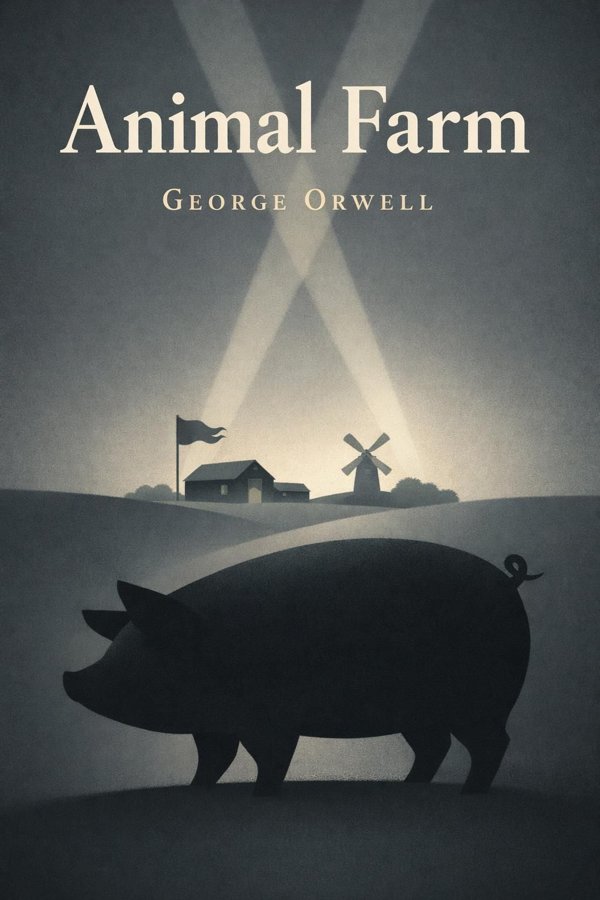
Animal Farm: Summary & Key Insights
 10 min9 chaptersAudio available
Key Takeaways from Animal Farm
Every revolution begins twice: first in imagination, then in action.
Freedom is most fragile at the moment it first appears secure.
The struggle after a revolution is often not between justice and injustice, but between rival visions of control.
Tyranny rarely survives on force alone; it depends on language that makes the unacceptable seem necessary.
The most heartbreaking victims of oppression are often the most decent.
What Is Animal Farm About?
Animal Farm by George Orwell is a classics book spanning 6 pages. Animal Farm is George Orwell’s brilliantly compact fable about revolution, power, and the ease with which noble ideals can be corrupted. On the surface, it tells the story of farm animals who overthrow their neglectful owner and attempt to build a just society where all animals are equal. But as the pigs rise to leadership, hope gives way to manipulation, privilege, and fear. What begins as a dream of liberation slowly becomes a new form of tyranny, one that looks disturbingly similar to the oppression it replaced. Orwell uses this simple premise to expose how political language, propaganda, and concentrated power can deform collective movements from within. The novel famously reflects the Russian Revolution and the rise of Stalinism, yet its warning reaches far beyond one historical moment. Orwell’s authority comes from his rare combination of literary skill, political clarity, and moral seriousness. Having witnessed ideological dishonesty and authoritarian abuse firsthand, he wrote with unusual precision about how systems of control operate. Animal Farm remains essential because it helps readers recognize how power disguises itself, rewrites truth, and demands obedience in every age.
This FizzRead summary covers all 9 key chapters of Animal Farm in approximately 10 minutes, distilling the most important ideas, arguments, and takeaways from George Orwell's work. Also available as an audio summary and Key Quotes Podcast.
Animal Farm
Animal Farm is George Orwell’s brilliantly compact fable about revolution, power, and the ease with which noble ideals can be corrupted. On the surface, it tells the story of farm animals who overthrow their neglectful owner and attempt to build a just society where all animals are equal. But as the pigs rise to leadership, hope gives way to manipulation, privilege, and fear. What begins as a dream of liberation slowly becomes a new form of tyranny, one that looks disturbingly similar to the oppression it replaced. Orwell uses this simple premise to expose how political language, propaganda, and concentrated power can deform collective movements from within. The novel famously reflects the Russian Revolution and the rise of Stalinism, yet its warning reaches far beyond one historical moment. Orwell’s authority comes from his rare combination of literary skill, political clarity, and moral seriousness. Having witnessed ideological dishonesty and authoritarian abuse firsthand, he wrote with unusual precision about how systems of control operate. Animal Farm remains essential because it helps readers recognize how power disguises itself, rewrites truth, and demands obedience in every age.
Who Should Read Animal Farm?
This book is perfect for anyone interested in classics and looking to gain actionable insights in a short read. Whether you're a student, professional, or lifelong learner, the key ideas from Animal Farm by George Orwell will help you think differently.
- ✓Readers who enjoy classics and want practical takeaways
- ✓Professionals looking to apply new ideas to their work and life
- ✓Anyone who wants the core insights of Animal Farm in just 10 minutes
Want the full summary?
Get instant access to this book summary and 100K+ more with Fizz Moment.
Get Free SummaryAvailable on App Store • Free to download
Key Chapters
Every revolution begins twice: first in imagination, then in action. Animal Farm opens with Old Major, an aging boar, gathering the animals of Manor Farm to describe the source of their misery. Their labor sustains humans, yet they receive hunger, exhaustion, and early death in return. His speech transforms private suffering into shared political awareness. Instead of seeing hardship as natural, the animals begin to understand it as a system. That change in consciousness matters as much as the later rebellion itself.
Old Major’s dream is powerful because it combines diagnosis with hope. He identifies exploitation, but he also offers a vision of a different future: a farm run by animals, for animals. In doing so, he turns resentment into purpose. Orwell shows that movements are often born from stories people tell about justice, dignity, and what life could be if power were reorganized. Yet he also hints at danger. A dream can inspire liberation, but if it remains vague, others may later define it for their own advantage.
This dynamic appears far beyond politics. In workplaces, schools, and communities, change often starts when someone names a hidden injustice and offers a better model. A toxic office culture, for example, may persist until a trusted colleague articulates why everyone feels demoralized and what fairer leadership would look like. The first step toward reform is often moral clarity.
Actionable takeaway: Pay attention to the narratives that mobilize people. When a powerful vision emerges, ask not only whether it is inspiring, but also how its principles will be protected once leadership changes hands.
Freedom is most fragile at the moment it first appears secure. After Old Major’s death, the animals eventually rebel when Mr. Jones neglects to feed them. Their uprising is spontaneous, but the conditions behind it have been building for a long time. Once Jones is driven off, Manor Farm becomes Animal Farm, and the animals experience the exhilaration of collective victory. They destroy symbols of oppression, rename the farm, and establish the Seven Commandments to guide their new society.
This section of the novel captures the emotional power of revolution. The animals believe they are entering a world of equality, dignity, and shared labor. Their optimism is sincere. Orwell treats this hope seriously, which is why the later betrayal feels so devastating. Importantly, the early success of the farm also reveals a structural weakness: the animals do not create strong mechanisms of accountability. They assume shared ideals will be enough. The pigs, being more literate and organized, quickly occupy leadership roles, and what seems practical at first becomes dangerous later.
The lesson is deeply relevant in modern institutions. A new organization, movement, or leadership transition often begins with enthusiasm and trust. But if rules are unclear, records are weak, and authority is concentrated in a few capable people, the founding mission can quietly shift. Startups, nonprofits, and activist groups frequently face this challenge. Good intentions cannot replace good governance.
Actionable takeaway: When building something new, protect the founding ideals with clear rules, shared knowledge, and transparent decision-making. Hope is essential, but systems are what keep hope from being captured.
The struggle after a revolution is often not between justice and injustice, but between rival visions of control. Once Animal Farm is established, two pigs emerge as its dominant figures: Snowball and Napoleon. Snowball is energetic, articulate, and imaginative. He organizes committees, promotes education, and develops plans like the windmill to improve life on the farm. Napoleon is quieter, more calculating, and less interested in persuasion than in power. Their conflict reveals how political competition can determine the fate of a movement.
Orwell uses these two characters to show that leadership style matters, but institutional power matters even more. Snowball may appear more idealistic and productive, yet he underestimates Napoleon’s willingness to build force behind the scenes. Napoleon secretly raises the dogs as his private enforcers, then uses them to drive Snowball from the farm. In that moment, debate gives way to coercion. The future of Animal Farm is no longer decided through argument or shared consent, but through intimidation.
This pattern is common wherever organizations rely too heavily on personality. Teams sometimes mistake charisma, intelligence, or strategic skill for trustworthy leadership. But the more revealing question is how someone behaves when challenged. Do they welcome disagreement, or do they eliminate rivals? A manager who sidelines dissenting voices, controls information, and rewards loyalty over competence may be more dangerous than one who merely makes bad decisions.
Actionable takeaway: Judge leaders not only by their plans, but by how they handle opposition. When a system stops making room for honest disagreement, it is already drifting toward authoritarianism.
Tyranny rarely survives on force alone; it depends on language that makes the unacceptable seem necessary. In Animal Farm, Squealer serves as Napoleon’s chief propagandist. He explains away contradictions, reframes theft as sacrifice, and turns the pigs’ privileges into duties supposedly carried out for everyone’s benefit. When the pigs begin sleeping in beds, drinking milk, or changing the rules, Squealer does not deny the facts. Instead, he adjusts the meaning of those facts until the animals doubt their own judgment.
This is one of Orwell’s sharpest insights. Propaganda does not always work by creating total ignorance. More often, it floods people with rationalizations, emotional pressure, and selective memory until truth becomes difficult to hold onto. Squealer’s most effective tactic is fear. Again and again, he suggests that any criticism of Napoleon would bring Mr. Jones back. By presenting only two options—obedience or disaster—he makes manipulation feel like prudence.
Modern readers will recognize this pattern in political messaging, corporate spin, and online misinformation. A company may call layoffs “rightsizing.” A politician may label criticism “disloyalty.” A public figure may redirect every failure toward an external enemy. The point is not merely to deceive, but to exhaust people’s ability to think clearly and independently.
Actionable takeaway: When someone in power constantly redefines terms, appeals to fear, and insists there is no alternative, slow down and verify the facts. Clear language is a defense against manipulation; if words are being twisted, reality usually is too.
The most heartbreaking victims of oppression are often the most decent. Boxer, the cart-horse, is Animal Farm’s moral center: hardworking, loyal, and genuinely committed to the common good. His personal mottos—“I will work harder” and later “Napoleon is always right”—capture both his virtue and his vulnerability. Boxer believes that discipline and sacrifice will help fulfill the revolution’s promise. He is not selfish, cynical, or power-hungry. That is precisely why he can be used so effectively.
Orwell’s treatment of Boxer reveals a painful truth: sincerity does not protect people from exploitation. In fact, exploitative systems often depend on the labor and trust of those who are least likely to question them. Boxer works beyond his strength to build the windmill and support the farm, even as conditions worsen and privileges become concentrated among the pigs. When he is injured and no longer useful, the regime sends him to the knacker instead of caring for him, then lies about what happened.
This lesson applies broadly. In workplaces, loyal employees may absorb unreasonable workloads because they identify with the mission. In families or communities, dependable people may be praised for selflessness while quietly being overburdened. Loyalty becomes dangerous when it is detached from accountability. Commitment should never require blindness.
Actionable takeaway: Value dedication, but pair it with critical thinking. If you are always being asked to give more while leaders exempt themselves from sacrifice, pause and reassess. Healthy loyalty includes the courage to ask whether the system deserves your trust.
The collapse of freedom often happens in edits, not announcements. Early in Animal Farm, the Seven Commandments represent the revolution’s moral constitution. They define what separates the animals’ new order from human tyranny. But as the pigs accumulate privilege, the commandments begin to change. “No animal shall sleep in a bed” becomes “with sheets.” “No animal shall drink alcohol” becomes “to excess.” These revisions are small enough to seem arguable, yet significant enough to hollow out the original ideals.
Orwell captures how authoritarian systems normalize abuse by changing standards incrementally. If the pigs had declared from the beginning that some animals deserved luxury and others deserved deprivation, the contrast would have been obvious. Instead, they move step by step, relying on fading memory, confusion, and fear. By the time the final commandment emerges—“All animals are equal, but some animals are more equal than others”—language itself has been emptied of logic. Contradiction has become law.
This pattern appears whenever institutions drift from their stated values. A company that claims to support work-life balance may gradually normalize after-hours messaging. A government that promises temporary emergency powers may keep extending them. A team that values openness may slowly silence uncomfortable feedback. Each change can sound minor, but together they transform the culture.
Actionable takeaway: Track principles in writing and compare them against actual behavior over time. The clearest warning sign of corruption is not always dramatic abuse; it is the quiet normalization of exceptions that consistently benefit those at the top.
When persuasion fails, power reveals its true foundation. After Napoleon expels Snowball, Animal Farm becomes increasingly governed by fear. The dogs enforce obedience, public confessions are staged, and dissent is treated as treachery. The animals are not simply ruled; they are psychologically broken into submission. Orwell shows that authoritarianism thrives when people are isolated, frightened, and uncertain whether their own thoughts are safe.
The forced confessions are especially important. They create the appearance that the regime’s enemies are everywhere, which justifies further repression. This cycle is familiar in many historical dictatorships: invent or exaggerate internal threats, then use them to legitimize violence. Terror does more than punish resistance; it teaches everyone else what silence is worth. Once fear becomes normalized, even absurd accusations may go unchallenged because survival feels more urgent than truth.
This mechanism can exist at smaller scales too. In controlling workplaces, leaders may humiliate employees publicly so that others fall in line. In abusive relationships, unpredictable punishment keeps victims off balance. In social groups, exclusion and reputational threats can become tools of discipline. Fear narrows imagination. It makes alternatives seem impossible.
Actionable takeaway: Notice environments where people are afraid to speak honestly, ask questions, or disagree. Whether in politics, organizations, or personal relationships, chronic fear is not a sign of order. It is a sign that power is being maintained through coercion rather than legitimacy.
People will endure extraordinary hardship if they believe it serves a meaningful future. The windmill in Animal Farm begins as Snowball’s ambitious plan to modernize the farm and reduce labor. After driving Snowball out, Napoleon first rejects the project, then adopts it as his own idea. From that point on, the windmill becomes less a practical improvement than a political instrument. It gives the animals a constant reason to work harder, accept shortages, and postpone disappointment.
Orwell’s point is not that large projects are inherently deceptive. Rather, he shows how leaders can use the language of progress to demand sacrifice without delivering real benefits. The windmill absorbs attention, redirects frustration, and creates a narrative of heroic struggle. When it collapses, blame is assigned to Snowball or sabotage rather than poor planning. Failure is never allowed to discredit the leadership; it is turned into another excuse for obedience.
We see similar dynamics whenever institutions prioritize symbolic achievements over real well-being. A company may obsess over a flashy initiative while neglecting employee burnout. A government may celebrate infrastructure or growth statistics while citizens face worsening daily conditions. Individuals do this too, pursuing prestigious goals while ignoring whether those goals actually improve life.
Actionable takeaway: Ask whether a promised future is producing meaningful present benefits, or merely justifying continued sacrifice. Progress should be measurable, shared, and reality-based. If a grand project always requires more suffering while accountability remains absent, the vision may be serving power more than people.
The deepest betrayal is not defeat by enemies, but transformation into them. In the final movement of Animal Farm, the pigs increasingly resemble the humans they once denounced. They trade with neighboring farmers, move into the farmhouse, walk on two legs, and eventually socialize with the very class the revolution claimed to abolish. By the end, the animals looking through the window can no longer tell pig from man.
This ending is devastating because it reveals that the revolution has not merely failed; it has reversed itself while preserving the rhetoric of liberation. Orwell suggests that without accountability, elite rule can survive even when its symbols change. The language of equality remains, but the social reality becomes one of hierarchy, exploitation, and exclusion. The system’s personnel are new, yet its structure of domination looks painfully familiar.
This insight matters whenever institutions celebrate change that is mostly cosmetic. A rebranding effort may hide unchanged incentives. New leadership may preserve old abuses under updated language. In public life, a movement can claim to represent ordinary people while quietly consolidating privilege among a small inner circle. The test of transformation is not whether the slogans have changed, but whether power is genuinely more distributed and lives are measurably better.
Actionable takeaway: Distinguish symbolic change from structural change. When evaluating reform, ask who benefits, who decides, and whether ordinary participants have more voice than before. If only the rulers have changed, the system may not have changed at all.
All Chapters in Animal Farm
About the Author
George Orwell, born Eric Arthur Blair in 1903, was an English writer, journalist, and essayist whose work remains central to discussions of politics, truth, and freedom. He served in the Indian Imperial Police in Burma, an experience that deepened his criticism of oppression and empire. Orwell later wrote journalism, memoir, fiction, and literary criticism marked by unusual clarity and moral urgency. His experiences among the poor and in the Spanish Civil War sharpened his distrust of authoritarianism in all forms. He is best known for Animal Farm and Nineteen Eighty-Four, two enduring novels that examine propaganda, surveillance, and the corruption of ideals by power. Orwell died in 1950, but his writing continues to shape political language and public thought across the world.
Get This Summary in Your Preferred Format
Read or listen to the Animal Farm summary by George Orwell anytime, anywhere. FizzRead offers multiple formats so you can learn on your terms — all free.
Available formats: App · Audio · PDF · EPUB — All included free with FizzRead
Download Animal Farm PDF and EPUB Summary
Key Quotes from Animal Farm
“Every revolution begins twice: first in imagination, then in action.”
“Freedom is most fragile at the moment it first appears secure.”
“The struggle after a revolution is often not between justice and injustice, but between rival visions of control.”
“Tyranny rarely survives on force alone; it depends on language that makes the unacceptable seem necessary.”
“The most heartbreaking victims of oppression are often the most decent.”
Frequently Asked Questions about Animal Farm
Animal Farm by George Orwell is a classics book that explores key ideas across 9 chapters. Animal Farm is George Orwell’s brilliantly compact fable about revolution, power, and the ease with which noble ideals can be corrupted. On the surface, it tells the story of farm animals who overthrow their neglectful owner and attempt to build a just society where all animals are equal. But as the pigs rise to leadership, hope gives way to manipulation, privilege, and fear. What begins as a dream of liberation slowly becomes a new form of tyranny, one that looks disturbingly similar to the oppression it replaced. Orwell uses this simple premise to expose how political language, propaganda, and concentrated power can deform collective movements from within. The novel famously reflects the Russian Revolution and the rise of Stalinism, yet its warning reaches far beyond one historical moment. Orwell’s authority comes from his rare combination of literary skill, political clarity, and moral seriousness. Having witnessed ideological dishonesty and authoritarian abuse firsthand, he wrote with unusual precision about how systems of control operate. Animal Farm remains essential because it helps readers recognize how power disguises itself, rewrites truth, and demands obedience in every age.
More by George Orwell


You Might Also Like


Browse by Category
Ready to read Animal Farm?
Get the full summary and 100K+ more books with Fizz Moment.