
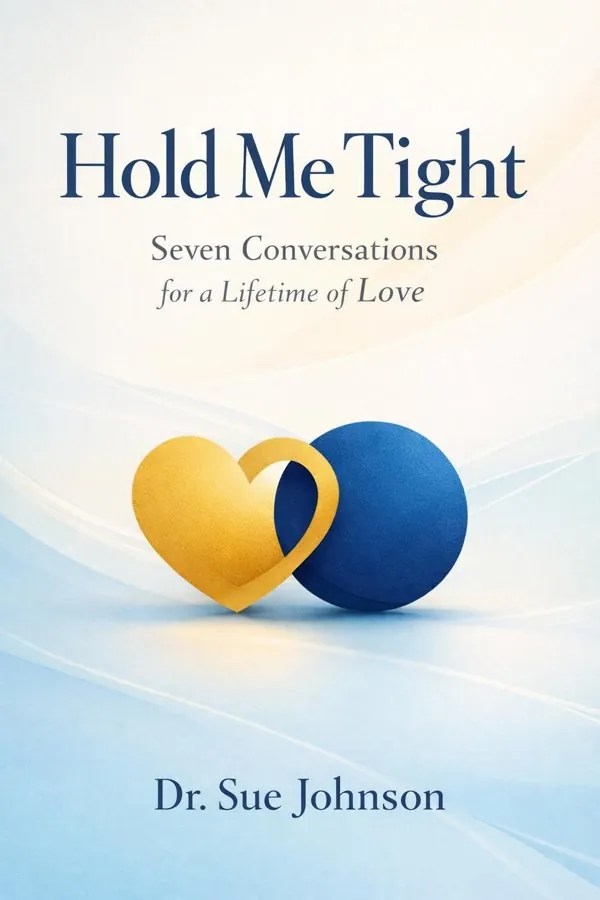
Hold Me Tight: Seven Conversations for a Lifetime of Love: Summary & Key Insights
 10 min10 chaptersAudio available
Key Takeaways from Hold Me Tight: Seven Conversations for a Lifetime of Love
One of the most powerful ideas in the book is that romantic love is not a luxury or a sentimental extra; it is an attachment bond.
Most couples do not destroy closeness through one dramatic betrayal.
Change begins when couples stop treating conflict as a series of isolated incidents and start seeing the underlying dance.
People do not react intensely only because of what is happening now.
Unresolved hurts do not simply disappear.
What Is Hold Me Tight: Seven Conversations for a Lifetime of Love About?
Hold Me Tight: Seven Conversations for a Lifetime of Love by Dr. Sue Johnson is a relationships book spanning 10 pages. Love often feels mysterious when it works and devastating when it breaks down. In Hold Me Tight, Dr. Sue Johnson argues that lasting love is neither a lucky accident nor an impossible ideal. It is built on something deeply human: the need for safe emotional connection. Drawing on attachment theory and her pioneering work developing Emotionally Focused Therapy, Johnson shows that adult relationships thrive when partners feel seen, soothed, valued, and emotionally secure. When that bond feels threatened, couples do not simply “fight about chores” or “struggle with communication.” They protest disconnection in predictable ways. This book matters because it translates decades of relationship science into a practical roadmap for couples. Johnson identifies the patterns that trap partners in conflict, helps them understand the hidden fears beneath anger and withdrawal, and offers seven transformative conversations that create trust, closeness, and resilience. Warm, clear, and grounded in real clinical experience, Hold Me Tight is both a relationship guide and a new way of understanding love itself. It is especially valuable for couples who want not just fewer arguments, but a stronger emotional bond that can endure stress, hurt, and change.
This FizzRead summary covers all 10 key chapters of Hold Me Tight: Seven Conversations for a Lifetime of Love in approximately 10 minutes, distilling the most important ideas, arguments, and takeaways from Dr. Sue Johnson's work. Also available as an audio summary and Key Quotes Podcast.
Hold Me Tight: Seven Conversations for a Lifetime of Love
Love often feels mysterious when it works and devastating when it breaks down. In Hold Me Tight, Dr. Sue Johnson argues that lasting love is neither a lucky accident nor an impossible ideal. It is built on something deeply human: the need for safe emotional connection. Drawing on attachment theory and her pioneering work developing Emotionally Focused Therapy, Johnson shows that adult relationships thrive when partners feel seen, soothed, valued, and emotionally secure. When that bond feels threatened, couples do not simply “fight about chores” or “struggle with communication.” They protest disconnection in predictable ways.
This book matters because it translates decades of relationship science into a practical roadmap for couples. Johnson identifies the patterns that trap partners in conflict, helps them understand the hidden fears beneath anger and withdrawal, and offers seven transformative conversations that create trust, closeness, and resilience. Warm, clear, and grounded in real clinical experience, Hold Me Tight is both a relationship guide and a new way of understanding love itself. It is especially valuable for couples who want not just fewer arguments, but a stronger emotional bond that can endure stress, hurt, and change.
Who Should Read Hold Me Tight: Seven Conversations for a Lifetime of Love?
This book is perfect for anyone interested in relationships and looking to gain actionable insights in a short read. Whether you're a student, professional, or lifelong learner, the key ideas from Hold Me Tight: Seven Conversations for a Lifetime of Love by Dr. Sue Johnson will help you think differently.
- ✓Readers who enjoy relationships and want practical takeaways
- ✓Professionals looking to apply new ideas to their work and life
- ✓Anyone who wants the core insights of Hold Me Tight: Seven Conversations for a Lifetime of Love in just 10 minutes
Want the full summary?
Get instant access to this book summary and 100K+ more with Fizz Moment.
Get Free SummaryAvailable on App Store • Free to download
Key Chapters
One of the most powerful ideas in the book is that romantic love is not a luxury or a sentimental extra; it is an attachment bond. Adults, like children, need reliable emotional connection. We want to know that the person we love will be there for us when life becomes painful, uncertain, or overwhelming. This need is not weakness, neediness, or dependency in a negative sense. It is part of how human beings are wired.
Johnson builds on attachment theory to explain why relationships matter so much to our emotional health. When partners feel securely connected, they are better able to handle stress, take risks, repair mistakes, and face the world with confidence. But when that bond feels threatened, fear takes over. A delayed text, a cold response, or repeated criticism can activate panic that is much deeper than the immediate issue. Suddenly, a disagreement about money or intimacy becomes a desperate question: Can I count on you? Do I matter to you?
This framework changes how couples interpret their conflicts. Instead of seeing one person as too emotional and the other as too distant, partners can begin to recognize that both are reacting to perceived disconnection. For example, a partner who complains, pursues, or criticizes may be fighting for reassurance. A partner who shuts down or avoids may be protecting themselves from failure or rejection.
The practical value of this idea is enormous. It invites compassion. Behind many arguments lies a simple emotional need: reach for me, respond to me, stay with me. Actionable takeaway: the next time conflict arises, ask not only “What are we fighting about?” but also “What threat to our bond is each of us reacting to?”
Most couples do not destroy closeness through one dramatic betrayal. More often, they get trapped in repeated negative interactions that slowly erode trust. Johnson calls these patterns the “Demon Dialogues.” They can make loving partners feel like enemies, even when both still long for connection.
She describes several common cycles. In “Find the Bad Guy,” each partner blames the other and defends themselves, creating escalating attack and counterattack. In “The Protest Polka,” one partner pursues with criticism or demands while the other withdraws, shuts down, or goes silent. In “Freeze and Flee,” both partners detach, avoid vulnerability, and gradually lose emotional contact. These patterns are powerful because they take on a life of their own. The problem stops being the original issue and becomes the cycle itself.
A key insight here is that the cycle is the enemy, not your partner. This is a profound shift. If couples stay focused on who is wrong, they remain stuck. But when they begin to see the pattern that traps both of them, they can unite against it. For instance, instead of saying, “You never listen,” a partner might say, “When I feel ignored, I get louder, and then you pull away. We both end up alone.”
This reframe reduces shame and defensiveness. It also creates space for curiosity. What triggers the cycle? What emotions come first? What protective moves keep it going? Once couples name their Demon Dialogue, they can interrupt it sooner.
Actionable takeaway: identify your relationship’s most common negative cycle and give it a shared name. Naming the pattern helps both partners recognize it in real time and work together to stop feeding it.
Change begins when couples stop treating conflict as a series of isolated incidents and start seeing the underlying dance. Johnson’s first transformative conversation asks partners to identify their negative cycle clearly and jointly. This step matters because without it, every disagreement feels personal, deliberate, and proof that the relationship is failing.
The cycle often follows a predictable sequence. One partner feels disappointed, lonely, or afraid and expresses that pain through criticism, complaint, irritation, or urgent pursuit. The other feels attacked, inadequate, or overwhelmed and retreats into silence, distraction, logic, or emotional distance. The first partner then becomes even more upset, and the second withdraws further. Both feel abandoned, and neither feels understood.
By mapping this pattern, couples begin to separate intention from impact. The pursuer is not simply controlling; they are often desperate for reassurance. The withdrawer is not simply uncaring; they are often afraid of making things worse or being found lacking. Johnson encourages couples to describe the cycle in concrete terms: what happens first, what each person feels, and what each does next.
A practical example might sound like this: “When you come home distracted, I tell myself I don’t matter. I ask sharp questions. You hear criticism and go quiet. Your silence makes me panic, so I push harder.” This kind of clarity lowers blame and increases emotional honesty.
The goal is not to eliminate all conflict. It is to stop being hijacked by a pattern that turns longing into attack and self-protection into disconnection. Actionable takeaway: sit down together and chart one recurring fight from beginning to end, focusing on the sequence rather than the content of the argument.
People do not react intensely only because of what is happening now. They react because present moments touch old wounds, fears, and insecurities. Johnson calls these tender vulnerabilities “raw spots.” Understanding them is essential because couples often misread each other’s strongest reactions as irrational, dramatic, or manipulative when they are actually rooted in pain.
A raw spot may come from childhood experiences, past relationships, betrayal, chronic criticism, abandonment, or times when emotional needs were ignored. For one person, a partner’s silence may echo years of feeling invisible. For another, criticism may instantly trigger deep shame or the belief that they are fundamentally not enough. These sensitivities shape how partners hear each other, especially under stress.
Johnson’s insight is not that the past excuses harmful behavior, but that it explains why certain moments carry so much emotional charge. When couples understand each other’s raw spots, they can respond with greater care. For example, instead of dismissing a partner’s fear as overreaction, one might say, “I see why this feels so painful for you. This touches that old fear of being left alone.”
This conversation invites vulnerability because it asks both partners to reveal what hurts most beneath their defenses. The angry partner may admit, “When you tune out, I feel unimportant.” The distant partner may confess, “When you sound disappointed in me, I feel like I can never get it right.” These admissions create empathy and reduce the tendency to personalize each reaction.
Actionable takeaway: each partner should identify one recurring trigger and explain the deeper fear or memory attached to it. The goal is not to justify the reaction, but to help your partner understand the wound beneath it.
Unresolved hurts do not simply disappear. They linger in the relationship as silent evidence that the bond may not be safe. Johnson argues that couples must revisit painful incidents, not to relive them endlessly, but to process them in a new way. A rift becomes damaging when partners remain alone with their pain, unable to make sense of what happened or receive comfort from each other.
This conversation asks couples to go back to a significant conflict, betrayal, or moment of abandonment and explore it through the lens of attachment. What did each person experience emotionally? What meaning did they make of the event? How did it affect their sense of safety in the relationship? The goal is deeper than factual agreement. It is emotional understanding.
Suppose one partner remembers a period when they reached out during a crisis and felt dismissed. They may still carry the message, “When I needed you, you were not there.” The other partner may recall feeling overwhelmed, confused, or ashamed, and may not have realized the full impact of their response. Revisiting the rift allows both to put words to the pain and hear each other differently.
Johnson emphasizes that healing requires responsiveness. The injured partner needs acknowledgment and emotional presence. The other partner must stay engaged rather than become defensive or minimize the hurt. This creates a corrective emotional experience: the very topic that once produced distance now becomes an opportunity for closeness.
Actionable takeaway: choose one unresolved relationship wound and talk about it slowly, focusing on emotions, meanings, and needs rather than proving whose version is correct.
Many couples know how to complain, defend, explain, or withdraw. Far fewer know how to reach for each other clearly and vulnerably. The central “Hold Me Tight” conversation teaches partners to express attachment needs directly: Are you there for me? Can I matter to you? Will you respond when I reach?
This is difficult because direct vulnerability feels risky. It is often easier to protest than to reveal fear. Instead of saying, “I miss you and I need reassurance,” a partner may criticize, sulk, or become controlling. Instead of saying, “I’m afraid of failing you,” the other may become distant or intellectual. These moves protect the self in the short term but block the connection both people want.
Johnson encourages couples to send clearer emotional signals and to respond with openness. A more secure conversation sounds like: “When we go days without real contact, I feel alone and begin to fear I don’t matter. I need to know you’re with me.” The partner’s task is not to solve the feeling away, but to answer it: “You do matter. I pull back when I feel pressured, but I want to stay connected.”
This exchange transforms the emotional climate. Instead of reenacting fear through attack and retreat, the couple creates a bond through accessibility, responsiveness, and engagement. It is not perfect wording that matters most, but emotional honesty and a sincere answer to the bid for connection.
Actionable takeaway: replace one criticism this week with a direct emotional request. State what you feel, what story you are telling yourself, and what reassurance or connection you need.
Forgiveness in intimate relationships is not a quick decision or a moral command. It is a process of rebuilding safety after emotional injury. Johnson treats injuries seriously because moments of betrayal, abandonment, contempt, or chronic unresponsiveness can shake the foundations of attachment. When trust is damaged, love cannot simply continue as usual.
The first step in healing is full acknowledgment. The injured partner needs their pain recognized without defensiveness, excuses, or pressure to move on. Generic apologies are rarely enough. What matters is emotional understanding: “I see that when I dismissed your pain, you felt alone and unimportant. I understand why that still hurts.” This tells the injured person that their inner experience is finally being held with care.
The second step is responsive engagement. The partner who caused the injury must remain emotionally present while the pain is explored. This is challenging because shame often triggers withdrawal or self-protection. But if they can stay engaged, answer questions honestly, and show remorse, the relationship begins to feel safer.
Forgiveness then becomes possible, not as forgetting, but as the gradual restoration of trust through repeated responsiveness. For example, if a partner has a history of disappearing emotionally during hard times, healing requires new moments of turning toward, staying present, and responding with comfort. Trust is rebuilt through experience.
Johnson’s larger point is hopeful: deep injuries can become turning points when couples process them openly and compassionately. Actionable takeaway: if a wound remains unresolved, focus less on getting past it quickly and more on offering specific acknowledgment, emotional presence, and consistent repair over time.
Sexual connection does not thrive in an emotional vacuum. Johnson argues that satisfying intimacy is rooted in secure attachment, not just technique, chemistry, or frequency. When couples feel emotionally safe, touch becomes a source of comfort, play, affirmation, and desire. When they feel disconnected, sex often becomes burdened with anxiety, rejection, performance pressure, or resentment.
This perspective helps explain why many sexual struggles are not simply about libido mismatch. A partner who refuses sex may be protecting themselves from feeling used, unseen, or emotionally distant. A partner who seeks sex urgently may not just want physical release; they may be searching for reassurance, acceptance, and closeness. Without understanding these meanings, couples easily misread each other and intensify shame.
Johnson invites partners to talk about touch and sexuality with emotional honesty. What makes touch feel welcoming or unsafe? When does sex create closeness, and when does it expose insecurity? How do old hurts, body image concerns, stress, or the negative cycle affect desire? These questions move the conversation beyond blame.
A practical shift might be for a couple to focus first on affectionate contact without pressure: holding hands, cuddling, or sitting close while talking openly about what helps each person relax. As safety increases, sexual intimacy often becomes more natural and mutual. The point is not to force desire, but to reconnect emotional and physical closeness.
Actionable takeaway: have one pressure-free conversation about what touch means to each of you emotionally, and agree on one small form of affectionate connection you can practice consistently.
Strong relationships are not maintained by avoiding all problems. They endure because partners know how to return to connection again and again. Johnson’s final conversation focuses on sustaining love by protecting the bond, recognizing stress early, and creating rituals of emotional responsiveness.
Life constantly tests attachment: work pressure, parenting, illness, aging, financial strain, disappointment, and change. Even couples who have made major progress can slip back into old cycles under stress. The goal is not perfection but awareness. Secure couples notice disconnection sooner and repair faster. They are able to say, “We are getting pulled into that old pattern,” instead of assuming the relationship is failing.
Keeping love alive means intentionally nurturing accessibility, responsiveness, and engagement. Small moments matter: greeting each other warmly, asking meaningful questions, checking in after a hard day, apologizing quickly, and making room for vulnerable conversations before resentment accumulates. It also means revisiting the core question of attachment over time: Are we there for each other?
Johnson presents love as a living bond that needs care, not a feeling that either lasts automatically or fades inevitably. Couples can create habits that reinforce security. For example, a weekly check-in may help partners discuss stress, appreciation, and unmet needs before they become arguments. A shared ritual at bedtime can restore connection even during busy seasons.
Actionable takeaway: create one regular ritual of connection, such as a weekly emotional check-in or a daily 10-minute undistracted conversation, and protect it as seriously as any other important commitment.
A major strength of Hold Me Tight is that it does not offer vague advice to “communicate better.” Johnson presents a structured model of change through Emotionally Focused Therapy. EFT works by helping couples identify their destructive cycles, access deeper emotions, and create new interactions based on vulnerability and responsiveness. The result is not just better conflict management, but a more secure bond.
Johnson’s clinical examples show that transformation often begins when one partner risks sharing softer feelings beneath anger or detachment and the other responds with genuine emotional presence. This can look simple on the surface, yet it changes everything. A withdrawn partner who says, “When you’re upset, I feel I will disappoint you, so I shut down,” gives the relationship something real to work with. A pursuing partner who replies, “I get angry because I’m scared of losing you,” shifts the conversation from blame to longing.
EFT is effective because it addresses the emotional logic underneath relationship distress. It helps couples experience each other differently in the moment. Rather than debating facts endlessly, they begin to create new emotional experiences: being reached for, being heard, being comforted, and being forgiven. These moments build trust at a deep level.
The broader application is encouraging. Whether a couple is in crisis or simply wants a stronger bond, the principles of EFT provide a map for change. Emotional responsiveness is learnable. Security can be built. Love can be repaired.
Actionable takeaway: when conflict arises, pause before solving the practical issue and ask, “What deeper feeling or need is trying to come through right now?” That question brings the conversation back to the level where healing happens.
All Chapters in Hold Me Tight: Seven Conversations for a Lifetime of Love
About the Author
Dr. Sue Johnson was a pioneering clinical psychologist, researcher, speaker, and author best known as the primary developer of Emotionally Focused Therapy (EFT), a leading evidence-based approach to couples therapy. Drawing on attachment theory, she transformed the way therapists and readers understand adult love, showing that relationship distress is often rooted in fear of disconnection rather than simple incompatibility. Johnson held academic and clinical positions in Canada and the United States, founded training programs that spread EFT worldwide, and taught professionals across the globe. Her writing made complex relationship science accessible, compassionate, and practical for everyday couples. Through books such as Hold Me Tight, she became one of the most influential voices in modern relationship psychology.
Get This Summary in Your Preferred Format
Read or listen to the Hold Me Tight: Seven Conversations for a Lifetime of Love summary by Dr. Sue Johnson anytime, anywhere. FizzRead offers multiple formats so you can learn on your terms — all free.
Available formats: App · Audio · PDF · EPUB — All included free with FizzRead
Download Hold Me Tight: Seven Conversations for a Lifetime of Love PDF and EPUB Summary
Key Quotes from Hold Me Tight: Seven Conversations for a Lifetime of Love
“One of the most powerful ideas in the book is that romantic love is not a luxury or a sentimental extra; it is an attachment bond.”
“Most couples do not destroy closeness through one dramatic betrayal.”
“Change begins when couples stop treating conflict as a series of isolated incidents and start seeing the underlying dance.”
“People do not react intensely only because of what is happening now.”
“Unresolved hurts do not simply disappear.”
Frequently Asked Questions about Hold Me Tight: Seven Conversations for a Lifetime of Love
Hold Me Tight: Seven Conversations for a Lifetime of Love by Dr. Sue Johnson is a relationships book that explores key ideas across 10 chapters. Love often feels mysterious when it works and devastating when it breaks down. In Hold Me Tight, Dr. Sue Johnson argues that lasting love is neither a lucky accident nor an impossible ideal. It is built on something deeply human: the need for safe emotional connection. Drawing on attachment theory and her pioneering work developing Emotionally Focused Therapy, Johnson shows that adult relationships thrive when partners feel seen, soothed, valued, and emotionally secure. When that bond feels threatened, couples do not simply “fight about chores” or “struggle with communication.” They protest disconnection in predictable ways. This book matters because it translates decades of relationship science into a practical roadmap for couples. Johnson identifies the patterns that trap partners in conflict, helps them understand the hidden fears beneath anger and withdrawal, and offers seven transformative conversations that create trust, closeness, and resilience. Warm, clear, and grounded in real clinical experience, Hold Me Tight is both a relationship guide and a new way of understanding love itself. It is especially valuable for couples who want not just fewer arguments, but a stronger emotional bond that can endure stress, hurt, and change.
You Might Also Like
The 5 Love Languages
Gary Chapman
10 min
Men Are from Mars, Women Are from Venus
John Gray
10 min
She Comes First
Ian Kerner
10 min
No More Mr Nice Guy
Robert Glover
10 min
Hold Me Tight
Sue Johnson
10 min
Mating in Captivity
Esther Perel
10 minBrowse by Category
Ready to read Hold Me Tight: Seven Conversations for a Lifetime of Love?
Get the full summary and 100K+ more books with Fizz Moment.