
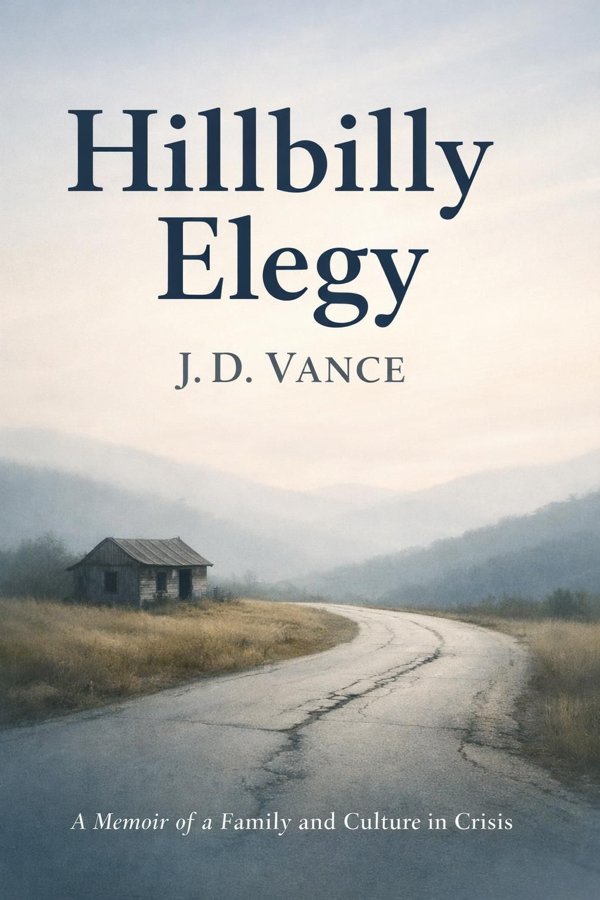
Hillbilly Elegy: A Memoir of a Family and Culture in Crisis: Summary & Key Insights
by J.D. Vance
 10 min8 chaptersAudio available
Key Takeaways from Hillbilly Elegy: A Memoir of a Family and Culture in Crisis
The places we come from often shape us long before we can name their influence.
Children can love the very people who frighten them most.
A single stable relationship can change the trajectory of a life.
Talent matters less when a person has never learned how to direct it.
Moving into a new world is not only about access; it is about learning rules that others absorbed without noticing.
What Is Hillbilly Elegy: A Memoir of a Family and Culture in Crisis About?
Hillbilly Elegy: A Memoir of a Family and Culture in Crisis by J.D. Vance is a biographies book spanning 5 pages. Hillbilly Elegy is a deeply personal memoir that doubles as a cultural diagnosis. In it, J.D. Vance traces his journey from a turbulent childhood in a working-class family with roots in Jackson, Kentucky, to the halls of Yale Law School. But this is not simply a story of individual success. It is also an attempt to understand the emotional habits, inherited wounds, and social realities that shape many families in Appalachia and the Rust Belt. Vance writes about addiction, domestic instability, pride, loyalty, economic decline, and the struggle to imagine a different future when chaos feels normal. What makes the book compelling is its blend of lived experience and broader reflection. Vance is not an outside observer studying poverty from a distance; he is someone who survived it, was formed by it, and still wrestles with its meaning. His authority comes from that intimate knowledge, as well as from his later education, military service, and exposure to elite institutions that gave him a new lens on his upbringing. Whether readers agree with all of his conclusions or not, Hillbilly Elegy matters because it gives human texture to a segment of America often reduced to stereotypes, headlines, or political talking points.
This FizzRead summary covers all 8 key chapters of Hillbilly Elegy: A Memoir of a Family and Culture in Crisis in approximately 10 minutes, distilling the most important ideas, arguments, and takeaways from J.D. Vance's work. Also available as an audio summary and Key Quotes Podcast.
Hillbilly Elegy: A Memoir of a Family and Culture in Crisis
Hillbilly Elegy is a deeply personal memoir that doubles as a cultural diagnosis. In it, J.D. Vance traces his journey from a turbulent childhood in a working-class family with roots in Jackson, Kentucky, to the halls of Yale Law School. But this is not simply a story of individual success. It is also an attempt to understand the emotional habits, inherited wounds, and social realities that shape many families in Appalachia and the Rust Belt. Vance writes about addiction, domestic instability, pride, loyalty, economic decline, and the struggle to imagine a different future when chaos feels normal.
What makes the book compelling is its blend of lived experience and broader reflection. Vance is not an outside observer studying poverty from a distance; he is someone who survived it, was formed by it, and still wrestles with its meaning. His authority comes from that intimate knowledge, as well as from his later education, military service, and exposure to elite institutions that gave him a new lens on his upbringing. Whether readers agree with all of his conclusions or not, Hillbilly Elegy matters because it gives human texture to a segment of America often reduced to stereotypes, headlines, or political talking points.
Who Should Read Hillbilly Elegy: A Memoir of a Family and Culture in Crisis?
This book is perfect for anyone interested in biographies and looking to gain actionable insights in a short read. Whether you're a student, professional, or lifelong learner, the key ideas from Hillbilly Elegy: A Memoir of a Family and Culture in Crisis by J.D. Vance will help you think differently.
- ✓Readers who enjoy biographies and want practical takeaways
- ✓Professionals looking to apply new ideas to their work and life
- ✓Anyone who wants the core insights of Hillbilly Elegy: A Memoir of a Family and Culture in Crisis in just 10 minutes
Want the full summary?
Get instant access to this book summary and 100K+ more with Fizz Moment.
Get Free SummaryAvailable on App Store • Free to download
Key Chapters
The places we come from often shape us long before we can name their influence. For J.D. Vance, Middletown, Ohio, and Jackson, Kentucky, are more than settings in a childhood story. They are emotional worlds, moral reference points, and symbols of a family identity built on migration, hardship, and pride. His grandparents left Appalachia in search of industrial stability, yet the culture of the mountains traveled with them. Even in Ohio, the family remained tied to the values, language, resentments, and loyalties of Kentucky.
Vance shows that family inheritance is not just genetic or financial. It includes stories people tell about themselves, the expectations they carry, and the fears they never outgrow. In his family, toughness mattered. Loyalty mattered. Respect mattered. But so did suspicion, explosive conflict, and a deeply ingrained sense that the wider world was not built for people like them. That combination created both resilience and limitation.
This idea helps explain why upward mobility is never just about getting a better job or a better education. It often requires a person to reinterpret where they come from without abandoning it. Anyone who has grown up in a tightly bound community will recognize this tension. A student leaving a small town for college, for example, may feel pride in opportunity and guilt about leaving family behind. A professional entering elite spaces may still carry the instincts of scarcity and defensiveness learned in childhood.
The practical lesson is to examine your own inherited narrative. Ask what beliefs about money, trust, success, and belonging came from your family and hometown. Which parts ground you, and which parts quietly hold you back? Actionable takeaway: write down three values your upbringing gave you and three assumptions it taught you that may no longer serve your growth.
Children can love the very people who frighten them most. One of the most powerful threads in Hillbilly Elegy is Vance’s portrait of a home life marked by instability, especially through his mother’s addiction and volatility. He does not reduce her to a villain. She is intelligent, hardworking, and capable of deep love. Yet she is also unpredictable, consumed by substance abuse, and unable to create a stable environment for her son. That complexity matters because family dysfunction rarely arrives in simple forms.
Vance describes a childhood shaped by emotional whiplash: moments of tenderness interrupted by chaos, hope followed by collapse. This kind of environment changes how a child sees the world. Instead of assuming safety, the child learns to scan for danger. Instead of trusting consistency, the child expects sudden change. Even when external conditions improve, those habits can linger into adulthood.
The book also makes clear that addiction is rarely an isolated problem. It affects relationships, money, schooling, self-esteem, and a child’s developing sense of what is normal. A parent’s addiction can make a child prematurely responsible, forcing them to manage adult emotions before they understand their own. Many readers may see parallels in families dealing with alcoholism, gambling, untreated mental illness, or chronic instability of other kinds.
The practical application is not to romanticize survival. Enduring chaos can build grit, but it can also leave hidden scars. Recognizing those scars is a form of strength, not weakness. Whether through therapy, trusted relationships, or structured reflection, naming dysfunction is often the first step toward breaking its cycle. Actionable takeaway: identify one destructive pattern from your family history and choose one concrete boundary or support system that helps prevent its repetition.
A single stable relationship can change the trajectory of a life. In Vance’s story, that stabilizing force comes primarily from his grandparents, Mamaw and Papaw. They are far from perfect. They are loud, rough-edged, and shaped by the same combustible culture that affects the rest of the family. Yet they offer something invaluable: protection, belief, and a home that feels more secure than the alternatives.
Mamaw, in particular, becomes a fierce defender of Vance’s future. Her love is not polished or sentimental. It is blunt, demanding, and sometimes frightening. But beneath her tough exterior is an unwavering insistence that he can become more than the circumstances surrounding him. Papaw, too, represents a lesson in transformation. Though he has his own history of drinking and instability, he evolves into a steadier figure later in life, proving that people can change.
Vance’s account highlights the role of what researchers might call protective factors: at least one adult who is reliable, emotionally invested, and willing to set expectations. In practical terms, this might be a grandparent, teacher, coach, mentor, or older sibling. For children in unstable homes, these figures can become models of order, discipline, and hope. They cannot erase trauma, but they can interrupt its momentum.
This idea has broad application beyond the memoir. Communities often focus on institutions, policies, and systems, all of which matter. But individual human anchors matter too. A young person struggling at school may need tutoring, but they may also need one adult who consistently asks how they are doing and means it. Actionable takeaway: if you are raising or guiding a young person, be the stable presence they can count on; if you needed such a person and had one, reflect on how their example can guide your own decisions now.
Talent matters less when a person has never learned how to direct it. One of the turning points in Hillbilly Elegy is Vance’s decision to join the U.S. Marine Corps. Until then, intelligence alone had not protected him from the confusion and poor habits shaped by his upbringing. The Marines offered something his early life often lacked: structure, accountability, and clear standards. They taught him practical skills, but more importantly, they taught him how to manage himself.
That lesson carried into college and eventually Yale Law School. Vance discovered that success in institutions is not just about raw ability. It depends on habits that more stable families often teach early: showing up on time, planning ahead, managing money, delaying gratification, asking for help, and reading social cues. These may look like small competencies, but together they create the foundation for long-term mobility.
What makes this section so useful is that it demystifies achievement. Vance does not present education as magical salvation. Instead, he shows that progress often comes from ordinary disciplines repeated consistently. A student from a chaotic background might need to learn how to use a calendar, maintain professional communication, or seek mentorship. A working adult trying to change careers may need similar structure: fixed routines, budget discipline, and an environment that reinforces ambition rather than undermines it.
The broader insight is that self-control is not merely a personality trait. It can be trained through institutions, routines, and meaningful responsibility. People who feel stuck may not need more inspiration first; they may need stronger systems. Actionable takeaway: choose one area of life where chaos dominates and build a simple structure around it, such as a weekly budget, a study schedule, or a morning routine that reinforces discipline.
Economic hardship is real, but culture influences how people respond to hardship. One of Vance’s most debated arguments is that the struggles of the white working class cannot be explained by economics alone. He points to attitudes and behaviors that, in his view, reinforce stagnation: fatalism, distrust, family instability, short-term thinking, and a tendency to blame outside forces while avoiding personal accountability.
This argument is uncomfortable because it pushes against explanations that focus only on jobs, wages, or policy. Vance does not deny structural problems. He writes about industrial decline, weak institutions, and communities battered by addiction and instability. But he also insists that culture matters. If a person grows up hearing that the system is rigged, that effort rarely pays off, and that people like them do not belong in successful spaces, those beliefs can become self-fulfilling. Likewise, when children witness adults cycle through relationships, excuses, and self-destructive choices, those patterns can feel normal.
The value of this idea lies in balance. Overemphasizing personal responsibility can ignore real barriers. Overemphasizing structure can strip people of agency. The memoir argues, sometimes bluntly, that both matter. In practical life, this means that meaningful change usually combines external support with internal ownership. A struggling community may need jobs and treatment programs, but individuals still benefit from honesty about their habits, relationships, and decision-making.
Readers can apply this by asking where their own narratives become excuses. Are there areas where resentment has replaced effort? Are there patterns blamed entirely on circumstances even when some choices remain open? Actionable takeaway: pick one recurring problem in your life and divide its causes into two columns, external barriers and internal behaviors, then commit to changing one behavior within your control.
Escaping a difficult environment is not the same as healing from it. Even after Vance gains educational opportunities and professional success, he continues to feel the emotional effects of his childhood. Anxiety, anger, insecurity, and hypervigilance do not disappear simply because his address changes or his resume improves. This is one of the memoir’s quieter but most important truths: survival strategies that once protected a person can later disrupt healthy adult life.
Children raised in chaos often become adults who struggle with trust, conflict, or emotional regulation. They may overreact to minor threats, sabotage stable relationships, or feel undeserving of good outcomes. Vance’s growth involves more than external advancement. It also requires recognizing how deeply the past lives in the body and mind. His story suggests that upward mobility without inner reflection can leave a person externally accomplished but internally unsettled.
This insight has broad relevance. Many people assume that once they leave a bad job, dysfunctional family, or impoverished neighborhood, the hardest part is over. But emotional residue can travel with them. A person who grew up around financial instability may hoard money or panic over small expenses. Someone raised in a volatile home may mistake calm relationships for lack of passion. Without awareness, old wiring can quietly govern new circumstances.
The practical implication is that healing should be treated as active work, not a passive reward for success. That work may include therapy, journaling, honest conversation, spiritual practice, or learning new relational skills. The goal is not to erase the past but to stop letting it dictate the present. Actionable takeaway: notice one emotional reaction that feels larger than the situation requires and ask what earlier experience may have trained that response.
Success can create a new identity crisis: where do you belong when you no longer fully fit your old world and never completely feel at home in the new one? As Vance moves from working-class Ohio and Kentucky into elite educational and professional spaces, he experiences a tension common to many first-generation strivers. He gains access to institutions that open doors, yet he also carries the speech patterns, instincts, and emotional memory of the place he came from.
This in-between state is not merely social discomfort. It can affect relationships, confidence, and self-understanding. People who move across class, geography, or culture often feel pressure from both directions. Their original community may see them as changed, disloyal, or arrogant. Their new environment may welcome them selectively while still marking them as outsiders. The result is a feeling of translation fatigue: always adjusting, always interpreting, never entirely at rest.
Vance’s memoir captures this with unusual clarity. He does not portray mobility as a clean escape but as a complicated negotiation between gratitude and distance, ambition and guilt. This is especially relevant for readers who are the first in their families to attend college, enter corporate life, or move into a different social class. They may recognize the strange loneliness of achievement when no one from home fully understands the new world and no one in the new world fully understands home.
The practical lesson is that belonging does not have to mean choosing one identity and rejecting the other. It can mean building an integrated self that honors origins without being confined by them. Actionable takeaway: define success in your own words, not as total assimilation or total loyalty, but as a life where your background informs your values without limiting your future.
All Chapters in Hillbilly Elegy: A Memoir of a Family and Culture in Crisis
About the Author
J.D. Vance is an American author, investor, and public figure best known for his memoir Hillbilly Elegy. Born in Middletown, Ohio, he grew up in a working-class family with roots in Jackson, Kentucky, an experience that shaped his writing and public identity. After a turbulent childhood, he joined the U.S. Marine Corps, an experience that helped instill discipline and direction. He later earned degrees from Ohio State University and Yale Law School. Hillbilly Elegy brought him national recognition for its portrayal of family dysfunction, class struggle, and upward mobility in America. In the years following the book’s success, Vance worked in venture capital and became increasingly involved in politics and public debate about culture, economics, and the American working class.
Get This Summary in Your Preferred Format
Read or listen to the Hillbilly Elegy: A Memoir of a Family and Culture in Crisis summary by J.D. Vance anytime, anywhere. FizzRead offers multiple formats so you can learn on your terms — all free.
Available formats: App · Audio · PDF · EPUB — All included free with FizzRead
Download Hillbilly Elegy: A Memoir of a Family and Culture in Crisis PDF and EPUB Summary
Key Quotes from Hillbilly Elegy: A Memoir of a Family and Culture in Crisis
“The places we come from often shape us long before we can name their influence.”
“Children can love the very people who frighten them most.”
“A single stable relationship can change the trajectory of a life.”
“Talent matters less when a person has never learned how to direct it.”
“Moving into a new world is not only about access; it is about learning rules that others absorbed without noticing.”
Frequently Asked Questions about Hillbilly Elegy: A Memoir of a Family and Culture in Crisis
Hillbilly Elegy: A Memoir of a Family and Culture in Crisis by J.D. Vance is a biographies book that explores key ideas across 8 chapters. Hillbilly Elegy is a deeply personal memoir that doubles as a cultural diagnosis. In it, J.D. Vance traces his journey from a turbulent childhood in a working-class family with roots in Jackson, Kentucky, to the halls of Yale Law School. But this is not simply a story of individual success. It is also an attempt to understand the emotional habits, inherited wounds, and social realities that shape many families in Appalachia and the Rust Belt. Vance writes about addiction, domestic instability, pride, loyalty, economic decline, and the struggle to imagine a different future when chaos feels normal. What makes the book compelling is its blend of lived experience and broader reflection. Vance is not an outside observer studying poverty from a distance; he is someone who survived it, was formed by it, and still wrestles with its meaning. His authority comes from that intimate knowledge, as well as from his later education, military service, and exposure to elite institutions that gave him a new lens on his upbringing. Whether readers agree with all of his conclusions or not, Hillbilly Elegy matters because it gives human texture to a segment of America often reduced to stereotypes, headlines, or political talking points.
You Might Also Like

An American Marriage
Tayari Jones
10 min
Benjamin Franklin: An American Life
Walter Isaacson
10 min
I Know Why The Caged Bird Sings
Maya Angelou
10 min
Long Walk to Freedom
Nelson Mandela
10 min
Persepolis
Marjane Satrapi
10 min
Surely You're Joking, Mr. Feynman!
Richard P. Feynman
10 minBrowse by Category
Ready to read Hillbilly Elegy: A Memoir of a Family and Culture in Crisis?
Get the full summary and 100K+ more books with Fizz Moment.