
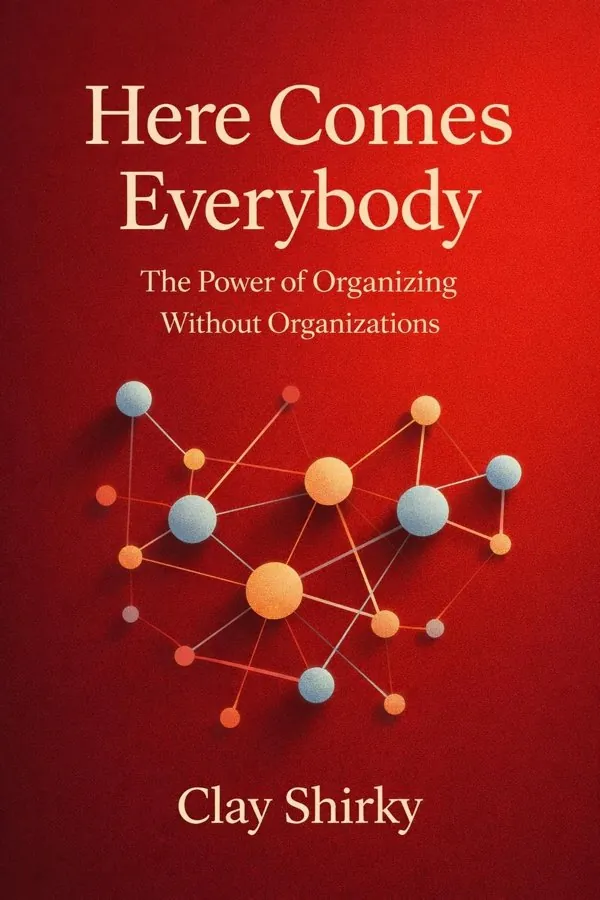
Here Comes Everybody: The Power of Organizing Without Organizations: Summary & Key Insights
by Clay Shirky
 10 min8 chaptersAudio available
Key Takeaways from Here Comes Everybody: The Power of Organizing Without Organizations
The hardest part of collective action used to be everything surrounding the action itself.
Sometimes a small event exposes a massive cultural change.
For centuries, institutions existed partly because society needed them to coordinate groups at scale.
Not all group activity is equally demanding.
A revolution begins when the audience gains the tools of the producer.
What Is Here Comes Everybody: The Power of Organizing Without Organizations About?
Here Comes Everybody: The Power of Organizing Without Organizations by Clay Shirky is a digital_culture book spanning 8 pages. Here Comes Everybody is Clay Shirky’s influential exploration of what happens when communication becomes cheap, fast, and global. The book argues that the internet did more than improve communication; it fundamentally changed how people gather, coordinate, and act together. In the past, organizing groups required institutions such as companies, governments, newspapers, and political parties because they absorbed the enormous costs of management, communication, and decision-making. Shirky shows that digital tools now allow loosely connected individuals to do many of those same things without formal hierarchy. What makes the book so important is that it explains a deep social shift rather than a passing tech trend. Social media, online forums, blogs, messaging tools, and collaborative platforms have reduced the barriers to participation so dramatically that ordinary people can now publish, protest, fundraise, build communities, and solve problems at scale. Shirky combines memorable case studies with clear social analysis to reveal both the promise and the chaos of this new world. As a writer, teacher, and longtime observer of internet culture, he brings unusual authority to the topic. This is a foundational book for understanding digital culture, networked communities, and the changing balance of power between institutions and connected individuals.
This FizzRead summary covers all 8 key chapters of Here Comes Everybody: The Power of Organizing Without Organizations in approximately 10 minutes, distilling the most important ideas, arguments, and takeaways from Clay Shirky's work. Also available as an audio summary and Key Quotes Podcast.
Here Comes Everybody: The Power of Organizing Without Organizations
Here Comes Everybody is Clay Shirky’s influential exploration of what happens when communication becomes cheap, fast, and global. The book argues that the internet did more than improve communication; it fundamentally changed how people gather, coordinate, and act together. In the past, organizing groups required institutions such as companies, governments, newspapers, and political parties because they absorbed the enormous costs of management, communication, and decision-making. Shirky shows that digital tools now allow loosely connected individuals to do many of those same things without formal hierarchy.
What makes the book so important is that it explains a deep social shift rather than a passing tech trend. Social media, online forums, blogs, messaging tools, and collaborative platforms have reduced the barriers to participation so dramatically that ordinary people can now publish, protest, fundraise, build communities, and solve problems at scale. Shirky combines memorable case studies with clear social analysis to reveal both the promise and the chaos of this new world. As a writer, teacher, and longtime observer of internet culture, he brings unusual authority to the topic. This is a foundational book for understanding digital culture, networked communities, and the changing balance of power between institutions and connected individuals.
Who Should Read Here Comes Everybody: The Power of Organizing Without Organizations?
This book is perfect for anyone interested in digital_culture and looking to gain actionable insights in a short read. Whether you're a student, professional, or lifelong learner, the key ideas from Here Comes Everybody: The Power of Organizing Without Organizations by Clay Shirky will help you think differently.
- ✓Readers who enjoy digital_culture and want practical takeaways
- ✓Professionals looking to apply new ideas to their work and life
- ✓Anyone who wants the core insights of Here Comes Everybody: The Power of Organizing Without Organizations in just 10 minutes
Want the full summary?
Get instant access to this book summary and 100K+ more with Fizz Moment.
Get Free SummaryAvailable on App Store • Free to download
Key Chapters
The hardest part of collective action used to be everything surrounding the action itself. Before the internet, if people wanted to organize a club, launch a campaign, share expertise, or coordinate a response to an event, they faced steep transaction costs: finding people, communicating repeatedly, assigning roles, storing information, and keeping everyone aligned. These hidden costs often mattered more than the goal. Many worthy ideas never became real because organizing them required too much time, money, and bureaucracy.
Shirky’s central insight is that digital tools slash those costs. Email, group chats, online calendars, shared documents, social networks, and publishing platforms remove much of the friction that once made coordination difficult. This does not mean organization becomes effortless, but it does mean that groups can form faster, with fewer resources, and often without a formal institution. A neighborhood can organize a cleanup through a messaging app. Freelancers can build a professional community online. Citizens can crowdsource information during a crisis before traditional media can catch up.
The deeper implication is that institutions no longer have a monopoly on organizing. In the old model, if you wanted group action, you often needed an organization first. In the new model, the group can emerge before the organization, or even without becoming one. That changes who gets to act, whose voices are heard, and what kinds of projects become possible.
Actionable takeaway: whenever you face a problem that seems to require formal structure, first ask whether lightweight digital coordination can achieve 80 percent of the goal faster and more cheaply.
Sometimes a small event exposes a massive cultural change. Shirky uses the story of a lost cell phone to show how networked communication can turn private frustration into public action. A woman loses her phone; through online posts and digital sleuthing, a group of strangers begins tracking where it went and who may have taken it. What would once have remained a minor personal inconvenience becomes a collaborative investigation, fueled by online visibility and rapid information sharing.
The point is not that every crowd-led effort is wise or fair. In fact, the story also highlights the risks of misdirected outrage and digital pile-ons. But it vividly demonstrates that ordinary people, connected by online tools, can gather attention and coordinate behavior without permission from any institution. Media organizations no longer control public narratives. Law enforcement no longer monopolizes investigation. Communities can mobilize around stories in real time.
This case captures both the power and volatility of internet-enabled organization. Digital networks can surface information, recruit participants, and intensify engagement with astonishing speed. Yet the same mechanisms that help a community solve a problem can also spread rumor, amplify emotional reactions, and blur the boundary between accountability and harassment.
The lesson is that online coordination is socially powerful because it links communication, visibility, and action. Once people can easily find one another around a shared issue, even an ordinary incident can become collective behavior.
Actionable takeaway: before joining or launching an online campaign, pause to ask not only whether the crowd can act, but whether it has enough verified information to act responsibly.
For centuries, institutions existed partly because society needed them to coordinate groups at scale. Newspapers gathered and distributed information. Political parties mobilized supporters. Corporations organized labor and capital. Nonprofits managed volunteers and donors. These structures were not just powerful because of expertise; they were powerful because large-scale coordination was difficult without them.
Shirky argues that digital networks weaken this old advantage. When publishing, communication, and membership become cheap, institutions are no longer the only vehicles for collective action. A loose online community can expose corruption. Volunteers can build software together without belonging to a company. Activists can coordinate through platforms rather than parties. This shift does not eliminate institutions, but it does force them to compete with new forms of self-organization.
That change has profound consequences. Institutions tend to prefer stability, clear roles, and controlled processes. Networks thrive on openness, participation, and rapid adaptation. As a result, organizations that ignore networked collaboration often look slow, rigid, or out of touch. Media companies lost their gatekeeping power when anyone could publish. Brands learned that customers could publicly organize around complaints. Governments discovered that citizens could document events independently and spread evidence globally.
Still, Shirky does not romanticize the crowd. Institutions remain essential for durability, accountability, and long-term execution. The real transformation is that institutions no longer begin with an automatic advantage. They must now justify their role by offering value beyond mere coordination.
Actionable takeaway: if you lead a team or organization, focus less on controlling participation and more on enabling it, because people can now organize around you as easily as through you.
Not all group activity is equally demanding. One of Shirky’s most useful distinctions is between sharing, cooperation, and collective action. Sharing is the simplest level: people contribute or distribute information with little need for alignment. Posting photos to a shared album, contributing links to a community forum, or sharing local updates in a neighborhood group are all examples. The barrier is low because participants do not need to agree on a larger strategy.
Cooperation requires more coordination. People adjust their behavior in relation to one another to produce a better result. Think of volunteers jointly editing a community guide, software developers contributing to an open-source project, or teachers pooling lesson plans in a shared system. Here, participants need norms, routines, and some way to resolve conflicts.
Collective action is more demanding still. It requires a group to commit to a shared outcome and often to make decisions that affect everyone. Organizing a boycott, mounting a political protest, or coordinating emergency relief all require stronger identity, clearer leadership or governance, and higher trust. The risk rises because the group’s success depends on people doing more than merely contributing content.
Shirky’s framework matters because many leaders mistakenly try to force collective action before a group has built the habits of sharing and cooperation. Online communities often succeed when they start simple, create value through low-friction participation, and gradually develop the norms needed for more ambitious goals.
Actionable takeaway: when building a community, begin with easy forms of sharing, then design pathways into cooperation before asking members to commit to full-scale collective action.
A revolution begins when the audience gains the tools of the producer. Shirky describes the rise of what he calls amateurization: activities once reserved for professionals can now be done by ordinary people with affordable digital tools. Publishing used to require presses, editors, and distribution networks. Broadcasting required licenses and infrastructure. Journalism demanded institutional backing. Now a person with a smartphone and internet access can document events, publish commentary, reach an audience, and influence public debate.
This does not mean amateurs replace professionals in every area. Professionals still matter for verification, consistency, expertise, and deep investigation. But digital culture changes the landscape by removing the old scarcity. The public no longer consumes media passively. People remix, comment, fact-check, and create. A witness on the scene may break a story before newsrooms do. A niche blogger may outperform major outlets in subject expertise. A distributed community may produce better knowledge than a single authority, as seen in collaborative projects like Wikipedia.
The challenge for professionals is not merely competition; it is adaptation. In a world of abundant content, authority must be earned through trust, transparency, and quality rather than assumed through institutional status. The challenge for audiences is discernment, because lowered barriers to publishing also mean lowered barriers to misinformation and noise.
Shirky’s point is not that everyone becomes a journalist, editor, or organizer, but that the possibility reshapes expectations. People now assume they can participate directly in cultural production.
Actionable takeaway: treat digital platforms as opportunities to contribute, not just consume, but pair participation with standards for credibility, sourcing, and responsibility.
Technology makes group formation easier, but it does not solve the human problems inside groups. One of Shirky’s most practical insights is that online communities succeed or fail based on social design, not just technical design. Once people gather, they bring disagreement, ego, uneven commitment, free-riding, and conflict. Without norms and governance, even a promising group can become chaotic or toxic.
Healthy communities develop mechanisms for membership, moderation, reputation, and conflict resolution. Sometimes these are formal rules; often they are social expectations reinforced by visible behavior. Open-source projects have contribution standards. Online forums have moderators and posting guidelines. Collaborative communities may use voting, version control, or role-based permissions. These systems help protect the group’s purpose and reduce the burden of constant negotiation.
Shirky emphasizes that groups are not just collections of individuals; they are social organisms. The larger and more visible they become, the more they need structures that channel participation productively. A platform that invites everyone but manages nothing can quickly be overwhelmed by spam, abuse, or noise. Conversely, a group with thoughtful norms can maintain openness while preserving quality.
This is especially important in digital settings because scale arrives quickly. A small, friendly group may work through informal trust, but once hundreds or thousands join, assumptions break down. Rules that seemed unnecessary become essential.
Actionable takeaway: if you create or manage a digital community, define acceptable behavior early, empower moderators, and make the group’s purpose explicit before growth turns friction into dysfunction.
When people can coordinate outside official channels, power begins to move. Shirky shows that digital networks redistribute influence from centralized institutions to what we might call networked publics: fluid groups of citizens, users, fans, activists, customers, or volunteers who can gather around a shared concern and act quickly. This shift affects politics, media, commerce, and civil society.
A company may still control its advertising, but it cannot fully control how customers organize around a product failure. A government may still issue official statements, but it cannot prevent citizens from documenting events and sharing them globally. A newsroom may still publish the evening’s headlines, but it no longer decides alone what deserves attention. Visibility and coordination now belong to many more actors.
This change is not automatically democratic or wise. Networked publics can expose wrongdoing, mobilize relief, and create valuable public knowledge. They can also spread conspiracy, coordinate harassment, or intensify polarization. Shirky’s contribution is to explain the structural shift: once coordination becomes easy, institutions lose their privileged position as default organizers of public life.
For leaders, this means legitimacy matters more than ever. People are less willing to accept top-down authority if they can assemble alternatives. For citizens, it means participation carries real consequences. The power to organize is also the responsibility to use that power well.
Actionable takeaway: whether you lead an institution or participate in online communities, assume that transparency, responsiveness, and trust are now strategic necessities, not optional virtues.
The most important question in Shirky’s book is not what the internet is, but what kinds of social arrangements it makes possible. His answer is that we are moving into a world where collective action can be faster, more decentralized, and more experimental than in the past. People no longer need to wait for permission, funding, or formal incorporation before trying to solve a problem together. They can form a group, test an idea, attract support, and adapt in public.
This creates enormous potential. Communities can respond to emergencies, organize mutual aid, support niche interests, fund creative projects, and build new civic infrastructures. It also creates instability. Fast-forming groups can dissolve quickly. Leadership may be unclear. Responsibility may be diffuse. Long-term maintenance often proves harder than initial mobilization.
Shirky invites readers to see this not as a utopia or a catastrophe, but as a new social environment. The old rules have not vanished entirely, but they no longer define the limits of what groups can do. The most effective actors will be those who understand when to use loose networks, when to build stronger structures, and how to move between the two.
In practice, this means the future favors adaptability over rigidity. The ability to convene people, lower barriers to participation, and harness distributed effort becomes a core advantage in nearly every field.
Actionable takeaway: build projects and communities in modular ways so people can join easily, contribute meaningfully, and help the group evolve instead of waiting for perfect structure from the start.
All Chapters in Here Comes Everybody: The Power of Organizing Without Organizations
About the Author
Clay Shirky is an American writer, educator, and consultant known for his influential work on the social effects of internet technologies. He has taught at New York University, where he focused on the intersection of media, technology, and society, and he has advised organizations on the impact of digital networks on communication and collaboration. Shirky became widely recognized for his ability to explain how the internet changes not just business models, but the structure of human interaction itself. His writing explores topics such as online communities, participatory culture, social media, and institutional disruption. In Here Comes Everybody, he brings together his academic insight, practical understanding, and sharp observation of digital life to show how connected individuals can now organize and act without traditional organizations.
Get This Summary in Your Preferred Format
Read or listen to the Here Comes Everybody: The Power of Organizing Without Organizations summary by Clay Shirky anytime, anywhere. FizzRead offers multiple formats so you can learn on your terms — all free.
Available formats: App · Audio · PDF · EPUB — All included free with FizzRead
Download Here Comes Everybody: The Power of Organizing Without Organizations PDF and EPUB Summary
Key Quotes from Here Comes Everybody: The Power of Organizing Without Organizations
“The hardest part of collective action used to be everything surrounding the action itself.”
“Sometimes a small event exposes a massive cultural change.”
“For centuries, institutions existed partly because society needed them to coordinate groups at scale.”
“Not all group activity is equally demanding.”
“A revolution begins when the audience gains the tools of the producer.”
Frequently Asked Questions about Here Comes Everybody: The Power of Organizing Without Organizations
Here Comes Everybody: The Power of Organizing Without Organizations by Clay Shirky is a digital_culture book that explores key ideas across 8 chapters. Here Comes Everybody is Clay Shirky’s influential exploration of what happens when communication becomes cheap, fast, and global. The book argues that the internet did more than improve communication; it fundamentally changed how people gather, coordinate, and act together. In the past, organizing groups required institutions such as companies, governments, newspapers, and political parties because they absorbed the enormous costs of management, communication, and decision-making. Shirky shows that digital tools now allow loosely connected individuals to do many of those same things without formal hierarchy. What makes the book so important is that it explains a deep social shift rather than a passing tech trend. Social media, online forums, blogs, messaging tools, and collaborative platforms have reduced the barriers to participation so dramatically that ordinary people can now publish, protest, fundraise, build communities, and solve problems at scale. Shirky combines memorable case studies with clear social analysis to reveal both the promise and the chaos of this new world. As a writer, teacher, and longtime observer of internet culture, he brings unusual authority to the topic. This is a foundational book for understanding digital culture, networked communities, and the changing balance of power between institutions and connected individuals.
More by Clay Shirky
You Might Also Like

An Ugly Truth: Inside Facebook’s Battle for Domination
Sheera Frenkel, Cecilia Kang
10 min
Cyber Citizens
Ian Goodfellow
10 min
Digital Minimalism: Choosing a Focused Life in a Noisy World
Cal Newport
10 min
E‑Books & Beyond
Various Authors
10 min
The Future of Media
Various Authors
10 min
This Is Why We Can't Have Nice Things
Whitney Phillips
10 minBrowse by Category
Ready to read Here Comes Everybody: The Power of Organizing Without Organizations?
Get the full summary and 100K+ more books with Fizz Moment.