
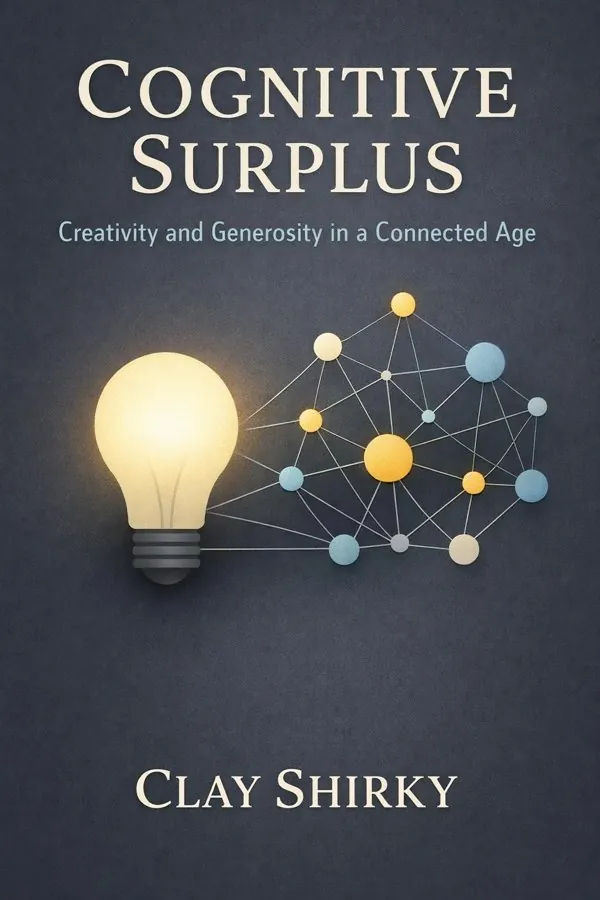
Cognitive Surplus: Creativity and Generosity in a Connected Age: Summary & Key Insights
by Clay Shirky
 10 min10 chaptersAudio available
Key Takeaways from Cognitive Surplus: Creativity and Generosity in a Connected Age
A revolution often begins not with new talent, but with old habits being redirected.
The most powerful change brought by connected technology is not faster information, but broader participation.
Not all meaningful work is driven by money.
The genius of networked collaboration is that it does not require heroic effort from every participant.
Modern culture often treats generosity as admirable but secondary, as if serious systems must run on profit, authority, or competition.
What Is Cognitive Surplus: Creativity and Generosity in a Connected Age About?
Cognitive Surplus: Creativity and Generosity in a Connected Age by Clay Shirky is a digital_culture book spanning 10 pages. Cognitive Surplus explores one of the most important shifts of the digital era: the movement from a culture built around passive media consumption to one shaped by participation, collaboration, and shared creation. In this influential book, Clay Shirky argues that modern society possesses a vast reservoir of free time, talent, and goodwill. For decades, much of that surplus was absorbed by television and other one-way media. But networked technologies have changed the equation. Today, ordinary people can publish, organize, solve problems, and build things together at a scale that once required large institutions. What makes the book so compelling is that Shirky does not simply celebrate the internet as a technological miracle. He examines the social habits, motivations, and institutional changes that allow collective creativity to flourish. Using examples such as Wikipedia, open-source communities, and civic media projects, he shows how small individual contributions can add up to major cultural value. Shirky writes with the authority of a leading thinker on digital culture, drawing on years of work as a teacher, writer, and analyst of networked collaboration. This book matters because it helps us understand how connected tools can turn spare moments into public value.
This FizzRead summary covers all 10 key chapters of Cognitive Surplus: Creativity and Generosity in a Connected Age in approximately 10 minutes, distilling the most important ideas, arguments, and takeaways from Clay Shirky's work. Also available as an audio summary and Key Quotes Podcast.
Cognitive Surplus: Creativity and Generosity in a Connected Age
Cognitive Surplus explores one of the most important shifts of the digital era: the movement from a culture built around passive media consumption to one shaped by participation, collaboration, and shared creation. In this influential book, Clay Shirky argues that modern society possesses a vast reservoir of free time, talent, and goodwill. For decades, much of that surplus was absorbed by television and other one-way media. But networked technologies have changed the equation. Today, ordinary people can publish, organize, solve problems, and build things together at a scale that once required large institutions.
What makes the book so compelling is that Shirky does not simply celebrate the internet as a technological miracle. He examines the social habits, motivations, and institutional changes that allow collective creativity to flourish. Using examples such as Wikipedia, open-source communities, and civic media projects, he shows how small individual contributions can add up to major cultural value. Shirky writes with the authority of a leading thinker on digital culture, drawing on years of work as a teacher, writer, and analyst of networked collaboration. This book matters because it helps us understand how connected tools can turn spare moments into public value.
Who Should Read Cognitive Surplus: Creativity and Generosity in a Connected Age?
This book is perfect for anyone interested in digital_culture and looking to gain actionable insights in a short read. Whether you're a student, professional, or lifelong learner, the key ideas from Cognitive Surplus: Creativity and Generosity in a Connected Age by Clay Shirky will help you think differently.
- ✓Readers who enjoy digital_culture and want practical takeaways
- ✓Professionals looking to apply new ideas to their work and life
- ✓Anyone who wants the core insights of Cognitive Surplus: Creativity and Generosity in a Connected Age in just 10 minutes
Want the full summary?
Get instant access to this book summary and 100K+ more with Fizz Moment.
Get Free SummaryAvailable on App Store • Free to download
Key Chapters
The most powerful change brought by connected technology is not faster information, but broader participation. Shirky argues that the digital age is defined by the transition from a world where media was produced by a few and consumed by many to one where the many can also produce, respond, remix, and organize. This is not merely a technical upgrade; it is a social transformation.
In the broadcast era, audiences were treated largely as spectators. Newspapers published, television transmitted, and viewers absorbed. Feedback was limited and slow. Online platforms disrupted that pattern by giving ordinary users tools to publish instantly and collaborate continuously. The same person can now be reader, writer, editor, donor, organizer, and critic all in the same hour.
This participatory model creates value in surprising ways. User comments can improve journalism. Open-source developers can fix software faster than a closed internal team. Patients can share treatment experiences in peer networks. Teachers can distribute lessons freely and adapt one another’s materials. The significance lies in the cumulative effect of small acts. A single post or edit may seem minor, but thousands of such contributions can produce knowledge systems, support communities, and cultural archives.
Participation also changes expectations. People no longer want to remain passive recipients in every domain. They expect to review products, fund creative work, join movements, and shape public conversations. Organizations that ignore this shift often appear outdated because they still operate as if audiences should simply receive rather than engage.
Actionable takeaway: In any project you lead, ask how the audience can become contributors. Even one simple participatory feature, such as feedback, submissions, or co-creation, can radically increase engagement and value.
Not all meaningful work is driven by money. One of Shirky’s most important contributions is his explanation of why people voluntarily give time and effort to shared projects. Traditional economics often assumes that incentives must be financial, yet digital communities repeatedly show that people contribute for social, personal, and communal reasons. Recognition, belonging, mastery, generosity, identity, and purpose can all be stronger motivators than payment.
Shirky distinguishes between intrinsic and extrinsic motivations. Intrinsic motivations come from the satisfaction of the activity itself: solving a problem, expressing creativity, helping others, learning a skill. Extrinsic motivations come from outside rewards such as money, status, or formal credentials. In collaborative online spaces, intrinsic motivation often plays the leading role. People edit Wikipedia because they value knowledge. Programmers improve open-source tools because they enjoy the challenge or want to support a community. Volunteers tag photos, translate documents, or moderate forums because participation feels meaningful.
This matters because many institutions underestimate the power of social motivation. They assume people need strict control, payment, or hierarchy. But when participation is easy, visible, and connected to a clear purpose, individuals often contribute far more than expected. Successful platforms understand this. They make effort count, show progress, acknowledge contributors, and create social norms that reward helpfulness.
At the same time, Shirky warns that badly designed incentives can undermine voluntary participation. If people feel exploited or manipulated, motivation fades. Community energy depends on trust, clarity, and the sense that contributions matter.
Actionable takeaway: When building a collaborative effort, do not start by asking only how to pay people. Ask how to give them purpose, visibility, community, and meaningful ownership.
The genius of networked collaboration is that it does not require heroic effort from every participant. Shirky shows that large-scale collective projects often emerge from many small, uneven contributions rather than from uniform commitment. In digital environments, people can participate at different levels: one person may contribute thousands of hours, another only five minutes, yet both still add value.
This is a crucial departure from older organizational models. Traditional institutions often required high commitment before someone could help. Membership, training, meetings, and hierarchy created friction. Online systems reduce that friction. A person can fix a typo in an article, answer a stranger’s question, tag an image, report a bug, sign a petition, or upload one useful photo. These lightweight acts make participation accessible, which is why collective projects can grow rapidly.
Wikipedia is a classic example. Not every editor writes full articles. Many simply correct dates, improve wording, add citations, or revert vandalism. Open-source software works similarly: some contributors write major code, others test updates or document instructions. Social platforms also rely on this uneven participation. A few create heavily, many contribute lightly, and the whole system still functions.
For leaders and creators, the lesson is profound. If you design only for highly committed participants, you exclude the majority of potential contributors. But if you create clear pathways for small acts, you invite broad engagement and increase the chances that casual users become long-term contributors.
Actionable takeaway: Break any collaborative project into contribution sizes. Offer one-minute, ten-minute, and one-hour ways for people to help so that participation feels possible at every commitment level.
Technology alone does not create collaboration; design determines whether people can participate meaningfully. Shirky emphasizes that the structure of a platform shapes the behavior it attracts. If contribution is confusing, invisible, or risky, most people will not bother. If it is simple, rewarding, and socially legible, participation can flourish.
Design for participation means lowering barriers while preserving enough structure to keep a project coherent. People need clear ways to join, contribute, and understand community norms. They also need signals that their effort matters. A well-designed system can channel scattered interest into productive action. A poorly designed one can turn even enthusiastic communities into chaos.
Examples are everywhere. Wikipedia works not because everyone agrees, but because it combines open editing with norms, histories, moderation, and discussion pages. Open-source communities succeed when documentation helps newcomers contribute and maintainers review changes reliably. Civic apps are more useful when they allow easy reporting, tracking, and response. Even workplace collaboration tools perform better when they reduce complexity and make shared progress visible.
Shirky’s insight is especially relevant for institutions trying to engage users. Too many organizations say they value participation while offering only symbolic input or cumbersome interfaces. Real participation requires practical pathways, not abstract invitations.
The best systems also account for social behavior. They anticipate conflict, reward constructive contribution, and make abuse harder. In other words, design is not neutral. It encodes assumptions about what people can do and how communities should work.
Actionable takeaway: If you want more participation, test your process from a newcomer’s perspective. Remove unnecessary steps, clarify norms, and create immediate feedback so contributors know their effort had an effect.
The same tools that enable generosity can also amplify distraction, misinformation, and mob behavior. Shirky does not present cognitive surplus as automatically virtuous. He recognizes that when millions of people gain the ability to contribute, not all contributions will be wise, useful, or humane. Participation expands possibilities in every direction, including harmful ones.
This is a critical corrective to naive digital optimism. Time spent online can produce encyclopedias, volunteer networks, and civic campaigns, but it can also produce harassment, conspiracy communities, empty novelty, and coordinated manipulation. The existence of cognitive surplus tells us that people have the capacity to act together; it does not guarantee that they will act well.
Shirky’s framework encourages a more mature question: not whether participation is good or bad, but what conditions make it constructive. Communities need norms, moderation, accountability, and shared purpose. Institutions need digital literacy, not just digital access. Citizens need to recognize that low barriers to contribution also mean low barriers to noise.
This idea applies personally as well. The internet makes it easy to confuse activity with value. Posting, reacting, and sharing can feel participatory while adding little substance. Productive cognitive surplus requires intention.
For organizations, this means that opening a platform is only the beginning. They must also manage trust, quality, and abuse. For individuals, it means choosing channels that reward creation and problem-solving rather than outrage and compulsive scrolling.
Actionable takeaway: Before joining or building an online community, define what “useful contribution” means and what behaviors will be limited. Healthy participation depends on clear standards, not just open access.
Many of the most important digital creations do not fit neatly into conventional economic models. Shirky argues that sharing and collaboration reveal forms of value that markets alone cannot fully explain. In a connected environment, people often create public goods that are free to use, hard to price traditionally, and immensely valuable to society.
Consider open-source software, collaborative knowledge bases, community forums, and crowdsourced archives. These resources may not emerge from direct profit incentives, yet they save time, spread expertise, and support innovation across entire sectors. A business may rely on free code. A student may learn from freely shared tutorials. A citizen may use crowd-generated information during a crisis. The value exists even when no simple transaction captures it.
This does not mean economics disappears. Platforms still require infrastructure, moderation, and sustainability. But Shirky pushes readers to see that the social production of value can coexist with, supplement, or sometimes outperform formal market structures. The digital age broadens the range of what is economically possible because coordinating volunteers and amateurs has become far cheaper.
This has strategic implications for businesses and institutions. Some of the smartest organizations now build ecosystems rather than merely products. They invite user feedback, support developer communities, publish resources openly, or encourage collaboration around their work. They understand that shared value can enhance private value rather than threaten it.
Actionable takeaway: When evaluating a project, measure more than revenue. Ask what shared knowledge, trust, community capacity, or network effects it creates, because these forms of value often determine long-term impact.
One of the deepest effects of digital participation is psychological: people begin to see themselves as agents rather than spectators. Shirky argues that when tools for contribution become widespread, culture itself changes. People who have experienced the ability to post, organize, remix, fund, teach, or mobilize no longer accept purely one-way relationships in every sphere of life.
This shift in expectations influences media, education, politics, and work. Audiences expect conversation rather than lectures. Students want to create as well as consume. Citizens organize through networks rather than waiting for institutions to act first. Employees expect collaboration tools, transparency, and the chance to share ideas across hierarchy. Even entertainment becomes more participatory through fandoms, remix culture, and creator communities.
The cultural transformation is not just about empowerment but about habit formation. Repeated participation teaches people that contribution is normal. Once enough people internalize that norm, institutions must adapt. News organizations open comment and membership models. Brands invite communities into product development. Governments experiment with participatory budgeting or public reporting tools.
Still, agency can be unevenly distributed. Access, skill, confidence, and social position affect who gets heard. That is why Shirky’s argument matters beyond technology. Building a participatory culture requires education, inclusion, and systems that welcome diverse contributors.
Ultimately, cognitive surplus changes society when people stop seeing free time as something only to be filled and start seeing it as something that can be invested.
Actionable takeaway: Strengthen your own sense of agency by choosing one area of life where you usually consume passively and turning it into a domain of contribution, collaboration, or public sharing.
The biggest promise of cognitive surplus is not more content but better collective problem-solving. Shirky believes connected society can use spare capacity not only for entertainment and hobbies, but for civic improvement. When people can coordinate easily, they can document injustice, respond to crises, translate information, tutor strangers, monitor institutions, and build tools for public benefit.
This idea expands the meaning of creativity. Creativity is not only artistic expression; it is the ability to arrange people, knowledge, and effort in new ways that solve real problems. Generosity is not only kindness; it is a willingness to contribute to shared systems that improve life for others. Together, these forces create civic imagination: the belief that ordinary people can help shape public outcomes.
Examples include citizen journalism during political unrest, volunteer mapping after disasters, mutual-aid networks, and collaborative educational resources. These projects often begin without official permission. They emerge because people see a need and have tools to respond. That does not eliminate the role of governments or institutions, but it changes the landscape. Public life becomes something citizens can actively co-produce.
Shirky’s message remains urgent. The connected age gives societies unprecedented coordination power, but whether that power produces noise or public value depends on norms, choices, and imagination. The future belongs not simply to the most connected, but to those who best convert connection into contribution.
Actionable takeaway: Choose one civic issue you care about and contribute in a small but public way this month, whether by sharing knowledge, supporting a volunteer effort, joining a digital community, or helping build a useful resource.
All Chapters in Cognitive Surplus: Creativity and Generosity in a Connected Age
About the Author
Clay Shirky is an American writer, educator, and consultant best known for analyzing how the internet changes communication, collaboration, and social organization. He has taught at New York University, where his work focused on the social effects of networked technologies and the rise of participatory media. Shirky became widely influential through his ability to explain complex digital shifts in clear, accessible language, often linking technology to broader cultural and institutional change. His books, including Here Comes Everybody and Cognitive Surplus, helped shape public understanding of online communities, social media, and collective action. Across his career, he has advised organizations and spoken extensively about how digital tools empower groups to coordinate, create, and share outside traditional hierarchies.
Get This Summary in Your Preferred Format
Read or listen to the Cognitive Surplus: Creativity and Generosity in a Connected Age summary by Clay Shirky anytime, anywhere. FizzRead offers multiple formats so you can learn on your terms — all free.
Available formats: App · Audio · PDF · EPUB — All included free with FizzRead
Download Cognitive Surplus: Creativity and Generosity in a Connected Age PDF and EPUB Summary
Key Quotes from Cognitive Surplus: Creativity and Generosity in a Connected Age
“A revolution often begins not with new talent, but with old habits being redirected.”
“The most powerful change brought by connected technology is not faster information, but broader participation.”
“Not all meaningful work is driven by money.”
“The genius of networked collaboration is that it does not require heroic effort from every participant.”
“Modern culture often treats generosity as admirable but secondary, as if serious systems must run on profit, authority, or competition.”
Frequently Asked Questions about Cognitive Surplus: Creativity and Generosity in a Connected Age
Cognitive Surplus: Creativity and Generosity in a Connected Age by Clay Shirky is a digital_culture book that explores key ideas across 10 chapters. Cognitive Surplus explores one of the most important shifts of the digital era: the movement from a culture built around passive media consumption to one shaped by participation, collaboration, and shared creation. In this influential book, Clay Shirky argues that modern society possesses a vast reservoir of free time, talent, and goodwill. For decades, much of that surplus was absorbed by television and other one-way media. But networked technologies have changed the equation. Today, ordinary people can publish, organize, solve problems, and build things together at a scale that once required large institutions. What makes the book so compelling is that Shirky does not simply celebrate the internet as a technological miracle. He examines the social habits, motivations, and institutional changes that allow collective creativity to flourish. Using examples such as Wikipedia, open-source communities, and civic media projects, he shows how small individual contributions can add up to major cultural value. Shirky writes with the authority of a leading thinker on digital culture, drawing on years of work as a teacher, writer, and analyst of networked collaboration. This book matters because it helps us understand how connected tools can turn spare moments into public value.
More by Clay Shirky
You Might Also Like

An Ugly Truth: Inside Facebook’s Battle for Domination
Sheera Frenkel, Cecilia Kang
10 min
Cyber Citizens
Ian Goodfellow
10 min
Digital Minimalism: Choosing a Focused Life in a Noisy World
Cal Newport
10 min
E‑Books & Beyond
Various Authors
10 min
The Future of Media
Various Authors
10 min
This Is Why We Can't Have Nice Things
Whitney Phillips
10 minBrowse by Category
Ready to read Cognitive Surplus: Creativity and Generosity in a Connected Age?
Get the full summary and 100K+ more books with Fizz Moment.