
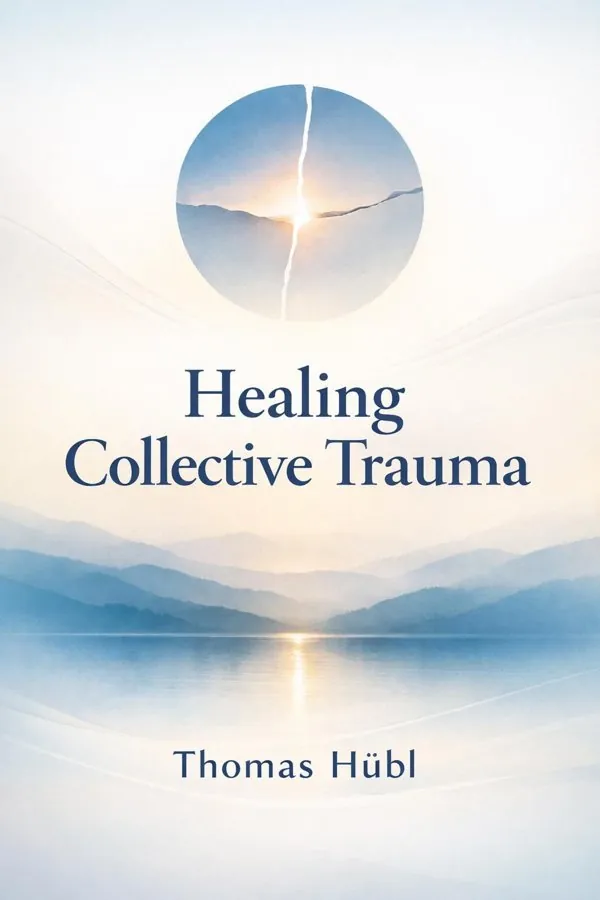
Healing Collective Trauma: A Process for Integrating Our Intergenerational and Cultural Wounds: Summary & Key Insights
by Thomas Hübl
 10 min6 chaptersAudio available
What Is Healing Collective Trauma: A Process for Integrating Our Intergenerational and Cultural Wounds About?
Healing Collective Trauma: A Process for Integrating Our Intergenerational and Cultural Wounds by Thomas Hübl is a mental_health book spanning 6 pages. Healing Collective Trauma explores how individuals and societies can address and integrate deep-seated wounds caused by historical, cultural, and intergenerational trauma. Thomas Hübl combines spiritual insight with psychological understanding to propose a process of collective healing that reconnects communities and fosters transformation.
This FizzRead summary covers all 6 key chapters of Healing Collective Trauma: A Process for Integrating Our Intergenerational and Cultural Wounds in approximately 10 minutes, distilling the most important ideas, arguments, and takeaways from Thomas Hübl's work. Also available as an audio summary and Key Quotes Podcast.
Healing Collective Trauma: A Process for Integrating Our Intergenerational and Cultural Wounds
Healing Collective Trauma explores how individuals and societies can address and integrate deep-seated wounds caused by historical, cultural, and intergenerational trauma. Thomas Hübl combines spiritual insight with psychological understanding to propose a process of collective healing that reconnects communities and fosters transformation.
Who Should Read Healing Collective Trauma: A Process for Integrating Our Intergenerational and Cultural Wounds?
This book is perfect for anyone interested in mental_health and looking to gain actionable insights in a short read. Whether you're a student, professional, or lifelong learner, the key ideas from Healing Collective Trauma: A Process for Integrating Our Intergenerational and Cultural Wounds by Thomas Hübl will help you think differently.
- ✓Readers who enjoy mental_health and want practical takeaways
- ✓Professionals looking to apply new ideas to their work and life
- ✓Anyone who wants the core insights of Healing Collective Trauma: A Process for Integrating Our Intergenerational and Cultural Wounds in just 10 minutes
Want the full summary?
Get instant access to this book summary and 100K+ more with Fizz Moment.
Get Free SummaryAvailable on App Store • Free to download
Key Chapters
When people think of trauma, they often imagine a single event—an accident, a war, an act of violence—that overwhelms an individual’s capacity to respond. But collective trauma works differently. It is cumulative, transmitted across generations, and held not only in personal memory but in social structures, family patterns, and the unconscious agreements of entire groups. I describe trauma as an interruption in the flow of life energy. When something too painful happens and cannot be processed fully, a split occurs—time freezes, and a portion of that experience becomes disconnected from awareness. Over time, these frozen fragments accumulate, influencing our relationships, our cultural narratives, and even our collective identities.
Historical wounds—such as genocide, colonialism, or systemic injustice—become woven into the social fabric. The unacknowledged pain of one generation silently shapes the nervous systems of the next. Children absorb the atmosphere of their parents’ unresolved grief and fear. Communities recreate roles of victim and perpetrator, often unconsciously, as if replaying an unfinished story. Without conscious integration, societies remain bound to patterns of polarity, projection, and division. To recognize this dynamic is not to assign blame but to illuminate a hidden force shaping our world.
Collective trauma also reveals itself in collective amnesia. We forget what cannot be felt. This forgetting becomes embedded in national myths, in how we teach history, and in the silences of our conversations. Healing begins when we turn toward these absences—not to reopen wounds but to bring presence into the frozen places of our shared psyche. Presence restores flow. As individuals and groups learn to hold the pain without judgment, the energy locked in trauma begins to move again, opening pathways for integration and renewal.
One of the core ideas I introduce in this work is the concept of a collective nervous system. Just as the human body responds to trauma through contraction, dissociation, or hyperarousal, so does the collective body. Communities tense against what they cannot bear. Nations compartmentalize their histories. The result is systemic entanglement—feedback loops of anxiety, reactivity, and fragmentation that play out through institutions, politics, and culture.
I often describe this using the metaphor of an orchestra. In a healthy system, each instrument attunes to the others; harmony arises through resonance and listening. But when one section of the orchestra becomes overwhelmed or ignored, dissonance spreads. Healing collective trauma means learning to listen again—to reestablish the subtle channels of resonance that connect us as living systems. This process demands more than intellectual understanding; it requires the cultivation of embodied awareness.
From a psychological perspective, our nervous systems are constantly co-regulating. A regulated presence can soothe dysregulated others, much like a calm parent settles a frightened child. On a social scale, leaders, healers, and communities can function as regulatory nodes for the wider collective field. This is why I emphasize presence practices: meditation, attunement, and transparent communication. These practices refine the capacity to sense and hold what is emerging in the field. The more attuned we become, the more the collective nervous system can reorganize itself toward coherence.
Systemic entanglement cannot be solved from the outside. We must perceive ourselves as integral parts of the system we wish to heal. As our awareness deepens, separation gives way to interbeing. With that understanding, even the most polarized societal conflicts begin to appear not as battles of ideology, but as expressions of unintegrated trauma seeking consciousness.
+ 4 more chapters — available in the FizzRead app
All Chapters in Healing Collective Trauma: A Process for Integrating Our Intergenerational and Cultural Wounds
About the Author
Thomas Hübl is a contemporary spiritual teacher and author from Austria known for integrating mystical principles with modern psychology. He founded the Academy of Inner Science and leads global programs focused on collective trauma healing and conscious evolution.
Get This Summary in Your Preferred Format
Read or listen to the Healing Collective Trauma: A Process for Integrating Our Intergenerational and Cultural Wounds summary by Thomas Hübl anytime, anywhere. FizzRead offers multiple formats so you can learn on your terms — all free.
Available formats: App · Audio · PDF · EPUB — All included free with FizzRead
Download Healing Collective Trauma: A Process for Integrating Our Intergenerational and Cultural Wounds PDF and EPUB Summary
Key Quotes from Healing Collective Trauma: A Process for Integrating Our Intergenerational and Cultural Wounds
“When people think of trauma, they often imagine a single event—an accident, a war, an act of violence—that overwhelms an individual’s capacity to respond.”
“One of the core ideas I introduce in this work is the concept of a collective nervous system.”
Frequently Asked Questions about Healing Collective Trauma: A Process for Integrating Our Intergenerational and Cultural Wounds
Healing Collective Trauma: A Process for Integrating Our Intergenerational and Cultural Wounds by Thomas Hübl is a mental_health book that explores key ideas across 6 chapters. Healing Collective Trauma explores how individuals and societies can address and integrate deep-seated wounds caused by historical, cultural, and intergenerational trauma. Thomas Hübl combines spiritual insight with psychological understanding to propose a process of collective healing that reconnects communities and fosters transformation.
You Might Also Like

Big Feelings: How to Be Okay When Things Are Not Okay
Liz Fosslien, Mollie West Duffy
10 min
Creative Arts Therapies Handbook: Art, Music and Dance Therapy Practices for Wellbeing
Susan I. Buchalter
10 min
Emotional First Aid: Healing Rejection, Guilt, Failure, and Other Everyday Hurts
Guy Winch
10 min
Lost Connections: Why You're Depressed and How to Find Hope
Johann Hari
10 min
No Time to Panic: How to Stop Worrying and Embrace Life
Matt Gutman
10 min
Overcoming Mobbing: A Recovery Guide for Workplace Aggression and Bullying
Maureen Duffy, Len Sperry
10 minBrowse by Category
Ready to read Healing Collective Trauma: A Process for Integrating Our Intergenerational and Cultural Wounds?
Get the full summary and 100K+ more books with Fizz Moment.