
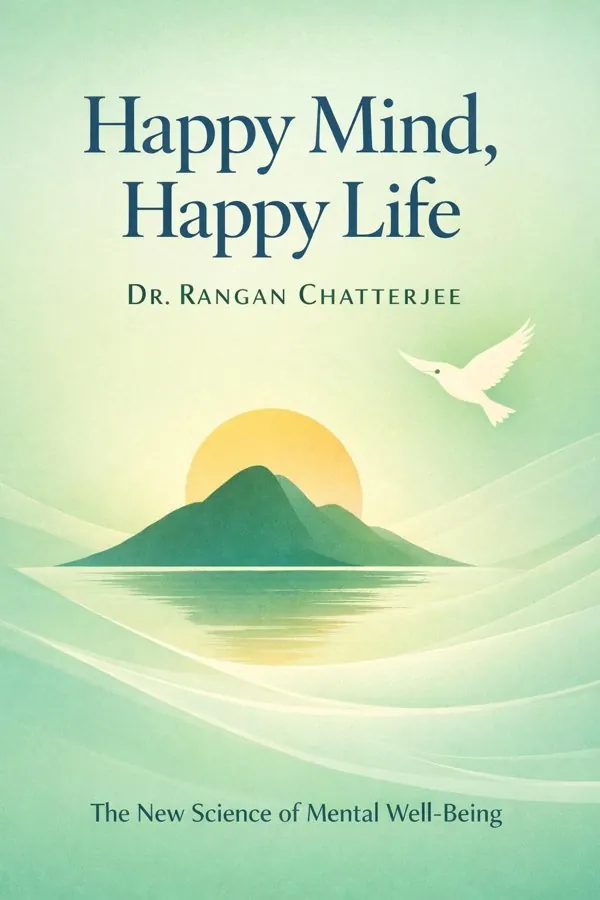
Happy Mind, Happy Life: The New Science of Mental Well-Being: Summary & Key Insights
 10 min9 chaptersAudio available
Key Takeaways from Happy Mind, Happy Life: The New Science of Mental Well-Being
Many people chase happiness as if it were a permanent emotional high, but that expectation is precisely what makes it so elusive.
Chatterjee emphasizes that mindset is not a buzzword but a core determinant of mental well-being.
Loneliness often hides in plain sight.
People often assume happiness comes from ease, yet many of our most fulfilling experiences come from effort in the service of something meaningful.
Stress is not always the enemy; unmanaged stress is.
What Is Happy Mind, Happy Life: The New Science of Mental Well-Being About?
Happy Mind, Happy Life: The New Science of Mental Well-Being by Dr. Rangan Chatterjee is a mental_health book spanning 9 pages. What if happiness were less a matter of luck and more a set of habits you could practice every day? In Happy Mind, Happy Life, Dr. Rangan Chatterjee argues that mental well-being is not reserved for the naturally optimistic or externally successful. It can be cultivated through intentional choices about how we think, connect, work, rest, and respond to stress. Blending modern research in psychology and neuroscience with the practical wisdom of lifestyle medicine, he shows that a healthier mind emerges from small, repeatable actions rather than dramatic life overhauls. The book matters because so many people today feel overwhelmed, distracted, and emotionally depleted despite living in a world of unprecedented convenience. Chatterjee offers a grounded alternative to both toxic positivity and passive resignation. His approach is compassionate, realistic, and highly actionable. As a physician, bestselling author, and host of the Feel Better, Live More podcast, he brings clinical experience, scientific literacy, and a talent for translating complex ideas into simple daily practices. The result is a guide to happiness that feels both evidence-based and deeply human.
This FizzRead summary covers all 9 key chapters of Happy Mind, Happy Life: The New Science of Mental Well-Being in approximately 10 minutes, distilling the most important ideas, arguments, and takeaways from Dr. Rangan Chatterjee's work. Also available as an audio summary and Key Quotes Podcast.
Happy Mind, Happy Life: The New Science of Mental Well-Being
What if happiness were less a matter of luck and more a set of habits you could practice every day? In Happy Mind, Happy Life, Dr. Rangan Chatterjee argues that mental well-being is not reserved for the naturally optimistic or externally successful. It can be cultivated through intentional choices about how we think, connect, work, rest, and respond to stress. Blending modern research in psychology and neuroscience with the practical wisdom of lifestyle medicine, he shows that a healthier mind emerges from small, repeatable actions rather than dramatic life overhauls.
The book matters because so many people today feel overwhelmed, distracted, and emotionally depleted despite living in a world of unprecedented convenience. Chatterjee offers a grounded alternative to both toxic positivity and passive resignation. His approach is compassionate, realistic, and highly actionable. As a physician, bestselling author, and host of the Feel Better, Live More podcast, he brings clinical experience, scientific literacy, and a talent for translating complex ideas into simple daily practices. The result is a guide to happiness that feels both evidence-based and deeply human.
Who Should Read Happy Mind, Happy Life: The New Science of Mental Well-Being?
This book is perfect for anyone interested in mental_health and looking to gain actionable insights in a short read. Whether you're a student, professional, or lifelong learner, the key ideas from Happy Mind, Happy Life: The New Science of Mental Well-Being by Dr. Rangan Chatterjee will help you think differently.
- ✓Readers who enjoy mental_health and want practical takeaways
- ✓Professionals looking to apply new ideas to their work and life
- ✓Anyone who wants the core insights of Happy Mind, Happy Life: The New Science of Mental Well-Being in just 10 minutes
Want the full summary?
Get instant access to this book summary and 100K+ more with Fizz Moment.
Get Free SummaryAvailable on App Store • Free to download
Key Chapters
Many people chase happiness as if it were a permanent emotional high, but that expectation is precisely what makes it so elusive. Dr. Rangan Chatterjee begins by reframing happiness not as constant pleasure, but as a steadier sense of inner well-being. In this view, mental wellness includes calm, meaning, connection, self-respect, and the capacity to navigate difficulty without being shattered by it. Happiness is not the absence of sadness, stress, or uncertainty. It is the ability to remain grounded and engaged with life even when those experiences appear.
This shift matters because the modern world trains us to equate happiness with achievement, consumption, or stimulation. We assume we will feel better when we earn more, look better, get promoted, or finally reach some future milestone. Yet the emotional boost from these wins often fades quickly. Chatterjee draws on science showing that our minds adapt to external gains. What creates deeper satisfaction is often less glamorous: strong relationships, a sense of agency, meaningful routines, and a healthy relationship with our thoughts.
In practice, this means asking different questions. Instead of “How can I feel amazing all the time?” ask “What helps me feel steady, purposeful, and emotionally healthy?” For one person, that may mean reducing overcommitment. For another, it may mean spending more time outdoors, speaking honestly with a partner, or sleeping properly for the first time in months.
The actionable takeaway is simple: define happiness for yourself in broader, healthier terms. Write down three qualities of a good life beyond pleasure or success, and use them as your new compass.
The same event can feel like a catastrophe to one person and a challenge to another, which reveals an uncomfortable truth: our interpretation often drives our suffering more than the event itself. Chatterjee emphasizes that mindset is not a buzzword but a core determinant of mental well-being. The stories we tell ourselves about failure, uncertainty, rejection, or stress shape our biology, emotions, and behavior.
A negative mental loop can become self-reinforcing. If you interpret a mistake as proof that you are inadequate, you are more likely to feel anxious, withdraw, and perform worse next time. But if you interpret the same mistake as feedback, your nervous system stays calmer, your learning remains open, and your confidence recovers faster. This is not about denying pain or forcing optimism. It is about noticing habitual thought patterns and choosing interpretations that are more balanced, compassionate, and useful.
Chatterjee encourages readers to become observers of the mind rather than unquestioning followers of it. Practical tools include journaling, pausing before reacting, challenging catastrophic assumptions, and replacing harsh self-talk with language you would use toward a friend. For example, instead of saying “I always ruin things,” you might say, “That didn’t go how I hoped, but I can learn from it.” This tiny shift reduces shame and increases resilience.
Over time, mindset changes through repetition, not insight alone. A person who regularly practices gratitude, perspective-taking, and self-compassion gradually trains the brain to respond differently.
The actionable takeaway: catch one recurring negative thought this week, write it down, and deliberately reframe it into a more accurate and constructive interpretation.
Loneliness often hides in plain sight. A person can be surrounded by colleagues, family, and social media updates yet still feel profoundly disconnected. Chatterjee treats human connection not as a lifestyle bonus, but as a biological and psychological need. We are wired for belonging, and when that need goes unmet, stress rises, mood declines, and everyday challenges feel heavier.
The book highlights that supportive relationships do more than provide comfort in hard times. They shape our baseline well-being. Being known, accepted, and able to share honestly with others creates emotional safety. That safety regulates the nervous system, lowers chronic stress, and strengthens resilience. In contrast, superficial busyness or constant digital contact can create the illusion of connection while depriving us of genuine intimacy.
Importantly, connection is not only about the number of people in our lives. It is about depth, presence, and reciprocity. A ten-minute conversation where you feel truly heard may be more nourishing than hours of distracted socializing. Chatterjee invites readers to invest in fewer but richer interactions: putting away the phone at dinner, asking a friend a real question, reconnecting with someone who matters, or joining a community built around shared interests or service.
He also points out that connection includes our relationship with ourselves. If we are constantly self-critical, ashamed, or disconnected from our own needs, it becomes harder to relate authentically to others.
The actionable takeaway: choose one relationship to strengthen this week. Reach out intentionally, be fully present in the conversation, and ask something deeper than the usual small talk.
People often assume happiness comes from ease, yet many of our most fulfilling experiences come from effort in the service of something meaningful. Chatterjee argues that purpose is a crucial pillar of mental well-being because it gives structure to suffering, direction to energy, and significance to ordinary days. Without purpose, even comfort can start to feel empty.
Purpose does not have to mean a grand mission, public impact, or career calling. It can be raising children with care, serving your community, creating beautiful work, helping patients, mentoring others, or living in alignment with your values. What matters is the felt sense that your actions connect to something larger than immediate gratification.
When people lose touch with purpose, they often become more vulnerable to anxiety, apathy, and overreliance on distractions. The mind seeks stimulation when it lacks meaning. This is why endless scrolling, binge-watching, or overworking can become substitutes for direction. Chatterjee encourages readers to identify what energizes them, what they value deeply, and where they feel useful. Questions such as “When do I feel most alive?” and “What kind of contribution matters to me?” can uncover buried clarity.
Purpose also helps during difficult periods. A stressful job may feel tolerable when connected to supporting a family or building something worthwhile. Recovery from illness may feel more possible when linked to a desire to be present for loved ones.
The actionable takeaway: write down three activities that make you feel useful or deeply engaged, then schedule one of them into your week as a non-negotiable act of meaning.
Stress is not always the enemy; unmanaged stress is. Chatterjee makes a nuanced distinction between acute stress, which can sharpen performance and help us respond to challenges, and chronic stress, which silently erodes mood, focus, sleep, and physical health. The problem for many people is not that stress appears in life, but that their body rarely gets the signal that the threat has passed.
Modern stressors are often psychological rather than physical: unread emails, financial pressure, social comparison, unresolved conflict, constant notifications, and unrealistic self-expectations. The nervous system reacts to these cues as if danger is ongoing. Over time, this can lead to irritability, exhaustion, poor decision-making, and a diminished capacity for joy.
Chatterjee advocates practical stress regulation rather than vague advice to simply “relax.” Helpful strategies include breathwork, regular movement, sleep protection, setting boundaries, reducing information overload, and creating brief moments of recovery throughout the day. For example, stepping outside for five minutes between meetings, taking a few slow breaths before checking messages, or refusing to begin the day with a flood of news can meaningfully reduce physiological strain.
He also emphasizes emotional honesty. Stress increases when feelings are suppressed, denied, or endlessly postponed. Naming pressure clearly often reduces its power. Saying “I am overwhelmed and need help” is not weakness; it is intelligent regulation.
The actionable takeaway: identify your biggest daily stress trigger and create one recovery ritual around it, such as a breathing pause, a boundary, or a short walk, then repeat it every day for a week.
Resilience is often misunderstood as toughness, but real resilience is not about suppressing emotion or pretending to be unaffected. Chatterjee presents it as the capacity to recover, adapt, and keep functioning with integrity after setbacks. It is less about never bending and more about learning how to bend without breaking.
Crucially, resilience is built in ordinary life, not just in emergencies. The small habits that support emotional regulation, self-trust, and physical stability become the reserves we draw on during difficult times. If your life contains no margin, no rest, no supportive relationships, and no self-awareness, even a modest disruption can feel overwhelming. By contrast, routines such as sleep consistency, reflective practices, healthy boundaries, and meaningful connection create psychological shock absorbers.
Chatterjee also emphasizes the role of self-talk in resilience. People who recover well from adversity tend not to avoid pain, but they do resist turning pain into identity. Instead of “I am broken,” they are more likely to think, “This is hard, but I can move through it.” That difference influences everything from motivation to immune function.
Practical resilience also includes flexibility. Sometimes strength means persistence; other times it means changing plans, asking for help, or letting go of impossible standards. A parent under pressure might become more resilient not by doing more, but by simplifying routines and accepting support from others.
The actionable takeaway: build one resilience reserve now. Choose a habit that restores you, such as journaling, walking, sleeping on time, or calling a trusted friend, and protect it before life gets harder.
We often think mental well-being is created only inside the mind, but Chatterjee shows that our surroundings continuously influence our emotional state. The spaces we occupy, the devices we use, the sounds we absorb, and the information we consume can either support calm and clarity or feed stress and fragmentation.
Digital life is one of the most powerful examples. Smartphones promise connection and convenience, but they also train the brain toward interruption, comparison, urgency, and compulsive checking. Constant exposure to notifications can keep the nervous system on alert. Social media can distort self-worth by pushing us to evaluate our lives against curated versions of others. Even entertainment can become overstimulation when it fills every quiet moment.
Physical environment matters too. Cluttered rooms can increase mental noise. Lack of natural light can dampen energy and mood. Time in nature, by contrast, often restores attention and reduces stress. Something as simple as a tidy workspace, a phone-free bedroom, or a regular walk in a park can improve emotional regulation more than people expect.
Chatterjee encourages environmental design rather than relying on willpower alone. If you want a calmer mind, make calm easier. Put devices out of reach at night. Turn off nonessential notifications. Create one corner of your home that signals rest. Spend part of each day outdoors, even briefly.
The actionable takeaway: audit your environment today. Remove one source of digital overstimulation and add one calming cue, such as a screen boundary, a plant, better light, or a daily dose of fresh air.
Transformation is rarely dramatic. The happiest and healthiest minds are usually shaped not by occasional breakthroughs, but by repeated daily practices that gently train attention, physiology, and emotional habits. Chatterjee stresses that consistency beats intensity. A five-minute practice done often can change more than an ambitious routine that collapses after three days.
This idea is powerful because many people fail at well-being by trying to overhaul everything at once. They set impossible goals, miss a day, and conclude they lack discipline. Chatterjee offers a more compassionate and realistic approach: make mental well-being part of the fabric of normal life. Morning sunlight, a few slow breaths, movement between tasks, moments of gratitude, short journaling sessions, and protected sleep routines may seem modest, but their cumulative effect is substantial.
Daily practices work because they interrupt autopilot. A gratitude habit shifts attention from scarcity to sufficiency. Breathwork signals safety to the body. Reflection creates distance from reactive thinking. Movement improves mood chemistry. Regular acts of connection remind us we are not alone. None of these removes life’s difficulties, but together they make those difficulties easier to meet.
Chatterjee’s broader point is that self-care should not be reserved for collapse. It should become maintenance, as normal as brushing your teeth. The most sustainable practices are simple, enjoyable, and linked to existing routines.
The actionable takeaway: choose one tiny habit that takes under five minutes, such as writing three gratitudes or taking ten slow breaths each morning, and commit to it daily for the next two weeks.
Feeling better for a few days is one thing; building a life that continues to support mental well-being is another. Chatterjee closes the loop by showing that lasting happiness depends on alignment. We suffer when our calendar, environment, relationships, and habits repeatedly pull us away from what we say matters most. Sustainable well-being grows when daily life reflects our values.
This means mental health is not fixed by one insight, one retreat, or one productive week. It is maintained through regular course correction. You may learn to manage stress, but if you keep saying yes to every demand, overwhelm will return. You may value connection, but if you never create space for loved ones, loneliness will persist. Long-term well-being asks for honesty about how we are living, not just how we are feeling.
Chatterjee encourages readers to review their lives gently but truthfully. Are your routines helping or harming you? Are your ambitions aligned with your health? Are your digital habits serving your mind? Are you making time for rest, reflection, and people who matter? The goal is not perfection. It is congruence. A life feels lighter when it is less divided.
This approach also makes relapse less threatening. Stressful periods, sadness, and emotional dips are part of being human. Instead of seeing them as failure, we can treat them as signals to reconnect with the foundations that support us.
The actionable takeaway: once a week, perform a ten-minute well-being review. Ask what gave you energy, what drained you, and what one adjustment would bring your life into better alignment next week.
All Chapters in Happy Mind, Happy Life: The New Science of Mental Well-Being
About the Author
Dr. Rangan Chatterjee is a British physician, author, broadcaster, and one of the leading voices in lifestyle medicine. He is best known for helping people understand how everyday habits shape both physical and mental health. Chatterjee rose to wider public attention through the BBC One series Doctor in the House and later built a large audience through his popular podcast Feel Better, Live More. Across his books, talks, and media appearances, he combines medical expertise with accessible, practical advice on stress, sleep, nutrition, movement, relationships, and emotional well-being. His work stands out for translating scientific research into simple changes ordinary people can actually sustain. Through a calm, compassionate approach, he encourages readers to take greater ownership of their health and build lives that support long-term vitality and fulfillment.
Get This Summary in Your Preferred Format
Read or listen to the Happy Mind, Happy Life: The New Science of Mental Well-Being summary by Dr. Rangan Chatterjee anytime, anywhere. FizzRead offers multiple formats so you can learn on your terms — all free.
Available formats: App · Audio · PDF · EPUB — All included free with FizzRead
Download Happy Mind, Happy Life: The New Science of Mental Well-Being PDF and EPUB Summary
Key Quotes from Happy Mind, Happy Life: The New Science of Mental Well-Being
“Many people chase happiness as if it were a permanent emotional high, but that expectation is precisely what makes it so elusive.”
“The same event can feel like a catastrophe to one person and a challenge to another, which reveals an uncomfortable truth: our interpretation often drives our suffering more than the event itself.”
“A person can be surrounded by colleagues, family, and social media updates yet still feel profoundly disconnected.”
“People often assume happiness comes from ease, yet many of our most fulfilling experiences come from effort in the service of something meaningful.”
“Stress is not always the enemy; unmanaged stress is.”
Frequently Asked Questions about Happy Mind, Happy Life: The New Science of Mental Well-Being
Happy Mind, Happy Life: The New Science of Mental Well-Being by Dr. Rangan Chatterjee is a mental_health book that explores key ideas across 9 chapters. What if happiness were less a matter of luck and more a set of habits you could practice every day? In Happy Mind, Happy Life, Dr. Rangan Chatterjee argues that mental well-being is not reserved for the naturally optimistic or externally successful. It can be cultivated through intentional choices about how we think, connect, work, rest, and respond to stress. Blending modern research in psychology and neuroscience with the practical wisdom of lifestyle medicine, he shows that a healthier mind emerges from small, repeatable actions rather than dramatic life overhauls. The book matters because so many people today feel overwhelmed, distracted, and emotionally depleted despite living in a world of unprecedented convenience. Chatterjee offers a grounded alternative to both toxic positivity and passive resignation. His approach is compassionate, realistic, and highly actionable. As a physician, bestselling author, and host of the Feel Better, Live More podcast, he brings clinical experience, scientific literacy, and a talent for translating complex ideas into simple daily practices. The result is a guide to happiness that feels both evidence-based and deeply human.
More by Dr. Rangan Chatterjee
You Might Also Like

Big Feelings: How to Be Okay When Things Are Not Okay
Liz Fosslien, Mollie West Duffy
10 min
Creative Arts Therapies Handbook: Art, Music and Dance Therapy Practices for Wellbeing
Susan I. Buchalter
10 min
Emotional First Aid: Healing Rejection, Guilt, Failure, and Other Everyday Hurts
Guy Winch
10 min
Lost Connections: Why You're Depressed and How to Find Hope
Johann Hari
10 min
No Time to Panic: How to Stop Worrying and Embrace Life
Matt Gutman
10 min
Overcoming Mobbing: A Recovery Guide for Workplace Aggression and Bullying
Maureen Duffy, Len Sperry
10 minBrowse by Category
Ready to read Happy Mind, Happy Life: The New Science of Mental Well-Being?
Get the full summary and 100K+ more books with Fizz Moment.