
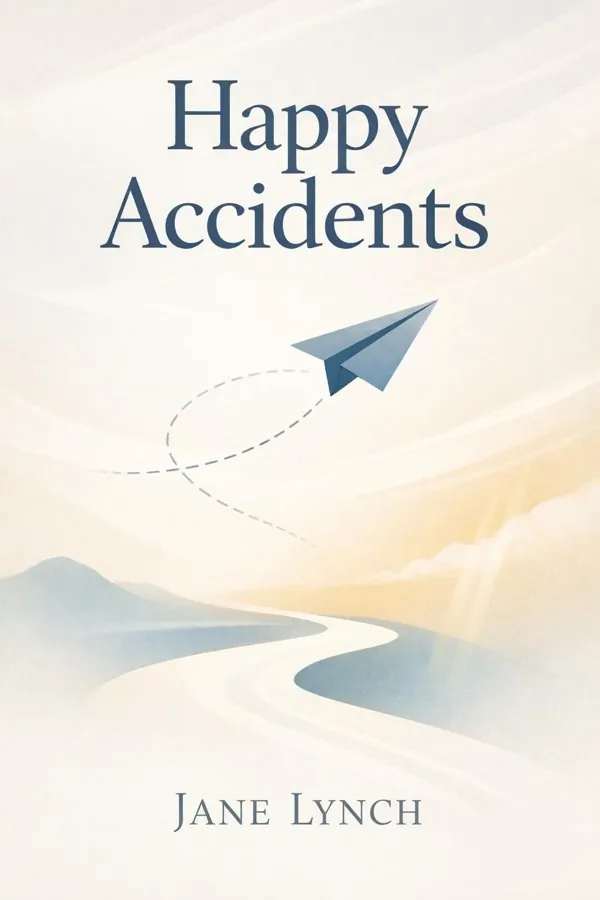
Happy Accidents: Summary & Key Insights
by Jane Lynch
 10 min10 chaptersAudio available
Key Takeaways from Happy Accidents
Some of the funniest people are first shaped by feeling awkward, invisible, or out of place.
We are often formed less by grand speeches than by the emotional climate of home.
Purpose is not always discovered in a flash of certainty; sometimes it arrives as a small feeling of aliveness.
A person can spend years performing normalcy before realizing the performance is the real burden.
Talent gets attention, but craft is what keeps a person going when attention is absent.
What Is Happy Accidents About?
Happy Accidents by Jane Lynch is a biographies book spanning 10 pages. Happy Accidents is Jane Lynch’s frank, funny, and unexpectedly moving memoir about becoming herself in a world that rarely offered clear instructions. Best known for her razor-sharp comic presence in Glee, Best in Show, and numerous film and television roles, Lynch uses this book to reveal the far less polished story behind the public persona. She writes about growing up in a working-class Illinois family, feeling out of place in her own body and identity, stumbling through uncertainty, wrestling with addiction, and slowly finding confidence through performance, honesty, and self-acceptance. What makes the memoir matter is not simply its celebrity appeal, but its deeper argument: life is rarely built through master plans. More often, it unfolds through detours, embarrassing moments, losses, and lucky breaks that only make sense in hindsight. Lynch has the authority to tell this story because she lived it from the inside out—not as a seamless rise to fame, but as a long, uneven journey toward authenticity. The result is a memoir that offers both laughter and reassurance to anyone still figuring things out.
This FizzRead summary covers all 10 key chapters of Happy Accidents in approximately 10 minutes, distilling the most important ideas, arguments, and takeaways from Jane Lynch's work. Also available as an audio summary and Key Quotes Podcast.
Happy Accidents
Happy Accidents is Jane Lynch’s frank, funny, and unexpectedly moving memoir about becoming herself in a world that rarely offered clear instructions. Best known for her razor-sharp comic presence in Glee, Best in Show, and numerous film and television roles, Lynch uses this book to reveal the far less polished story behind the public persona. She writes about growing up in a working-class Illinois family, feeling out of place in her own body and identity, stumbling through uncertainty, wrestling with addiction, and slowly finding confidence through performance, honesty, and self-acceptance. What makes the memoir matter is not simply its celebrity appeal, but its deeper argument: life is rarely built through master plans. More often, it unfolds through detours, embarrassing moments, losses, and lucky breaks that only make sense in hindsight. Lynch has the authority to tell this story because she lived it from the inside out—not as a seamless rise to fame, but as a long, uneven journey toward authenticity. The result is a memoir that offers both laughter and reassurance to anyone still figuring things out.
Who Should Read Happy Accidents?
This book is perfect for anyone interested in biographies and looking to gain actionable insights in a short read. Whether you're a student, professional, or lifelong learner, the key ideas from Happy Accidents by Jane Lynch will help you think differently.
- ✓Readers who enjoy biographies and want practical takeaways
- ✓Professionals looking to apply new ideas to their work and life
- ✓Anyone who wants the core insights of Happy Accidents in just 10 minutes
Want the full summary?
Get instant access to this book summary and 100K+ more with Fizz Moment.
Get Free SummaryAvailable on App Store • Free to download
Key Chapters
Some of the funniest people are first shaped by feeling awkward, invisible, or out of place. Jane Lynch’s early life in Dolton, Illinois, shows how humor often begins not as performance but as survival. She was not the loudest child in the room. She was observant, shy, and often unsure of where she fit. In a lively family and neighborhood culture full of strong personalities, she learned to watch people carefully. That habit of watching became one of her great artistic strengths. Comedy, in her case, grew out of noticing contradiction: how people posture, how they exaggerate, how pain and absurdity sit side by side.
Lynch’s story reminds readers that a difficult or uncomfortable childhood does not automatically damage a person’s voice; sometimes it sharpens it. Feeling like an outsider gave her perspective. She learned how to read a room, sense tension, and identify the tiny human behaviors that later made her performances so specific and memorable. Many people assume confidence creates great performers, but Lynch suggests the opposite can also be true: self-consciousness can create deep perception.
This idea applies far beyond acting. In ordinary life, the moments when we feel strange, embarrassed, or socially uncertain often teach us the most about people. A quiet child may become a perceptive leader. An awkward employee may become the best communicator because they truly listen. A person who once felt excluded may become unusually compassionate.
Instead of trying to erase your awkwardness, ask what it has taught you to notice. Actionable takeaway: identify one insecurity from your past and write down the skill it may have secretly developed in you—observation, empathy, timing, or resilience.
We are often formed less by grand speeches than by the emotional climate of home. In Happy Accidents, Jane Lynch paints her parents not as idealized heroes but as ordinary people whose humor, steadiness, and imperfections deeply influenced her. Her mother offered gentleness and grounding. Her father brought energy, sociability, and personality. Together, they created a family environment where showing up mattered and where laughter softened life’s rough edges.
Lynch’s portrayal of family is important because it avoids easy sentimentality. Families do not need to be flawless to be foundational. They can be noisy, limited, emotionally uneven, and still provide the raw materials of identity. For Lynch, working-class life in Illinois gave her both constraints and gifts. There was no glamorous roadmap to entertainment success. But there was loyalty, familiarity, and a culture that helped her understand the rhythms of real people. That understanding later became central to her acting.
Readers can apply this by looking at family as a source of patterns rather than just memories. Maybe you inherited humor from one parent, caution from another, or a habit of endurance from watching adults improvise through hardship. Even family traits you resisted may have taught you something useful. For example, growing up around people who avoided emotional honesty might make you value direct communication now.
Lynch shows that self-understanding often begins with recognizing where our instincts came from. We do not fully choose our starting point, but we can reinterpret it. Actionable takeaway: list three traits your family gave you—one positive, one difficult, and one mixed—and consider how each still influences your choices today.
A person can spend years performing normalcy before realizing the performance is the real burden. One of the most meaningful threads in Happy Accidents is Jane Lynch’s account of identity, especially her gradual acceptance of herself as a lesbian in a culture that offered fewer models and less openness than many readers know today. Her story is not framed as a dramatic revelation alone, but as a long emotional negotiation with shame, fear, and the desire to belong.
What makes this section powerful is its honesty about timing. Lynch did not become self-assured overnight. She wrestled with discomfort, uncertainty, and the social pressure to fit into familiar expectations. That struggle reflects a universal truth: identity issues are not limited to sexuality. Many people suppress central parts of themselves—ambition, sensitivity, creativity, difference, faith, doubt, even joy—because acceptance feels risky.
Lynch’s memoir argues that self-acceptance is not indulgence. It is a practical necessity. The more energy you spend hiding, the less energy remains for living and creating. Once she moved toward honesty, she became freer not just personally but professionally. Authenticity improved her work because she was no longer building a life around avoidance.
In everyday terms, this may mean speaking more plainly about what you want, setting boundaries that reflect who you are, or refusing roles that depend on self-erasure. It may also mean finding people with whom you can be unedited. Acceptance often grows in safe company.
Actionable takeaway: notice one area where you are managing others’ expectations more than honoring your truth, and make one small move toward honesty in that area.
Talent gets attention, but craft is what keeps a person going when attention is absent. Jane Lynch’s years in Chicago theater were crucial because they gave her exactly that: repetition, discipline, collaboration, and the chance to fail without quitting. Long before mainstream fame, she was doing the less glamorous work of becoming reliable. She was learning timing, ensemble performance, character work, and how to trust the process rather than immediate results.
Chicago’s theater scene mattered because it rewarded commitment more than image. In that environment, the point was not to be famous quickly but to get better. Lynch’s development there highlights a truth that many ambitious people resist: the middle years are not wasted years. Apprenticeship is not a delay of success; it is often the foundation of it. The ability to hold a room, shape a scene, and make bold choices under pressure does not usually come from raw instinct alone. It comes from doing the work over and over.
This lesson applies to any field. A designer improves through iterations, a manager through difficult teams, a therapist through patient listening, and an entrepreneur through repeated experiments. Environments that value substance over glamour can be transformative, even if they do not look impressive from the outside.
Lynch also shows the importance of artistic community. Being surrounded by serious, funny, striving people raises standards. Progress becomes shared rather than solitary. If you want to grow, put yourself near people who practice seriously.
Actionable takeaway: identify the “Chicago theater” phase of your own life—the unglamorous training ground you may be tempted to dismiss—and commit to mastering one core skill there before chasing recognition.
One of the most dangerous misunderstandings about success is the belief that the right path will feel consistently affirming. Jane Lynch’s move into the professional entertainment world, especially Hollywood, dismantles that myth. She encountered rejection, uncertainty, and the kind of invisibility that can make even talented people question their worth. Yet these disappointments did not mean she lacked ability. They meant she was in a competitive system that often cannot immediately recognize what later becomes undeniable.
Lynch’s experience is valuable because she did not romanticize struggle, but she also did not let rejection define reality. In creative industries, and in many professional settings, timing, fit, trend, and other people’s limited imagination play an enormous role. Someone can be excellent and still not get picked. The mature response is not to assume failure means personal deficiency. It is to separate feedback from identity.
This idea helps anyone navigating stalled progress. A job application can fail because of organizational politics. A manuscript can be rejected because it does not fit a list. A presentation can be overlooked because the room is not ready for it. Persistence is easier when you understand that outcomes are not always verdicts.
Lynch kept building a career by showing up, improving, and staying available to opportunity. She did not wait to feel constantly validated. She learned to keep moving while uncertain. That is often what progress actually looks like.
Actionable takeaway: the next time you face rejection, write down three possible explanations that do not involve “I am not good enough,” then decide on one productive next step instead of retreating.
A career often changes when a person stops imitating general success and starts leaning into what is uniquely theirs. For Jane Lynch, comedy—especially the dry, sharp, character-based style seen in her collaborations and Christopher Guest films—became the place where her individuality clicked. She was not trying to become a generic leading lady. She was becoming irreplaceable by embracing a voice that matched her instincts.
This matters because many people delay success by trying to fit familiar templates. They smooth out their eccentricities, hide what makes them unusual, and aim for broad approval. Lynch’s memoir suggests the opposite strategy can be more powerful. The qualities that initially seem too specific, too odd, or too unconventional may become the very traits that make you memorable. Her authority on screen came from precision: a raised eyebrow, clipped delivery, emotional control, and the ability to make absurdity feel completely real.
The broader application is clear. In any profession, differentiation matters. A teacher might be exceptional because of humor and storytelling. A consultant might stand out through clarity and calm. A founder might succeed by combining analytical rigor with unusual empathy. Instead of asking, “How can I be more like everyone else who succeeds?” ask, “What do I do naturally that people consistently respond to?”
Lynch’s comedic voice also came from trust. She trusted silence, restraint, and specificity. She did not need to overperform. That confidence can be built in any craft by studying what works and repeating it with intention.
Actionable takeaway: identify one trait people repeatedly notice in your work style, then strengthen it deliberately rather than minimizing it.
Many people use coping mechanisms long after they have stopped helping. In Happy Accidents, Jane Lynch is open about struggles with alcoholism, insecurity, and the emotional static that can accumulate when a person is not fully dealing with themselves. Her recovery is not presented as a magical reset but as a difficult, humbling process of becoming more honest. Sobriety, in her story, is less about deprivation than about clarity.
This is one of the memoir’s deepest contributions. Lynch shows how addictive patterns often coexist with self-doubt. When someone feels fundamentally uncomfortable in their own skin, numbness can look attractive. But the cost is high: stalled growth, damaged self-trust, and reduced presence. Recovery requires more than quitting a substance. It demands building a life that no longer depends on escape.
Even readers who have not faced addiction directly can learn from this. Everyone has forms of avoidance—overwork, doom-scrolling, compulsive busyness, unhealthy relationships, perfectionism. The underlying question is the same: what am I using to avoid feeling what I need to feel? Lynch’s story makes clear that freedom begins when avoidance is named.
Growth after sobriety also involves patience. Identity has to be rebuilt. Confidence has to be earned in real time. But the reward is substantial: more grounded relationships, better decision-making, and the ability to live without constant self-blurring.
Actionable takeaway: choose one habit you use to disconnect from discomfort, and for one week replace it with a more conscious response—walking, journaling, calling someone honest, or simply sitting with the feeling before reacting.
The dream of recognition often hides a second question: what happens after you get it? Jane Lynch’s Glee era brought a level of fame and visibility that transformed her public image, but the memoir makes clear that success does not automatically resolve inner issues. Fame can amplify insecurities just as easily as it rewards effort. It can bring validation, money, and new opportunities while also exposing a person to scrutiny, projection, and pressure.
Lynch’s perspective on this period is useful because it resists fantasy. She appreciates the breakthrough while staying honest about its complexity. Public success can distort ordinary life. People begin responding not to you, but to what you represent to them. The risk is that you start measuring yourself by attention instead of substance. Lynch’s grounded humor helps counter that trap. She understands that the external markers of arrival do not replace the internal work of staying sane, kind, and real.
This lesson applies to smaller forms of success too. A promotion, a thriving business, a large online following, or professional acclaim can all create similar distortions. The more visible you become, the more important private anchors become: trusted friends, routine, perspective, and values not tied to applause.
The memoir suggests that achievement is healthiest when it is integrated into a life rather than allowed to consume it. Success is good; losing yourself inside success is not.
Actionable takeaway: define success in two columns—external rewards and internal conditions—and make sure your current goals protect both, not just the visible half.
The title of the memoir contains its central philosophy: the best parts of life are not always planned. Jane Lynch’s journey did not unfold through a flawless master strategy. It emerged through detours, missed expectations, chance encounters, setbacks, evolving self-knowledge, and moments that only later revealed their value. A “happy accident” is not merely luck. It is what happens when openness meets experience, and when a person is flexible enough to use what life unexpectedly offers.
This idea is especially comforting in a culture obsessed with optimization. People are told to know their path early, move efficiently, and avoid mistakes. Lynch’s story offers a gentler and more realistic model. Wrong turns can become training. Delays can create maturity. Painful endings can redirect us toward better fits. What feels messy in the middle may look coherent in retrospect.
Importantly, this philosophy does not celebrate passivity. Happy accidents happen to people who keep participating. Lynch pursued work, developed skill, built relationships, confronted her struggles, and stayed available to possibility. The accident becomes “happy” because she responds to it with courage and curiosity.
For readers, this means loosening the grip on rigid narratives. You may not be behind. You may be in the middle of a chapter whose usefulness is not visible yet. The challenge is to remain engaged enough to discover its meaning.
Actionable takeaway: think of one unplanned event in your life that eventually helped you, then ask how that memory might help you trust the uncertainty of your current season.
All Chapters in Happy Accidents
About the Author
Jane Lynch is an American actress, comedian, singer, and writer celebrated for her commanding presence, sharp comic timing, and distinctive deadpan style. Born in Illinois, she built her craft through years of stage work in Chicago before establishing herself as a standout character performer in film and television. She is widely known for her roles in Christopher Guest’s ensemble comedies, including Best in Show and A Mighty Wind, and for portraying Sue Sylvester on Glee, a performance that earned her major critical acclaim and multiple Emmy Awards. Lynch has also worked on Broadway, hosted television programs, and written about her personal life with candor and humor. In Happy Accidents, she brings the same intelligence and wit to the page, sharing a deeply personal story of self-discovery, recovery, and unconventional success.
Get This Summary in Your Preferred Format
Read or listen to the Happy Accidents summary by Jane Lynch anytime, anywhere. FizzRead offers multiple formats so you can learn on your terms — all free.
Available formats: App · Audio · PDF · EPUB — All included free with FizzRead
Download Happy Accidents PDF and EPUB Summary
Key Quotes from Happy Accidents
“Some of the funniest people are first shaped by feeling awkward, invisible, or out of place.”
“We are often formed less by grand speeches than by the emotional climate of home.”
“Purpose is not always discovered in a flash of certainty; sometimes it arrives as a small feeling of aliveness.”
“A person can spend years performing normalcy before realizing the performance is the real burden.”
“Talent gets attention, but craft is what keeps a person going when attention is absent.”
Frequently Asked Questions about Happy Accidents
Happy Accidents by Jane Lynch is a biographies book that explores key ideas across 10 chapters. Happy Accidents is Jane Lynch’s frank, funny, and unexpectedly moving memoir about becoming herself in a world that rarely offered clear instructions. Best known for her razor-sharp comic presence in Glee, Best in Show, and numerous film and television roles, Lynch uses this book to reveal the far less polished story behind the public persona. She writes about growing up in a working-class Illinois family, feeling out of place in her own body and identity, stumbling through uncertainty, wrestling with addiction, and slowly finding confidence through performance, honesty, and self-acceptance. What makes the memoir matter is not simply its celebrity appeal, but its deeper argument: life is rarely built through master plans. More often, it unfolds through detours, embarrassing moments, losses, and lucky breaks that only make sense in hindsight. Lynch has the authority to tell this story because she lived it from the inside out—not as a seamless rise to fame, but as a long, uneven journey toward authenticity. The result is a memoir that offers both laughter and reassurance to anyone still figuring things out.
You Might Also Like
An American Marriage
Tayari Jones
10 min
Benjamin Franklin: An American Life
Walter Isaacson
10 min
I Know Why The Caged Bird Sings
Maya Angelou
10 min
Long Walk to Freedom
Nelson Mandela
10 min
Persepolis
Marjane Satrapi
10 min
Surely You're Joking, Mr. Feynman!
Richard P. Feynman
10 minBrowse by Category
Ready to read Happy Accidents?
Get the full summary and 100K+ more books with Fizz Moment.