
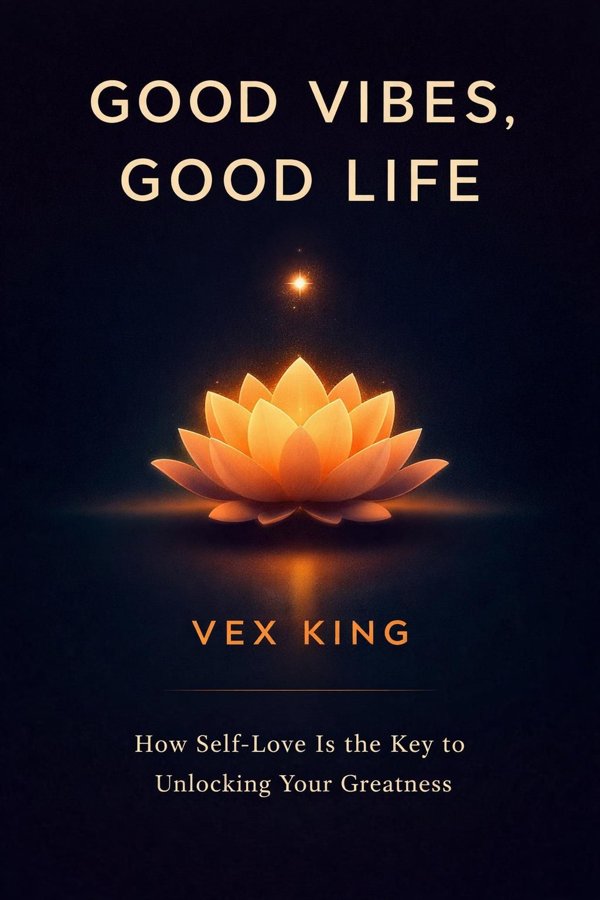
Good Vibes Good Life: Summary & Key Insights
by Vex King
 10 min10 chaptersAudio available
Key Takeaways from Good Vibes Good Life
In the book, energy is not treated as a vague mystical concept alone, but as the emotional and mental atmosphere created by your thoughts, intentions, habits, and attention.
Many people spend years chasing success, love, and validation while quietly believing they are not enough.
The mind often repeats old stories so convincingly that we mistake them for facts.
Two people can face the same event and walk away with entirely different interpretations, and King uses this reality to highlight the power of mindset.
What you pay attention to becomes the emotional texture of your life.
What Is Good Vibes Good Life About?
Good Vibes Good Life by Vex King is a self-help book published in 2018 spanning 10 pages. Good Vibes, Good Life by Vex King is a practical guide to building a better inner world so you can create a better outer life. At its core, the book argues that the quality of your thoughts, beliefs, habits, and relationships shapes the quality of your reality. Drawing on themes such as self-love, mindfulness, gratitude, healing, and manifestation, King shows how emotional energy influences confidence, choices, and long-term wellbeing. Rather than offering empty positivity, he connects spiritual ideas with everyday practices: noticing self-talk, setting boundaries, calming the mind, and acting in alignment with your goals. What makes the book resonate with so many readers is King’s personal credibility. He writes not as someone who avoided hardship, but as someone who lived through adversity, loss, discrimination, and insecurity, then consciously rebuilt his mindset and sense of self. His message is simple but powerful: you do not need perfect circumstances to begin transforming your life. You need awareness, self-respect, and consistent inner work. For readers seeking a gentle but motivating introduction to personal growth, Good Vibes, Good Life offers an accessible path toward emotional resilience and purposeful living.
This FizzRead summary covers all 10 key chapters of Good Vibes Good Life in approximately 10 minutes, distilling the most important ideas, arguments, and takeaways from Vex King's work. Also available as an audio summary and Key Quotes Podcast.
Good Vibes Good Life
Good Vibes, Good Life by Vex King is a practical guide to building a better inner world so you can create a better outer life. At its core, the book argues that the quality of your thoughts, beliefs, habits, and relationships shapes the quality of your reality. Drawing on themes such as self-love, mindfulness, gratitude, healing, and manifestation, King shows how emotional energy influences confidence, choices, and long-term wellbeing. Rather than offering empty positivity, he connects spiritual ideas with everyday practices: noticing self-talk, setting boundaries, calming the mind, and acting in alignment with your goals.
What makes the book resonate with so many readers is King’s personal credibility. He writes not as someone who avoided hardship, but as someone who lived through adversity, loss, discrimination, and insecurity, then consciously rebuilt his mindset and sense of self. His message is simple but powerful: you do not need perfect circumstances to begin transforming your life. You need awareness, self-respect, and consistent inner work. For readers seeking a gentle but motivating introduction to personal growth, Good Vibes, Good Life offers an accessible path toward emotional resilience and purposeful living.
Who Should Read Good Vibes Good Life?
This book is perfect for anyone interested in self-help and looking to gain actionable insights in a short read. Whether you're a student, professional, or lifelong learner, the key ideas from Good Vibes Good Life by Vex King will help you think differently.
- ✓Readers who enjoy self-help and want practical takeaways
- ✓Professionals looking to apply new ideas to their work and life
- ✓Anyone who wants the core insights of Good Vibes Good Life in just 10 minutes
Want the full summary?
Get instant access to this book summary and 100K+ more with Fizz Moment.
Get Free SummaryAvailable on App Store • Free to download
Key Chapters
Every room you enter already tells you something before a word is spoken, and Vex King builds on that intuitive truth: energy is always present, and it affects how we feel, think, and act. In the book, energy is not treated as a vague mystical concept alone, but as the emotional and mental atmosphere created by your thoughts, intentions, habits, and attention. According to King, everything vibrates at a frequency, including your emotions. Feelings such as peace, gratitude, and love elevate your state, while resentment, fear, and self-hatred pull you downward.
This idea matters because your internal state influences what you notice, how you respond, and the kinds of people and opportunities you move toward. When you wake up irritated, assume the worst, and feed negative thinking, you are more likely to interpret events through a pessimistic lens. By contrast, when you care for your mind, slow down, and choose empowering thoughts, you become more grounded and open. This does not mean difficult things stop happening. It means you meet life from a stronger place.
King encourages readers to become more conscious of what raises or drains their energy. That may include the media you consume, the people you spend time with, the way you speak to yourself, or the physical condition of your body and surroundings. For example, a cluttered room, doom-scrolling late at night, and constant comparison can leave you mentally heavy. A walk outside, a few minutes of stillness, and a conversation with someone supportive can shift your state.
The practical takeaway is to perform a daily energy audit. Ask yourself: What today lifted me, and what depleted me? Then reduce one draining influence and strengthen one uplifting habit.
Many people spend years chasing success, love, and validation while quietly believing they are not enough. King argues that this is the central wound behind much suffering, and that self-love is the foundation of all meaningful transformation. Self-love, in his view, is not arrogance, narcissism, or avoidance of growth. It is the decision to treat yourself with care, dignity, compassion, and honesty.
Without self-love, people accept poor treatment, sabotage opportunities, and build their lives around pleasing others. They look outward for worth instead of developing it inwardly. King explains that when you value yourself, your standards change. You become more selective with relationships, more patient with your healing, and more committed to habits that support your wellbeing. Self-love also helps you recover from mistakes faster because you stop using failure as proof of unworthiness.
Practically, self-love can look simple. It may mean speaking to yourself kindly after a hard day instead of criticizing yourself. It may mean resting when you are exhausted, saying no when something violates your boundaries, or investing in growth even when nobody is watching. It also means becoming aware of the ways you abandon yourself, such as constantly comparing your body, silencing your needs, or staying in environments that diminish you.
King’s message is that the relationship you have with yourself sets the tone for every other relationship in your life. If you constantly seek approval, you will shape-shift to be accepted. If you believe you matter, you will show up more authentically.
The actionable takeaway is to choose one daily self-love ritual, such as journaling, affirmations, intentional rest, or boundary-setting, and practice it consistently until self-respect becomes a habit rather than a mood.
The mind often repeats old stories so convincingly that we mistake them for facts. One of King’s most important insights is that many of our struggles are reinforced by limiting beliefs we absorbed from painful experiences, family patterns, social expectations, or repeated failure. Thoughts like “I’m not attractive enough,” “I always mess things up,” or “Success is for other people” do not remain harmless ideas; they become filters through which we interpret reality.
King emphasizes that negative self-talk is not just unpleasant. It actively shapes confidence, behavior, and outcomes. If you believe you are undeserving, you may hesitate to apply for opportunities, tolerate poor treatment, or avoid trying at all. In that way, the belief becomes self-fulfilling. The good news is that beliefs can be questioned, weakened, and replaced.
He encourages readers to first notice their inner dialogue without judgment. Awareness comes before change. Once you identify a recurring thought, ask where it came from and whether it is universally true. For example, someone who thinks “I’m always rejected” may be generalizing from a few painful experiences. Reframing does not mean lying to yourself with unrealistic positivity. It means building thoughts that are truthful and constructive, such as “Rejection hurts, but it does not define my value” or “I am learning to show up more confidently.”
This shift becomes more powerful when paired with action. If you want to become less socially anxious, challenge the belief that you are awkward and then practice small social interactions. If you think you are undisciplined, create one tiny daily commitment and keep it.
The takeaway is to write down one limiting belief, replace it with a healthier statement, and take one action this week that proves the old belief is not in control.
Two people can face the same event and walk away with entirely different interpretations, and King uses this reality to highlight the power of mindset. Mindset is the lens through which we understand ourselves and the world. It influences whether setbacks become evidence of defeat or invitations to grow. According to the book, life improves not only when circumstances change, but when the meaning we assign to them changes.
A disempowering mindset tends to personalize every difficulty, dwell on what is missing, and expect disappointment. An empowering mindset does not deny pain, but it looks for agency, lessons, and possibility. For example, losing a job can trigger thoughts such as “I’m a failure” or “This is painful, but it may push me toward work that suits me better.” The facts may be the same, yet the emotional and practical consequences of each interpretation are radically different.
King encourages readers to take responsibility for the narratives they feed. If you constantly tell yourself that life is unfair and people cannot be trusted, your choices will reflect defensiveness and fear. If you adopt a mindset of growth, patience, and openness, you are more likely to persevere and connect. This is especially important during difficult seasons, when the mind naturally seeks certainty and often defaults to negativity.
Cultivating mindset involves repeated mental training. It includes observing your reactions, reframing setbacks, consuming nourishing ideas, and surrounding yourself with people who support your growth. It may also involve replacing all-or-nothing thinking with nuance. A bad day is not a bad life. A delay is not a denial.
The practical takeaway is to catch one recurring negative interpretation this week and consciously ask, “What is another meaning I could give this experience that helps me move forward?”
What you pay attention to becomes the emotional texture of your life. King argues that gratitude and mindfulness are two of the simplest, most effective ways to shift your vibration because they train you to become present rather than trapped in lack, regret, or anxiety. Gratitude teaches you to notice what is already supportive, beautiful, or meaningful. Mindfulness teaches you to witness your thoughts and emotions without being ruled by them.
Gratitude is not pretending everything is perfect. It is choosing not to overlook what is still good. Even in stressful seasons, there may be health, friendship, shelter, lessons, or moments of peace worth acknowledging. This practice helps retrain the brain, which is naturally biased toward spotting threats and problems. Over time, gratitude can reduce emotional heaviness and create a sense of stability.
Mindfulness complements gratitude by helping you slow down. Much suffering comes not only from events themselves, but from the mind replaying the past or fearing the future. A mindful pause allows you to breathe, observe, and respond intentionally. If someone criticizes you, mindfulness creates space between the trigger and your reaction. If you feel overwhelmed, it helps you return to the present moment instead of spiraling.
King suggests bringing these practices into ordinary routines. You might begin the day by naming three things you appreciate, or take five conscious breaths before checking your phone. During a difficult conversation, you might notice tension in your body and soften your response. At night, you might reflect on one moment that brought joy, however small.
The actionable takeaway is to create a two-part daily ritual: spend one minute noticing your breath and one minute writing down three things you are grateful for. Small consistency creates deep emotional change.
The people around you influence your self-image more than you realize, and King stresses that healthy living requires healthy energetic alignment in relationships. This means your friendships, romantic partnerships, and social circles should support your peace, growth, and authenticity rather than constantly undermine them. Love is not just about chemistry or history; it is also about alignment in values, respect, and emotional responsibility.
Many people stay connected to draining dynamics out of guilt, loneliness, or the hope that others will change. King reminds readers that protecting your energy is not cruelty. It is wisdom. If someone repeatedly disrespects you, dismisses your feelings, manipulates your choices, or leaves you emotionally exhausted, their presence may be costing you more than their companionship is giving you. High-quality relationships are not perfect, but they feel safe, reciprocal, and growth-oriented.
King also points inward here. The relationships you accept often mirror the relationship you have with yourself. When self-worth is low, you may normalize mixed signals, overgiving, or emotional chaos. As self-love grows, so does your ability to choose better. Boundaries become easier because you no longer believe that being loved requires self-betrayal.
Practically, alignment can mean spending more time with people who inspire honesty and less time with those who thrive on drama. It can mean clearly communicating your needs instead of expecting mind-reading. It can also mean leaving spaces where you consistently shrink yourself to belong.
The actionable takeaway is to review your close relationships and ask: Do I feel expanded or diminished after spending time with this person? Use your answer to strengthen one boundary or deepen one nourishing connection.
Fear does not always shout; often it whispers through procrastination, overthinking, perfectionism, and self-doubt. King makes the important point that external negativity and internal fear can quietly run a person’s life if they are never challenged. Many people assume confidence means the absence of fear, but in reality confidence often grows when you act despite fear and stop treating discomfort as danger.
External negativity can come from critics, cynical peers, dismissive family members, or a culture that rewards comparison and panic. Internal negativity can come from your own harsh judgments and worst-case assumptions. King advises readers not to absorb every opinion or emotional atmosphere around them. If someone projects their insecurity onto you, that projection does not have to become your identity. Discernment is essential.
Responding wisely begins with emotional regulation. When fear rises, pause before reacting. Notice the story your mind is telling. Are you truly incapable, or simply uncomfortable? Are you being warned of real danger, or just stepping outside familiarity? In many cases, growth feels unsafe because it is new, not because it is wrong.
King’s approach is both compassionate and practical. Reduce exposure to people and environments that constantly lower your mood. Strengthen your inner voice through reflection, affirmations, and intentional action. Start small if needed. If fear tells you not to speak up, say one honest sentence. If negativity tells you your goals are unrealistic, take one concrete step anyway.
The takeaway is to identify one fear-based behavior in your life and interrupt it with a tiny act of courage. Repeated courage weakens fear’s authority.
One of the most popular themes in Good Vibes, Good Life is manifestation, but King presents it in a grounded way: you do not manifest through wishing alone, but through energetic and practical alignment. Your intentions matter, your beliefs matter, your emotional state matters, and your actions matter. In other words, manifestation is less about demanding outcomes from the universe and more about becoming the kind of person who can recognize, pursue, and sustain what they desire.
King suggests that when your thoughts are conflicted, your actions hesitant, and your self-worth low, it becomes difficult to move toward what you want. You may say you want love while tolerating disrespect, or say you want success while constantly reinforcing the belief that you are not capable. Alignment means reducing this contradiction. It means thinking, feeling, and behaving in ways that support your vision.
This often begins with clarity. Vague desires produce vague effort. Be specific about what you want and why. Then examine whether your daily habits match that intention. If you want greater peace, are you creating moments of stillness? If you want a healthier body, are your routines moving in that direction? If you want creative success, are you actually making time to create?
King also emphasizes trust and patience. Not everything arrives on your timeline, and forcing outcomes from desperation often leads to frustration. A calmer approach combines intention with openness. You do your part consistently, remain receptive, and avoid clinging to one rigid form.
The practical takeaway is to choose one goal, write down the belief, feeling, and behavior that best align with it, and practice all three each day for the next week.
A meaningful life is rarely built by copying what impresses other people. King argues that purpose emerges when you live in alignment with your authentic self rather than constantly performing for approval. Many people feel lost not because they lack talent, but because they have become disconnected from their values, desires, and inner guidance. They chase status, image, or external success, then wonder why achievement still feels empty.
Authenticity requires honesty. What genuinely matters to you? What kind of life feels peaceful, energizing, and true? What parts of yourself have you hidden to be accepted? King encourages readers to stop measuring their path against everyone else’s timeline. Comparison creates noise. Purpose becomes clearer when you become quiet enough to hear your own truth.
This does not mean purpose must be grand or dramatic. It may be expressed through how you work, create, love, help others, or carry yourself. For one person, purpose may involve public leadership. For another, it may involve healing, parenting, service, or artistry. The key is alignment: your choices should increasingly reflect your deepest values rather than your loudest fears.
Living authentically also demands courage because not everyone will understand your evolution. Some people are comfortable only with the version of you that was easier to control or predict. King reminds readers that pleasing everyone is incompatible with living truthfully. The more aligned you become, the more natural your confidence and peace will feel.
The actionable takeaway is to list your top three values and examine whether your current schedule, relationships, and goals reflect them. Then make one adjustment that brings your life into closer alignment with who you really are.
Transformation is rarely a dramatic overnight event; it is usually the result of small choices repeated long enough to reshape identity. King closes much of his teaching with this practical truth: maintaining good energy requires ongoing inner work. You do not heal once and never struggle again. You build tools, awareness, and habits that help you return to yourself whenever life becomes heavy.
This perspective matters because many people become discouraged when old fears, insecurities, or painful emotions reappear. They assume they have failed. King reframes growth as cyclical rather than linear. You may revisit lessons at deeper levels. A trigger does not erase your progress. It reveals where more compassion, boundaries, or understanding are needed.
Daily practice creates emotional resilience. This may include meditation, exercise, journaling, prayer, reading uplifting material, limiting toxic input, getting proper rest, and spending time in nature. The goal is not perfection but consistency. Even a five-minute habit can become an anchor if practiced regularly. The key is to choose rituals that support the person you want to become.
King also reminds readers to celebrate progress. Personal growth can become exhausting if you focus only on what still needs fixing. Notice where you have become calmer, wiser, or more self-aware. Respect the distance you have traveled.
The actionable takeaway is to build a simple personal growth routine with three non-negotiables you can realistically sustain, such as ten minutes of movement, five minutes of reflection, and one intentional boundary each day. Protect these practices as investments in your future self.
All Chapters in Good Vibes Good Life
About the Author
Vex King is a British author, mind coach, and motivational voice best known for his work on self-love, positive mindset, and emotional healing. He built a large global following by sharing accessible insights on personal growth, spirituality, and resilience through social media and public speaking. King’s writing is deeply shaped by his own life experience, including childhood adversity, loss, discrimination, and financial struggle. Rather than presenting personal development as abstract theory, he writes from lived experience, which gives his message warmth and credibility. His bestselling books have introduced many readers to topics such as mindfulness, manifestation, self-worth, and inner peace. Through his work, King encourages people to heal their relationship with themselves so they can create more meaningful, grounded, and fulfilling lives.
Get This Summary in Your Preferred Format
Read or listen to the Good Vibes Good Life summary by Vex King anytime, anywhere. FizzRead offers multiple formats so you can learn on your terms — all free.
Available formats: App · Audio · PDF · EPUB — All included free with FizzRead
Download Good Vibes Good Life PDF and EPUB Summary
Key Quotes from Good Vibes Good Life
“Every room you enter already tells you something before a word is spoken, and Vex King builds on that intuitive truth: energy is always present, and it affects how we feel, think, and act.”
“Many people spend years chasing success, love, and validation while quietly believing they are not enough.”
“The mind often repeats old stories so convincingly that we mistake them for facts.”
“Two people can face the same event and walk away with entirely different interpretations, and King uses this reality to highlight the power of mindset.”
“What you pay attention to becomes the emotional texture of your life.”
Frequently Asked Questions about Good Vibes Good Life
Good Vibes Good Life by Vex King is a self-help book that explores key ideas across 10 chapters. Good Vibes, Good Life by Vex King is a practical guide to building a better inner world so you can create a better outer life. At its core, the book argues that the quality of your thoughts, beliefs, habits, and relationships shapes the quality of your reality. Drawing on themes such as self-love, mindfulness, gratitude, healing, and manifestation, King shows how emotional energy influences confidence, choices, and long-term wellbeing. Rather than offering empty positivity, he connects spiritual ideas with everyday practices: noticing self-talk, setting boundaries, calming the mind, and acting in alignment with your goals. What makes the book resonate with so many readers is King’s personal credibility. He writes not as someone who avoided hardship, but as someone who lived through adversity, loss, discrimination, and insecurity, then consciously rebuilt his mindset and sense of self. His message is simple but powerful: you do not need perfect circumstances to begin transforming your life. You need awareness, self-respect, and consistent inner work. For readers seeking a gentle but motivating introduction to personal growth, Good Vibes, Good Life offers an accessible path toward emotional resilience and purposeful living.
More by Vex King

You Might Also Like


Featured In
Browse by Category
Ready to read Good Vibes Good Life?
Get the full summary and 100K+ more books with Fizz Moment.