
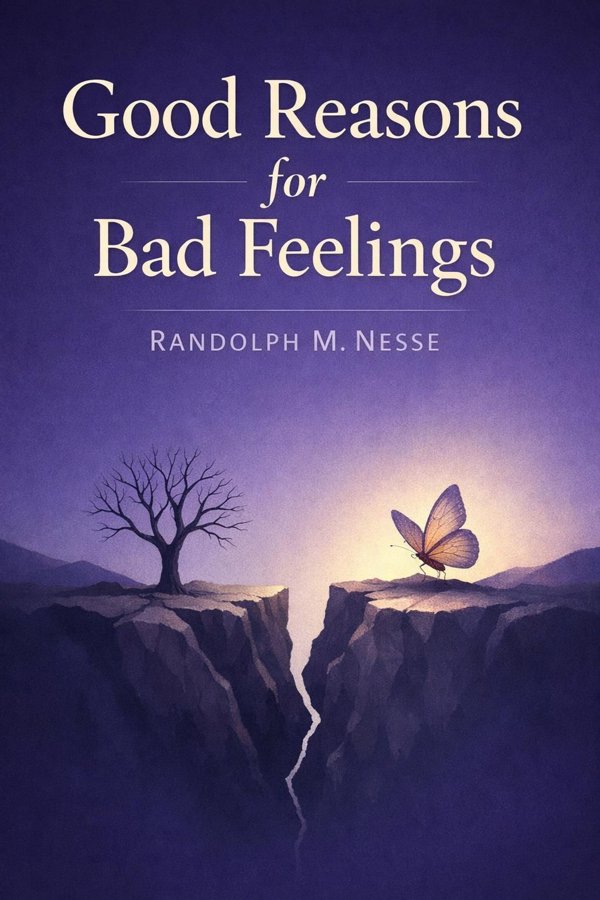
Good Reasons for Bad Feelings: Insights from the Frontier of Evolutionary Psychiatry: Summary & Key Insights
 10 min10 chaptersAudio available
What Is Good Reasons for Bad Feelings: Insights from the Frontier of Evolutionary Psychiatry About?
Good Reasons for Bad Feelings: Insights from the Frontier of Evolutionary Psychiatry by Randolph M. Nesse is a mental_health book spanning 10 pages. In this groundbreaking work, psychiatrist and evolutionary biologist Randolph M. Nesse explores why natural selection has left us vulnerable to mental disorders. Drawing on decades of research, Nesse argues that many psychological conditions—such as anxiety, depression, and addiction—can be better understood as evolutionary adaptations gone awry. By examining the evolutionary roots of emotions and mental health, the book offers a new framework for understanding the human mind and improving psychiatric care.
This FizzRead summary covers all 10 key chapters of Good Reasons for Bad Feelings: Insights from the Frontier of Evolutionary Psychiatry in approximately 10 minutes, distilling the most important ideas, arguments, and takeaways from Randolph M. Nesse's work. Also available as an audio summary and Key Quotes Podcast.
Good Reasons for Bad Feelings: Insights from the Frontier of Evolutionary Psychiatry
In this groundbreaking work, psychiatrist and evolutionary biologist Randolph M. Nesse explores why natural selection has left us vulnerable to mental disorders. Drawing on decades of research, Nesse argues that many psychological conditions—such as anxiety, depression, and addiction—can be better understood as evolutionary adaptations gone awry. By examining the evolutionary roots of emotions and mental health, the book offers a new framework for understanding the human mind and improving psychiatric care.
Who Should Read Good Reasons for Bad Feelings: Insights from the Frontier of Evolutionary Psychiatry?
This book is perfect for anyone interested in mental_health and looking to gain actionable insights in a short read. Whether you're a student, professional, or lifelong learner, the key ideas from Good Reasons for Bad Feelings: Insights from the Frontier of Evolutionary Psychiatry by Randolph M. Nesse will help you think differently.
- ✓Readers who enjoy mental_health and want practical takeaways
- ✓Professionals looking to apply new ideas to their work and life
- ✓Anyone who wants the core insights of Good Reasons for Bad Feelings: Insights from the Frontier of Evolutionary Psychiatry in just 10 minutes
Want the full summary?
Get instant access to this book summary and 100K+ more with Fizz Moment.
Get Free SummaryAvailable on App Store • Free to download
Key Chapters
When I first began to ask evolutionary questions about psychiatry, I realized that medicine had overlooked something fundamental: every part of the human body—every organ, every emotion—exists because it conferred some advantage in our evolutionary past. Natural selection shapes traits that help individuals survive and reproduce. But that same process, by its very nature, also creates vulnerabilities. The human eye is a marvel, yet its design leaves a blind spot. Similarly, our minds have evolved capacities for imagination, empathy, and moral judgment, but they carry trade-offs that expose us to pain.
An evolutionary perspective reveals that emotions are products of natural selection precisely because they regulate behavior in adaptive ways. Fear keeps us from danger; disgust shields us from toxins; love sustains bonds essential to offspring survival. However, evolution cannot anticipate every environmental shift. What once served us well may now malfunction under conditions far different from those for which it was designed. This is not a flaw in evolution—it is its consequence.
Consider anxiety. In ancestral environments, overreacting to a rustle that might be a predator was safer than ignoring it and becoming a meal. Natural selection thus favored mechanisms that tend toward caution and arousal. The same system in today’s world—a world of constant stimuli and abstract threats—can readily overshoot, resulting in chronic anxiety or panic. Vulnerability is not evidence of poor design; it marks the limits of adaptive logic.
Evolutionary thinking also clarifies why genetic variation that predisposes to mental illness persists. No gene is purely good or bad; many carry trade-offs. The same genetic tendencies that make one individual intensely anxious may also make them vigilant and successful in certain contexts. Likewise, low mood can conserve energy and prompt reassessment of futile efforts, though it becomes depression when it sinks too deep or lasts too long. Evolution works on averages, not perfections.
Seeing psychiatry through this lens frees us from the assumption that suffering simply means malfunction. Instead, it suggests that what we call disorders may be exaggerated or mistimed defenses, misfires of otherwise useful mechanisms. Understanding that principle changes everything—from diagnosis to empathy.
Emotions have always puzzled scientists: they can feel irrational, yet drive the most vital decisions of life. From an evolutionary standpoint, they are functional systems designed to solve specific adaptive problems. Fear prepares the body for escape; anger mobilizes defense; sadness signals loss and prompts withdrawal; joy reinforces beneficial behaviors. Each emotion evolved because it adjusted the organism’s behavior in ways that increased survival and reproduction.
To appreciate this, one must think of emotions not as moods floating freely but as mechanisms with triggers, outputs, and purposes. Fear is not merely a feeling—it is an integrated program activating heart rate, attention, and learning, all in service of safety. But natural selection optimizes for reproductive success, not happiness. Thus, emotions do not always make us feel good; they make us respond adaptively.
When these systems fire in the wrong circumstances, problems arise. The same anger that helped our ancestors defend resources can become destructive in modern workplaces. The sadness that once signaled when to give up unattainable goals can turn pathological in a world where relentless social comparison magnifies perceived failure. Our feelings have ancient logic, but modern triggers.
Evolutionary psychiatry reframes emotions as signals—not errors. When they become persistent or disabling, the clinician's task is to ask: what system might be malfunctioning, and why? Is the individual’s environment provoking a malfunction through constant stress or mismatch? Understanding emotions as adaptive systems allows us to ask more useful questions than ‘what’s wrong with you?’ It directs us toward ‘what purpose might this feeling once have served, and why is it misfiring now?’
This perspective does not trivialize suffering; it grounds it. We begin to see that, far from being broken, our emotional machinery is simply overwhelmed or mistuned for modern life.
+ 8 more chapters — available in the FizzRead app
All Chapters in Good Reasons for Bad Feelings: Insights from the Frontier of Evolutionary Psychiatry
About the Author
Randolph M. Nesse is an American psychiatrist and evolutionary biologist, known for his pioneering work in evolutionary medicine. He is a founding member of the field and co-author of 'Why We Get Sick'. Nesse has served as a professor at the University of Michigan and Arizona State University, where he continues to research the evolutionary origins of emotions and mental disorders.
Get This Summary in Your Preferred Format
Read or listen to the Good Reasons for Bad Feelings: Insights from the Frontier of Evolutionary Psychiatry summary by Randolph M. Nesse anytime, anywhere. FizzRead offers multiple formats so you can learn on your terms — all free.
Available formats: App · Audio · PDF · EPUB — All included free with FizzRead
Download Good Reasons for Bad Feelings: Insights from the Frontier of Evolutionary Psychiatry PDF and EPUB Summary
Key Quotes from Good Reasons for Bad Feelings: Insights from the Frontier of Evolutionary Psychiatry
“Natural selection shapes traits that help individuals survive and reproduce.”
“Emotions have always puzzled scientists: they can feel irrational, yet drive the most vital decisions of life.”
Frequently Asked Questions about Good Reasons for Bad Feelings: Insights from the Frontier of Evolutionary Psychiatry
Good Reasons for Bad Feelings: Insights from the Frontier of Evolutionary Psychiatry by Randolph M. Nesse is a mental_health book that explores key ideas across 10 chapters. In this groundbreaking work, psychiatrist and evolutionary biologist Randolph M. Nesse explores why natural selection has left us vulnerable to mental disorders. Drawing on decades of research, Nesse argues that many psychological conditions—such as anxiety, depression, and addiction—can be better understood as evolutionary adaptations gone awry. By examining the evolutionary roots of emotions and mental health, the book offers a new framework for understanding the human mind and improving psychiatric care.
You Might Also Like
Big Feelings: How to Be Okay When Things Are Not Okay
Liz Fosslien, Mollie West Duffy
10 min
Creative Arts Therapies Handbook: Art, Music and Dance Therapy Practices for Wellbeing
Susan I. Buchalter
10 min
Emotional First Aid: Healing Rejection, Guilt, Failure, and Other Everyday Hurts
Guy Winch
10 min
Lost Connections: Why You're Depressed and How to Find Hope
Johann Hari
10 min
No Time to Panic: How to Stop Worrying and Embrace Life
Matt Gutman
10 min
Overcoming Mobbing: A Recovery Guide for Workplace Aggression and Bullying
Maureen Duffy, Len Sperry
10 minBrowse by Category
Ready to read Good Reasons for Bad Feelings: Insights from the Frontier of Evolutionary Psychiatry?
Get the full summary and 100K+ more books with Fizz Moment.