
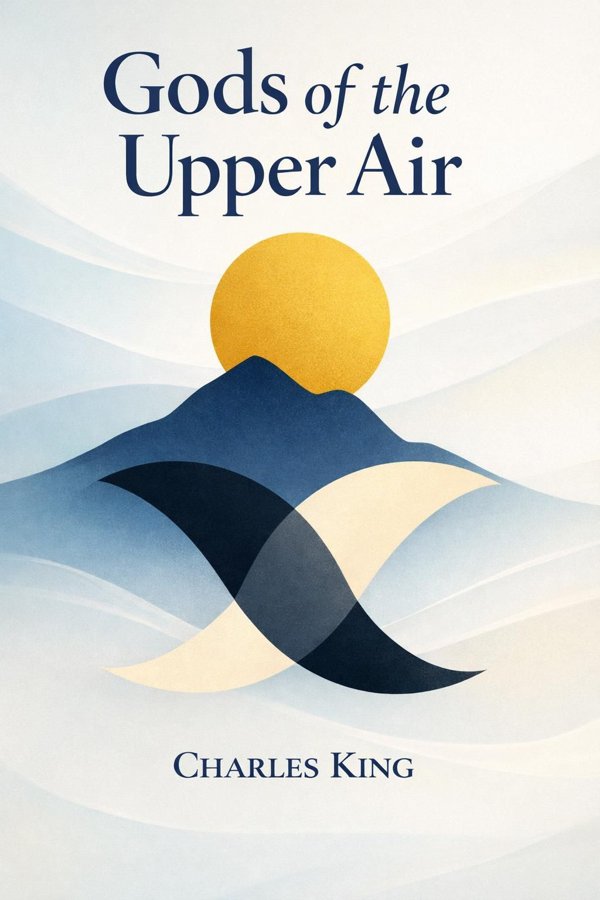
Gods of the Upper Air: How a Circle of Renegade Anthropologists Reinvented Race, Sex, and Gender in the Twentieth Century: Summary & Key Insights
by Charles King
 10 min5 chaptersAudio available
What Is Gods of the Upper Air: How a Circle of Renegade Anthropologists Reinvented Race, Sex, and Gender in the Twentieth Century About?
Gods of the Upper Air: How a Circle of Renegade Anthropologists Reinvented Race, Sex, and Gender in the Twentieth Century by Charles King is a biographies book spanning 5 pages. A narrative history exploring how a group of pioneering anthropologists, led by Franz Boas and including figures such as Margaret Mead and Ruth Benedict, challenged prevailing ideas about race, sex, and culture in the twentieth century. The book traces their intellectual and personal journeys, showing how their work reshaped modern understandings of human diversity and equality.
This FizzRead summary covers all 5 key chapters of Gods of the Upper Air: How a Circle of Renegade Anthropologists Reinvented Race, Sex, and Gender in the Twentieth Century in approximately 10 minutes, distilling the most important ideas, arguments, and takeaways from Charles King's work. Also available as an audio summary and Key Quotes Podcast.
Gods of the Upper Air: How a Circle of Renegade Anthropologists Reinvented Race, Sex, and Gender in the Twentieth Century
A narrative history exploring how a group of pioneering anthropologists, led by Franz Boas and including figures such as Margaret Mead and Ruth Benedict, challenged prevailing ideas about race, sex, and culture in the twentieth century. The book traces their intellectual and personal journeys, showing how their work reshaped modern understandings of human diversity and equality.
Who Should Read Gods of the Upper Air: How a Circle of Renegade Anthropologists Reinvented Race, Sex, and Gender in the Twentieth Century?
This book is perfect for anyone interested in biographies and looking to gain actionable insights in a short read. Whether you're a student, professional, or lifelong learner, the key ideas from Gods of the Upper Air: How a Circle of Renegade Anthropologists Reinvented Race, Sex, and Gender in the Twentieth Century by Charles King will help you think differently.
- ✓Readers who enjoy biographies and want practical takeaways
- ✓Professionals looking to apply new ideas to their work and life
- ✓Anyone who wants the core insights of Gods of the Upper Air: How a Circle of Renegade Anthropologists Reinvented Race, Sex, and Gender in the Twentieth Century in just 10 minutes
Want the full summary?
Get instant access to this book summary and 100K+ more with Fizz Moment.
Get Free SummaryAvailable on App Store • Free to download
Key Chapters
Franz Boas was born in 1858 in Germany, a product of the age of positivism and Darwinian enthusiasm. Yet even as a young man drawn to the natural sciences, he grew skeptical of easy generalizations. His early expeditions to Baffin Island and the Northwest Coast introduced him to the complexity of human experience unmatched by the racial typologies circulating in Europe. Measuring ice thickness or the cultural patterns of the Inuit, Boas realized that environment could not explain all differences among people. His data undermined deterministic accounts of culture.
When Boas emigrated to the United States, he entered an intellectual environment enthralled with eugenic thinking. Race was treated as the primary determinant of intelligence, morality, and even capacity for civilization. Anthropology itself, in its early American form, served as a handmaiden to colonial ideologies, organizing museums to tell triumphalist stories of progress from savage to civilized. Boas turned anthropology on its head. He urged that every culture must be studied on its own terms—what would come to be known as cultural relativism. He rejected the notion of universal hierarchies, insisting that customs and behaviors must be understood within their particular social and historical contexts.
Boas’s lectures at Columbia University became rallying points for a generation of young scholars searching for alternatives to orthodoxy. To them, Boas offered more than method; he offered moral rebellion. In his view, the scientist’s responsibility was to respect the intrinsic worth of all peoples, to dismantle the pseudoscientific justifications for imperialism and racial prejudice. This stance would isolate him in some circles, but it laid the intellectual foundations for the redefinition of human equality. His insistence that race was a social rather than biological construct anticipated later civil rights discourse and transformed anthropology from a colonial enterprise into an ethical one.
Ruth Benedict entered Boas’s seminar with a background steeped in literature and philosophy. The daughter of a scholarly family, she found in anthropology a language through which to reconcile her introspection with public meaning. Her seminal work, *Patterns of Culture*, argued that each society selects certain traits from the vast spectrum of human potential and builds a coherent moral universe around them. To Benedict, diversity was not chaos but design—the unique configurations of thought and behavior that make cultures distinct.
In a world where biology was believed to determine destiny, Benedict’s message was liberation. She showed that what Westerners called normal or abnormal varied radically across societies, that morality itself was a cultural artifact. In exploring tribes such as the Pueblo Indians and the Kwakiutl, she illustrated that restraint or flamboyance, modesty or ambition, were not directly linked to social evolution but to each culture’s historical habits and philosophies.
Her work resonated far beyond academia. During World War II, Benedict’s anthropological insights informed American efforts to understand Japan, culminating in her study *The Chrysanthemum and the Sword.* Without ever setting foot in Japan, Benedict translated cultural pattern into empathy—an act of intellectual diplomacy that embodied Boas’s legacy of understanding rather than judgment.
Through Benedict’s writings, anthropology gained a poetic voice. She envisioned humanity as a tapestry woven from multiple designs, none superior to another. Her tone was both analytical and lyrical, reminding readers that to grasp culture is to embrace the infinite creativity of the human mind. In her hands, anthropology became a moral art—a discipline devoted not simply to knowledge but to wisdom.
+ 3 more chapters — available in the FizzRead app
All Chapters in Gods of the Upper Air: How a Circle of Renegade Anthropologists Reinvented Race, Sex, and Gender in the Twentieth Century
About the Author
Charles King is a professor of international affairs and government at Georgetown University. He is known for his works on history, politics, and culture, and has received several awards for his writing, including the Francis Parkman Prize. His research often focuses on the intersection of anthropology, history, and social change.
Get This Summary in Your Preferred Format
Read or listen to the Gods of the Upper Air: How a Circle of Renegade Anthropologists Reinvented Race, Sex, and Gender in the Twentieth Century summary by Charles King anytime, anywhere. FizzRead offers multiple formats so you can learn on your terms — all free.
Available formats: App · Audio · PDF · EPUB — All included free with FizzRead
Download Gods of the Upper Air: How a Circle of Renegade Anthropologists Reinvented Race, Sex, and Gender in the Twentieth Century PDF and EPUB Summary
Key Quotes from Gods of the Upper Air: How a Circle of Renegade Anthropologists Reinvented Race, Sex, and Gender in the Twentieth Century
“Franz Boas was born in 1858 in Germany, a product of the age of positivism and Darwinian enthusiasm.”
“Ruth Benedict entered Boas’s seminar with a background steeped in literature and philosophy.”
Frequently Asked Questions about Gods of the Upper Air: How a Circle of Renegade Anthropologists Reinvented Race, Sex, and Gender in the Twentieth Century
Gods of the Upper Air: How a Circle of Renegade Anthropologists Reinvented Race, Sex, and Gender in the Twentieth Century by Charles King is a biographies book that explores key ideas across 5 chapters. A narrative history exploring how a group of pioneering anthropologists, led by Franz Boas and including figures such as Margaret Mead and Ruth Benedict, challenged prevailing ideas about race, sex, and culture in the twentieth century. The book traces their intellectual and personal journeys, showing how their work reshaped modern understandings of human diversity and equality.
You Might Also Like

An American Marriage
Tayari Jones
10 min
Benjamin Franklin: An American Life
Walter Isaacson
10 min
I Know Why The Caged Bird Sings
Maya Angelou
10 min
Long Walk to Freedom
Nelson Mandela
10 min
Persepolis
Marjane Satrapi
10 min
Surely You're Joking, Mr. Feynman!
Richard P. Feynman
10 minBrowse by Category
Ready to read Gods of the Upper Air: How a Circle of Renegade Anthropologists Reinvented Race, Sex, and Gender in the Twentieth Century?
Get the full summary and 100K+ more books with Fizz Moment.