
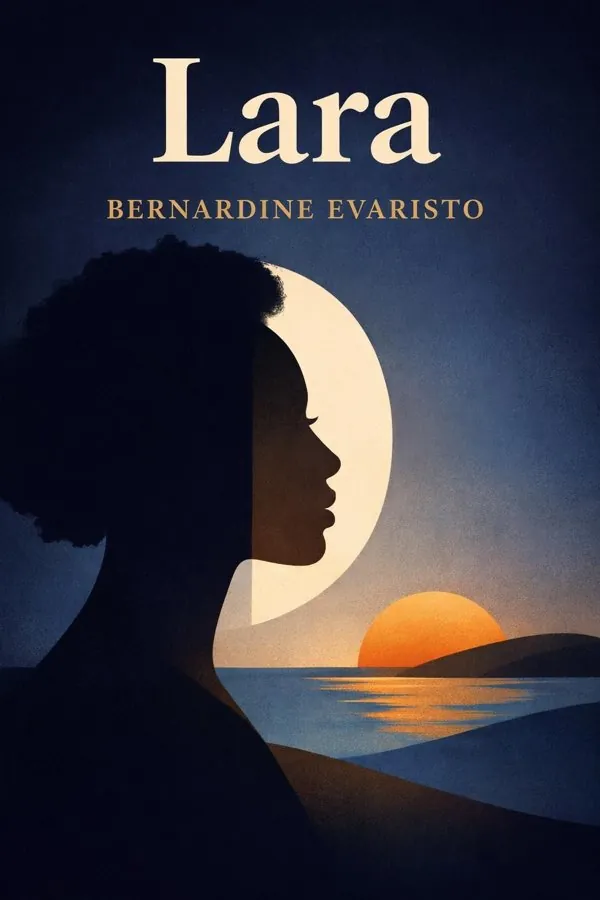
Lara: Summary & Key Insights
 10 min8 chaptersAudio available
Key Takeaways from Lara
Identity often begins not with certainty, but with contradiction.
To understand a child, we often need to understand the dreams that arrived before them.
Family history is often preserved not only in what is told, but in what is carefully avoided.
Becoming yourself often starts with noticing the scripts that do not fit.
A family tree is never just personal; it is also historical.
What Is Lara About?
Lara by Bernardine Evaristo is a classics book spanning 7 pages. Bernardine Evaristo’s Lara is a daring, lyrical novel in verse that turns family history into a living map of identity. Following Lara, a young woman of mixed heritage growing up in London, the book moves across generations and geographies—England, Nigeria, Brazil, Germany, and beyond—to show how one life is shaped by many inherited stories. What begins as a portrait of childhood and adolescence becomes a deeper meditation on race, migration, class, memory, and belonging. Lara is not simply asking where its heroine comes from; it is asking how personal identity is made out of fragments, silences, and survival. The novel matters because it gives language to experiences that traditional family sagas often flatten or overlook: mixed-race identity, diasporic lineage, and the emotional cost of moving between cultures. Evaristo’s verse form brings urgency, intimacy, and musicality to this search for self. Long before she won the Booker Prize for Girl, Woman, Other, Evaristo was already expanding what British literature could contain and how it could sound. Lara remains one of her most personal and inventive works—a powerful exploration of ancestry, estrangement, and the hard-won freedom of self-definition.
This FizzRead summary covers all 8 key chapters of Lara in approximately 10 minutes, distilling the most important ideas, arguments, and takeaways from Bernardine Evaristo's work. Also available as an audio summary and Key Quotes Podcast.
Lara
Bernardine Evaristo’s Lara is a daring, lyrical novel in verse that turns family history into a living map of identity. Following Lara, a young woman of mixed heritage growing up in London, the book moves across generations and geographies—England, Nigeria, Brazil, Germany, and beyond—to show how one life is shaped by many inherited stories. What begins as a portrait of childhood and adolescence becomes a deeper meditation on race, migration, class, memory, and belonging. Lara is not simply asking where its heroine comes from; it is asking how personal identity is made out of fragments, silences, and survival.
The novel matters because it gives language to experiences that traditional family sagas often flatten or overlook: mixed-race identity, diasporic lineage, and the emotional cost of moving between cultures. Evaristo’s verse form brings urgency, intimacy, and musicality to this search for self. Long before she won the Booker Prize for Girl, Woman, Other, Evaristo was already expanding what British literature could contain and how it could sound. Lara remains one of her most personal and inventive works—a powerful exploration of ancestry, estrangement, and the hard-won freedom of self-definition.
Who Should Read Lara?
This book is perfect for anyone interested in classics and looking to gain actionable insights in a short read. Whether you're a student, professional, or lifelong learner, the key ideas from Lara by Bernardine Evaristo will help you think differently.
- ✓Readers who enjoy classics and want practical takeaways
- ✓Professionals looking to apply new ideas to their work and life
- ✓Anyone who wants the core insights of Lara in just 10 minutes
Want the full summary?
Get instant access to this book summary and 100K+ more with Fizz Moment.
Get Free SummaryAvailable on App Store • Free to download
Key Chapters
Identity often begins not with certainty, but with contradiction. In Lara, childhood is shaped by the feeling of being formed by several worlds at once and fully claimed by none of them. Lara grows up in London in a family marked by cultural collision: a Nigerian father with high expectations and fierce discipline, an English mother carrying her own family inheritance of restraint and difficulty, and a wider society that does not know how to receive difference without suspicion. Her earliest life is not framed as a simple coming-of-age story, but as an education in decoding mixed messages—about race, class, belonging, behavior, and love.
Evaristo shows that growing up "between worlds" is not merely a social fact; it is a psychological condition. Lara must learn how to read rooms, how to interpret what is spoken and what is withheld, and how to survive the pressures of fitting in while remaining true to a self that is still forming. The family home is one site of tension, but school, the street, and public institutions reinforce the same lesson: identity is negotiated under pressure. What makes this portrayal powerful is that Evaristo refuses to treat mixed heritage as a slogan. Instead, she shows its texture—confusion, pride, shame, curiosity, and resilience all existing at once.
In practical terms, this idea helps readers think about how early environments shape self-understanding. Many people, even outside Lara’s specific context, know what it means to code-switch, mediate between family expectations and public roles, or feel that different parts of themselves are activated in different spaces. Evaristo invites us to take those experiences seriously rather than dismiss them as personal awkwardness.
Actionable takeaway: Reflect on the worlds that shaped you—family, school, neighborhood, culture—and write down the conflicting messages they gave you about who you should be.
To understand a child, we often need to understand the dreams that arrived before them. One of Lara’s deepest inheritances comes through her father, whose journey from Nigeria to postwar Britain carries ambition, pride, dislocation, and disappointment. He does not arrive as a passive figure in someone else’s nation-building story. He comes with a sense of purpose, with education and aspiration, believing Britain offers opportunity and recognition. Yet the reality he encounters is harsher: racism, exclusion, misunderstanding, and the daily diminishment that comes from being seen as an outsider.
Evaristo presents him as neither villain nor hero, but as a complex man shaped by both conviction and injury. His authority within the family is connected to his experiences in a society that repeatedly denies him dignity. His strictness, ego, and emotional limitations are not excused, but they are contextualized. This matters because Lara’s father is more than a private parent figure—he represents the burden many migrants carry when they must reinvent themselves in hostile conditions while trying to preserve self-respect. His disappointments become part of the atmosphere Lara breathes.
The broader concept here is intergenerational transmission. Families pass down not only values and stories, but wounds, coping mechanisms, and unrealized hopes. A parent’s migration story can shape a child’s emotional landscape even when many details remain unspoken. Readers may recognize this in families where sacrifice becomes expectation, where education is treated as redemption, or where tenderness is hidden behind discipline because survival once required hardness.
In everyday life, this insight encourages a more layered view of authority figures. Instead of seeing only rigidity or distance, we can ask what historical pressures produced them. Understanding does not erase harm, but it can clarify it.
Actionable takeaway: Ask an older family member about a major move, sacrifice, or disappointment in their life, and notice how that story may still influence the family today.
Family history is often preserved not only in what is told, but in what is carefully avoided. Lara’s maternal line reveals another side of inheritance: Englishness shaped by class anxiety, emotional restraint, buried tensions, and the quiet rules that govern what may be spoken aloud. If the father’s history is marked by visible migration and ambition, the mother’s lineage carries subtler but equally powerful legacies—social aspiration, repression, domestic strain, and the tendency to manage pain through silence.
Evaristo shows that English identity is not neutral or simple. It is structured by class position, by assumptions about propriety, by half-hidden shame, and by the fear of social exposure. Through Lara’s mother and maternal ancestors, the novel explores how families can appear ordinary while carrying generations of unresolved difficulty. Silence becomes a form of order. Emotions are managed rather than examined. Histories are edited to protect appearances. For Lara, this means that one half of her heritage is not merely "white" or "British"; it is a highly specific cultural inheritance with its own codes and constraints.
This is an important corrective to the idea that only migrant families have complicated histories. Evaristo reveals that every lineage contains fractures. Some are named through displacement and colonial history; others are hidden inside domestic normality. Readers can apply this insight by looking more carefully at the inherited habits in their own families: indirect communication, embarrassment around money, discomfort with affection, or avoidance of painful truths. These patterns are historical, not random.
The practical value of this key idea lies in recognizing that silence is not emptiness. It communicates priorities, fears, and loyalties. Once seen, these patterns can be interrupted. Healthy family understanding often begins when someone is willing to ask the question no one else asks.
Actionable takeaway: Identify one topic your family tends to avoid, and consider how that silence has shaped your beliefs, relationships, or emotional habits.
Becoming yourself often starts with noticing the scripts that do not fit. In Lara, adolescence is not merely a phase of rebellion; it is the beginning of artistic and personal self-creation. As Lara grows older, she becomes increasingly alert to the contradictions surrounding her—racial expectations, gender roles, family pressures, and the narrow categories others use to define her. She feels difference not just as discomfort, but as a source of perception. What isolates her also sharpens her attention.
Evaristo traces the development of a young woman learning to convert observation into voice. This is crucial because the novel suggests that creativity is not decorative; it is a survival tool. For someone whose identity is constantly interpreted by others, storytelling becomes a way to resist simplification. Lara’s emerging artistic consciousness allows her to hold complexity rather than collapse into one imposed version of herself. Her movement toward voice is also a movement toward agency.
This idea speaks far beyond literature. Many readers know what it means to outgrow the roles assigned in childhood—the obedient daughter, the high-achieving student, the outsider, the peacemaker, the troublemaker. Adolescence often becomes the first period when those inherited labels are tested. Journaling, art, music, and reading can become methods of self-definition, especially for those who feel unseen in mainstream narratives. Evaristo reminds us that finding a voice does not mean becoming instantly confident. It means beginning to trust your own interpretation of your life.
In practical terms, this chapter encourages readers to treat creativity as a legitimate mode of inquiry. Writing, drawing, or even private reflection can reveal patterns that conversation alone cannot. Voice develops through practice, not permission.
Actionable takeaway: Start a simple weekly writing habit—ten minutes of uncensored reflection—to notice which parts of your life feel most urgent, constrained, or ready to be named.
A family tree is never just personal; it is also historical. One of the most striking aspects of Lara is the way it expands beyond Britain and Nigeria to include Brazil and other transatlantic routes, revealing a lineage shaped by colonialism, slavery, migration, and cultural mixing. Evaristo refuses the tidy idea of heritage as a single origin. Instead, ancestry appears as movement—forced, chosen, fragmented, and partially recoverable. Lara’s identity is made from crossings, not roots alone.
This broader genealogical vision matters because it places one woman’s life inside world history. The novel asks readers to see that race and belonging are not abstract themes; they are the afterlives of empire, trade, coercion, intimacy, and survival. Family history becomes a record of how large systems enter individual bodies and homes. By tracing these bloodlines, Evaristo honors people who might otherwise disappear from official narratives. The book suggests that recovering ancestry is not an exercise in nostalgia, but an act of restoration.
For modern readers, this has obvious relevance. Many people inherit incomplete histories due to migration, slavery, adoption, secrecy, or lost records. DNA tests and genealogy websites may provide clues, but Lara reminds us that the meaning of ancestry exceeds data. What matters is not only who your ancestors were, but what structures shaped their options and what emotional residue remains in descendants. Understanding those histories can deepen empathy and sharpen political awareness.
A practical application is to approach family research with both curiosity and humility. Some gaps may never be filled. Yet even partial knowledge can alter self-understanding by connecting personal experience to larger historical currents. Evaristo models a way of looking backward that is imaginative, critical, and emotionally honest.
Actionable takeaway: Trace one branch of your family back as far as you can, and pair the names you find with the historical events that likely shaped their lives.
Sometimes we understand home only after leaving it. As Lara matures, travel and adult relationships expand her perspective, allowing her to revisit family and identity with more complexity. Distance becomes clarifying. What once felt only oppressive or confusing can now be seen in relation to history, geography, and emotional need. This does not mean Lara suddenly resolves every conflict; rather, she develops the ability to hold contradiction without being consumed by it.
Evaristo uses movement—across cities, countries, and emotional states—to show that self-knowledge is relational. Encounters with lovers, new places, and unfamiliar cultural environments force Lara to test what she carries from home and what she is ready to release. Travel is not romanticized as easy liberation. It can unsettle, expose ignorance, and intensify loneliness. Yet it also opens a wider frame. Lara begins to understand that reconciliation is not the same as approval. She can seek connection with her origins without surrendering critical judgment.
This is a valuable life lesson. Many people imagine healing as a final conversation, a dramatic apology, or a single breakthrough. Lara suggests something subtler: reconciliation often happens gradually through reinterpretation. We revisit the past from a different age, after different experiences, and discover meanings that were impossible to see before. Love also plays a role here, not as a cure-all, but as a mirror that reveals both vulnerability and pattern.
Readers can apply this insight by noticing how new environments change their sense of self. Studying abroad, moving cities, entering a serious relationship, or spending time away from family can reveal how much of our identity is inherited performance. Growth often requires a change in context.
Actionable takeaway: Revisit one painful family memory from your current perspective and ask what you understand now that your younger self could not have seen.
We do not become whole by erasing the past, but by learning how to live with its fragments. In Lara, memory is not presented as a clean archive. It is partial, emotional, selective, and often unstable. Yet this instability does not weaken the story; it makes it truer. Evaristo shows that personal history is assembled from recollection, imagination, inherited anecdote, and recovered fact. The self emerges through this act of composition.
What gives the novel its emotional force is the sense that continuity is created, not simply discovered. Lara cannot return to a pure origin or uncover a perfectly coherent identity. Instead, she learns to accept multiplicity: conflicting ancestors, mixed cultures, unresolved family dynamics, and the tension between pain and love. Self-acceptance here is not a slogan about confidence. It is a mature willingness to stop demanding impossible simplicity from one’s life story.
This idea has practical significance in an era obsessed with neat personal branding and fixed identity labels. Many readers feel pressure to summarize themselves quickly and cleanly. Lara resists that demand. It argues, through form and content, that a life may be truthful precisely because it is layered. Memory can be an instrument of healing when we use it to understand rather than to idealize. Even difficult family legacies can become sources of insight once they are named and placed in context.
One useful application is reflective life mapping: listing key family stories, places, ruptures, and turning points to see patterns over time. This helps transform diffuse feeling into narrative awareness. The goal is not to solve yourself, but to recognize the continuity beneath apparent fragmentation.
Actionable takeaway: Create a one-page timeline of your life and family influences, then note where pain, pride, silence, and transformation intersect.
Sometimes a fragmented life can only be told in a fragmented form. One of Lara’s most important achievements is formal: Bernardine Evaristo writes the novel in verse, using poetic rhythms, compression, and momentum to mirror the movement of memory and identity. This choice is not ornamental. The form allows sudden shifts in time, tone, place, and perspective, making it possible to hold generations together without flattening their differences. The story breathes, leaps, and circles back the way memory does.
The verse form also intensifies emotion without relying on melodrama. A line break can carry hesitation, shock, irony, or grief more effectively than exposition. Evaristo’s style creates intimacy while preserving complexity. Readers are invited to feel history in the body of the language: its cadences, pressures, repetitions, and silences. In this sense, the novel’s structure becomes part of its argument. Conventional linear storytelling might suggest that identity develops in orderly steps. Lara’s verse insists that selfhood is recursive, rhythmic, and made from echoes.
For readers and writers alike, this offers a practical lesson in choosing forms that fit lived experience. Not every story should be told as a straightforward chronology. If your memories come in flashes, scenes, or images, a fragmented or poetic approach may capture them more honestly. In broader terms, Evaristo demonstrates that experimentation can increase accessibility when it serves emotional truth. The form helps readers enter a complex family history through feeling as well as fact.
This is also one reason the novel endures. Its literary innovation is inseparable from its social vision. Evaristo expands what the British novel can look and sound like, making room for hybrid identities through a hybrid form.
Actionable takeaway: When reflecting on your own experiences, try describing one important memory in short, image-driven lines instead of full paragraphs, and see what becomes newly visible.
All Chapters in Lara
About the Author
Bernardine Evaristo is a British author, poet, dramatist, and professor whose work has transformed contemporary literature by centering voices and histories often excluded from the mainstream. Born in London to an English mother and Nigerian father, she has long explored themes of race, gender, migration, class, and diaspora through innovative forms, including verse fiction. Her books include Lara, The Emperor’s Babe, Blonde Roots, Mr Loverman, and the Booker Prize-winning Girl, Woman, Other, which brought her international acclaim in 2019. Evaristo has also been a major advocate for diversity in the arts and for emerging writers. Her writing is celebrated for its energy, intelligence, and emotional range, as well as for challenging narrow ideas of British identity and literary form.
Get This Summary in Your Preferred Format
Read or listen to the Lara summary by Bernardine Evaristo anytime, anywhere. FizzRead offers multiple formats so you can learn on your terms — all free.
Available formats: App · Audio · PDF · EPUB — All included free with FizzRead
Download Lara PDF and EPUB Summary
Key Quotes from Lara
“Identity often begins not with certainty, but with contradiction.”
“To understand a child, we often need to understand the dreams that arrived before them.”
“Family history is often preserved not only in what is told, but in what is carefully avoided.”
“Becoming yourself often starts with noticing the scripts that do not fit.”
“A family tree is never just personal; it is also historical.”
Frequently Asked Questions about Lara
Lara by Bernardine Evaristo is a classics book that explores key ideas across 8 chapters. Bernardine Evaristo’s Lara is a daring, lyrical novel in verse that turns family history into a living map of identity. Following Lara, a young woman of mixed heritage growing up in London, the book moves across generations and geographies—England, Nigeria, Brazil, Germany, and beyond—to show how one life is shaped by many inherited stories. What begins as a portrait of childhood and adolescence becomes a deeper meditation on race, migration, class, memory, and belonging. Lara is not simply asking where its heroine comes from; it is asking how personal identity is made out of fragments, silences, and survival. The novel matters because it gives language to experiences that traditional family sagas often flatten or overlook: mixed-race identity, diasporic lineage, and the emotional cost of moving between cultures. Evaristo’s verse form brings urgency, intimacy, and musicality to this search for self. Long before she won the Booker Prize for Girl, Woman, Other, Evaristo was already expanding what British literature could contain and how it could sound. Lara remains one of her most personal and inventive works—a powerful exploration of ancestry, estrangement, and the hard-won freedom of self-definition.
More by Bernardine Evaristo


You Might Also Like






Browse by Category
Ready to read Lara?
Get the full summary and 100K+ more books with Fizz Moment.