
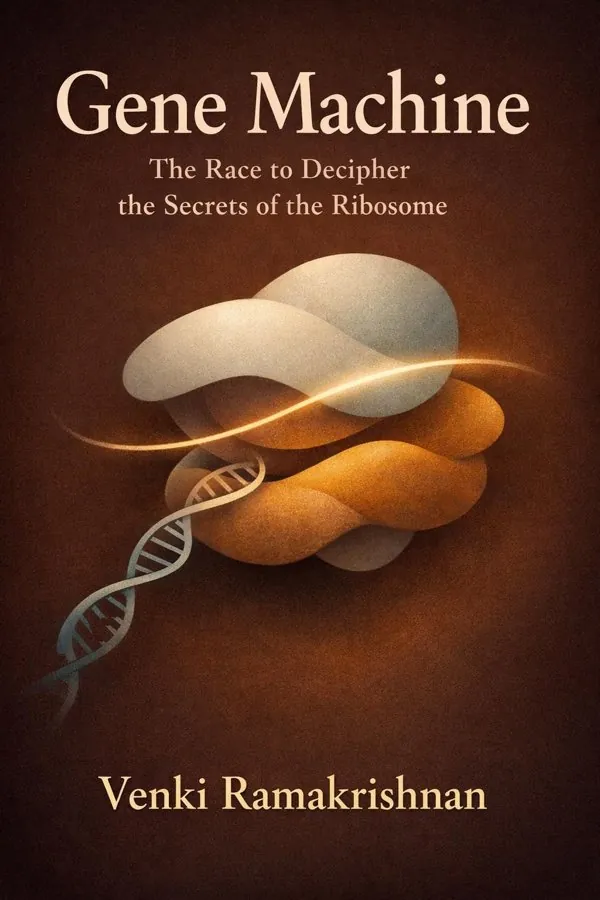
Gene Machine: The Race to Decipher the Secrets of the Ribosome: Summary & Key Insights
 10 min5 chaptersAudio available
What Is Gene Machine: The Race to Decipher the Secrets of the Ribosome About?
Gene Machine: The Race to Decipher the Secrets of the Ribosome by Venki Ramakrishnan is a biographies book spanning 5 pages. In this memoir, Nobel laureate Venki Ramakrishnan recounts his journey from a small town in India to the forefront of molecular biology, culminating in his groundbreaking work on the structure of the ribosome. The book offers an insider’s view of the competitive world of scientific discovery, the challenges of research, and the human stories behind major scientific achievements.
This FizzRead summary covers all 5 key chapters of Gene Machine: The Race to Decipher the Secrets of the Ribosome in approximately 10 minutes, distilling the most important ideas, arguments, and takeaways from Venki Ramakrishnan's work. Also available as an audio summary and Key Quotes Podcast.
Gene Machine: The Race to Decipher the Secrets of the Ribosome
In this memoir, Nobel laureate Venki Ramakrishnan recounts his journey from a small town in India to the forefront of molecular biology, culminating in his groundbreaking work on the structure of the ribosome. The book offers an insider’s view of the competitive world of scientific discovery, the challenges of research, and the human stories behind major scientific achievements.
Who Should Read Gene Machine: The Race to Decipher the Secrets of the Ribosome?
This book is perfect for anyone interested in biographies and looking to gain actionable insights in a short read. Whether you're a student, professional, or lifelong learner, the key ideas from Gene Machine: The Race to Decipher the Secrets of the Ribosome by Venki Ramakrishnan will help you think differently.
- ✓Readers who enjoy biographies and want practical takeaways
- ✓Professionals looking to apply new ideas to their work and life
- ✓Anyone who wants the core insights of Gene Machine: The Race to Decipher the Secrets of the Ribosome in just 10 minutes
Want the full summary?
Get instant access to this book summary and 100K+ more with Fizz Moment.
Get Free SummaryAvailable on App Store • Free to download
Key Chapters
My childhood in India was steeped in science. My parents were both academics—my father a physicist, my mother a science teacher—and I grew up believing that the universe was something rational, decipherable. Yet, it was only later that I realized understanding atoms is one thing; understanding life is another. As a young man at Baroda University, immersed in theoretical physics, I was captivated by elegance—the clarity of equations, the symmetry of nature. But something began to gnaw at me: physics could explain the stars, yet it struggled to explain a single living cell.
The decisive shift came when I encountered molecular biology, a discipline that combined the rigor of physics with the beauty of life’s complexity. In the 1970s, biology was undergoing its own revolution—the genetic code had been cracked, and the first protein and DNA structures were appearing. The frontier of structural biology beckoned. I decided to start over, to learn an entirely new science. It was a daunting step, leaving behind a comfortable trajectory for something uncertain, but curiosity defeated caution.
Moving to the United States for graduate study at Ohio University, I found myself an outsider twice over—an Indian physicist among biologists, a newcomer in a rapidly evolving field. I had to relearn not just scientific language, but an entire way of thinking: from deterministic equations to the probabilistic dance of molecules. Yet, slowly, I began to see how structure governs function, how the architecture of a molecule is a kind of code written in three dimensions. The ribosome entered my imagination during these formative years—a structure so monstrous and enigmatic that few dared approach it.
To understand the ribosome is to glimpse life’s translation engine. It is the molecular machine that reads the genetic script and stitches amino acids into proteins—the very act that turns information into function. For decades, biologists grasped its importance but could only speculate about its form. It was too large, too dynamic, too intricate for the tools of the time.
In the postdoctoral years that followed my PhD, I faced not only professional frustration—short-term contracts, uncertain funding—but also an intellectual crucible. The quest to visualize the ribosome seemed quixotic. Many colleagues scoffed at it: too ambitious, too resource-draining. But precisely because it was hard, I couldn’t let it go. The ribosome felt like nature’s last great fortress, and I wanted to see inside.
During my stay at the University of Utah, I refined the craft of X-ray crystallography: coaxing biological molecules into crystalline order, blasting them with X-rays, and decoding the resulting diffraction patterns. It was less a clean science than an alchemy of patience—months, even years, spent nurturing fragile crystals that could collapse at a touch. Yet each faint pattern on the detector hinted at atoms arranged with exquisite precision. Piece by piece, the invisible began to yield a shape.
Eventually, I joined the Medical Research Council Laboratory of Molecular Biology in Cambridge—a crucible of discovery where giants like Crick and Perutz had once worked. There, amidst sharp intellects and sharper competition, I devoted myself entirely to the small ribosomal subunit—the part responsible for interpreting the genetic code. Solving its structure became not just a professional goal but a spiritual pursuit: a way to read nature’s deepest text.
+ 3 more chapters — available in the FizzRead app
All Chapters in Gene Machine: The Race to Decipher the Secrets of the Ribosome
About the Author
Venki Ramakrishnan is a structural biologist who shared the 2009 Nobel Prize in Chemistry for his work on the structure and function of the ribosome. Born in Chidambaram, India, he has served as President of the Royal Society and is a Fellow of Trinity College, Cambridge.
Get This Summary in Your Preferred Format
Read or listen to the Gene Machine: The Race to Decipher the Secrets of the Ribosome summary by Venki Ramakrishnan anytime, anywhere. FizzRead offers multiple formats so you can learn on your terms — all free.
Available formats: App · Audio · PDF · EPUB — All included free with FizzRead
Download Gene Machine: The Race to Decipher the Secrets of the Ribosome PDF and EPUB Summary
Key Quotes from Gene Machine: The Race to Decipher the Secrets of the Ribosome
“My childhood in India was steeped in science.”
“To understand the ribosome is to glimpse life’s translation engine.”
Frequently Asked Questions about Gene Machine: The Race to Decipher the Secrets of the Ribosome
Gene Machine: The Race to Decipher the Secrets of the Ribosome by Venki Ramakrishnan is a biographies book that explores key ideas across 5 chapters. In this memoir, Nobel laureate Venki Ramakrishnan recounts his journey from a small town in India to the forefront of molecular biology, culminating in his groundbreaking work on the structure of the ribosome. The book offers an insider’s view of the competitive world of scientific discovery, the challenges of research, and the human stories behind major scientific achievements.
You Might Also Like

An American Marriage
Tayari Jones
10 min
Benjamin Franklin: An American Life
Walter Isaacson
10 min
I Know Why The Caged Bird Sings
Maya Angelou
10 min
Long Walk to Freedom
Nelson Mandela
10 min
Persepolis
Marjane Satrapi
10 min
Surely You're Joking, Mr. Feynman!
Richard P. Feynman
10 minBrowse by Category
Ready to read Gene Machine: The Race to Decipher the Secrets of the Ribosome?
Get the full summary and 100K+ more books with Fizz Moment.