
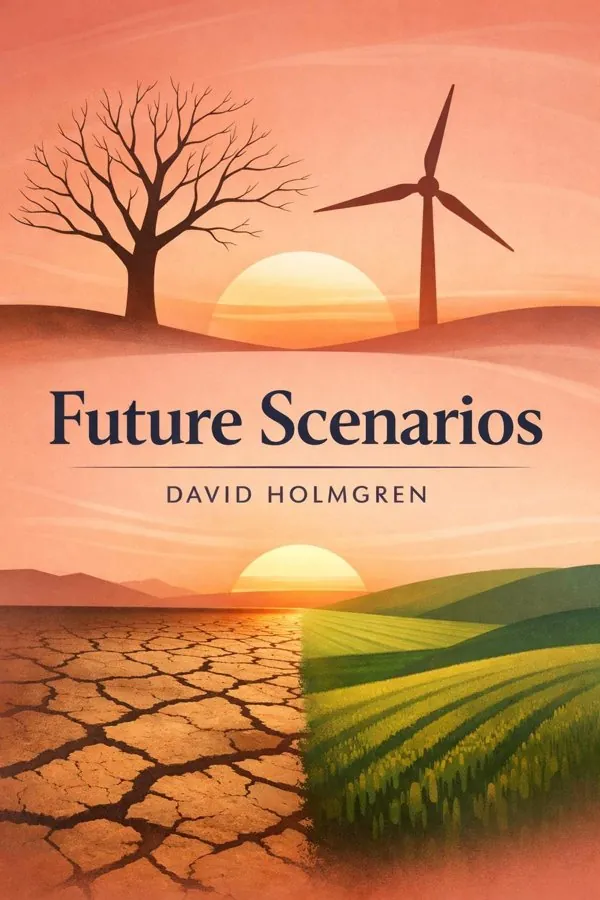
Future Scenarios: How Communities Can Adapt to Peak Oil and Climate Change: Summary & Key Insights
 10 min8 chaptersAudio available
What Is Future Scenarios: How Communities Can Adapt to Peak Oil and Climate Change About?
Future Scenarios: How Communities Can Adapt to Peak Oil and Climate Change by David Holmgren is a environment book spanning 8 pages. Future Scenarios explores how global energy descent and climate change may shape the future of human societies. Holmgren outlines four possible scenarios—ranging from energy descent to collapse—based on the interplay between energy availability and climate stability. The book encourages communities and individuals to prepare for resilient, sustainable living in a post-carbon world.
This FizzRead summary covers all 8 key chapters of Future Scenarios: How Communities Can Adapt to Peak Oil and Climate Change in approximately 10 minutes, distilling the most important ideas, arguments, and takeaways from David Holmgren's work. Also available as an audio summary and Key Quotes Podcast.
Future Scenarios: How Communities Can Adapt to Peak Oil and Climate Change
Future Scenarios explores how global energy descent and climate change may shape the future of human societies. Holmgren outlines four possible scenarios—ranging from energy descent to collapse—based on the interplay between energy availability and climate stability. The book encourages communities and individuals to prepare for resilient, sustainable living in a post-carbon world.
Who Should Read Future Scenarios: How Communities Can Adapt to Peak Oil and Climate Change?
This book is perfect for anyone interested in environment and looking to gain actionable insights in a short read. Whether you're a student, professional, or lifelong learner, the key ideas from Future Scenarios: How Communities Can Adapt to Peak Oil and Climate Change by David Holmgren will help you think differently.
- ✓Readers who enjoy environment and want practical takeaways
- ✓Professionals looking to apply new ideas to their work and life
- ✓Anyone who wants the core insights of Future Scenarios: How Communities Can Adapt to Peak Oil and Climate Change in just 10 minutes
Want the full summary?
Get instant access to this book summary and 100K+ more with Fizz Moment.
Get Free SummaryAvailable on App Store • Free to download
Key Chapters
To make sense of the vast and unpredictable intersection between energy and climate, I use a simple but powerful framework. I imagine a two-dimensional matrix defined by two axes: energy availability and climate stability. The energy axis ranges from abundance to scarcity, representing our access to concentrated fossil fuels and their renewable alternatives. The climate axis moves from stability to instability, reflecting the extent to which global warming disrupts ecosystems, agriculture, and settlement patterns.
By exploring the combinations of these two variables, we can map four overarching scenarios, each outlining a different trajectory for industrial civilization. The goal of this analytical approach is not to claim omniscience but to embrace uncertainty in a structured way. We can think of it as design thinking applied to the planetary system. The methodology allows communities, governments, and individuals to imagine responses appropriate to each quadrant of the matrix.
In one quadrant, where energy declines modestly and climate remains relatively stable, we might see a reformist path—technological optimism translating into a managed transition. In another, where both systems collapse, survivalist decentralization may arise. The combinations of factors—ranging from managed decline to chaotic breakdown—create distinct social, political, and ecological landscapes. Recognizing these patterns gives us a vocabulary for understanding the forces shaping our possible futures.
In this sense, 'scenarios' are not forecasts; they are stories, rich with ecological realism. Each scenario weaves together energy descent, climate stress, and human adaptation into a narrative that invites moral as well as practical reflection. The value lies less in their accuracy and more in their power to guide intelligent action under uncertainty.
To grasp the weight of the coming descent, we must revisit the energetic ascent that brought us here. For most of human history, civilizations operated on the steady but limited flow of solar energy—through food, forests, wind, and water. The Industrial Revolution broke that rhythm. With the discovery and exploitation of coal, oil, and gas, humanity temporarily escaped the constraints of solar economics. We tapped into ancient sunlight stored in fossilized form, releasing millions of years of accumulated energy in mere centuries.
This abundance ushered in an age of expansion. Agriculture industrialized, population soared, cities multiplied, and material culture grew more complex and dependent on fossil fuels. Yet within this abundance lay the seeds of fragility. Every increment of modernization entangled us further in a web of nonrenewable dependencies. The 'progress' narrative ignored the thermodynamic reality that energy extraction always faces diminishing returns.
When we look at the 20th century through this ecological lens, we see a civilization living off a one-time inheritance. The Great Acceleration—characterized by exponential increases in population, consumption, and emissions—was effectively the combustion of Earth’s stored energy capital. Now, as we reach the geological limits of extraction and confront climatic feedbacks triggered by that very process, we enter what I call the energy descent future. This is not a temporary energy crisis; it is the permanent end of cheap fossil energy.
Understanding this history reframes the moral question before us. The end of the fossil fuel era is not simply an economic inconvenience; it marks the end of a civilizational phase. Whether this transition is chaotic or creative depends entirely on how we design our descent.
+ 6 more chapters — available in the FizzRead app
All Chapters in Future Scenarios: How Communities Can Adapt to Peak Oil and Climate Change
About the Author
David Holmgren is an Australian environmental designer, ecological educator, and co-originator of the permaculture concept. His work focuses on sustainable living, energy descent, and community resilience.
Get This Summary in Your Preferred Format
Read or listen to the Future Scenarios: How Communities Can Adapt to Peak Oil and Climate Change summary by David Holmgren anytime, anywhere. FizzRead offers multiple formats so you can learn on your terms — all free.
Available formats: App · Audio · PDF · EPUB — All included free with FizzRead
Download Future Scenarios: How Communities Can Adapt to Peak Oil and Climate Change PDF and EPUB Summary
Key Quotes from Future Scenarios: How Communities Can Adapt to Peak Oil and Climate Change
“To make sense of the vast and unpredictable intersection between energy and climate, I use a simple but powerful framework.”
“To grasp the weight of the coming descent, we must revisit the energetic ascent that brought us here.”
Frequently Asked Questions about Future Scenarios: How Communities Can Adapt to Peak Oil and Climate Change
Future Scenarios: How Communities Can Adapt to Peak Oil and Climate Change by David Holmgren is a environment book that explores key ideas across 8 chapters. Future Scenarios explores how global energy descent and climate change may shape the future of human societies. Holmgren outlines four possible scenarios—ranging from energy descent to collapse—based on the interplay between energy availability and climate stability. The book encourages communities and individuals to prepare for resilient, sustainable living in a post-carbon world.
You Might Also Like
A Life on Our Planet: My Witness Statement and a Vision for the Future
David Attenborough
10 min
A Sky Full Of Birds
Matt Merritt
10 min
Carbon Zero: Imagining Cities That Can Save the Planet
Alex Steffen
10 min
Eaarth: Making a Life on a Tough New Planet
Bill McKibben
10 min
The Social Contract and Environmental Governance
Various Editors
10 min
The Wild Places
Robert Macfarlane
10 minBrowse by Category
Ready to read Future Scenarios: How Communities Can Adapt to Peak Oil and Climate Change?
Get the full summary and 100K+ more books with Fizz Moment.