
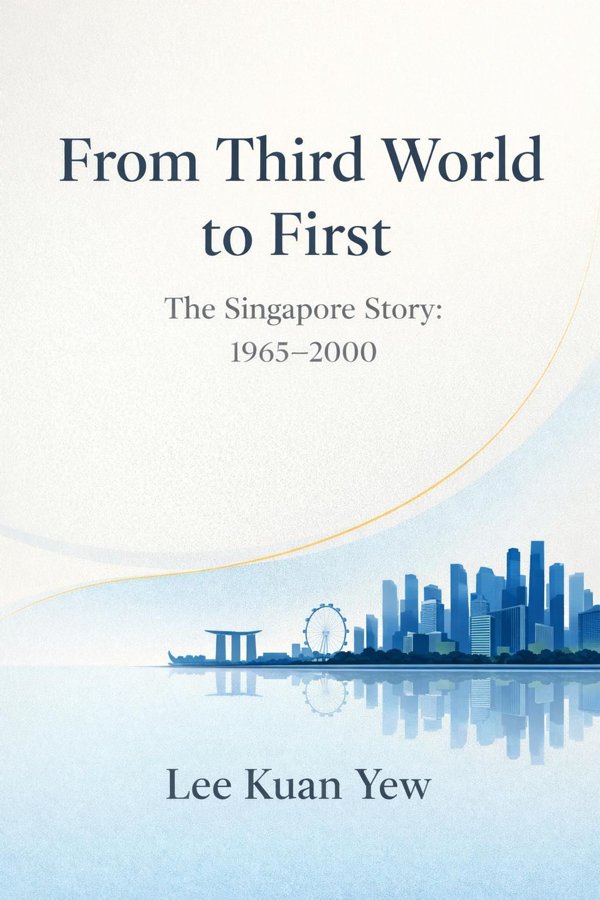
From Third World to First: The Singapore Story: 1965–2000: Summary & Key Insights
by Lee Kuan Yew
 10 min13 chaptersAudio available
What Is From Third World to First: The Singapore Story: 1965–2000 About?
From Third World to First: The Singapore Story: 1965–2000 by Lee Kuan Yew is a biographies book spanning 13 pages. This memoir by Lee Kuan Yew, Singapore’s founding Prime Minister, recounts the nation’s transformation from a struggling postcolonial state into a prosperous global hub. Covering the years 1965 to 2000, it details the political, economic, and social strategies that shaped modern Singapore, offering insights into leadership, governance, and nation-building.
This FizzRead summary covers all 13 key chapters of From Third World to First: The Singapore Story: 1965–2000 in approximately 10 minutes, distilling the most important ideas, arguments, and takeaways from Lee Kuan Yew's work. Also available as an audio summary and Key Quotes Podcast.
From Third World to First: The Singapore Story: 1965–2000
This memoir by Lee Kuan Yew, Singapore’s founding Prime Minister, recounts the nation’s transformation from a struggling postcolonial state into a prosperous global hub. Covering the years 1965 to 2000, it details the political, economic, and social strategies that shaped modern Singapore, offering insights into leadership, governance, and nation-building.
Who Should Read From Third World to First: The Singapore Story: 1965–2000?
This book is perfect for anyone interested in biographies and looking to gain actionable insights in a short read. Whether you're a student, professional, or lifelong learner, the key ideas from From Third World to First: The Singapore Story: 1965–2000 by Lee Kuan Yew will help you think differently.
- ✓Readers who enjoy biographies and want practical takeaways
- ✓Professionals looking to apply new ideas to their work and life
- ✓Anyone who wants the core insights of From Third World to First: The Singapore Story: 1965–2000 in just 10 minutes
Want the full summary?
Get instant access to this book summary and 100K+ more with Fizz Moment.
Get Free SummaryAvailable on App Store • Free to download
Key Chapters
Independence came to us abruptly, and with it came an enormous void. Singapore in 1965 was fragile: unemployment hovered around 10 percent, our population was growing faster than our economy, and our streets bore the signs of unrest. We had no army, no stable currency, and certainly no natural resources that could sustain industrial growth. To many observers, we looked destined to fail.
The first task was psychological—to lift our people from despair to determination. I insisted that we speak frankly about our weakness but never submit to pessimism. The British had left us with a port, but little else; our survival would depend on human capital, organization, and credibility. From those early years came the philosophy that “no one owes us a living.” We would make our own way through merit and hard work.
In those days, even everyday governance demanded creativity. Without oil, we turned to energy efficiency. Without land, we learned to build vertically. And without water sources, we began negotiating with Malaysia while simultaneously planning for self-sufficiency. Our leadership cabinet often worked late into the night, exploring every conceivable way to keep people employed and society coherent. Those were the formative lessons in realism: the recognition that ideology is useless unless it solves practical problems.
The fragility of our beginnings was more blessing than curse—it taught us the value of every decision. That crucible shaped the pragmatic thinking that would guide all our policies thereafter: that our best defense was competence, our best weapon was integrity.
Singapore was born a divided society—Chinese, Malay, Indian, and others living under mutual suspicion, shaped by colonial legacies and racial politics. After independence, the most urgent mission was to build a common identity. I believed this could not be done through slogans; it had to be codified in education, language policy, and national institutions that treated all citizens equally.
We chose English as the working language—not as a rejection of our roots, but as a bridge among communities. This decision anchored our multicultural equilibrium and opened the world’s markets to our youth. Alongside that, I established bilingual education to preserve mother tongues and ensure that cultural pride coexisted with national unity.
National Service was another turning point. By bringing together young men of every race and religion to train, serve, and defend their country, we seeded a shared experience that transcended divides. It was not simply a defense policy; it was an instrument of national integration.
Over time, Singaporeans began to see themselves less as members of separate communities and more as citizens of a common destiny. We celebrated diversity but emphasized equal opportunity, because only equality could prevent resentment. These values were not rhetorical—they were embedded in public housing design, schools, and laws. As I saw it, identity is not born from uniformity, but from fairness. That belief became the moral architecture of our nation.
+ 11 more chapters — available in the FizzRead app
All Chapters in From Third World to First: The Singapore Story: 1965–2000
About the Author
Lee Kuan Yew (1923–2015) was the founding Prime Minister of Singapore, serving from 1959 to 1990. Widely regarded as the architect of Singapore’s rapid development, he played a central role in transforming the country into one of the world’s most successful economies.
Get This Summary in Your Preferred Format
Read or listen to the From Third World to First: The Singapore Story: 1965–2000 summary by Lee Kuan Yew anytime, anywhere. FizzRead offers multiple formats so you can learn on your terms — all free.
Available formats: App · Audio · PDF · EPUB — All included free with FizzRead
Download From Third World to First: The Singapore Story: 1965–2000 PDF and EPUB Summary
Key Quotes from From Third World to First: The Singapore Story: 1965–2000
“Independence came to us abruptly, and with it came an enormous void.”
“Singapore was born a divided society—Chinese, Malay, Indian, and others living under mutual suspicion, shaped by colonial legacies and racial politics.”
Frequently Asked Questions about From Third World to First: The Singapore Story: 1965–2000
From Third World to First: The Singapore Story: 1965–2000 by Lee Kuan Yew is a biographies book that explores key ideas across 13 chapters. This memoir by Lee Kuan Yew, Singapore’s founding Prime Minister, recounts the nation’s transformation from a struggling postcolonial state into a prosperous global hub. Covering the years 1965 to 2000, it details the political, economic, and social strategies that shaped modern Singapore, offering insights into leadership, governance, and nation-building.
You Might Also Like
An American Marriage
Tayari Jones
10 min
Benjamin Franklin: An American Life
Walter Isaacson
10 min
I Know Why The Caged Bird Sings
Maya Angelou
10 min
Long Walk to Freedom
Nelson Mandela
10 min
Persepolis
Marjane Satrapi
10 min
Surely You're Joking, Mr. Feynman!
Richard P. Feynman
10 minBrowse by Category
Ready to read From Third World to First: The Singapore Story: 1965–2000?
Get the full summary and 100K+ more books with Fizz Moment.