
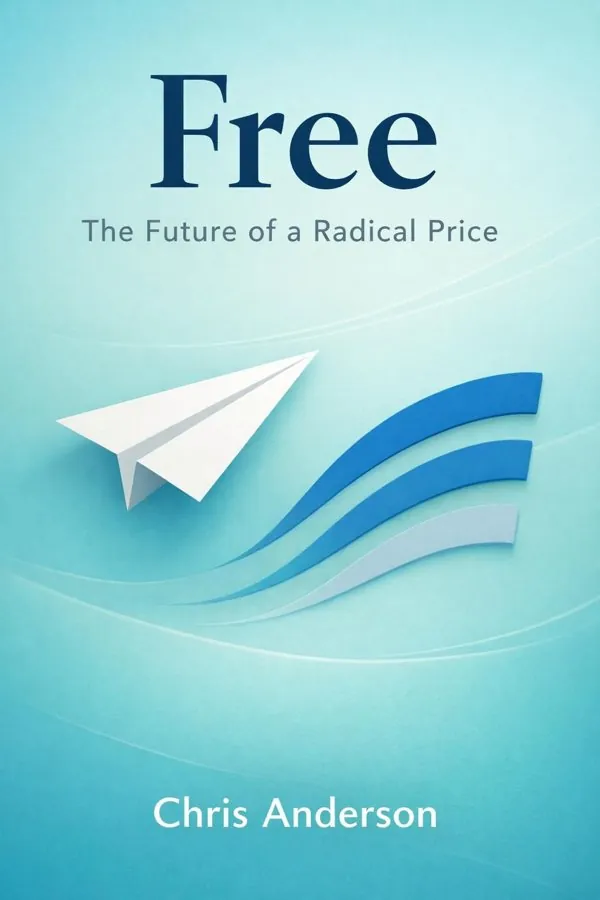
Free: The Future of a Radical Price: Summary & Key Insights
 10 min5 chaptersAudio available
What Is Free: The Future of a Radical Price About?
Free: The Future of a Radical Price by Chris Anderson is a economics book spanning 5 pages. In this book, Chris Anderson explores how the concept of 'free' is transforming business models in the digital age. He examines how companies can profit by giving products and services away, leveraging attention, reputation, and alternative revenue streams. The work analyzes examples from technology, media, and consumer industries to show how zero-cost strategies can coexist with profitability.
This FizzRead summary covers all 5 key chapters of Free: The Future of a Radical Price in approximately 10 minutes, distilling the most important ideas, arguments, and takeaways from Chris Anderson's work. Also available as an audio summary and Key Quotes Podcast.
Free: The Future of a Radical Price
In this book, Chris Anderson explores how the concept of 'free' is transforming business models in the digital age. He examines how companies can profit by giving products and services away, leveraging attention, reputation, and alternative revenue streams. The work analyzes examples from technology, media, and consumer industries to show how zero-cost strategies can coexist with profitability.
Who Should Read Free: The Future of a Radical Price?
This book is perfect for anyone interested in economics and looking to gain actionable insights in a short read. Whether you're a student, professional, or lifelong learner, the key ideas from Free: The Future of a Radical Price by Chris Anderson will help you think differently.
- ✓Readers who enjoy economics and want practical takeaways
- ✓Professionals looking to apply new ideas to their work and life
- ✓Anyone who wants the core insights of Free: The Future of a Radical Price in just 10 minutes
Want the full summary?
Get instant access to this book summary and 100K+ more with Fizz Moment.
Get Free SummaryAvailable on App Store • Free to download
Key Chapters
To grasp how 'free' works, you must first understand the physics of marginal cost. In the physical world, every additional unit of production costs something—materials, labor, shipping. But in digital space, that rule disintegrates. Copying a file, streaming a song, or distributing an app costs virtually nothing once the infrastructure is in place. This dynamic marks a fundamental shift in economic logic.
Historically, industries relied on cost to determine price. The printing press gave rise to the economics of mass production: as output scaled, costs per unit fell but never vanished. With computing and bandwidth, however, we crossed the threshold where costs approach zero. The implications are extraordinary. Suddenly, pricing based on marginal cost collapses, and the only rational price in many cases becomes free.
Consider software. Once a program is built, distributing it costs almost nothing—no physical goods to move, no production lines to maintain. Companies like Microsoft once thrived on selling licenses, but newer players—Google, Mozilla, or the vast open-source community—offer free tools and reap rewards through ads, data, or upgraded services. What seemed at first like madness—giving software away—proved smarter in a world where ubiquity generates more value than direct sales.
This shift changes the way we think about markets. When things are free, barriers fall. Demand surges. Audiences grow exponentially. And with attention now the scarcest commodity, success depends not on controlling supply but on capturing engagement. The more zero-cost distribution spreads, the more free becomes an inevitable economic baseline rather than a promotional exception.
The word 'free' covers many different business models. Some are centuries old; others are native to the online world. One enduring model is the cross-subsidy. You give something away to attract customers who pay for another piece of the value chain. Think of the classic razor-and-blade example: the razor handle is cheap or free, but the blades bring ongoing revenue. In the digital era, cross-subsidy became even more potent because distribution costs are negligible.
I’ve often described the freemium model as the most elegant evolution of free for the online age. Freemium splits the audience into two groups: the majority who use a free version and a minority who pay for premium features. This model depends not on charging everyone, but on charging enough of the right ones. A small percentage of users—often less than five percent—can support the rest if the product scales widely. The free users become both your marketing engine and your proof of relevance.
Look at companies like Dropbox or LinkedIn. Their free tiers drive mass adoption and network effects, while advanced functionality or added storage convert professionals and enthusiasts into paying customers. What’s remarkable is that the free offering isn’t just bait—it’s a full experience. The presence of passionate free users strengthens the ecosystem, enhances feedback loops, and creates trust. Freemium balances openness with sustainability, generosity with discipline.
If you understand how to design a freemium strategy, you’re not devaluing your products; you’re activating them to grow. In a world of infinite digital reach, your biggest challenge is obscurity, not piracy. Free turns obscurity into attention. From there, attention turns into reputation, and reputation becomes revenue.
+ 3 more chapters — available in the FizzRead app
All Chapters in Free: The Future of a Radical Price
About the Author
Chris Anderson is an American author and entrepreneur, best known for his books on technology and economics. He served as editor-in-chief of Wired magazine and is recognized for popularizing concepts such as 'The Long Tail' and 'Free' in the context of digital business and innovation.
Get This Summary in Your Preferred Format
Read or listen to the Free: The Future of a Radical Price summary by Chris Anderson anytime, anywhere. FizzRead offers multiple formats so you can learn on your terms — all free.
Available formats: App · Audio · PDF · EPUB — All included free with FizzRead
Download Free: The Future of a Radical Price PDF and EPUB Summary
Key Quotes from Free: The Future of a Radical Price
“To grasp how 'free' works, you must first understand the physics of marginal cost.”
“The word 'free' covers many different business models.”
Frequently Asked Questions about Free: The Future of a Radical Price
Free: The Future of a Radical Price by Chris Anderson is a economics book that explores key ideas across 5 chapters. In this book, Chris Anderson explores how the concept of 'free' is transforming business models in the digital age. He examines how companies can profit by giving products and services away, leveraging attention, reputation, and alternative revenue streams. The work analyzes examples from technology, media, and consumer industries to show how zero-cost strategies can coexist with profitability.
More by Chris Anderson
You Might Also Like
Business Adventures
John Brooks
10 min
Nudge
Richard H. Thaler, Cass R. Sunstein
10 min
The Hitchhiker"s Guide to the Galaxy
Douglas Adams
10 minThe Muqaddimah
Ibn Khaldun
10 minThe Outsiders
William N. Thorndike
10 min
A Little History of Economics
Niall Kishtainy
10 minBrowse by Category
Ready to read Free: The Future of a Radical Price?
Get the full summary and 100K+ more books with Fizz Moment.