
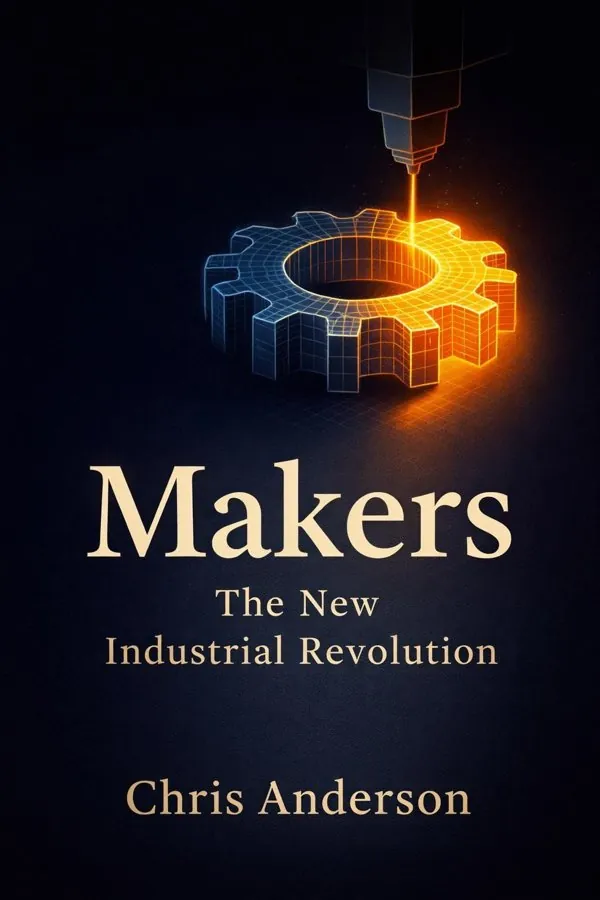
Makers: The New Industrial Revolution: Summary & Key Insights
 10 min11 chaptersAudio available
What Is Makers: The New Industrial Revolution About?
Makers: The New Industrial Revolution by Chris Anderson is a entrepreneurship book spanning 11 pages. Makers: The New Industrial Revolution explores how digital manufacturing technologies such as 3D printing and open-source hardware are transforming traditional production and entrepreneurship. Chris Anderson argues that the democratization of manufacturing will spark a new wave of innovation, enabling individuals and small startups to compete with large corporations.
This FizzRead summary covers all 11 key chapters of Makers: The New Industrial Revolution in approximately 10 minutes, distilling the most important ideas, arguments, and takeaways from Chris Anderson's work. Also available as an audio summary and Key Quotes Podcast.
Makers: The New Industrial Revolution
Makers: The New Industrial Revolution explores how digital manufacturing technologies such as 3D printing and open-source hardware are transforming traditional production and entrepreneurship. Chris Anderson argues that the democratization of manufacturing will spark a new wave of innovation, enabling individuals and small startups to compete with large corporations.
Who Should Read Makers: The New Industrial Revolution?
This book is perfect for anyone interested in entrepreneurship and looking to gain actionable insights in a short read. Whether you're a student, professional, or lifelong learner, the key ideas from Makers: The New Industrial Revolution by Chris Anderson will help you think differently.
- ✓Readers who enjoy entrepreneurship and want practical takeaways
- ✓Professionals looking to apply new ideas to their work and life
- ✓Anyone who wants the core insights of Makers: The New Industrial Revolution in just 10 minutes
Want the full summary?
Get instant access to this book summary and 100K+ more with Fizz Moment.
Get Free SummaryAvailable on App Store • Free to download
Key Chapters
Years ago, I wrote *The Long Tail* to describe how the internet changed markets for digital goods. Online distribution made niche content profitable, because low costs and global reach allowed small audiences to sustain diverse creators. With *Makers*, I take that idea further: physical goods now follow the same pattern. The Long Tail of manufacturing means that personalized products, limited editions, and one-off innovations are suddenly viable business propositions.
Digital fabrication eliminates the need for mass production to achieve cost efficiency. A 3D printer doesn’t care if you make one part or a thousand; the cost remains nearly the same. Combine this with online marketplaces and global logistics, and we have a landscape where micro-manufacturers can thrive. When you design a specialized part for drone enthusiasts, or custom furniture for small spaces, you can reach the exact people who want it — without appealing to the mainstream. Niche is no longer a constraint; it’s a strategy.
As I reflect on this phenomenon, I realize how profoundly it alters consumer culture. Product diversity no longer depends on what large factories decide to make. Instead, it emerges organically through communities and creators working globally but thinking locally. The internet’s promise of infinite niches now extends to the physical world, where even the smallest idea can find its audience and business model.
This transition from bits to atoms marks the physical incarnation of the digital revolution. It begins with a file — a 3D model or a blueprint created in software — and ends with a tangible object. The technologies enabling this include 3D printers, CNC machines, and laser cutters. Each turns data into matter, just as the web turned information into shared experience.
In traditional manufacturing, creating a prototype was expensive, slow, and often exclusive to big companies. Now, anyone can design using free or affordable software, and produce parts within hours. This shift empowers experimentation. You no longer need to commit to thousands of units before testing a design; you can iterate endlessly. That iterative loop drives innovation faster than any centralized R&D department could.
What fascinates me most is how this blurs the boundaries between the virtual and the physical. The lessons of the software industry — agile development, user feedback, and rapid iteration — apply directly to physical product design. Ideas circulate quicker, communities collaborate, and the cycle of improvement accelerates. The result is a cultural shift: making has become digital at its core, yet human at its heart.
+ 9 more chapters — available in the FizzRead app
All Chapters in Makers: The New Industrial Revolution
About the Author
Chris Anderson is an American author, entrepreneur, and former editor-in-chief of Wired magazine. He is known for his influential works on technology and economics, including The Long Tail and Free. Anderson co-founded 3D Robotics, a company specializing in drone technology.
Get This Summary in Your Preferred Format
Read or listen to the Makers: The New Industrial Revolution summary by Chris Anderson anytime, anywhere. FizzRead offers multiple formats so you can learn on your terms — all free.
Available formats: App · Audio · PDF · EPUB — All included free with FizzRead
Download Makers: The New Industrial Revolution PDF and EPUB Summary
Key Quotes from Makers: The New Industrial Revolution
“Years ago, I wrote *The Long Tail* to describe how the internet changed markets for digital goods.”
“This transition from bits to atoms marks the physical incarnation of the digital revolution.”
Frequently Asked Questions about Makers: The New Industrial Revolution
Makers: The New Industrial Revolution by Chris Anderson is a entrepreneurship book that explores key ideas across 11 chapters. Makers: The New Industrial Revolution explores how digital manufacturing technologies such as 3D printing and open-source hardware are transforming traditional production and entrepreneurship. Chris Anderson argues that the democratization of manufacturing will spark a new wave of innovation, enabling individuals and small startups to compete with large corporations.
More by Chris Anderson


You Might Also Like
Lean Analytics
Alistair Croll, Benjamin Yoskovitz
10 min
21 Days To A Big Idea: Creating Breakthrough Business Concepts
Bryan Mattimore
10 min
Sam Walton: Made in America: My Story
Sam Walton
10 min
10x Is Easier Than 2x: How World-Class Entrepreneurs Achieve More by Doing Less
Dan Sullivan, Benjamin Hardy
10 min
12 Months to $1 Million: How to Pick a Winning Product, Build a Real Business, and Become a Seven-Figure Entrepreneur
Ryan Daniel Moran
10 min
24 Assets: Create a Digital, Scalable, Valuable Business
Daniel Priestley
10 minBrowse by Category
Ready to read Makers: The New Industrial Revolution?
Get the full summary and 100K+ more books with Fizz Moment.