
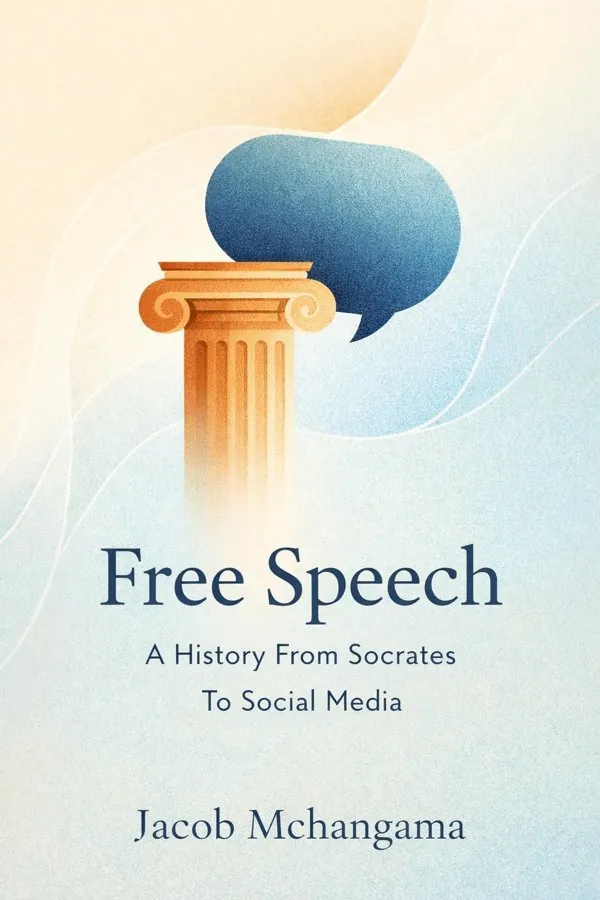
Free Speech: A History From Socrates To Social Media: Summary & Key Insights
 10 min11 chaptersAudio available
What Is Free Speech: A History From Socrates To Social Media About?
Free Speech: A History From Socrates To Social Media by Jacob Mchangama is a civilization book spanning 11 pages. In this sweeping history, Jacob Mchangama traces the evolution of free speech from its origins in ancient Greece to the digital age. Through vivid stories of philosophers, revolutionaries, and activists, he explores how the idea of free expression has shaped societies and faced challenges across centuries. The book examines the tension between liberty and censorship, offering insights into how free speech remains vital for democracy and human progress.
This FizzRead summary covers all 11 key chapters of Free Speech: A History From Socrates To Social Media in approximately 10 minutes, distilling the most important ideas, arguments, and takeaways from Jacob Mchangama's work. Also available as an audio summary and Key Quotes Podcast.
Free Speech: A History From Socrates To Social Media
In this sweeping history, Jacob Mchangama traces the evolution of free speech from its origins in ancient Greece to the digital age. Through vivid stories of philosophers, revolutionaries, and activists, he explores how the idea of free expression has shaped societies and faced challenges across centuries. The book examines the tension between liberty and censorship, offering insights into how free speech remains vital for democracy and human progress.
Who Should Read Free Speech: A History From Socrates To Social Media?
This book is perfect for anyone interested in civilization and looking to gain actionable insights in a short read. Whether you're a student, professional, or lifelong learner, the key ideas from Free Speech: A History From Socrates To Social Media by Jacob Mchangama will help you think differently.
- ✓Readers who enjoy civilization and want practical takeaways
- ✓Professionals looking to apply new ideas to their work and life
- ✓Anyone who wants the core insights of Free Speech: A History From Socrates To Social Media in just 10 minutes
Want the full summary?
Get instant access to this book summary and 100K+ more with Fizz Moment.
Get Free SummaryAvailable on App Store • Free to download
Key Chapters
Every story of free speech begins in Athens. In that small polis of the fifth century BCE, the idea of *parrhesia*—frank speech—was born. It was the right, and indeed the duty, of citizens to speak openly in the democratic assembly. Yet this same democracy, for all its achievements, crucified its founding voice. When Socrates was tried and sentenced to death for ‘corrupting the youth’ and impiety, the paradox was set: the society that invented free speech was also prepared to kill it. His trial reminds us that liberty of thought is never absolute; it depends on whether society tolerates the discomfort that truth produces.
After Athens, the Stoics carried forth the torch of reason and self-expression, but Rome soon demonstrated another side of history. The Roman Republic valued eloquence in the Senate, yet emperors turned words into weapons. Libel laws served not to protect citizens but to suppress opposition. Speech became something to be managed, not celebrated. This early oscillation—between speech as the lifeblood of democracy and as a threat to power—would echo through every age to come.
When the Roman Empire embraced Christianity, free speech became entangled with divine authority. What had once been political heresy turned into theological heresy. By the fourth century, what one believed and spoke about God became a matter of state. Emperors punished not only sedition but blasphemy. Tolerance waned as orthodoxy hardened, and the word ‘heresy’ became synonymous with rebellion.
Yet even in this environment, rebellious minds like Tertullian argued that belief without freedom was meaningless. His plea for liberty of conscience sowed a seed that would germinate much later. Still, for most of the early medieval world, the Church became the arbiter of permitted speech, and the empire learned that controlling belief was a means of controlling minds. The idea of universal truth justified censorship more effectively than any decree.
+ 9 more chapters — available in the FizzRead app
All Chapters in Free Speech: A History From Socrates To Social Media
About the Author
Jacob Mchangama is a Danish lawyer, human rights advocate, and founder of the think tank Justitia. He is known for his work on freedom of expression and has written extensively on civil liberties and democratic values. His scholarship and advocacy have made him a leading voice in global debates on free speech.
Get This Summary in Your Preferred Format
Read or listen to the Free Speech: A History From Socrates To Social Media summary by Jacob Mchangama anytime, anywhere. FizzRead offers multiple formats so you can learn on your terms — all free.
Available formats: App · Audio · PDF · EPUB — All included free with FizzRead
Download Free Speech: A History From Socrates To Social Media PDF and EPUB Summary
Key Quotes from Free Speech: A History From Socrates To Social Media
“Every story of free speech begins in Athens.”
“When the Roman Empire embraced Christianity, free speech became entangled with divine authority.”
Frequently Asked Questions about Free Speech: A History From Socrates To Social Media
Free Speech: A History From Socrates To Social Media by Jacob Mchangama is a civilization book that explores key ideas across 11 chapters. In this sweeping history, Jacob Mchangama traces the evolution of free speech from its origins in ancient Greece to the digital age. Through vivid stories of philosophers, revolutionaries, and activists, he explores how the idea of free expression has shaped societies and faced challenges across centuries. The book examines the tension between liberty and censorship, offering insights into how free speech remains vital for democracy and human progress.
You Might Also Like
The Structure of Scientific Revolutions
Thomas S. Kuhn
10 min
Genius
Harold Bloom
10 min
A Cultural History of the Medieval Age
Various Editors
10 min
A History of God: The 4,000-Year Quest of Judaism, Christianity and Islam
Karen Armstrong
10 min
A History of the World in 10½ Chapters
Julian Barnes
10 min
A Short History of Progress
Ronald Wright
10 minBrowse by Category
Ready to read Free Speech: A History From Socrates To Social Media?
Get the full summary and 100K+ more books with Fizz Moment.