
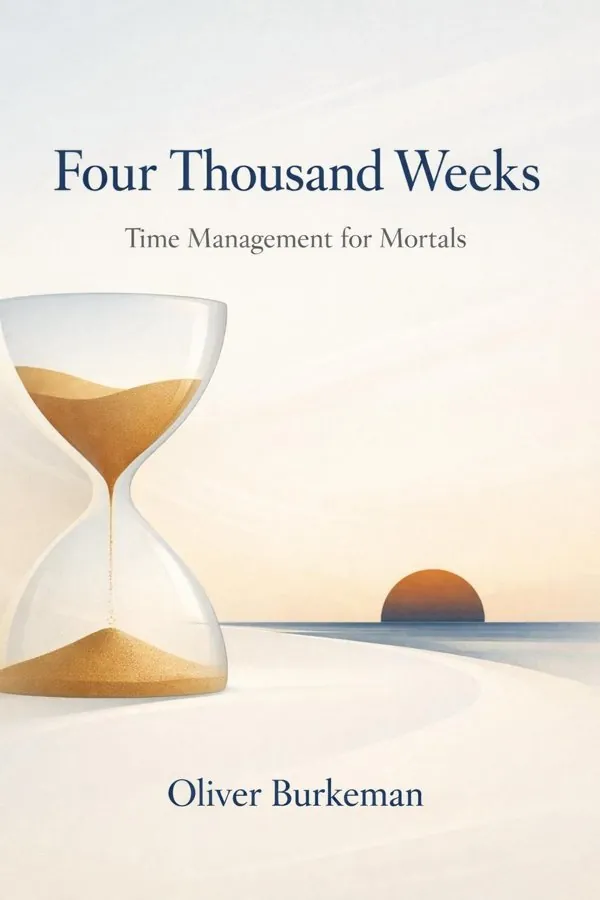
Four Thousand Weeks: Time Management for Mortals: Summary & Key Insights
 10 min11 chaptersAudio available
What Is Four Thousand Weeks: Time Management for Mortals About?
Four Thousand Weeks: Time Management for Mortals by Oliver Burkeman is a productivity book spanning 11 pages. Four Thousand Weeks: Time Management for Mortals is a philosophical and practical exploration of how humans can live meaningfully within the finite span of roughly four thousand weeks—the average human lifespan. Burkeman challenges the modern obsession with productivity and efficiency, arguing that embracing limitations and impermanence leads to a more fulfilling life. Drawing on philosophy, psychology, and personal reflection, the book encourages readers to focus on what truly matters rather than striving for impossible control over time.
This FizzRead summary covers all 11 key chapters of Four Thousand Weeks: Time Management for Mortals in approximately 10 minutes, distilling the most important ideas, arguments, and takeaways from Oliver Burkeman's work. Also available as an audio summary and Key Quotes Podcast.
Four Thousand Weeks: Time Management for Mortals
Four Thousand Weeks: Time Management for Mortals is a philosophical and practical exploration of how humans can live meaningfully within the finite span of roughly four thousand weeks—the average human lifespan. Burkeman challenges the modern obsession with productivity and efficiency, arguing that embracing limitations and impermanence leads to a more fulfilling life. Drawing on philosophy, psychology, and personal reflection, the book encourages readers to focus on what truly matters rather than striving for impossible control over time.
Who Should Read Four Thousand Weeks: Time Management for Mortals?
This book is perfect for anyone interested in productivity and looking to gain actionable insights in a short read. Whether you're a student, professional, or lifelong learner, the key ideas from Four Thousand Weeks: Time Management for Mortals by Oliver Burkeman will help you think differently.
- ✓Readers who enjoy productivity and want practical takeaways
- ✓Professionals looking to apply new ideas to their work and life
- ✓Anyone who wants the core insights of Four Thousand Weeks: Time Management for Mortals in just 10 minutes
Want the full summary?
Get instant access to this book summary and 100K+ more with Fizz Moment.
Get Free SummaryAvailable on App Store • Free to download
Key Chapters
One of the defining myths of our era is that time can be mastered. We tell ourselves that with the right techniques—prioritization systems, task management tools, or morning routines—we can become omnipotent managers of our days. But this is an illusion, born from a culture that equates busyness with virtue. Deep down, most of us don’t seek productivity merely to accomplish tasks; we seek reassurance that we are in control. Productivity becomes a substitute for existential security, the promise that we can outsmart the chaos of being alive.
In truth, the very pursuit of total control creates anxiety. Every new method or tool gives a fleeting sense of mastery, followed by the crushing realization that the tide of obligations never stops rising. Behind the cult of efficiency lies a fear of finitude: if we could do everything, we’d never have to confront what to give up. But being human means exactly that—making hard choices about what will not be done. Time mastery is an alluring fantasy because it lets us postpone those choices. Yet every attempt to tame time fails for the same reason: we imagine infinite possibility in a finite life.
Once we accept that hundreds of worthwhile experiences will remain unfulfilled, something paradoxically freeing happens. The impossibility of doing it all no longer feels tragic—it feels clarifying. Liberation begins when we stop measuring worth by the tally of completed tasks and start asking what truly deserves our attention. Time, then, becomes not a resource to optimize, but a medium of experience through which we can live intentionally, imperfectly, and vividly.
The hardest and most transformative realization we face as adults is that we are finite. Philosophers from Heidegger to Seneca have wrestled with this truth: to live authentically, one must face the limit of one’s time. Yet culturally, we are allergic to that confrontation. We plan and schedule as if our calendars stretch into infinity. We imagine retirement as the time we’ll finally rest or enjoy life. But life’s brevity is not a glitch in the system; it is the system.
When I grasped the meaning of those four thousand weeks, it wasn’t a mathematical exercise—it was a reckoning. Each day spent in frantic multitasking is a day spent refusing to acknowledge that there will not be enough days. The denial of mortality shows up, ironically, as overwork and distraction. The attempt to avoid finitude becomes the very mechanism that drains our days of meaning.
So, what happens when we stop fighting time’s limits? We begin to orient life around presence instead of postponement. The ancient Stoics urged acceptance of what lies beyond control, seeing mortality as a lens that sharpens all priorities. To face finitude is to look squarely at the reality that everything worth doing takes time, and that by choosing one thing, we inevitably forego another. This acceptance doesn’t lead to despair—it leads to life lived more honestly. When we stop denying death, we can finally inhabit the days that remain with clarity and gratitude.
+ 9 more chapters — available in the FizzRead app
All Chapters in Four Thousand Weeks: Time Management for Mortals
About the Author
Oliver Burkeman is a British author and journalist known for his work on psychology, productivity, and the human condition. He wrote a long-running column for The Guardian called 'This Column Will Change Your Life' and has published several books exploring the intersection of time, happiness, and meaning.
Get This Summary in Your Preferred Format
Read or listen to the Four Thousand Weeks: Time Management for Mortals summary by Oliver Burkeman anytime, anywhere. FizzRead offers multiple formats so you can learn on your terms — all free.
Available formats: App · Audio · PDF · EPUB — All included free with FizzRead
Download Four Thousand Weeks: Time Management for Mortals PDF and EPUB Summary
Key Quotes from Four Thousand Weeks: Time Management for Mortals
“One of the defining myths of our era is that time can be mastered.”
“The hardest and most transformative realization we face as adults is that we are finite.”
Frequently Asked Questions about Four Thousand Weeks: Time Management for Mortals
Four Thousand Weeks: Time Management for Mortals by Oliver Burkeman is a productivity book that explores key ideas across 11 chapters. Four Thousand Weeks: Time Management for Mortals is a philosophical and practical exploration of how humans can live meaningfully within the finite span of roughly four thousand weeks—the average human lifespan. Burkeman challenges the modern obsession with productivity and efficiency, arguing that embracing limitations and impermanence leads to a more fulfilling life. Drawing on philosophy, psychology, and personal reflection, the book encourages readers to focus on what truly matters rather than striving for impossible control over time.
More by Oliver Burkeman

You Might Also Like



Browse by Category
Ready to read Four Thousand Weeks: Time Management for Mortals?
Get the full summary and 100K+ more books with Fizz Moment.