
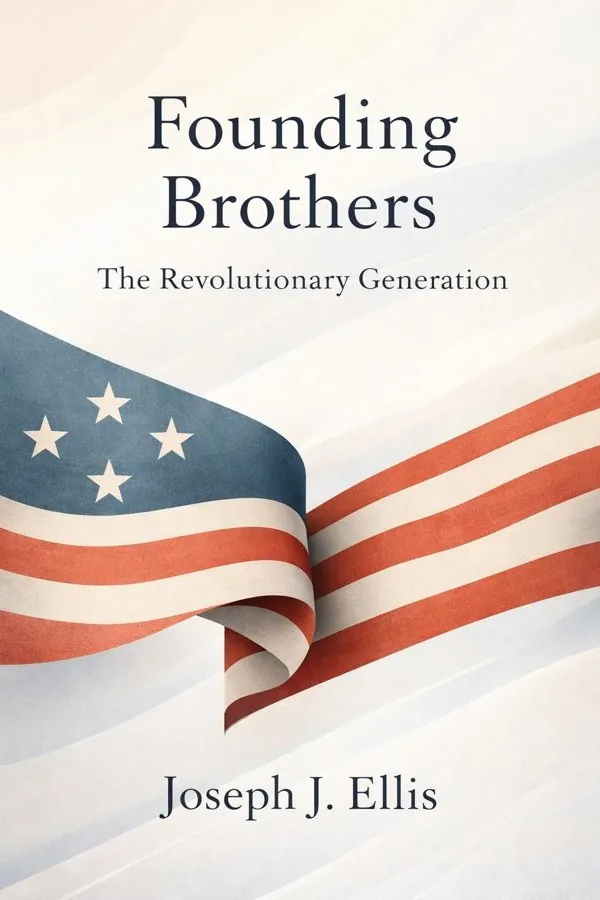
Founding Brothers: The Revolutionary Generation: Summary & Key Insights
 10 min7 chaptersAudio available
What Is Founding Brothers: The Revolutionary Generation About?
Founding Brothers: The Revolutionary Generation by Joseph J. Ellis is a world_history book spanning 7 pages. In this Pulitzer Prize–winning work, historian Joseph J. Ellis explores the intertwined lives and political relationships of the key figures who shaped the early United States. Through a series of interconnected narratives, Ellis examines how the Founding Fathers—such as George Washington, Thomas Jefferson, John Adams, Alexander Hamilton, James Madison, and Aaron Burr—navigated the challenges of nation-building, personal rivalries, and ideological divisions in the aftermath of the American Revolution.
This FizzRead summary covers all 7 key chapters of Founding Brothers: The Revolutionary Generation in approximately 10 minutes, distilling the most important ideas, arguments, and takeaways from Joseph J. Ellis's work. Also available as an audio summary and Key Quotes Podcast.
Founding Brothers: The Revolutionary Generation
In this Pulitzer Prize–winning work, historian Joseph J. Ellis explores the intertwined lives and political relationships of the key figures who shaped the early United States. Through a series of interconnected narratives, Ellis examines how the Founding Fathers—such as George Washington, Thomas Jefferson, John Adams, Alexander Hamilton, James Madison, and Aaron Burr—navigated the challenges of nation-building, personal rivalries, and ideological divisions in the aftermath of the American Revolution.
Who Should Read Founding Brothers: The Revolutionary Generation?
This book is perfect for anyone interested in world_history and looking to gain actionable insights in a short read. Whether you're a student, professional, or lifelong learner, the key ideas from Founding Brothers: The Revolutionary Generation by Joseph J. Ellis will help you think differently.
- ✓Readers who enjoy world_history and want practical takeaways
- ✓Professionals looking to apply new ideas to their work and life
- ✓Anyone who wants the core insights of Founding Brothers: The Revolutionary Generation in just 10 minutes
Want the full summary?
Get instant access to this book summary and 100K+ more with Fizz Moment.
Get Free SummaryAvailable on App Store • Free to download
Key Chapters
The book opens with the fateful confrontation between Alexander Hamilton and Aaron Burr in July 1804—a duel that Ellis treats as both a literal and symbolic event. As I present it, this moment dramatizes not just personal hatred but the collapse of civility in the young republic’s political culture. Hamilton, the architect of financial nationalism, and Burr, the consummate opportunist, embodied opposing visions of political legitimacy. Their quarrel had deeper roots than insult—it reflected a system still learning to balance ambition and virtue without monarchy’s constraints.
I invite the reader to understand why reason surrendered to ritual violence. The code of honor, inherited from a fading aristocratic world, offered a way to convert moral outrage into public vindication. Burr demanded satisfaction; Hamilton offered himself, perhaps knowingly, into destiny’s hands. His death signified the end of a generation’s trust that gentlemen could resolve differences with civility. America’s experiment in republican governance was proving that personal character and political conflict were not separate spheres.
Through the duel, I wanted to show the fragility of early political norms. The revolution’s promise had been to replace hierarchy with principle, but its founders still lived in a culture of reputation. Burr’s victory was Pyrrhic; Hamilton’s martyrdom transformed him into a secular saint for Federalism. And America learned that the republic, though founded on ideals, was sustained by fallible men whose passions could destroy even the best of them.
The next story takes us to a quiet evening in 1790 when three men—Thomas Jefferson, James Madison, and Alexander Hamilton—met over dinner at Jefferson’s residence in New York. On its surface, they negotiated policy; at its heart, they forged the first great political compromise in American history. This encounter demonstrates a central truth: governance begins not with grand declarations but with human negotiation.
Hamilton desperately needed congressional approval for federal assumption of state debts, a plan essential to national credit but hated by southern states. Madison and Jefferson resisted, fearing the concentration of financial power in Northern hands. As I unfold the episode, you will see how mutual necessity forced cooperation. Jefferson, normally aloof from fiscal matters, became the mediator. Over his wine and conversation, he brokered a deal—Hamilton would get his assumption plan; in return, the new national capital would sit on the Potomac, closer to Virginia’s influence.
The Dinner is thus a microcosm of political realism. Ideology bowed to practicality. Friendship and trust—thin as they were—made the difference between gridlock and progress. Through this tale, I wanted readers to appreciate governance as the art of possible, where ideals require daily translation into policy. The Founders knew that unity required the steady dance between conviction and compromise—a lesson we still struggle to learn.
+ 5 more chapters — available in the FizzRead app
All Chapters in Founding Brothers: The Revolutionary Generation
About the Author
Joseph J. Ellis is an American historian and professor emeritus at Mount Holyoke College, best known for his works on the Founding Fathers of the United States. He won the Pulitzer Prize for History for 'Founding Brothers' and the National Book Award for 'American Sphinx: The Character of Thomas Jefferson.' His scholarship focuses on the early American republic and the personal dynamics among its leaders.
Get This Summary in Your Preferred Format
Read or listen to the Founding Brothers: The Revolutionary Generation summary by Joseph J. Ellis anytime, anywhere. FizzRead offers multiple formats so you can learn on your terms — all free.
Available formats: App · Audio · PDF · EPUB — All included free with FizzRead
Download Founding Brothers: The Revolutionary Generation PDF and EPUB Summary
Key Quotes from Founding Brothers: The Revolutionary Generation
“The book opens with the fateful confrontation between Alexander Hamilton and Aaron Burr in July 1804—a duel that Ellis treats as both a literal and symbolic event.”
“The next story takes us to a quiet evening in 1790 when three men—Thomas Jefferson, James Madison, and Alexander Hamilton—met over dinner at Jefferson’s residence in New York.”
Frequently Asked Questions about Founding Brothers: The Revolutionary Generation
Founding Brothers: The Revolutionary Generation by Joseph J. Ellis is a world_history book that explores key ideas across 7 chapters. In this Pulitzer Prize–winning work, historian Joseph J. Ellis explores the intertwined lives and political relationships of the key figures who shaped the early United States. Through a series of interconnected narratives, Ellis examines how the Founding Fathers—such as George Washington, Thomas Jefferson, John Adams, Alexander Hamilton, James Madison, and Aaron Burr—navigated the challenges of nation-building, personal rivalries, and ideological divisions in the aftermath of the American Revolution.
You Might Also Like
The Age of Capital
Eric Hobsbawm
10 min
The Gulag Archipelago
Aleksandr Solzhenitsyn
10 min
Jerusalem: The Biography
Simon Sebag Montefiore
10 min
The Anglo-Saxons
James Campbell
10 min
The Boer War
Thomas Pakenham
10 min
The Industrial Revolutionaries: The Making of the Modern World 1776–1914
Gavin Weightman
10 minBrowse by Category
Ready to read Founding Brothers: The Revolutionary Generation?
Get the full summary and 100K+ more books with Fizz Moment.