
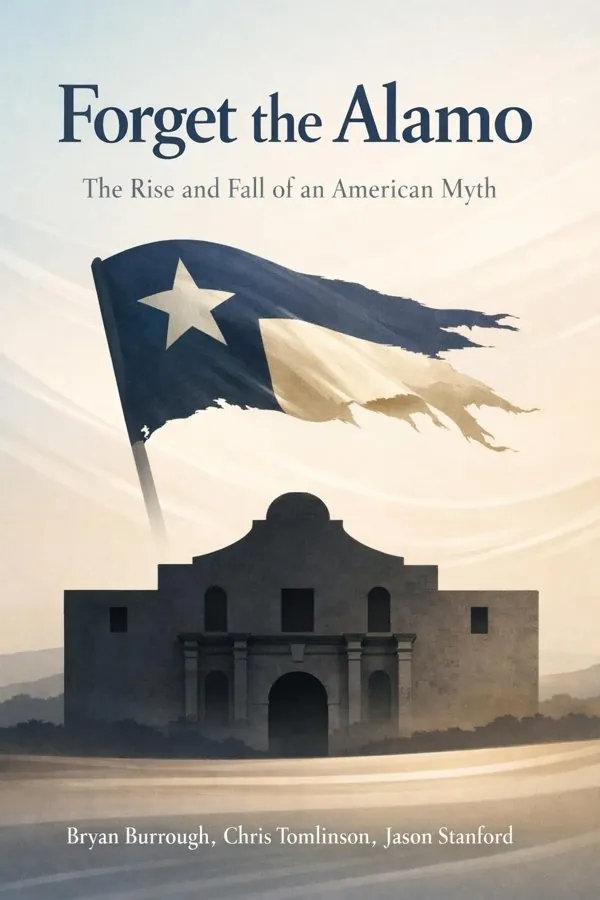
Forget the Alamo: The Rise and Fall of an American Myth: Summary & Key Insights
by Bryan Burrough, Chris Tomlinson, Jason Stanford
 10 min9 chaptersAudio available
Key Takeaways from Forget the Alamo: The Rise and Fall of an American Myth
The most powerful legends often feel ancient, but many are assembled long after the events they claim to preserve.
Patriotic myths become most persuasive when they hide the motives that feel hardest to defend.
A military loss becomes culturally useful when a society can transform it into a moral victory.
People often remember films, songs, and schoolbook images more vividly than archival evidence.
The stories a society chooses to honor often reveal whom it considers fully human.
What Is Forget the Alamo: The Rise and Fall of an American Myth About?
Forget the Alamo: The Rise and Fall of an American Myth by Bryan Burrough, Chris Tomlinson, Jason Stanford is a world_history book spanning 12 pages. Some national legends survive not because they are fully true, but because they are emotionally useful. Forget the Alamo examines one of America’s most cherished regional myths and asks a disruptive question: what if the story generations have been taught about the Alamo says more about politics, race, and identity than about the battle itself? Bryan Burrough, Chris Tomlinson, and Jason Stanford revisit the 1836 siege not to deny its drama, but to separate documented history from the mythmaking that followed. They show how a brief military defeat was transformed into a near-sacred tale of noble white heroes defending liberty, while uncomfortable realities such as slavery, land hunger, Tejano participation, and anti-Mexican prejudice were minimized or erased. The book matters because the Alamo is not just about Texas memory; it is a case study in how societies turn history into ideology. Burrough brings narrative skill and investigative depth, Tomlinson contributes historical and cultural insight rooted in Texas journalism, and Stanford adds a sharp understanding of politics and public messaging. Together, they offer a lively, revisionist, and highly accessible account of how myths are made, defended, and sometimes finally challenged.
This FizzRead summary covers all 9 key chapters of Forget the Alamo: The Rise and Fall of an American Myth in approximately 10 minutes, distilling the most important ideas, arguments, and takeaways from Bryan Burrough, Chris Tomlinson, Jason Stanford's work. Also available as an audio summary and Key Quotes Podcast.
Forget the Alamo: The Rise and Fall of an American Myth
Some national legends survive not because they are fully true, but because they are emotionally useful. Forget the Alamo examines one of America’s most cherished regional myths and asks a disruptive question: what if the story generations have been taught about the Alamo says more about politics, race, and identity than about the battle itself? Bryan Burrough, Chris Tomlinson, and Jason Stanford revisit the 1836 siege not to deny its drama, but to separate documented history from the mythmaking that followed. They show how a brief military defeat was transformed into a near-sacred tale of noble white heroes defending liberty, while uncomfortable realities such as slavery, land hunger, Tejano participation, and anti-Mexican prejudice were minimized or erased.
The book matters because the Alamo is not just about Texas memory; it is a case study in how societies turn history into ideology. Burrough brings narrative skill and investigative depth, Tomlinson contributes historical and cultural insight rooted in Texas journalism, and Stanford adds a sharp understanding of politics and public messaging. Together, they offer a lively, revisionist, and highly accessible account of how myths are made, defended, and sometimes finally challenged.
Who Should Read Forget the Alamo: The Rise and Fall of an American Myth?
This book is perfect for anyone interested in world_history and looking to gain actionable insights in a short read. Whether you're a student, professional, or lifelong learner, the key ideas from Forget the Alamo: The Rise and Fall of an American Myth by Bryan Burrough, Chris Tomlinson, Jason Stanford will help you think differently.
- ✓Readers who enjoy world_history and want practical takeaways
- ✓Professionals looking to apply new ideas to their work and life
- ✓Anyone who wants the core insights of Forget the Alamo: The Rise and Fall of an American Myth in just 10 minutes
Want the full summary?
Get instant access to this book summary and 100K+ more with Fizz Moment.
Get Free SummaryAvailable on App Store • Free to download
Key Chapters
The most powerful legends often feel ancient, but many are assembled long after the events they claim to preserve. One of the book’s central insights is that the familiar Alamo story did not emerge in complete form immediately after the 1836 battle. Early accounts were inconsistent, incomplete, and often contradictory. There was no instant consensus about what happened inside the mission, who behaved heroically, or what larger cause the battle represented. In other words, the Alamo was first a contested episode, not a polished national scripture.
The site itself had a long history before the battle: it was a Spanish mission, later a military outpost, and only afterward a shrine. The version many people know today, centered on Davy Crockett, Jim Bowie, and William Barret Travis as pure defenders of freedom, took shape gradually through memoirs, speeches, textbooks, newspaper retellings, and popular entertainment. As the decades passed, the rough edges were sanded down. Complexities were removed. The battle became easier to remember and harder to question.
This matters beyond Texas. It offers a practical lesson in how public memory works. Most people inherit stories in finished form and mistake them for unfiltered truth. But historical narratives are edited products. They are influenced by who writes first, who gets published, whose version serves political needs, and which voices are excluded.
A useful application is to treat every iconic story as a timeline, not a snapshot. Ask: when did this version become dominant, who benefited from it, and what earlier interpretations existed? Actionable takeaway: when confronting a famous historical event, study not only what happened but also when the accepted story was created.
Patriotic myths become most persuasive when they hide the motives that feel hardest to defend. Forget the Alamo argues that the Texas Revolution cannot be understood as a simple freedom struggle against tyranny. Anglo settlers in Mexican Texas had deep economic and political reasons to resist Mexican authority, and one of the most important was slavery. Mexico had moved toward limiting or abolishing slavery, while many settlers from the American South wanted to preserve a plantation system dependent on enslaved labor.
This does not mean every participant fought only for slavery, nor does it reduce the entire conflict to one cause. But the book insists that slavery was not a side issue. It was woven into the tensions over immigration, governance, land, and legal sovereignty. Many defenders of the traditional Alamo story prefer a cleaner narrative in which liberty-loving frontiersmen rose up for universal freedom. The authors show that this framing obscures the fact that some revolutionaries were defending their own right to deny freedom to others.
The broader value of this argument lies in its refusal to confuse rhetoric with reality. Political movements often describe themselves in noble language while pursuing narrower material interests. That pattern appears across world history, from colonial revolutions to modern nationalist campaigns.
Readers can apply this insight by looking past slogans. When a movement claims to fight for liberty, ask liberty for whom, and at whose expense? Investigate laws, labor systems, property interests, and demographic anxieties. Actionable takeaway: whenever a historical struggle is framed as purely idealistic, check whether economic power and social hierarchy were equally central to the conflict.
A military loss becomes culturally useful when a society can transform it into a moral victory. The fall of the Alamo was, on its face, a battlefield defeat. Yet over time it became one of the most celebrated episodes in Texas and American memory. The authors show how this happened through a deliberate process of mythmaking in the nineteenth century. Politicians, veterans, writers, and boosters reshaped the battle into a founding drama that offered Texas a heroic origin story.
This transformation served several functions. It gave the young republic, and later the state, a symbolic center. It converted a chaotic and morally complicated conflict into a tale of sacrifice, courage, and destiny. It also aligned Texas with a broader American taste for frontier epics, exceptionalism, and masculine self-invention. The slogan “Remember the Alamo” condensed all of this into a reusable emotional command.
The key point is that myths are not just falsehoods. They are narrative systems that organize public feeling. They simplify, repeat, and ritualize events until they become identity markers. Once that happens, challenging the story can feel to believers like an attack on the community itself. This explains why debates about the Alamo remain so heated: the issue is not only evidence, but belonging.
A practical example can be seen in monuments, commemorations, and school rituals. These do more than teach facts; they teach citizens what deserves reverence. Actionable takeaway: when a society repeatedly celebrates a historical defeat or victory, ask what emotional need that story fulfills in the present, not just what it claims about the past.
People often remember films, songs, and schoolbook images more vividly than archival evidence. One of the book’s strongest themes is that the Alamo myth endured not simply because historians endorsed it, but because popular culture made it emotionally irresistible. Novels, pageants, television, tourism campaigns, and especially Hollywood adaptations gave audiences a dramatic and visually memorable version of events. In many households, the Alamo was learned through spectacle long before it was studied through documents.
These cultural retellings emphasized noble sacrifice, clear moral lines, and rugged white protagonists. They reduced Mexicans to faceless antagonists and sidelined Tejanos, women, enslaved people, and political context. The more often the story was repeated in familiar forms, the more natural it seemed. Myth became memory through repetition.
This process is highly relevant today. Modern societies still absorb history through entertainment platforms that reward simplification and emotional clarity. A streaming series or viral clip can cement a public interpretation faster than years of scholarship. The problem is not that storytelling is bad; it is that audiences often fail to distinguish between dramatic narrative and historical complexity.
A practical application is media literacy. When a historical film or television series moves you, notice what it leaves out. Who is centered? Who speaks? Which motivations are simplified? What political assumptions are embedded in casting, dialogue, or plot structure? This kind of questioning does not ruin the experience; it deepens it. Actionable takeaway: treat popular representations of history as interpretations, not authorities, and pair them with at least one serious historical account before accepting them as truth.
The stories a society chooses to honor often reveal whom it considers fully human. Forget the Alamo argues that race was not incidental to the Alamo legend; it was central to how the story was told, preserved, and weaponized. The traditional narrative elevated white Anglo defenders as the sole carriers of courage and civilization, while Mexican soldiers were cast as cruel invaders and Tejanos were pushed to the margins. This framing supported a broader racial order in Texas that privileged whiteness and justified exclusion.
The authors trace how anti-Mexican prejudice became intertwined with Alamo remembrance. The battle was repeatedly used to dramatize a civilizational clash between liberty and despotism, often mapped onto racial assumptions about Anglo superiority. At the same time, the role of Tejanos who supported the revolution, and the realities of Indigenous displacement and Black enslavement, received far less attention. The result was not just an incomplete history but a moral hierarchy embedded in public memory.
This insight matters because historical myths do cultural work. They help define insiders and outsiders. A heroic narrative that erases some participants while demonizing others can reinforce present-day inequality, especially in schools, politics, and civic ritual.
Readers can apply this framework to any national myth. Ask whose suffering is visible, whose courage is celebrated, and whose perspective is absent. Look for patterns in naming, imagery, and classroom emphasis. Actionable takeaway: when evaluating a historical narrative, examine not only factual accuracy but also how race and identity shape who gets remembered as a hero, villain, or footnote.
Myths do not persist by accident; they survive because institutions keep feeding them. The book shows how politicians, education boards, heritage groups, and public officials repeatedly used the Alamo story to serve contemporary agendas. The legend could be invoked to promote Texas exceptionalism, patriotic conformity, conservative cultural identity, or resistance to historical revision. Once a myth becomes politically useful, defending it becomes a form of power.
This helps explain why the Alamo remains such a flashpoint. The debate is not just between historians and the public. It is often between evidence and interests. Leaders who rely on simplified heritage narratives may see nuanced history as dangerous because it complicates loyalty, exposes injustice, or weakens symbolic unity. In that environment, criticism of the myth is framed as disrespect rather than scholarship.
The pattern extends far beyond Texas. Around the world, governments and movements mobilize selected pasts to justify present policies. School standards are revised, monuments are protected or repurposed, and historical anniversaries become political theater. Control over memory becomes a way to control identity.
For readers, the practical lesson is to pay attention to who is sponsoring remembrance. A textbook chapter, museum exhibit, or official speech is never neutral just because it sounds patriotic. Ask what current debate the historical reference is really addressing. Is the past being used to illuminate or to discipline?
Actionable takeaway: whenever a politician invokes a famous historical event, examine the present-day objective behind the reference, because memory in public life is often less about the past than about winning today’s cultural battles.
Revisionist history is often accused of tearing down heroes, but at its best it restores complexity where myth imposed simplicity. The authors position their work within a longer effort by scholars and journalists to revisit the Alamo using evidence rather than inherited reverence. Revisionism here does not mean inventing a new ideology. It means reopening questions that older storytellers prematurely closed.
That includes reexamining battlefield details, reassessing the motives of Texian leaders, recovering the role of Tejanos, and placing the battle inside larger histories of slavery, empire, migration, and race. It also means acknowledging uncertainty. Some cherished details may never be fully verified, and some heroic anecdotes may be embellished or false. A mature historical culture can live with that ambiguity.
This matters because many people are taught to think history should provide pride, certainty, and uncomplicated role models. But the deeper purpose of historical thinking is understanding. Complex histories cultivate judgment, empathy, and the ability to recognize how power shapes memory. They make citizens harder to manipulate.
A practical application is to resist the false choice between celebration and cynicism. You can admire courage under fire while still questioning the cause, the narration, and the exclusions. In classrooms, book clubs, and civic conversations, ask not “Was this hero good or bad?” but “What conditions, motives, and consequences shaped this event?”
Actionable takeaway: welcome revisionist work as an invitation to think more carefully, and judge historical arguments by their evidence and explanatory power rather than by whether they preserve comforting legends.
What children repeatedly learn in school becomes what adults later mistake for common sense. The book emphasizes that education played a decisive role in preserving the Alamo myth. Textbooks, lesson plans, state standards, and classroom rituals often presented a streamlined version of the battle that highlighted bravery but omitted the contested politics of slavery, settler expansion, and racial exclusion. Once such a narrative is institutionalized in education, it gains extraordinary durability.
This is why curriculum fights matter so much. They are not academic side disputes; they are battles over the moral imagination of future citizens. If students are taught that history exists mainly to produce pride, they may struggle to confront injustice honestly. If they are taught that questioning inherited stories is disloyal, democratic debate becomes weaker. On the other hand, when education includes multiple perspectives and competing interpretations, students learn that history is an evidence-based conversation rather than a patriotic script.
The Alamo becomes an example of a larger civic challenge: how do we teach difficult pasts without collapsing into either propaganda or nihilism? The authors suggest that honesty strengthens public culture. Students can handle contradiction. They can understand that bravery and moral compromise can coexist in the same event.
Parents, educators, and readers can use this idea by reviewing curriculum materials critically and asking which voices are present or absent. Museums and public history sites can do the same through labels, tours, and programming. Actionable takeaway: support history education that teaches students how to evaluate evidence, compare perspectives, and confront uncomfortable facts rather than memorize flattering legends.
Correcting a myth is never just about adding facts; it is about changing the moral shape of memory. The book’s final contribution is its argument that recovering the fuller history of the Alamo can lead to a more honest public culture. Reclaiming truth does not require forgetting the battle itself. It requires letting go of the selective legend that turned the event into a racialized civic religion.
This means making room for forgotten actors, especially Tejanos and others erased by the dominant narrative. It means acknowledging the role of slavery in the Texas Revolution. It means understanding the Alamo not as a timeless clash between freedom and tyranny, but as part of a messy struggle driven by competing loyalties, ambitions, and inequalities. When these realities are restored, the story becomes less flattering but far more meaningful.
The practical importance is significant. Societies that cannot revise their myths struggle to mature. They repeat symbolic gestures while avoiding structural truths. By contrast, communities willing to revisit sacred stories can build identities based on honesty rather than denial. This does not eliminate conflict, but it makes better citizenship possible.
Readers can apply this idea in conversations about monuments, local history, museums, and family memory. The goal is not to shame people for what they were taught, but to invite them into a larger narrative. Truthful remembrance is not cultural destruction; it is cultural growth.
Actionable takeaway: replace defensive debates about whether history should inspire pride with a better question—does this story help us understand the past accurately enough to act more justly in the present?
All Chapters in Forget the Alamo: The Rise and Fall of an American Myth
About the Authors
Bryan Burrough, Chris Tomlinson, and Jason Stanford are three Texas-based writers who combine narrative skill, historical curiosity, and political insight in Forget the Alamo. Burrough is an award-winning journalist and bestselling author best known for Barbarians at the Gate and other works of nonfiction that translate complex subjects into compelling stories. Tomlinson is a respected journalist and columnist for the Houston Chronicle, with extensive experience covering Texas culture, politics, economics, and race. Stanford is a writer and political consultant whose work often focuses on messaging, identity, and the uses of history in public life. Together, they bring complementary strengths to this book: deep reporting, strong storytelling, and a keen understanding of how myths become embedded in institutions, media, and collective memory.
Get This Summary in Your Preferred Format
Read or listen to the Forget the Alamo: The Rise and Fall of an American Myth summary by Bryan Burrough, Chris Tomlinson, Jason Stanford anytime, anywhere. FizzRead offers multiple formats so you can learn on your terms — all free.
Available formats: App · Audio · PDF · EPUB — All included free with FizzRead
Download Forget the Alamo: The Rise and Fall of an American Myth PDF and EPUB Summary
Key Quotes from Forget the Alamo: The Rise and Fall of an American Myth
“The most powerful legends often feel ancient, but many are assembled long after the events they claim to preserve.”
“Patriotic myths become most persuasive when they hide the motives that feel hardest to defend.”
“A military loss becomes culturally useful when a society can transform it into a moral victory.”
“People often remember films, songs, and schoolbook images more vividly than archival evidence.”
“The stories a society chooses to honor often reveal whom it considers fully human.”
Frequently Asked Questions about Forget the Alamo: The Rise and Fall of an American Myth
Forget the Alamo: The Rise and Fall of an American Myth by Bryan Burrough, Chris Tomlinson, Jason Stanford is a world_history book that explores key ideas across 9 chapters. Some national legends survive not because they are fully true, but because they are emotionally useful. Forget the Alamo examines one of America’s most cherished regional myths and asks a disruptive question: what if the story generations have been taught about the Alamo says more about politics, race, and identity than about the battle itself? Bryan Burrough, Chris Tomlinson, and Jason Stanford revisit the 1836 siege not to deny its drama, but to separate documented history from the mythmaking that followed. They show how a brief military defeat was transformed into a near-sacred tale of noble white heroes defending liberty, while uncomfortable realities such as slavery, land hunger, Tejano participation, and anti-Mexican prejudice were minimized or erased. The book matters because the Alamo is not just about Texas memory; it is a case study in how societies turn history into ideology. Burrough brings narrative skill and investigative depth, Tomlinson contributes historical and cultural insight rooted in Texas journalism, and Stanford adds a sharp understanding of politics and public messaging. Together, they offer a lively, revisionist, and highly accessible account of how myths are made, defended, and sometimes finally challenged.
You Might Also Like
The Age of Capital
Eric Hobsbawm
10 min
The Gulag Archipelago
Aleksandr Solzhenitsyn
10 min
Jerusalem: The Biography
Simon Sebag Montefiore
10 min
The Anglo-Saxons
James Campbell
10 min
The Boer War
Thomas Pakenham
10 min
The Industrial Revolutionaries: The Making of the Modern World 1776–1914
Gavin Weightman
10 minBrowse by Category
Ready to read Forget the Alamo: The Rise and Fall of an American Myth?
Get the full summary and 100K+ more books with Fizz Moment.