
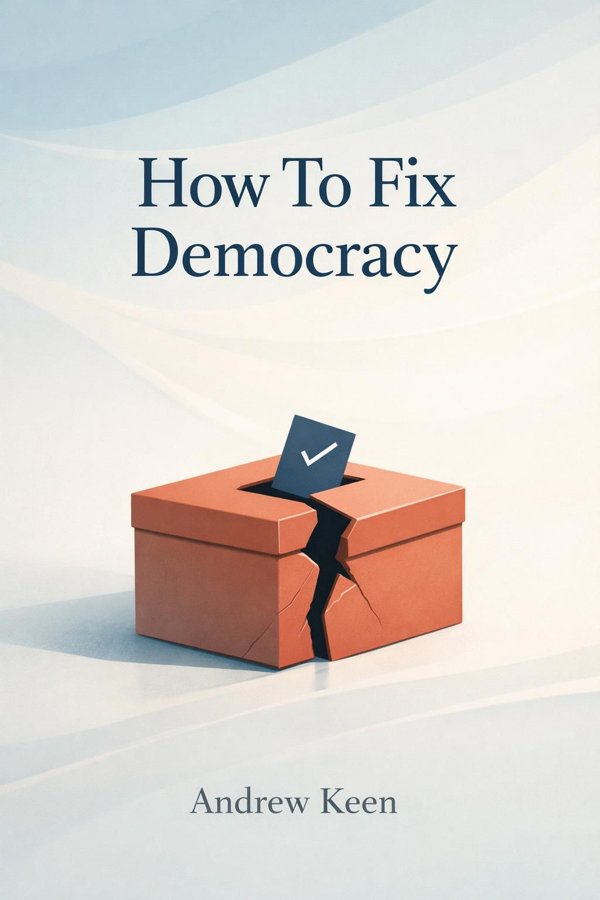
How To Fix Democracy: Summary & Key Insights
by Andrew Keen
 10 min8 chaptersAudio available
Key Takeaways from How To Fix Democracy
A democracy rarely dies all at once; more often, it erodes when citizens stop trusting the people and institutions meant to represent them.
The internet did not invent democratic dysfunction, but it has intensified nearly every existing weakness.
It is easy to dismiss populism as irrational anger or crude political theater, but Keen encourages readers to see it first as a symptom.
Democracy cannot be defended honestly if it is treated as already perfect.
A democracy is only as healthy as the habits of mind practiced by its citizens.
What Is How To Fix Democracy About?
How To Fix Democracy by Andrew Keen is a politics book. How To Fix Democracy by Andrew Keen is a timely and provocative examination of the political, technological, and cultural pressures destabilizing democratic life in the twenty-first century. Rather than offering a single neat formula, the book gathers essays, interviews, and reflections that confront the core question of our age: why do so many citizens feel disillusioned with democracy, and what can realistically be done to restore trust, legitimacy, and civic participation? Keen explores the rise of populism, the influence of digital platforms, the weakening of institutions, and the growing sense that liberal democracy no longer delivers fairness or belonging for many people. What makes the book especially compelling is its range. It moves across countries, crises, and ideas, drawing on conversations with thinkers, journalists, and political observers to map a fractured democratic landscape. Keen writes with urgency, but also with skepticism toward simplistic solutions. As a longtime commentator on technology, culture, and politics, he brings authority to the subject, particularly in showing how digital life has altered public debate. This is a book for readers who want to understand not only what is going wrong with democracy, but how renewal might still be possible.
This FizzRead summary covers all 8 key chapters of How To Fix Democracy in approximately 10 minutes, distilling the most important ideas, arguments, and takeaways from Andrew Keen's work. Also available as an audio summary and Key Quotes Podcast.
How To Fix Democracy
How To Fix Democracy by Andrew Keen is a timely and provocative examination of the political, technological, and cultural pressures destabilizing democratic life in the twenty-first century. Rather than offering a single neat formula, the book gathers essays, interviews, and reflections that confront the core question of our age: why do so many citizens feel disillusioned with democracy, and what can realistically be done to restore trust, legitimacy, and civic participation? Keen explores the rise of populism, the influence of digital platforms, the weakening of institutions, and the growing sense that liberal democracy no longer delivers fairness or belonging for many people. What makes the book especially compelling is its range. It moves across countries, crises, and ideas, drawing on conversations with thinkers, journalists, and political observers to map a fractured democratic landscape. Keen writes with urgency, but also with skepticism toward simplistic solutions. As a longtime commentator on technology, culture, and politics, he brings authority to the subject, particularly in showing how digital life has altered public debate. This is a book for readers who want to understand not only what is going wrong with democracy, but how renewal might still be possible.
Who Should Read How To Fix Democracy?
This book is perfect for anyone interested in politics and looking to gain actionable insights in a short read. Whether you're a student, professional, or lifelong learner, the key ideas from How To Fix Democracy by Andrew Keen will help you think differently.
- ✓Readers who enjoy politics and want practical takeaways
- ✓Professionals looking to apply new ideas to their work and life
- ✓Anyone who wants the core insights of How To Fix Democracy in just 10 minutes
Want the full summary?
Get instant access to this book summary and 100K+ more with Fizz Moment.
Get Free SummaryAvailable on App Store • Free to download
Key Chapters
A democracy rarely dies all at once; more often, it erodes when citizens stop trusting the people and institutions meant to represent them. One of the central insights in How To Fix Democracy is that the crisis facing democratic societies is not simply ideological disagreement, but the collapse of confidence in parliaments, parties, journalists, experts, and even electoral systems themselves. When citizens begin to believe that everything is rigged, corrupted, or manipulated, democratic procedures may still exist, yet their legitimacy starts to drain away.
Keen shows that distrust does not emerge from nowhere. It is fueled by widening inequality, repeated political disappointments, elite arrogance, and the sense that ordinary people are heard only during elections and ignored afterward. In that environment, demagogues flourish. They present themselves as authentic outsiders, even when they belong to the same power structures they criticize. Their appeal lies less in policy detail than in emotional recognition: they seem to validate popular frustration.
This matters because democracy depends on more than voting. It requires citizens to believe that institutions, however imperfect, can still be reformed rather than destroyed. A society that views every court ruling, news report, or election result as inherently illegitimate cannot sustain democratic compromise for long. You can see this dynamic in polarized countries where each side assumes the other is not merely wrong, but fundamentally fraudulent.
The practical implication is clear. Repairing democracy means rebuilding trust through transparency, accountability, and visible responsiveness. Governments need to explain decisions better, admit failures honestly, and create more meaningful channels for public participation between elections. Institutions must earn trust instead of demanding it.
Actionable takeaway: If you want democracy to recover, start by supporting leaders and institutions that practice transparency, accountability, and respectful engagement rather than outrage and permanent blame.
The internet did not invent democratic dysfunction, but it has intensified nearly every existing weakness. Keen argues that digital platforms have transformed public life in ways that reward speed over reflection, emotion over evidence, and visibility over wisdom. In theory, online media promised a more open and participatory democracy. In practice, it has often fragmented the public sphere, undermined trusted intermediaries, and turned politics into a continuous performance.
A healthy democracy needs common ground: shared facts, trusted procedures, and spaces where disagreement can occur without total breakdown. Social media often works against all three. Algorithms privilege content that captures attention, and outrage is one of the most reliable attention magnets. That means provocative falsehoods, conspiracies, and tribal messaging often travel faster than nuanced analysis. Citizens are not merely informed by digital systems; they are shaped by them.
Keen is particularly alert to the political consequences of this shift. When people consume information in customized feeds, public debate becomes less collective and more isolated. Individuals feel connected, yet they inhabit different realities. Political actors exploit this by targeting messages to narrow audiences, bypassing traditional scrutiny. The result is a democracy that feels louder but not necessarily more informed.
This does not mean technology is inherently anti-democratic. Digital tools can expand access to information, expose corruption, and mobilize civic action. But those benefits do not emerge automatically. They depend on regulation, digital literacy, platform accountability, and a cultural willingness to slow down judgment.
Examples include election misinformation campaigns, viral rumors during crises, and online harassment that discourages serious public participation. In each case, the medium affects not just how politics is communicated, but what kind of politics becomes possible.
Actionable takeaway: Treat digital content with disciplined skepticism, diversify your information sources, and support platform rules and media habits that strengthen truth, context, and civic responsibility.
It is easy to dismiss populism as irrational anger or crude political theater, but Keen encourages readers to see it first as a symptom. Populist movements rise where citizens feel abandoned by established parties, ignored by institutions, and humiliated by economic or cultural change. Their slogans may oversimplify, but the resentment beneath them often reflects real democratic failures.
This is one of the book’s most important contributions: it refuses the comfortable illusion that liberal democracy can be preserved simply by condemning its loudest critics. If millions of voters reject centrist parties, support anti-system candidates, or embrace nationalist rhetoric, the response cannot be limited to moral outrage. Democratic repair requires understanding what these citizens believe they have lost: economic security, social recognition, local identity, or control over collective decisions.
Keen does not romanticize populism. He recognizes that many populist leaders weaken institutions, scapegoat minorities, and weaponize distrust for personal gain. Yet he also suggests that ignoring the social conditions that nourish populism is politically reckless. When elites portray discontented voters as merely ignorant or backward, they deepen the divide they claim to oppose.
A practical example can be seen in deindustrialized regions where communities once built around stable work now experience decline, resentment, and invisibility. In such places, democracy feels abstract while disruption feels concrete. Populists succeed because they name the betrayal, even if they misdiagnose the cure.
The challenge, then, is not to imitate populism, but to answer the needs it exploits. That means restoring economic opportunity, rebuilding local institutions, respecting cultural anxieties without endorsing exclusion, and giving citizens more reasons to believe democracy serves them.
Actionable takeaway: Instead of mocking populist discontent, ask what unmet needs or broken institutions are driving it, then focus on solutions that restore dignity, representation, and practical security.
Democracy cannot be defended honestly if it is treated as already perfect. A recurring theme in How To Fix Democracy is that liberal democracies have too often relied on self-congratulation rather than self-correction. They celebrate openness, rights, and pluralism, yet frequently fail to address structural inequality, policy stagnation, and public alienation. The danger is not only that critics attack democracy, but that defenders become complacent.
Keen’s broader argument suggests that democratic systems endure not because they avoid failure, but because they possess the capacity to reform themselves. That capacity weakens when institutions become insulated, technocratic, or overly dependent on old assumptions about legitimacy. If political parties no longer represent broad coalitions, if media institutions lose credibility, and if policymaking appears detached from lived experience, democracy starts to look procedural rather than meaningful.
This helps explain why calls to simply “protect democracy” often ring hollow. People want to know what exactly is being protected: stagnant elites, distant bureaucracies, and symbolic participation, or a living system capable of adaptation? Democratic resilience depends on the latter. Reform might involve electoral modernization, stronger anti-corruption mechanisms, decentralization, civic education, or new forms of citizen deliberation.
The book’s strength lies in its willingness to insist that defending democracy and criticizing it are not opposites. In fact, serious criticism may be the most democratic act of all when it aims to improve institutions rather than destroy them. A functioning democracy should invite scrutiny, not fear it.
In practical terms, citizens, journalists, educators, and policymakers all share responsibility. Reform is not just a constitutional matter; it is also cultural. Societies must normalize debate about institutional redesign before crisis forces abrupt rupture.
Actionable takeaway: Support democratic reform, not democratic nostalgia; ask how institutions can become more representative, accountable, and adaptive rather than merely preserving the status quo.
A democracy is only as healthy as the habits of mind practiced by its citizens. Keen emphasizes that institutional design matters, but institutions alone cannot save a society whose civic culture has become shallow, reactive, or manipulated. Democracy depends on people who can tolerate disagreement, assess evidence, resist simplistic narratives, and remain engaged even when politics becomes frustrating or slow.
This is where civic culture becomes crucial. Many democratic crises are also crises of attention, education, and public responsibility. If citizens consume politics mainly as entertainment, identify opponents as enemies, or mistake virality for truth, democratic life grows brittle. The problem is not that everyone must become an expert. It is that democratic participation requires a baseline commitment to seriousness.
Keen’s concern intersects strongly with media literacy and public education. Schools, universities, families, and civic organizations all help shape whether people understand rights as connected to duties, and whether freedom of expression is paired with the discipline of listening. In polarized environments, these capacities are not luxuries; they are democratic infrastructure.
Examples are easy to find. A citizen who reads only headlines may spread misinformation unintentionally. A voter who never encounters credible opposing views may become more ideologically rigid. A local community with no civic institutions beyond partisan media may lose the practice of collective problem-solving. By contrast, communities with town halls, libraries, debate forums, and strong local journalism often maintain thicker democratic habits.
The book suggests that fixing democracy is not merely about replacing leaders. It is about cultivating citizens capable of sustaining democratic norms in everyday life. That means curiosity over certainty, patience over instant reaction, and participation over cynical withdrawal.
Actionable takeaway: Strengthen your own civic habits by reading broadly, checking sources, engaging respectfully with disagreement, and participating in local institutions where democracy is practiced face to face.
Modern democracies are asked to solve problems that do not respect national borders, and this creates a deep political strain. Keen highlights a key contradiction of contemporary governance: citizens vote in national systems, but many of the most urgent challenges they face, from climate change to migration to digital regulation, are transnational. This gap between political structure and political reality fuels frustration and confusion.
When voters feel that elected leaders cannot truly control the forces shaping their lives, democratic legitimacy suffers. Governments appear weak, evasive, or dishonest, even when they are confronting genuinely complex constraints. Populists often exploit this by promising simple acts of regained sovereignty: close the border, leave the treaty, punish the outsider, restore control. These promises resonate emotionally because they seem to restore agency. Yet many such solutions fail because the underlying problems remain international.
Keen’s perspective is valuable because he does not reduce democracy to domestic party competition. He situates it in a world of interconnected systems where financial flows, online speech, pandemics, and environmental threats cross borders instantly. The democratic challenge is to create forms of cooperation that are effective without becoming remote and unaccountable.
A practical example is digital governance. A single country may struggle to regulate a global technology platform whose infrastructure, data systems, and business model span continents. The same is true for tax avoidance by multinational corporations or coordinated disinformation campaigns. National politics alone cannot address them adequately.
This does not mean democracy is obsolete. It means democratic thinking must expand beyond old assumptions. Citizens need leaders who can explain interdependence honestly, while also making international cooperation more transparent and democratically legitimate.
Actionable takeaway: Be wary of political solutions that promise total national control over global problems; support leaders and policies that combine democratic accountability with realistic international cooperation.
Political moderation is not automatically virtuous; it must prove that it can respond to real urgency. One of the underlying tensions in How To Fix Democracy is the weakness of the political center in an era of rage, inequality, and institutional distrust. Centrist politics often presents itself as sensible and responsible, but when it becomes synonymous with managerial drift, technocratic language, and lack of imagination, it loses democratic energy.
Keen’s work points toward an uncomfortable truth for establishment politics: many voters no longer reject the center because they hate compromise, but because they believe compromise has delivered too little. If moderation means preserving a broken status quo, it will be outcompeted by movements that at least offer emotional clarity and visible conviction. The center cannot survive on tone alone.
This matters because healthy democracies do need mediating forces. They need parties and institutions capable of balancing competing interests, resisting extremism, and turning conflict into policy. But the center remains credible only when it is reformist rather than merely defensive. It must address housing costs, wage stagnation, regional inequality, public service decline, and social fragmentation with seriousness and boldness.
A practical lesson is visible in political campaigns that emphasize competence without narrative. Voters may appreciate stability, but they also want meaning, fairness, and evidence that leaders understand everyday insecurity. A centrist platform that talks only in abstractions about growth or efficiency often fails to connect. One that combines pragmatism with moral purpose stands a better chance.
Keen’s broader democratic vision suggests that the answer to extremism is not passivity, but credible renewal. Moderation should be a method of governing, not an excuse for timidity.
Actionable takeaway: Judge centrist or establishment leaders not by their claims of reasonableness alone, but by whether they offer concrete, ambitious reforms that address citizens’ lived frustrations.
Democracy is sustained not only by constitutions and elections, but by conversation. Because How To Fix Democracy is built partly through essays and interviews, it models a crucial democratic principle: difficult problems become clearer when competing perspectives are aired seriously rather than reduced to slogans. In a polarized age, that approach is more radical than it may first appear.
Keen’s method reflects his message. Democratic decline is accelerated when public discourse becomes performative, tribal, and simplified for maximum emotional effect. Slogans mobilize, but they rarely clarify. They flatten complexity into moral certainty and encourage people to treat politics as identity warfare. By contrast, interviews and reflective essays make space for ambiguity, contradiction, and revision. They remind readers that understanding is often dialogic.
This has practical implications well beyond the book. Citizens often inherit political opinions from their social circles, media ecosystems, or partisan loyalties. Without conversation across difference, those opinions harden into dogma. A democratic culture needs forums where disagreement does not automatically imply contempt. That could mean public debates, local assemblies, independent media, classrooms, podcasts, or simply disciplined personal conversations.
Of course, dialogue is not a cure-all. Some actors operate in bad faith, and not every conflict can be solved by talking. But democracies become more brittle when citizens lose the capacity to listen seriously to views they oppose. Once politics becomes pure denunciation, compromise starts to look like betrayal.
The form of Keen’s book therefore carries its own lesson: democracy can be repaired partly by rebuilding practices of inquiry and exchange. Better questions may matter as much as louder answers.
Actionable takeaway: Create space in your own life for serious political conversation with people outside your ideological bubble, aiming first to understand the argument rather than to win the exchange.
All Chapters in How To Fix Democracy
About the Author
Andrew Keen is a British-American author, entrepreneur, and public intellectual known for his sharp critiques of digital culture and its social consequences. He first gained wide attention with books such as The Cult of the Amateur and The Internet Is Not the Answer, which challenged the idea that the internet automatically creates more openness, equality, or wisdom. Over the years, Keen has written and spoken extensively about technology, media, politics, and the future of public life, often focusing on how digital platforms reshape truth, authority, and democracy. He has also hosted interviews and conversations with major thinkers, bringing a broad international perspective to contemporary issues. In How To Fix Democracy, Keen draws on that background to examine the political turmoil of the modern era with skepticism, urgency, and intellectual range.
Get This Summary in Your Preferred Format
Read or listen to the How To Fix Democracy summary by Andrew Keen anytime, anywhere. FizzRead offers multiple formats so you can learn on your terms — all free.
Available formats: App · Audio · PDF · EPUB — All included free with FizzRead
Download How To Fix Democracy PDF and EPUB Summary
Key Quotes from How To Fix Democracy
“A democracy rarely dies all at once; more often, it erodes when citizens stop trusting the people and institutions meant to represent them.”
“The internet did not invent democratic dysfunction, but it has intensified nearly every existing weakness.”
“It is easy to dismiss populism as irrational anger or crude political theater, but Keen encourages readers to see it first as a symptom.”
“Democracy cannot be defended honestly if it is treated as already perfect.”
“A democracy is only as healthy as the habits of mind practiced by its citizens.”
Frequently Asked Questions about How To Fix Democracy
How To Fix Democracy by Andrew Keen is a politics book that explores key ideas across 8 chapters. How To Fix Democracy by Andrew Keen is a timely and provocative examination of the political, technological, and cultural pressures destabilizing democratic life in the twenty-first century. Rather than offering a single neat formula, the book gathers essays, interviews, and reflections that confront the core question of our age: why do so many citizens feel disillusioned with democracy, and what can realistically be done to restore trust, legitimacy, and civic participation? Keen explores the rise of populism, the influence of digital platforms, the weakening of institutions, and the growing sense that liberal democracy no longer delivers fairness or belonging for many people. What makes the book especially compelling is its range. It moves across countries, crises, and ideas, drawing on conversations with thinkers, journalists, and political observers to map a fractured democratic landscape. Keen writes with urgency, but also with skepticism toward simplistic solutions. As a longtime commentator on technology, culture, and politics, he brings authority to the subject, particularly in showing how digital life has altered public debate. This is a book for readers who want to understand not only what is going wrong with democracy, but how renewal might still be possible.
You Might Also Like

Antifa: The Anti-Fascist Handbook
Mark Bray
10 min
Attack from Within: How Disinformation Is Sabotaging America
Barbara McQuade
10 min
Coercion, Capital, and European States, AD 990–1992
Charles Tilly
10 min
Digital Democracy: Concepts, Methodologies, Tools, and Applications
Various Authors
10 min
Fascism
Stanley G. Payne
10 min
Fire And Fury: Inside The Trump White House
Michael Wolff
10 minBrowse by Category
Ready to read How To Fix Democracy?
Get the full summary and 100K+ more books with Fizz Moment.