
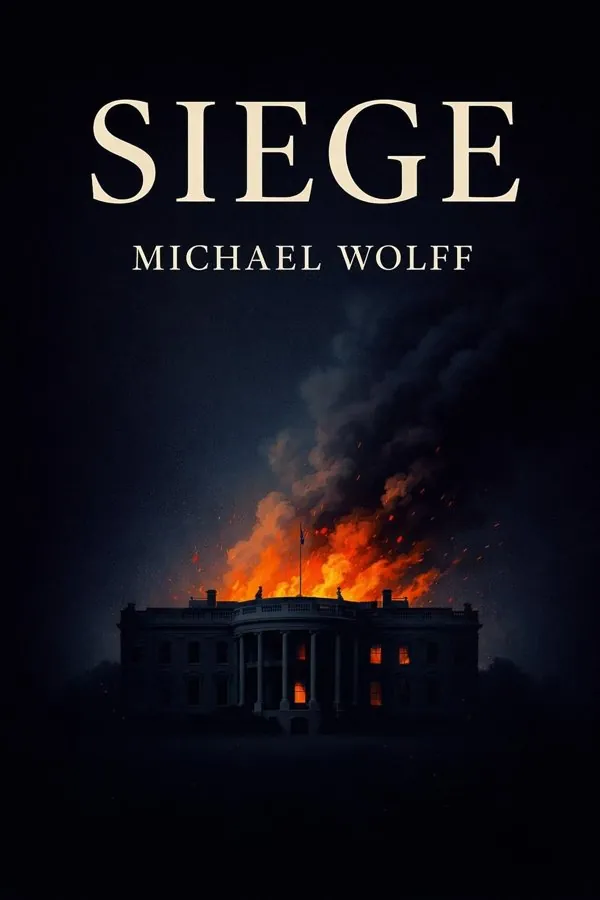
Siege: Summary & Key Insights
 10 min10 chaptersAudio available
What Is Siege About?
Siege by Michael Wolff is a politics book spanning 10 pages. “Siege: Trump Under Fire” is the sequel to Michael Wolff’s bestselling exposé “Fire and Fury.” It chronicles the second year of Donald Trump’s presidency, portraying the internal chaos, political struggles, and personal conflicts within the White House. Drawing on insider accounts, Wolff depicts a presidency under siege from investigations, staff turnover, and growing isolation.
This FizzRead summary covers all 10 key chapters of Siege in approximately 10 minutes, distilling the most important ideas, arguments, and takeaways from Michael Wolff's work. Also available as an audio summary and Key Quotes Podcast.
Siege
“Siege: Trump Under Fire” is the sequel to Michael Wolff’s bestselling exposé “Fire and Fury.” It chronicles the second year of Donald Trump’s presidency, portraying the internal chaos, political struggles, and personal conflicts within the White House. Drawing on insider accounts, Wolff depicts a presidency under siege from investigations, staff turnover, and growing isolation.
Who Should Read Siege?
This book is perfect for anyone interested in politics and looking to gain actionable insights in a short read. Whether you're a student, professional, or lifelong learner, the key ideas from Siege by Michael Wolff will help you think differently.
- ✓Readers who enjoy politics and want practical takeaways
- ✓Professionals looking to apply new ideas to their work and life
- ✓Anyone who wants the core insights of Siege in just 10 minutes
Want the full summary?
Get instant access to this book summary and 100K+ more with Fizz Moment.
Get Free SummaryAvailable on App Store • Free to download
Key Chapters
If the first year of Trump’s presidency was about daring the world to hold him accountable, the second was about the reckoning he could no longer avoid. The Mueller investigation was not simply a legal inquiry; it was a gravitational center that bent every decision, every whisper, every tweet toward its pull.
From the inside, the administration spoke of Mueller as both ghost and executioner—someone who could neither be seen nor stopped. The leaks about indictments and grand juries reached Trump’s desk like tremors before an earthquake. Advisors cycled between defiance and despair, drafting talking points one day, preparing damage control the next.
For Trump, the investigation was personal—a betrayal, an affront to his legitimacy. He viewed every subpoena as an act of political warfare, every cooperating witness as a traitor. Where previous presidents met investigations with strategy, Trump met them with instinct—firing off tweets, floating pardons, or demanding loyalty pledges from those around him.
What fascinated me most was not the legal intricacies but the psychology of paranoia it fostered. People whispered in hallways, phones were checked for bugs, and trust steadily evaporated. It was as if the presidency itself had become an exercise in survival, not governance. The investigation broke open the White House’s internal logic: every conversation turned on the question of who might turn next.
That siege mindset—us versus them—defined the year. And as Mueller’s work continued, Trump’s circle shrank to near invisibility.
If you want to understand chaos, watch what happens when loyalty becomes the only qualification for power. In Trump’s orbit, the real test wasn’t competence, but devotion—how loudly one could proclaim it, how long one could survive after failing to prove it.
The exodus began with Hope Hicks, whose departure left not only an emotional gap but a symbolic one: Trump’s most trusted gatekeeper was gone. Soon followed other heavyweights—H.R. McMaster, John Kelly—each removal both a spectacle and a warning. The walls of the West Wing became revolving doors; people entered with purpose and left in silence, escorted by security, their access badges disabled by the end of the day.
I wasn’t interested merely in listing the names; I wanted to capture the atmosphere of collapse, the fatigue of those who stayed, the strange blend of ambition and fear that hummed through every room. Everyone, it seemed, believed they were indispensable until the tweet announcing otherwise appeared.
As internal order disintegrated, Trump’s method of management—a mix of improvisation, flattery, and intimidation—took over completely. Meetings dissolved into shouting matches, directives contradicted one another, and staffers began keeping private records of every request, every outburst, in case the law or history called them to account. The White House functioned not as a team, but as concentric circles of self-preservation.
+ 8 more chapters — available in the FizzRead app
All Chapters in Siege
About the Author
Michael Wolff is an American journalist, author, and columnist known for his investigative works on media and politics. He has written for publications such as The Guardian, USA Today, and The Hollywood Reporter, and is best known for his books on the Trump administration, including “Fire and Fury” and “Siege.”
Get This Summary in Your Preferred Format
Read or listen to the Siege summary by Michael Wolff anytime, anywhere. FizzRead offers multiple formats so you can learn on your terms — all free.
Available formats: App · Audio · PDF · EPUB — All included free with FizzRead
Download Siege PDF and EPUB Summary
Key Quotes from Siege
“If the first year of Trump’s presidency was about daring the world to hold him accountable, the second was about the reckoning he could no longer avoid.”
“If you want to understand chaos, watch what happens when loyalty becomes the only qualification for power.”
Frequently Asked Questions about Siege
Siege by Michael Wolff is a politics book that explores key ideas across 10 chapters. “Siege: Trump Under Fire” is the sequel to Michael Wolff’s bestselling exposé “Fire and Fury.” It chronicles the second year of Donald Trump’s presidency, portraying the internal chaos, political struggles, and personal conflicts within the White House. Drawing on insider accounts, Wolff depicts a presidency under siege from investigations, staff turnover, and growing isolation.
More by Michael Wolff
You Might Also Like
Antifa: The Anti-Fascist Handbook
Mark Bray
10 min
Attack from Within: How Disinformation Is Sabotaging America
Barbara McQuade
10 min
Coercion, Capital, and European States, AD 990–1992
Charles Tilly
10 min
Digital Democracy: Concepts, Methodologies, Tools, and Applications
Various Authors
10 min
Fascism
Stanley G. Payne
10 min
Fire And Fury: Inside The Trump White House
Michael Wolff
10 minBrowse by Category
Ready to read Siege?
Get the full summary and 100K+ more books with Fizz Moment.