
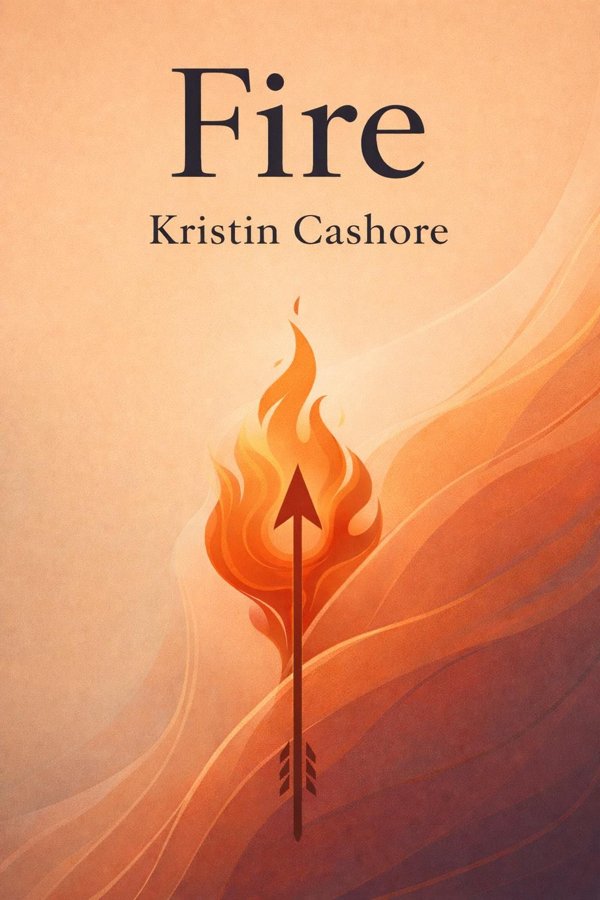
Fire: Summary & Key Insights
 10 min9 chaptersAudio available
Key Takeaways from Fire
The cruelest kind of isolation is not being physically alone, but being unable to trust what others feel toward you.
Affection becomes dangerous when it ignores freedom.
Being needed by a system does not mean being welcomed by it.
The deepest forms of love are often built not on intensity, but on steadiness.
Power becomes morally complicated when it can bypass another person’s full freedom.
What Is Fire About?
Fire by Kristin Cashore is a scifi_fantasy book spanning 6 pages. What if the very qualities that make you extraordinary also make you dangerous? Kristin Cashore’s Fire, a companion novel set in the Graceling Realm, explores that unsettling question through the story of a young woman whose beauty can bend minds, stir obsession, and reshape political destinies. In the lush and volatile kingdom of the Dells, Fire is the last human monster: a rare being blessed with stunning appearance, heightened abilities, and a power that can influence the thoughts of others. But her gifts come with a terrible inheritance, because her father used similar powers for cruelty, manipulation, and ruin. As war threatens the kingdom, Fire is pulled into court politics, military strategy, and intimate moral dilemmas. Cashore turns what could have been a simple fantasy adventure into a rich examination of consent, power, trauma, duty, and self-definition. The novel matters because it asks timeless questions: How do we live ethically when we have influence over others? Can we separate ourselves from the harm done by those who came before us? And what does love look like when trust must be earned rather than claimed? Cashore, celebrated for creating emotionally complex heroines, delivers a fantasy that is both atmospheric and deeply human.
This FizzRead summary covers all 9 key chapters of Fire in approximately 10 minutes, distilling the most important ideas, arguments, and takeaways from Kristin Cashore's work. Also available as an audio summary and Key Quotes Podcast.
Fire
What if the very qualities that make you extraordinary also make you dangerous? Kristin Cashore’s Fire, a companion novel set in the Graceling Realm, explores that unsettling question through the story of a young woman whose beauty can bend minds, stir obsession, and reshape political destinies. In the lush and volatile kingdom of the Dells, Fire is the last human monster: a rare being blessed with stunning appearance, heightened abilities, and a power that can influence the thoughts of others. But her gifts come with a terrible inheritance, because her father used similar powers for cruelty, manipulation, and ruin.
As war threatens the kingdom, Fire is pulled into court politics, military strategy, and intimate moral dilemmas. Cashore turns what could have been a simple fantasy adventure into a rich examination of consent, power, trauma, duty, and self-definition. The novel matters because it asks timeless questions: How do we live ethically when we have influence over others? Can we separate ourselves from the harm done by those who came before us? And what does love look like when trust must be earned rather than claimed? Cashore, celebrated for creating emotionally complex heroines, delivers a fantasy that is both atmospheric and deeply human.
Who Should Read Fire?
This book is perfect for anyone interested in scifi_fantasy and looking to gain actionable insights in a short read. Whether you're a student, professional, or lifelong learner, the key ideas from Fire by Kristin Cashore will help you think differently.
- ✓Readers who enjoy scifi_fantasy and want practical takeaways
- ✓Professionals looking to apply new ideas to their work and life
- ✓Anyone who wants the core insights of Fire in just 10 minutes
Want the full summary?
Get instant access to this book summary and 100K+ more with Fizz Moment.
Get Free SummaryAvailable on App Store • Free to download
Key Chapters
The cruelest kind of isolation is not being physically alone, but being unable to trust what others feel toward you. Fire lives inside that paradox. She is admired everywhere she goes, yet that admiration is poisoned by fear, desire, and the corrupting influence of her monster beauty. As the last human monster in the Dells, she carries not only unusual power but also the legacy of her father, Cansrel, whose manipulation and cruelty left the kingdom scarred. Fire’s identity is therefore shaped by suspicion before she even speaks. People do not meet her as herself; they meet the memory of what her father did.
Cashore uses Fire’s position to explore a powerful emotional truth: inheritance is not destiny, but it is a burden. Many people know what it feels like to carry a family story they did not choose, whether it is a parent’s reputation, a community stereotype, or a history of harm. Fire’s struggle mirrors the real challenge of building an ethical life when others expect you to repeat the past. She resists using her mind powers casually, avoids exploiting people who are vulnerable to her, and constantly questions whether her intentions are honorable. That restraint is not weakness. It is moral discipline.
The Dells itself reflects this theme. Its beauty is vivid and intoxicating, yet danger lurks beneath the surface, just as Fire’s appearance conceals the emotional cost of being so desired. Her world becomes a beautiful prison because admiration limits freedom as effectively as chains.
In everyday life, the lesson is clear: power should be treated as responsibility, not entitlement. Whether your influence comes from charisma, status, intelligence, beauty, or authority, the first ethical question is not what you can do, but what you should do. Actionable takeaway: identify one form of influence you have over others and set a personal boundary for how you will use it responsibly.
Affection becomes dangerous when it ignores freedom. One of Fire’s most emotionally charged relationships is with Archer, her childhood companion and first lover. Their bond is intense, familiar, and tangled in years of dependence. Archer loves Fire with devotion, but his love is also possessive, immature, and shaped by a need to claim her closeness. He sees himself as her protector, yet he often fails to recognize that real protection must include respect for autonomy.
Through Archer, Cashore examines a difficult but necessary truth: not all intimacy is healthy simply because it is deep. Fire cares for him, understands his wounds, and remembers the comfort they once gave each other. But history does not erase imbalance. Archer’s emotional demands make it hard for Fire to breathe as an independent person. His affection often pressures her to reassure, soothe, and accommodate, even when she is already carrying the weight of war and public scrutiny.
This dynamic feels strikingly real beyond fantasy. Many relationships, romantic or otherwise, are sustained by habit and emotional dependency rather than mutual growth. Someone may genuinely love you and still fail to honor your boundaries. Fire’s journey shows that choosing distance from a beloved person can be an act of integrity rather than betrayal. She does not reject love itself; she rejects the version of love that consumes rather than supports.
Cashore also avoids simplistic moralizing. Archer is not a cartoon villain. He is vulnerable, charming, and deeply human. That complexity matters because unhealthy attachment rarely looks monstrous at first. It often looks familiar, flattering, and difficult to untangle.
For readers, the practical lesson is to ask whether a close relationship increases your freedom to become yourself or narrows your emotional world around another person’s needs. Actionable takeaway: reflect on one important relationship and name one boundary that would make it healthier, clearer, or more respectful.
Being needed by a system does not mean being welcomed by it. When Fire is summoned to King Nash’s court, she enters a world where her gifts are invaluable but her presence is unsettling. The kingdom faces political instability and the threat of war, and Fire’s ability to read and influence minds could help uncover deception, shape strategy, and prevent catastrophe. Yet the same nobles and leaders who need her are wary of her, because her power unsettles the very idea of consent and trust.
This section of the novel transforms Fire from a secluded figure into a reluctant political actor. Court life forces her to confront a difficult reality: moral purity is easier at a distance. Once she is involved in governance, military planning, and intelligence gathering, every decision becomes compromised by urgency. Should she enter the minds of prisoners? Should she manipulate enemies to save lives? Should she lend her beauty and power to a crown that benefits from both? Cashore does not offer easy answers. Instead, she shows the tension between ideal ethics and crisis ethics.
The court also reveals how institutions often treat exceptional people. They are celebrated when useful, distrusted when independent, and blamed when outcomes become uncomfortable. Fire’s experience resembles the modern workplace or public life, where talented individuals are frequently asked to solve problems without being granted dignity, security, or emotional understanding in return.
What makes this idea compelling is that duty in Fire is never glamorous for long. It is exhausting, morally ambiguous, and often thankless. Yet Fire accepts it because refusing to act would also be a choice with consequences.
The practical insight is that responsibility often arrives before comfort or confidence. You may not be fully trusted, fully prepared, or fully safe when called to contribute. Actionable takeaway: when facing a difficult responsibility, define your non-negotiable ethical limit before you begin, so urgency does not erase your principles.
The deepest forms of love are often built not on intensity, but on steadiness. Brigan, the king’s brother and military commander, enters Fire’s life as someone who is skeptical, disciplined, and difficult to win over. Unlike others who are dazzled by Fire’s beauty or frightened by her reputation, Brigan tries to see her clearly. His caution initially wounds her, but it also creates the conditions for something she rarely experiences: trust that is earned rather than enchanted.
Their relationship becomes one of the novel’s richest achievements. Cashore does not rush it into fantasy romance conventions. Instead, Fire and Brigan grow closer through work, honesty, and observation. He values her judgment, yet he also questions her methods. She admires his strength, yet she sees his grief, restraint, and protectiveness. Their bond forms in the space where neither person owns the other’s vulnerability. That is what makes it healing.
Brigan matters because he offers Fire a relationship untouched by the entitlement that shapes so many others around her. He does not assume access to her mind, body, or emotions. He learns her limits. He respects her fear. He notices her pain. In turn, Fire discovers that love need not feel like surrender. It can feel like being met.
This dynamic has practical relevance for anyone rethinking what healthy attachment looks like. Grand declarations can be seductive, but dependable care is what makes intimacy sustainable. A trustworthy partner does not merely desire you; they make room for your complexity. They do not erase your scars, but they do not exploit them either.
The broader lesson is that healing often begins when we are seen without being consumed. Actionable takeaway: in your closest relationships, pay attention to consistency over intensity and ask whether trust is being built through respect, patience, and honest communication.
Power becomes morally complicated when it can bypass another person’s full freedom. Fire’s beauty is not ordinary attractiveness; it is a supernatural force that draws attention, weakens resistance, and can amplify her influence over people’s thoughts and emotions. Combined with her mind-reading and mind-bending abilities, this makes every interaction ethically charged. Cashore turns these fantasy elements into a sophisticated meditation on consent.
Fire knows that desire directed at her is often not entirely chosen. That knowledge isolates her because she can never fully trust admiration. When someone is charmed, softened, or mentally exposed in her presence, is their response real? This question shapes her cautious behavior and explains why she is so careful with those around her. She understands that the line between persuasion and violation can be crossed long before anyone notices.
This is one of the novel’s most contemporary themes. In real life, influence takes many forms: charisma, beauty, social power, money, expertise, public platforms, and emotional leverage. We may not be able to enter minds literally, but we can still pressure others without overt force. Fire invites readers to think beyond legality or intention and focus on the internal experience of the person being influenced. Did they have genuine room to choose? Were they free to disagree without consequence? Were they treated as a full person or as an instrument?
Cashore’s accomplishment lies in making ethics intimate rather than abstract. Fire’s restraint is painful because it often requires her to deny herself easier solutions. But that refusal is exactly what gives her moral depth. She knows that having the power to compel does not create the right to use it.
The practical takeaway is simple but demanding: whenever you hold an advantage in a relationship or decision, actively create space for the other person’s autonomy. Actionable takeaway: in your next important conversation, pause to ask whether the other person truly has freedom to say no, disagree, or choose differently.
In times of conflict, people reveal not only what they fear, but what they are willing to become. As war closes in on the Dells, Fire is forced into ever more painful decisions involving espionage, strategy, divided loyalties, and personal sacrifice. The political tensions of the novel sharpen into direct crisis, and long-hidden truths emerge about family, allegiance, and the emotional costs of survival. Cashore uses the war plot not simply to raise stakes, but to test every moral principle Fire has tried to protect.
What makes this part of the story compelling is that victory is never presented as clean. Every tactical advantage comes with an ethical price. Fire’s powers could shorten suffering, but they could also dehumanize enemies and compromise her own sense of self. The novel insists that methods matter, even under pressure. This is especially visible in the theme of mercy. Mercy in Fire is not weakness, sentimentality, or naïveté. It is the deliberate refusal to let violence define what is permissible.
Revelation also plays a major role here. As secrets come to light, Fire must revise her understanding of the people she loves and the narratives she has inherited. This reflects a universal experience: maturity often requires us to outgrow simple stories about good and evil, loyalty and betrayal, victimhood and responsibility.
The real-world application is powerful. Under stress, people often justify actions they would normally condemn. Emergency becomes an excuse for cruelty, impatience, or moral shortcuts. Fire reminds us that crisis does not eliminate character; it exposes it. Choosing mercy may not always feel efficient, but it preserves the kind of person you remain afterward.
Actionable takeaway: when facing conflict, define one line you will not cross, even if crossing it would make success easier. Protecting your values in hard moments is how integrity survives.
Grief is not only sadness over what is gone; it is the painful work of discovering who you are without it. By the end of Fire, loss has touched nearly every part of the protagonist’s life: family history, romantic attachment, physical safety, certainty about the future, and old versions of herself. Cashore treats grief with unusual tenderness. She shows that healing is not a dramatic transformation but a gradual rearranging of identity after pain.
Fire’s arc is especially moving because so much of her suffering is tied to what others projected onto her. Throughout the novel, she has been defined as a daughter, a weapon, an object of desire, a symbol of danger, and a political tool. Grief creates space for a different question: Who is Fire when she is no longer trying to answer everyone else’s fears? The answer does not come all at once. It emerges through choices, boundaries, and the quiet rebuilding of trust.
This theme resonates far beyond the novel. Many readers know the experience of losing not only people, but roles, identities, and assumptions. A breakup, family rupture, illness, career collapse, or betrayal can force a painful but necessary reconstruction of the self. Fire suggests that grief can become clarifying when it strips away what was never truly yours to carry.
Importantly, recovery in the novel does not mean forgetting wounds. It means integrating them without surrendering the future. Fire’s sorrow does not vanish, but it ceases to govern every choice. That is a realistic and compassionate vision of healing.
The practical lesson is that identity can be renewed without being erased. You do not need to become someone untouched by pain; you need to become someone no longer ruled by it. Actionable takeaway: write down one role or expectation you have outgrown, and name one new value or direction you want to build your life around instead.
One of the most radical things a fantasy novel can do is refuse the idea that softness and strength are opposites. Fire is often read as powerful because of her mental abilities and political importance, but Cashore also makes her powerful through qualities that are frequently dismissed: empathy, gentleness, sensitivity, aesthetic awareness, and emotional intelligence. Fire does not become compelling by hardening into someone traditionally coded as invulnerable. She remains deeply feeling, and that feeling becomes a source of discernment rather than weakness.
This matters because the world around her repeatedly interprets beauty as danger or decoration, not depth. Fire’s red-gold hair, luminous appearance, and creature-like grace make her impossible to overlook, but the novel refuses to let femininity collapse into spectacle. Instead, Cashore asks readers to consider how often societies trivialize what they also exploit. Fire’s beauty draws attention, but her true strength lies in how carefully she navigates the moral consequences of being seen.
The same theme appears in her relationships and decisions. Fire listens closely, observes emotional shifts, and often senses what others conceal from themselves. These are not lesser skills beside combat or command; they are forms of intelligence essential to survival. In fact, many of the novel’s emotional breakthroughs happen not through force but through attunement.
In real life, people often undervalue relational abilities because they do not resemble obvious dominance. Yet leadership, caregiving, negotiation, and conflict resolution all depend on them. Cashore’s portrayal encourages readers to rethink inherited ideas about what competence looks like.
The practical application is especially useful for anyone who has been told they are too sensitive or too soft. Those traits may need boundaries, but they are not defects. Actionable takeaway: identify one quality you have been taught to undervalue in yourself and reframe it as a potential strength you can develop with intention.
Freedom begins when you stop living as the answer to someone else’s narrative. Throughout Fire, the heroine struggles not only against external threats but against definitions imposed on her by family history, public fear, and political usefulness. Everyone seems to have a story about what she is: monster, temptation, curse, asset, daughter of evil, impossible beauty. The deepest conflict of the novel is her refusal to let any of those stories become her final identity.
Cashore presents self-definition as an active process rather than a private feeling. Fire does not discover herself through abstract reflection alone. She defines herself through repeated choices: whom she trusts, how she uses her powers, what lines she refuses to cross, and what future she is willing to imagine. This is why the novel remains emotionally satisfying. Its central transformation is not simply romantic or political. It is existential.
The theme speaks directly to readers navigating expectations placed on them by family, culture, gender, or past mistakes. Many people spend years reacting to labels they never chose, trying either to disprove them or unconsciously fulfill them. Fire offers a wiser path. She does not need to erase the past to move beyond it. She needs to stop letting the past dictate every moral decision in the present.
There is also a hopeful realism in this idea. Identity is not built once and for all. It is revised through courage, honesty, and practice. The self is not something hidden that we eventually uncover fully formed. It is something we make, especially when circumstances tempt us to become smaller than we are.
Actionable takeaway: choose one label, expectation, or old story that no longer serves you, and replace it with a specific statement of values-based identity—for example, not who others say you are, but who you are choosing to become.
All Chapters in Fire
About the Author
Kristin Cashore is an American fantasy author best known for the Graceling Realm series, which includes Graceling, Fire, and subsequent companion novels. She is widely admired for writing intelligent, emotionally layered fantasy with strong female protagonists and morally complex themes. Her work often explores power, autonomy, justice, consent, and the difficult choices that shape identity. Cashore’s fiction stands out for combining immersive worldbuilding with intimate character development, making her books popular with both young adult and adult readers. Fire remains one of her most praised novels for its lyrical atmosphere and psychological depth. Through her storytelling, Cashore has established herself as a distinctive voice in contemporary fantasy, especially for readers seeking adventure paired with emotional and ethical substance.
Get This Summary in Your Preferred Format
Read or listen to the Fire summary by Kristin Cashore anytime, anywhere. FizzRead offers multiple formats so you can learn on your terms — all free.
Available formats: App · Audio · PDF · EPUB — All included free with FizzRead
Download Fire PDF and EPUB Summary
Key Quotes from Fire
“The cruelest kind of isolation is not being physically alone, but being unable to trust what others feel toward you.”
“Affection becomes dangerous when it ignores freedom.”
“Being needed by a system does not mean being welcomed by it.”
“The deepest forms of love are often built not on intensity, but on steadiness.”
“Power becomes morally complicated when it can bypass another person’s full freedom.”
Frequently Asked Questions about Fire
Fire by Kristin Cashore is a scifi_fantasy book that explores key ideas across 9 chapters. What if the very qualities that make you extraordinary also make you dangerous? Kristin Cashore’s Fire, a companion novel set in the Graceling Realm, explores that unsettling question through the story of a young woman whose beauty can bend minds, stir obsession, and reshape political destinies. In the lush and volatile kingdom of the Dells, Fire is the last human monster: a rare being blessed with stunning appearance, heightened abilities, and a power that can influence the thoughts of others. But her gifts come with a terrible inheritance, because her father used similar powers for cruelty, manipulation, and ruin. As war threatens the kingdom, Fire is pulled into court politics, military strategy, and intimate moral dilemmas. Cashore turns what could have been a simple fantasy adventure into a rich examination of consent, power, trauma, duty, and self-definition. The novel matters because it asks timeless questions: How do we live ethically when we have influence over others? Can we separate ourselves from the harm done by those who came before us? And what does love look like when trust must be earned rather than claimed? Cashore, celebrated for creating emotionally complex heroines, delivers a fantasy that is both atmospheric and deeply human.
You Might Also Like
Red Rising
Pierce Brown
10 min
Stranger in a Strange Land
Robert A. Heinlein
10 min
AI Valley
Chen Qiufan
10 min
Bloodchild
Octavia E. Butler
10 min
Do Androids Dream of Electric Sheep?
Philip K. Dick
10 min
Jujutsu Kaisen, Vol. 24
Gege Akutami
10 minBrowse by Category
Ready to read Fire?
Get the full summary and 100K+ more books with Fizz Moment.