
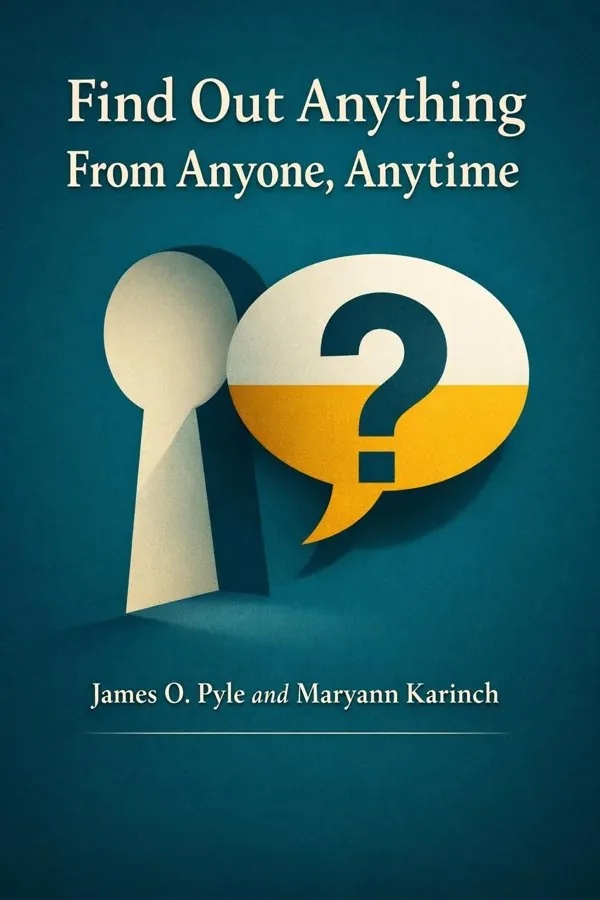
Find Out Anything From Anyone, Anytime: Secrets of Calculated Questioning From a Veteran Interrogator: Summary & Key Insights
by James O. Pyle, Maryann Karinch
 10 min5 chaptersAudio available
What Is Find Out Anything From Anyone, Anytime: Secrets of Calculated Questioning From a Veteran Interrogator About?
Find Out Anything From Anyone, Anytime: Secrets of Calculated Questioning From a Veteran Interrogator by James O. Pyle and Maryann Karinch is a communication book spanning 5 pages. This book, written by former U.S. Army interrogator James O. Pyle and communication expert Maryann Karinch, teaches readers how to use strategic questioning to elicit truthful and useful information in any situation. It combines psychological insight, communication techniques, and real-world examples to help readers improve their interviewing, negotiation, and interpersonal skills.
This FizzRead summary covers all 5 key chapters of Find Out Anything From Anyone, Anytime: Secrets of Calculated Questioning From a Veteran Interrogator in approximately 10 minutes, distilling the most important ideas, arguments, and takeaways from James O. Pyle and Maryann Karinch's work. Also available as an audio summary and Key Quotes Podcast.
Find Out Anything From Anyone, Anytime: Secrets of Calculated Questioning From a Veteran Interrogator
This book, written by former U.S. Army interrogator James O. Pyle and communication expert Maryann Karinch, teaches readers how to use strategic questioning to elicit truthful and useful information in any situation. It combines psychological insight, communication techniques, and real-world examples to help readers improve their interviewing, negotiation, and interpersonal skills.
Who Should Read Find Out Anything From Anyone, Anytime: Secrets of Calculated Questioning From a Veteran Interrogator?
This book is perfect for anyone interested in communication and looking to gain actionable insights in a short read. Whether you're a student, professional, or lifelong learner, the key ideas from Find Out Anything From Anyone, Anytime: Secrets of Calculated Questioning From a Veteran Interrogator by James O. Pyle and Maryann Karinch will help you think differently.
- ✓Readers who enjoy communication and want practical takeaways
- ✓Professionals looking to apply new ideas to their work and life
- ✓Anyone who wants the core insights of Find Out Anything From Anyone, Anytime: Secrets of Calculated Questioning From a Veteran Interrogator in just 10 minutes
Want the full summary?
Get instant access to this book summary and 100K+ more with Fizz Moment.
Get Free SummaryAvailable on App Store • Free to download
Key Chapters
To ask effectively, you must first grasp how human beings decide what to reveal. In every conversation, the mind evaluates risk and trust. People disclose information when they feel understood, respected, and safe. Conversely, they withhold when they sense judgment or manipulation. This understanding forms the foundation of what I call calculated questioning—the process of structuring inquiry with both purpose and sensitivity.
From my experience, the psychological key is curiosity without pressure. When someone feels genuinely heard, their resistance drops. Instead of defending themselves, they join you in exploring the subject. Effective questioning thus begins not with an interrogation mindset but with authentic interest. Psychology also tells us that memory works through association; so questions that follow a person’s natural thought sequence produce far more accurate answers than those that interrupt it. For example, instead of asking, “Where were you Tuesday at 2 p.m.?”, you might ask, “Walk me through your Tuesday morning—what did your day look like from the start?” The latter invites narrative recall, making it both easier and more reliable.
Understanding motivation is equally crucial. Every disclosure is influenced by whether the person seeks approval, fears consequences, or wants to impress. My task as a questioner is not to suppress these motives but to navigate them skillfully, guiding the conversation without confrontation. The greatest mistake most interrogators—or managers or journalists—make is to ask a question to which they already assume an answer. That signal closes the door. The goal is not to prove your theory, but to discover the other person’s reality.
If there is one lesson I’ve taught more than any other, it’s that open-ended questions are the lifeblood of discovery. Closed questions—those that can be answered with a simple yes or no—restrict conversation to the interviewer’s frame. Open-ended ones expand it, offering the subject ownership of the response and leading you to terrain you might never have mapped.
When I first trained soldiers in questioning, many favored direct yes/no questions: “Did you see this person?” “Was that your vehicle?” While straightforward, such questions often yielded partial or misleading answers. I began demonstrating how small changes open the door to revelation. Ask, “Tell me about the people you saw that day,” and you invite storytelling. The subject begins to reconstruct memory spontaneously, and details emerge you could not have planned to uncover.
Open-ended questions must, however, be disciplined. Randomly asking for stories without a framework leads nowhere. The architecture of discovery demands that we move from general to specific, from safe to significant. You might start with the broad—“Help me understand what your workday usually looks like”—then narrow gently: “You mentioned the meeting that afternoon; what stood out for you in that discussion?” This progressive focusing technique not only enriches the quality of data but also allows rapport to deepen naturally, step by step.
In business conversations, I’ve seen this principle transform negotiations. When a leader stops asking, “Will you accept these terms?” and instead asks, “What would an ideal agreement look like from your perspective?”, information starts to flow. The other side feels invited, not cornered. And in that invitation lies both truth and opportunity.
+ 3 more chapters — available in the FizzRead app
All Chapters in Find Out Anything From Anyone, Anytime: Secrets of Calculated Questioning From a Veteran Interrogator
About the Authors
James O. Pyle is a former U.S. Army intelligence officer and interrogation instructor with decades of experience in human intelligence operations. Maryann Karinch is an author and communication specialist known for her works on human behavior and performance.
Get This Summary in Your Preferred Format
Read or listen to the Find Out Anything From Anyone, Anytime: Secrets of Calculated Questioning From a Veteran Interrogator summary by James O. Pyle and Maryann Karinch anytime, anywhere. FizzRead offers multiple formats so you can learn on your terms — all free.
Available formats: App · Audio · PDF · EPUB — All included free with FizzRead
Download Find Out Anything From Anyone, Anytime: Secrets of Calculated Questioning From a Veteran Interrogator PDF and EPUB Summary
Key Quotes from Find Out Anything From Anyone, Anytime: Secrets of Calculated Questioning From a Veteran Interrogator
“To ask effectively, you must first grasp how human beings decide what to reveal.”
“If there is one lesson I’ve taught more than any other, it’s that open-ended questions are the lifeblood of discovery.”
Frequently Asked Questions about Find Out Anything From Anyone, Anytime: Secrets of Calculated Questioning From a Veteran Interrogator
Find Out Anything From Anyone, Anytime: Secrets of Calculated Questioning From a Veteran Interrogator by James O. Pyle and Maryann Karinch is a communication book that explores key ideas across 5 chapters. This book, written by former U.S. Army interrogator James O. Pyle and communication expert Maryann Karinch, teaches readers how to use strategic questioning to elicit truthful and useful information in any situation. It combines psychological insight, communication techniques, and real-world examples to help readers improve their interviewing, negotiation, and interpersonal skills.
You Might Also Like

Magic Words: The Science and Secrets Behind Seven Words That Motivate, Engage, and Influence
Tim David
10 min
Talking Across The Divide: How to Communicate with People You Disagree with and Maybe Even Change the World
Justin Lee
10 min
The Exceptional Presenter: A Proven Formula to Open Up! and Own the Room
Timothy J. Koegel
10 min
4 Essential Keys to Effective Communication in Love, Life, Work--Anywhere!: Including the 12-Day Communication Challenge!
Bento C. Leal III
10 min
Active Listening Techniques: 30 Practical Tools to Hone Your Communication Skills
Nisha Gupta
10 min
Bargaining for Advantage: Negotiation Strategies for Reasonable People
G. Richard Shell
10 minFeatured In
Browse by Category
Ready to read Find Out Anything From Anyone, Anytime: Secrets of Calculated Questioning From a Veteran Interrogator?
Get the full summary and 100K+ more books with Fizz Moment.