
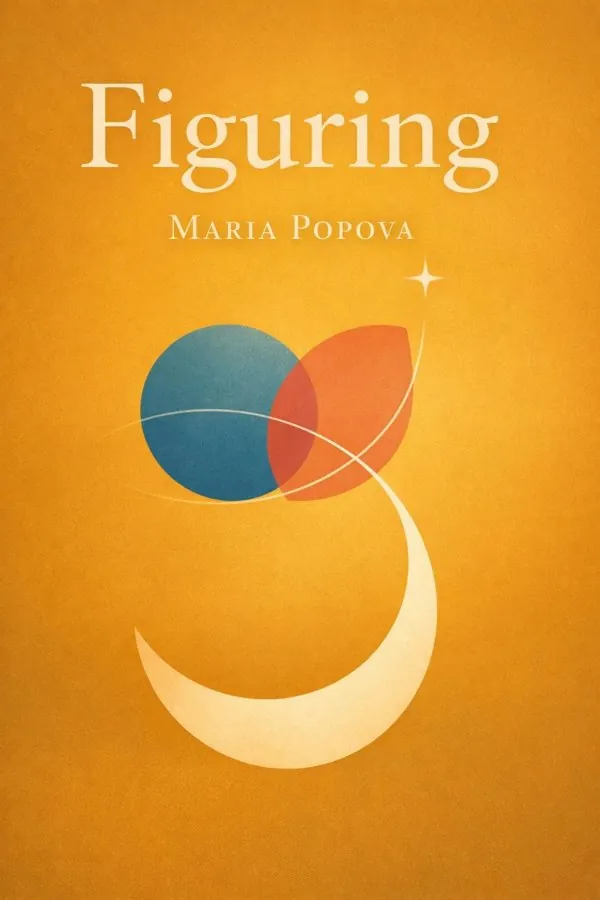
Figuring: Summary & Key Insights
by Maria Popova
 10 min10 chaptersAudio available
Key Takeaways from Figuring
Some of humanity’s greatest discoveries begin not with certainty, but with a stubborn faith that reality is intelligible.
A society’s limits become visible when someone refuses to live inside them.
Withdrawal is often mistaken for absence, but solitude can be one of the richest forms of presence.
Facts change history most powerfully when they are joined to moral imagination.
We often talk as if ideas come from intellect alone, but Figuring insists that thought is shaped by feeling.
What Is Figuring About?
Figuring by Maria Popova is a civilization book spanning 10 pages. Figuring is a sweeping work of literary nonfiction about how human beings make meaning across science, art, love, loss, and time. Maria Popova traces unexpected connections among historical figures such as Johannes Kepler, Margaret Fuller, Emily Dickinson, Herman Melville, Rachel Carson, and astronomer Maria Mitchell, showing that discovery is never purely intellectual. It is emotional, moral, and deeply personal. The book asks how we learn to live with uncertainty while still pursuing truth, beauty, and belonging. What makes Figuring especially powerful is its refusal to separate disciplines that modern life often keeps apart. Popova moves fluidly between astronomy, poetry, ecology, philosophy, and biography to reveal a larger pattern: our greatest breakthroughs often come from lives shaped by wonder, heartbreak, friendship, and courage. The result is not just a history of ideas, but a meditation on what it means to be fully awake to the world. Popova brings unusual authority to this project. As the creator of The Marginalian, she has spent years synthesizing literature, science, and philosophy for a wide audience. In Figuring, that gift becomes a rich, humane narrative about civilization’s ongoing search for coherence.
This FizzRead summary covers all 10 key chapters of Figuring in approximately 10 minutes, distilling the most important ideas, arguments, and takeaways from Maria Popova's work. Also available as an audio summary and Key Quotes Podcast.
Figuring
Figuring is a sweeping work of literary nonfiction about how human beings make meaning across science, art, love, loss, and time. Maria Popova traces unexpected connections among historical figures such as Johannes Kepler, Margaret Fuller, Emily Dickinson, Herman Melville, Rachel Carson, and astronomer Maria Mitchell, showing that discovery is never purely intellectual. It is emotional, moral, and deeply personal. The book asks how we learn to live with uncertainty while still pursuing truth, beauty, and belonging.
What makes Figuring especially powerful is its refusal to separate disciplines that modern life often keeps apart. Popova moves fluidly between astronomy, poetry, ecology, philosophy, and biography to reveal a larger pattern: our greatest breakthroughs often come from lives shaped by wonder, heartbreak, friendship, and courage. The result is not just a history of ideas, but a meditation on what it means to be fully awake to the world.
Popova brings unusual authority to this project. As the creator of The Marginalian, she has spent years synthesizing literature, science, and philosophy for a wide audience. In Figuring, that gift becomes a rich, humane narrative about civilization’s ongoing search for coherence.
Who Should Read Figuring?
This book is perfect for anyone interested in civilization and looking to gain actionable insights in a short read. Whether you're a student, professional, or lifelong learner, the key ideas from Figuring by Maria Popova will help you think differently.
- ✓Readers who enjoy civilization and want practical takeaways
- ✓Professionals looking to apply new ideas to their work and life
- ✓Anyone who wants the core insights of Figuring in just 10 minutes
Want the full summary?
Get instant access to this book summary and 100K+ more with Fizz Moment.
Get Free SummaryAvailable on App Store • Free to download
Key Chapters
Some of humanity’s greatest discoveries begin not with certainty, but with a stubborn faith that reality is intelligible. In Figuring, Johannes Kepler represents this faith at its most luminous. He was not merely trying to calculate planetary motion; he was trying to understand whether the universe possessed an underlying order that could be felt as beauty as well as measured as fact. For Kepler, astronomy was never detached from emotion, spirituality, or imagination. His science grew from the conviction that truth and harmony belonged together.
Popova presents Kepler as a model of intellectual courage. He worked through grief, poverty, political instability, and personal isolation, yet remained committed to the difficult labor of understanding. His insights did not emerge from a straight line of progress. They came through revision, error, and persistence. This matters because modern readers often imagine genius as instant clarity, when in fact Kepler’s achievement was a disciplined willingness to remain confused without giving up.
The practical lesson is clear: deep understanding requires patience with complexity. Whether you are solving a problem at work, making sense of a relationship, or pursuing a creative project, you may need to live with incomplete answers for a long time. Kepler shows that rigor and wonder can coexist. Data matters, but so does the larger question of why the pattern matters.
Actionable takeaway: choose one difficult question in your life and stay with it longer than feels comfortable. Instead of rushing to closure, ask what hidden pattern might reveal itself through sustained attention.
A society’s limits become visible when someone refuses to live inside them. Margaret Fuller appears in Figuring as a fierce example of intellectual and emotional self-possession. In nineteenth-century America, she insisted that women were not ornamental beings but full minds, deserving of education, agency, and participation in public thought. Yet Popova does not flatten Fuller into a symbol. She emerges as a whole person: ambitious, vulnerable, intellectually hungry, politically alive, and deeply invested in the life of feeling.
Fuller’s significance lies in her refusal to separate self-cultivation from social transformation. She believed that expanding one’s inner life was not a private luxury but a civic act. To think more clearly, feel more deeply, and live more authentically was to challenge the narrow scripts imposed by gender and custom. Her conversations, essays, and public work modeled a broader vision of personhood, one in which growth meant claiming the right to complexity.
This idea remains highly relevant. Many people still internalize inherited expectations about what kind of life is acceptable, productive, feminine, masculine, serious, or respectable. Fuller’s life suggests that liberation begins when we examine those assumptions and ask whose interests they serve. In practical terms, this might mean speaking more honestly, pursuing study outside your professional track, or resisting roles that diminish your intelligence.
Actionable takeaway: write down one identity label or expectation you have accepted without question. Then ask how your life would change if you treated it as negotiable rather than fixed.
Withdrawal is often mistaken for absence, but solitude can be one of the richest forms of presence. Through Emily Dickinson, Figuring explores the idea that a quiet life can generate immense inward intensity. Dickinson did not participate in public literary culture in conventional ways, yet her poetry transformed the emotional and philosophical possibilities of language. Popova shows that Dickinson’s seeming seclusion was not emptiness. It was a way of attending more radically to existence, mortality, desire, nature, and the instability of the self.
What makes this portrait compelling is its challenge to common assumptions about visibility and achievement. We live in a culture that equates significance with constant output, public recognition, and social performance. Dickinson offers another model. Her life suggests that creative power may depend on privacy, slowness, and forms of attention that cannot be optimized. She reminds us that interiority is not an escape from reality but a way of encountering it more truthfully.
This does not mean everyone must become reclusive. It means we should take seriously the role of protected mental space. Practical examples are everywhere: a scientist needs uninterrupted time to think through a problem; a manager needs silence to hear what they actually believe; an artist needs room to experiment without immediate judgment. Solitude can become a workshop for perception.
Actionable takeaway: create one recurring hour each week that is deliberately unshared, unplugged, and unproductive by external standards. Use it to read, write, think, or simply observe what rises in your mind.
Facts change history most powerfully when they are joined to moral imagination. Rachel Carson embodies this union in Figuring. She was not only a scientist who documented ecological harm; she was a writer who helped people feel the stakes of that harm. By revealing the interconnectedness of living systems, Carson challenged the illusion that humans stand outside nature, free to manipulate it without consequence. Her work made visible what industrial modernity preferred not to see: that damage done to the environment eventually becomes damage done to ourselves.
Popova presents Carson as a thinker of relationship. She understood that science is not merely a technical enterprise but a way of enlarging responsibility. To study ecosystems is to recognize mutual dependence. This insight has applications far beyond environmental policy. In organizations, communities, and families, local actions ripple through larger systems. Decisions that appear efficient in the short term may create hidden costs later.
Carson also shows the importance of language in public life. Data alone rarely changes behavior. People act when evidence is translated into meaning, ethics, and felt reality. Whether you are advocating for sustainability, public health, or institutional reform, the challenge is not only to be correct but to be communicative.
Actionable takeaway: identify one system you are part of, such as your household, workplace, or neighborhood, and map one consequence of your routine behavior on others. Then change one habit to reduce harm or increase care.
We often talk as if ideas come from intellect alone, but Figuring insists that thought is shaped by feeling. Across its intertwined biographies, the book shows how love, grief, longing, and heartbreak are not distractions from serious work. They are among its conditions. Kepler’s cosmic search, Fuller’s intensity, Dickinson’s compression, and Carson’s sensitivity all emerge from lives marked by attachment and loss. Emotional life does not stand outside creation; it gives creation urgency.
This is one of Popova’s most humane arguments. Civilization is not built only by detached minds producing abstract theories. It is built by vulnerable people trying to make sense of transience. In this way, the book reframes biography itself. To understand a thinker, we must understand not only what they published, but what they feared, whom they loved, what they mourned, and how they endured uncertainty.
For modern readers, this can be liberating. Many people believe they must overcome emotional turbulence before they can do meaningful work. Figuring suggests a different possibility: our emotional lives can deepen our powers of observation, interpretation, and compassion when we work with them rather than against them. Journaling through grief, creating after disappointment, or allowing heartbreak to clarify values are practical examples of this transformation.
Actionable takeaway: when facing a strong emotion, ask not only how to eliminate it, but what it might be trying to teach you about what matters most. Turn that insight into one concrete act or creative expression.
The modern habit of dividing knowledge into separate boxes can make us less intelligent about reality. One of Figuring’s central achievements is showing that science and art are not opposing domains but complementary ways of perceiving truth. Kepler’s astronomy was animated by aesthetic intuition. Carson’s science gained force through lyrical prose. Dickinson’s poetry examined existence with near-scientific precision. Again and again, Popova reveals that analytic rigor and imaginative sensitivity strengthen one another.
This matters because specialization, though useful, can narrow the mind. A purely technical approach may miss meaning, while a purely expressive approach may drift away from evidence. The richest understanding often comes from crossing methods: measuring and metaphorizing, observing and feeling, calculating and narrating. In practical life, this means the best leaders, educators, researchers, and creators are often those who can combine accurate information with interpretive depth.
Consider everyday applications. A doctor needs data but also narrative skill to understand a patient’s life. A designer needs creativity but also systems thinking. A teacher needs subject mastery but also emotional imagination. The point is not to master every field, but to resist the false choice between precision and wonder.
Actionable takeaway: expose one current problem you are facing to a second mode of thinking. If you have approached it analytically, try drawing, storytelling, or metaphor. If you have approached it emotionally, bring in structure, evidence, or measurement.
To become fully oneself often requires resisting the categories one has been given. In Figuring, questions of gender, role, selfhood, and belonging run through the lives Popova examines. Figures such as Margaret Fuller and Maria Mitchell challenged cultural assumptions about who gets to think, discover, speak, and be remembered. Their lives illuminate how identity is shaped both by social constraint and by the inward work of self-definition.
Popova’s insight is that identity is not a static possession but an evolving conversation between the individual and the world. This conversation can be painful because inherited labels offer security, even when they are limiting. Yet growth demands a willingness to outgrow versions of the self that once seemed necessary. The expanding mind requires an expanding identity.
This idea applies broadly today. People often feel trapped by old narratives: the reliable child, the practical professional, the agreeable partner, the outsider, the expert, the failure. These narratives can become invisible prisons. The figures in Figuring demonstrate that intellectual vitality depends on a certain fluidity of self. We do not discover our fullest capacities by conforming to what has already been imagined for us.
In practical terms, rethinking identity might involve pursuing a late-life field of study, speaking publicly after years of self-silencing, or allowing contradictory parts of yourself to coexist without rushing to simplify them.
Actionable takeaway: identify one story you repeatedly tell about who you are. Then test it against reality by taking one small action that your old identity would have ruled out.
The awareness that life is finite can either paralyze us or sharpen our devotion. Figuring repeatedly returns to mortality, not as a morbid theme but as a clarifying force. The people Popova writes about created under the shadow of impermanence. They knew that bodies fail, reputations fade, relationships end, and even civilizations are unstable. Yet this knowledge did not drain their work of meaning. It intensified the need to make something worthy of a brief life.
Popova suggests that legacy is not simply what survives us in public memory. It is also what we set in motion in other minds and lives. A poem, a scientific insight, a letter, a friendship, a courageous act of witness: all can outlast their maker in ways both visible and invisible. This broader sense of legacy resists the modern fixation on fame. Endurance is not always scale. Sometimes it is depth.
This perspective can be highly practical. When people remember that time is limited, priorities often become clearer. Petty status competition weakens. Attention returns to meaningful work, relationships, and service. Mortality becomes not an abstraction but a tool for decision-making. If a commitment would not matter in five years, perhaps it deserves less energy today.
Actionable takeaway: ask yourself what you would continue doing if recognition were impossible but impact remained real. Use your answer to reallocate at least one hour this week toward what feels enduring rather than merely urgent.
Wonder is not childish; it is a discipline that keeps the mind alive. Throughout Figuring, curiosity appears as more than private interest. It is a civic and spiritual practice, a way of resisting numbness, dogma, and premature certainty. The lives in the book are united by an appetite for reality: they wanted to know how planets move, how language holds feeling, how ecosystems balance, how freedom enlarges the human soul. Their curiosity was not casual consumption of facts. It was a mode of devotion.
Popova’s treatment of curiosity is especially important in an age of distraction. Information is abundant, but sustained inquiry is rare. We skim, react, and move on. The figures in Figuring remind us that real curiosity asks us to linger. It requires humility, because to be curious is to admit that we do not yet understand. It also requires courage, because genuine questions can unsettle identity, belief, and comfort.
Applied practically, curiosity improves nearly every domain of life. In relationships, it softens defensiveness and deepens empathy. At work, it fosters innovation by challenging stale assumptions. In citizenship, it resists ideological simplification. Curiosity can turn frustration into investigation: instead of asking, “Why is this happening to me?” we might ask, “What is this situation revealing?”
Actionable takeaway: replace one certainty today with a question. In a conversation, conflict, or problem, ask one sincere follow-up that aims to understand rather than to win.
No idea appears alone; every insight belongs to a larger human conversation. The deepest pattern in Figuring is interconnectedness, not only in nature but in culture, thought, and time. Popova shows how lives separated by centuries speak to one another through influence, affinity, shared struggle, and recurring questions. Kepler’s cosmic order, Fuller’s selfhood, Dickinson’s inwardness, and Carson’s ecology are not isolated episodes. Together, they form a map of civilization as a network of minds trying to orient themselves in existence.
This vision challenges the myth of the solitary genius. Individual brilliance matters, but it is always entangled with relationships, predecessors, correspondences, and inherited language. To understand one life is often to uncover many others. That makes intellectual history feel less like a sequence of monuments and more like an ecosystem of exchange.
There is a practical ethical implication here. If we are shaped by one another, then attention becomes a form of stewardship. The books we read, the conversations we sustain, the voices we amplify, and the traditions we preserve all affect the future texture of culture. We participate in civilization not only by producing, but by connecting, remembering, and transmitting.
Actionable takeaway: trace one important idea you hold back to its sources. Read one predecessor, share one influence with someone else, and consciously enter the chain of cultural inheritance instead of treating your mind as self-made.
All Chapters in Figuring
About the Author
Maria Popova is a Bulgarian-born American writer, essayist, and cultural curator known for her distinctive ability to connect literature, science, philosophy, art, and history. She is the creator of The Marginalian, formerly Brain Pickings, a long-running publication that has introduced millions of readers to both canonical and overlooked thinkers through thoughtful essays and reflections. Popova’s work is marked by intellectual range, lyrical prose, and a commitment to exploring what gives human life meaning. Rather than treating knowledge as divided into separate subjects, she emphasizes the deep relationships among disciplines and across generations. In Figuring, she brings this interdisciplinary sensibility to full scale, weaving biography and cultural history into a meditation on creativity, love, mortality, and the search for truth.
Get This Summary in Your Preferred Format
Read or listen to the Figuring summary by Maria Popova anytime, anywhere. FizzRead offers multiple formats so you can learn on your terms — all free.
Available formats: App · Audio · PDF · EPUB — All included free with FizzRead
Download Figuring PDF and EPUB Summary
Key Quotes from Figuring
“Some of humanity’s greatest discoveries begin not with certainty, but with a stubborn faith that reality is intelligible.”
“A society’s limits become visible when someone refuses to live inside them.”
“Withdrawal is often mistaken for absence, but solitude can be one of the richest forms of presence.”
“Facts change history most powerfully when they are joined to moral imagination.”
“We often talk as if ideas come from intellect alone, but Figuring insists that thought is shaped by feeling.”
Frequently Asked Questions about Figuring
Figuring by Maria Popova is a civilization book that explores key ideas across 10 chapters. Figuring is a sweeping work of literary nonfiction about how human beings make meaning across science, art, love, loss, and time. Maria Popova traces unexpected connections among historical figures such as Johannes Kepler, Margaret Fuller, Emily Dickinson, Herman Melville, Rachel Carson, and astronomer Maria Mitchell, showing that discovery is never purely intellectual. It is emotional, moral, and deeply personal. The book asks how we learn to live with uncertainty while still pursuing truth, beauty, and belonging. What makes Figuring especially powerful is its refusal to separate disciplines that modern life often keeps apart. Popova moves fluidly between astronomy, poetry, ecology, philosophy, and biography to reveal a larger pattern: our greatest breakthroughs often come from lives shaped by wonder, heartbreak, friendship, and courage. The result is not just a history of ideas, but a meditation on what it means to be fully awake to the world. Popova brings unusual authority to this project. As the creator of The Marginalian, she has spent years synthesizing literature, science, and philosophy for a wide audience. In Figuring, that gift becomes a rich, humane narrative about civilization’s ongoing search for coherence.
You Might Also Like
The Structure of Scientific Revolutions
Thomas S. Kuhn
10 min
Genius
Harold Bloom
10 min
A Cultural History of the Medieval Age
Various Editors
10 min
A History of God: The 4,000-Year Quest of Judaism, Christianity and Islam
Karen Armstrong
10 min
A History of the World in 10½ Chapters
Julian Barnes
10 min
A Short History of Progress
Ronald Wright
10 minBrowse by Category
Ready to read Figuring?
Get the full summary and 100K+ more books with Fizz Moment.